

TL;DR:
- Capturing authentic candid moments in Venice requires timing, appropriate gear, and a patient, observant mindset.
- Photographers should explore lesser-known neighborhoods early in the morning and use discreet techniques to preserve the city’s natural mood.
Venice is one of the most photographed cities on Earth, and yet genuine candid moments there feel almost mythical. The gondoliers, the morning mist, the woman in a red coat crossing a stone bridge — you can sense these scenes everywhere, but capturing them authentically is a different story. This guide to candid moments in Venice gives you the practical tools to move beyond posed tourist snapshots and into the world of real, unguarded imagery: the right gear, the best neighborhoods, the perfect hours, and the quiet techniques that let you photograph Venice the way it actually feels.
Table of Contents
- Key Takeaways
- Your guide to candid moments in Venice starts with gear
- Best times to photograph candid moments in Venice
- Hidden gems and the best spots for candid photos in Venice
- Techniques for capturing candid shots in Venice
- Ethics and post-shoot review for candid photography
- My honest take on shooting Venice candidly
- Capture Venice with expert guidance from Italyphototour
- FAQ
Key Takeaways
| Point | Details |
|---|---|
| Time your sessions carefully | Arriving before 8 AM at iconic spots gives you near-solitude and the best natural light. |
| Gear light but think long | A telephoto zoom (70-200mm) lets you photograph from a respectful distance without disturbing scenes. |
| Explore beyond San Marco | Cannaregio, Castello, and Dorsoduro offer far more authentic street life than tourist-heavy areas. |
| Blend in, don’t intrude | Shooting from bridges and fondamenta keeps you unobtrusive and preserves the natural mood. |
| Respect your subjects | Understanding local customs and sharing images responsibly are non-negotiable parts of candid photography. |
Your guide to candid moments in Venice starts with gear
The camera you carry shapes how freely you move, and in Venice that freedom is everything. A large DSLR with a white telephoto lens announces your presence from half a canal away. A compact mirrorless body, or even a rangefinder-style camera, lets you disappear into the crowd like a local heading to the market. When selecting lenses, wide-angle and telephoto zoom lenses in the 16-35mm and 70-200mm ranges give you maximum flexibility for any scene that unfolds.
The wide-angle pulls in the full atmosphere of a narrow calle with people weaving through it. The telephoto compresses distance and lets you stay fifty feet back while still filling the frame with an animated conversation between two gondoliers. Both have their place, and carrying one of each is not excessive when you know how to use them.
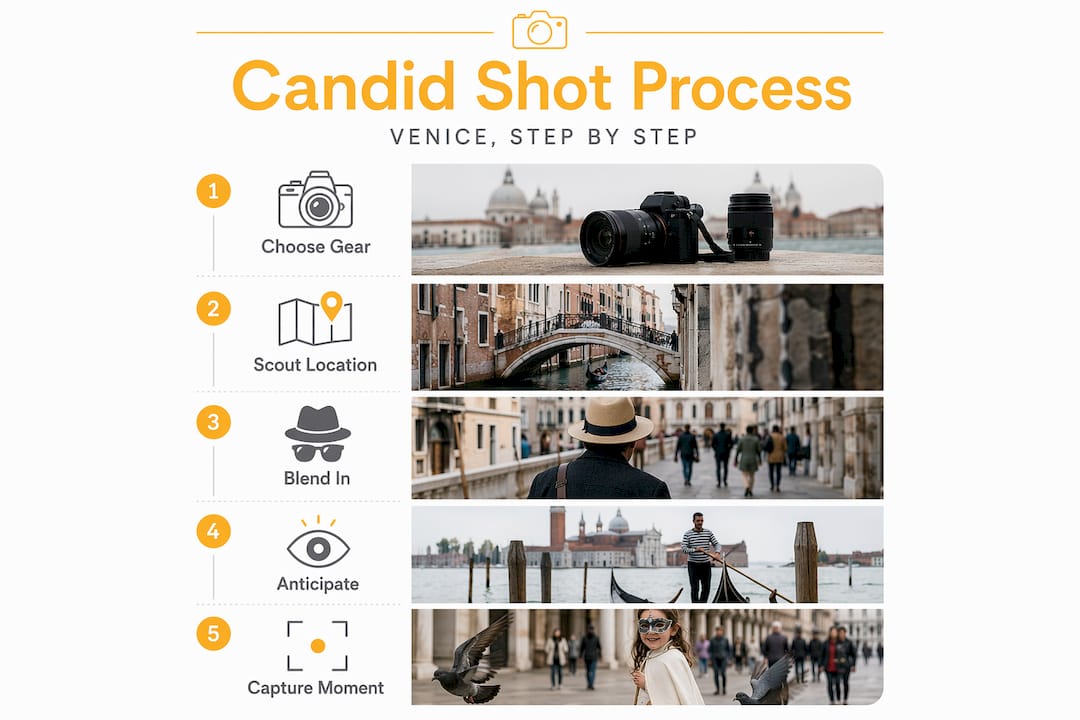
One often-overlooked piece of kit is a circular polarizer for water reflections, which can reduce glare by one to two stops and reveal the color and depth beneath Venice’s canal surfaces. It sounds like a minor thing until you see your first properly polarized reflection of a palazzo shimmering in green-gold water.
Pro Tip: Set your camera to silent shutter mode and continuous autofocus before you even leave your hotel. In Venice, moments are measured in seconds, and fumbling with settings is how you miss them.
The mindset matters as much as the gear. Patience and openness to random moments are what separate compelling candid work from the kind of travel photography that merely documents. You are not hunting. You are waiting, observing, letting the city reveal itself. Walk slowly. Linger on bridges. Order an espresso and watch what happens at the corner of the fondamenta for ten minutes before raising your camera.
Best times to photograph candid moments in Venice
Timing is arguably the single most powerful tool you have for capturing candid moments, and Venice rewards the early riser more than almost any other city. Arriving at San Marco before 8 AM gives you a square that is practically empty, where the scale of the architecture becomes visible and the light falls in long, warm diagonals across the stones. In summer that means a 6:30 AM start. In winter, 7:30 AM is often sufficient.
Here is a practical time map for a full day of candid shooting in Venice:
6:30 to 8:00 AM. Golden-hour light, near-empty streets, and the city stirring to life. This is when delivery boats move through the canals and vendors set up their stalls. The best images often arise from these unexpected, incidental moments of city activity.
8:00 to 10:00 AM. The first tourists begin to appear, but the pace is still relaxed. Local residents are heading to work and school, which means authentic street scenes are abundant in residential neighborhoods.
10:00 AM to 4:00 PM. Peak tourist congestion hits nearly every corner. Neighborhoods like Cannaregio and Castello are best explored outside these hours if you want genuinely local scenes rather than crowds of visitors.
4:00 to 6:30 PM. Afternoon light softens and becomes golden again. Crowds thin as group tours end. This window produces warm, emotive candids, especially along the quieter fondamente of Dorsoduro.
After 7:00 PM. Twilight and blue hour transform Venice into something otherworldly. Fewer cameras in sight. Long exposures on a small tripod can capture the shimmering reflections and lone figures crossing bridges in ways that feel like paintings.
Seasonally, shoulder season months like March, April, October, and November offer genuinely reduced tourist numbers and softer, more atmospheric light. Winter visits, though cold, reveal a Venice that few photographers ever document: fog settling over the canals, locals reclaiming their city, and a mood that is achingly beautiful.
Hidden gems and the best spots for candid photos in Venice
Most visitors spend their entire trip inside a triangle of Piazza San Marco, the Rialto Bridge, and the Grand Canal. That is where the beautiful imagery lives in travel magazines, and it is also where iconic spots feel nearly inaccessible for candid work due to the crowds. The solution is not to abandon these places but to approach them differently, and to discover the neighborhoods that remain largely unvisited.
| Neighborhood | Vibe | Best time |
|---|---|---|
| Cannaregio | Residential, local markets, quiet canals | Early morning |
| Castello | Working-class character, less polished | Mid-morning |
| Dorsoduro | Artistic, studenty, waterfront views | Late afternoon |
| Santa Croce | Genuine local life, low tourist density | Anytime before 10 AM |
| Northern Cannaregio | Near-empty canals, fishermen, old bridges | Dawn |
Cannaregio is where many Venetians actually live. Walk north toward the Jewish Ghetto and you will find small canals reflecting the muted ochre and terracotta of residential palazzi, children heading to school, neighbors calling across water. This is authentic street life that rarely appears in photography guides.
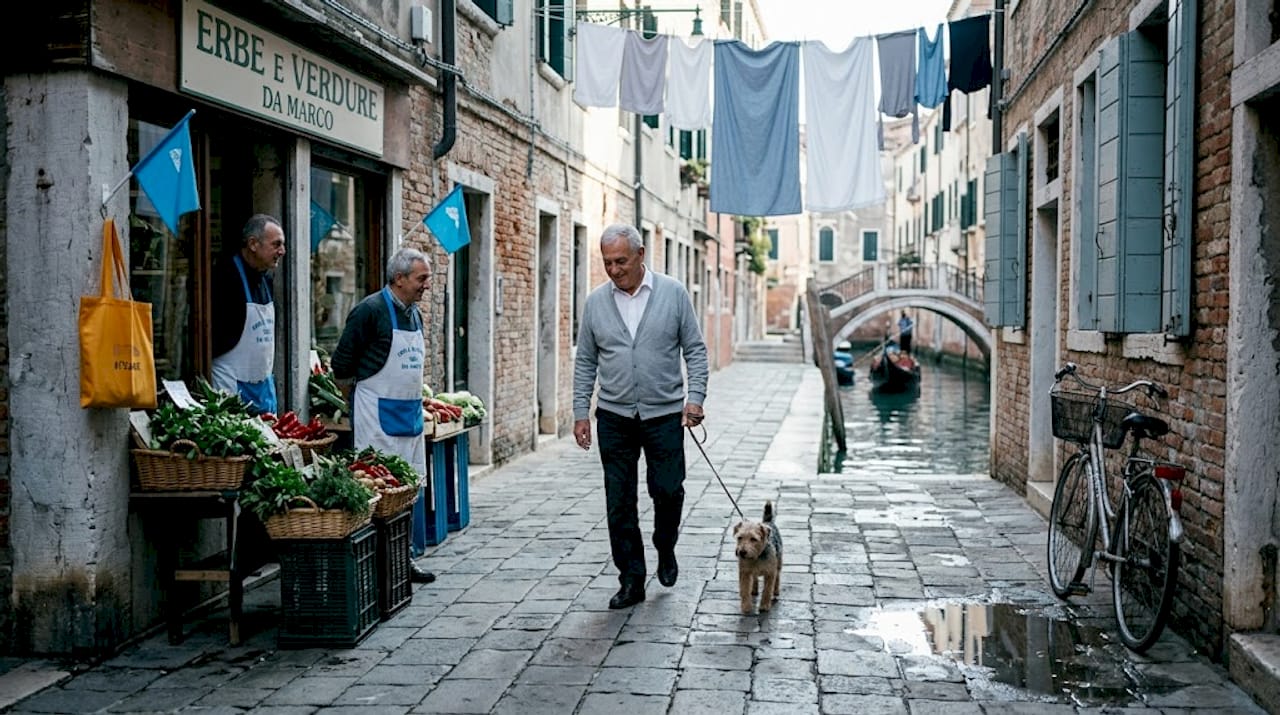
For gondola shots that feel spontaneous rather than staged, position yourself on a bridge or fondamenta and photograph down into the boats. This elevated angle preserves a sense of distance and natural movement that shooting from water level simply cannot replicate. You also benefit from the compression of the scene, fitting boat, gondolier, and reflecting water into a single, layered frame.
Pro Tip: Scout your spots the evening before your early-morning shoot. Walk the bridges in Cannaregio and Dorsoduro at sunset, note where the light will fall at dawn, and decide your exact shooting positions in advance. Morning light waits for no one.
The smaller canals in northern Cannaregio, particularly near the Fondamenta della Misericordia, feel like a different city entirely. Cats sleep on windowsills. Laundry hangs between buildings. A fisherman fixes a net in the kind of absorbed, oblivious concentration that makes for extraordinary portraits.
Techniques for capturing candid shots in Venice
Knowing where to go and when to arrive gets you in position. What you do with your camera in the moment is where the real art of candid photography in Venice begins. These techniques will help you work confidently and invisibly.
Use your telephoto reach. Shooting from 50 to 100 feet away with a 200mm lens isolates your subject against a beautifully blurred background while keeping you at enough distance that you do not disrupt the scene. This is the single most effective technique for how to photograph Venice candidly.
Work from fixed positions. Rather than following people with your camera, choose a spot on a bridge or beside a doorway and let the scene come to you. Blending into surroundings means avoiding obvious pointing and movement. People walking past a stationary figure holding a camera simply stop noticing you.
Use reflections as a compositional tool. Low-angle reflection shots using puddles or water surfaces add a surreal, poetic quality to candid street scenes. Pour a small amount of water on a flat stone surface and shoot from ground level to create a mirrored foreground filled with moving figures.
Manage crowds with a 6-stop ND filter. A 6-stop ND filter with 30 to 60 second exposures blurs moving crowds into ghostly wisps while sharp subjects like a gondolier or a seated local remain crisp and defined. It turns a cluttered, tourist-heavy scene into something ethereal.
Bracket your exposures at dawn and dusk. Venice’s unique light conditions at dawn and dusk change rapidly. Bracketing three exposures (one stop under, correct, one stop over) takes seconds and protects you against the fast-shifting chiaroscuro that makes Venice mornings so dramatic and so difficult.
Pro Tip: Pay attention to Venice’s tidal cycles if you are shooting near the canals. High tides limit your shooting angles and can flood fondamente entirely. Low tides expose moss-covered stone and add extraordinary visual texture to waterline shots.
Let moments evolve without forcing them. The temptation to direct or arrange a candid shot the moment you sense it is the surest way to destroy it. Lower the camera slightly, wait, and let what is happening continue to happen. The slow wandering approach to Venice that chases changing light rather than rigid plans produces images that feel discovered rather than made.
Ethics and post-shoot review for candid photography
Capturing candid moments carries a quiet responsibility that every photographer owes to the people they photograph. Before you share any image online, consider whether the subject is identifiable and whether the context in which they appear could cause them discomfort or harm. This is not a legal checklist. It is a matter of respect for the city and the people who call it home.
A few principles worth keeping in mind as you review and share your work:
Examine each image for what it actually communicates, not just what you hoped to capture. A truly powerful candid tells a story in a single frame: a relationship, an emotion, a sense of place. If the story is unclear, the image may simply be a photograph of a person who did not know you were there, and that is a meaningful difference.
When sharing images publicly, Venice’s authorities have specific restrictions around commercial photography in certain protected areas, including the Piazza San Marco. Informational, non-commercial sharing of candid street photography is generally acceptable, but it is worth understanding the distinction before you post.
Review your images critically for common technical mistakes: missed focus on the subject’s eyes, blown-out reflections from unmanaged glare, or motion blur from a shutter speed that was too slow for a moving figure. Each of these has a specific fix, and recognizing the pattern across a set of images is how you improve systematically rather than accidentally.
Finally, if a subject approaches you after you have photographed them and asks you to delete the image, do so without argument. That moment of grace says more about you as a photographer than any single frame ever could.
My honest take on shooting Venice candidly
I’ve been photographing Venice for years, and the lesson that took me longest to learn is that patience is not passive. When I started, I would wander for hours, camera raised, hunting for something. I came home with hundreds of frames and almost none of them had the quality of stillness I was looking for.
What changed things for me was sitting down. Literally. I started choosing one spot, ordering a coffee, and spending forty-five minutes just watching. By the time I raised my camera, I had already seen the scene a dozen times in my mind. The light, the rhythm of people crossing that particular bridge, the way the water moved. I was no longer reacting. I was anticipating.
I’ve found that early mornings in the residential neighborhoods reward you in ways that no golden-hour session at the Rialto ever will. There is a quality of ordinariness in those scenes, a fisherman’s hands, a child’s school bag, a woman shaking a rug from a fourth-floor window, that is more genuinely Venetian than any postcard image. Those are the photographs I cherish most.
The hardest part of exploring Venice candidly is resisting the city’s visual seduction long enough to find the human story inside it. Venice is almost aggressively beautiful. Every canal, every archway competes for your attention. But the real photographs live in the spaces between the monuments, in the unguarded human moments that the architecture merely frames.
— Mino
Capture Venice with expert guidance from Italyphototour

There is a significant difference between knowing these techniques and having an experienced photographer beside you when the light changes at 6:47 AM over a Cannaregio canal. Italyphototour offers immersive Venice photography experiences led by Mino Di Vita, designed specifically for photographers who want to move beyond tourist snapshots and into authentic, storytelling imagery. Each session covers gear selection, light reading, composition, and the practical art of candid street photography in Venice’s most compelling locations.
Whether you are new to photography or simply new to Venice, Italyphototour’s guided photography tours give you the creative confidence to bring home images worth keeping. Explore the full range of experiences at Italyphototour and find the tour that fits your vision.
FAQ
What is the best time for candid photos in Venice?
Arriving before 8 AM gives you the quietest streets and best light for candid photography in Venice, with summer starts as early as 6:30 AM and winter starts around 7:30 AM.
Which Venice neighborhoods are best for candid street photography?
Cannaregio, Castello, and Santa Croce offer the most authentic local street life for candid shots, and these areas are best visited outside the 10 AM to 4 PM peak tourist window.
What camera gear do I need for candid photography in Venice?
A compact mirrorless camera paired with a 70-200mm telephoto zoom is ideal for shooting from a distance without disrupting natural scenes, and a circular polarizer improves canal reflection shots significantly.
How do I photograph gondolas candidly?
Position yourself on a bridge or fondamenta and shoot down into the boats rather than from water level. This elevated angle preserves natural movement and creates a more compelling, layered composition.
Is candid photography in Venice legal?
Non-commercial, informational candid street photography is generally acceptable, but Venice has restrictions in certain protected zones like Piazza San Marco. Always respect subject privacy and delete images if a person makes a direct request.