

TL;DR:
- Winter photography involves capturing snowy scenes with proper exposure and gear protection to enhance image quality. Overcast days provide soft, atmospheric light that benefits snowy landscape images.
Winter photography is the art of capturing snowy, icy, and cold-season scenes where light behaves differently, landscapes transform into graphic canvases, and every breath of cold air carries creative possibility. The season strips the world down to its essentials: bare trees, white fields, and a quiet that invites intentional framing. Success depends on mastering exposure for reflective snow, protecting your gear from the cold, and reading winter’s unique light with patience and purpose. This guide covers the core techniques every aspiring photographer needs to shoot stunning winter scenes with confidence.
1. How should you adjust exposure for snowy scenes?
Snow is the most deceptive subject in photography. Camera meters are calibrated to read a scene as middle gray, so when you point your lens at a bright snowfield, the meter underexposes the image and the snow turns dull and muddy. The fix is direct: apply exposure compensation of +1 to +2 stops to restore snow’s natural brightness.
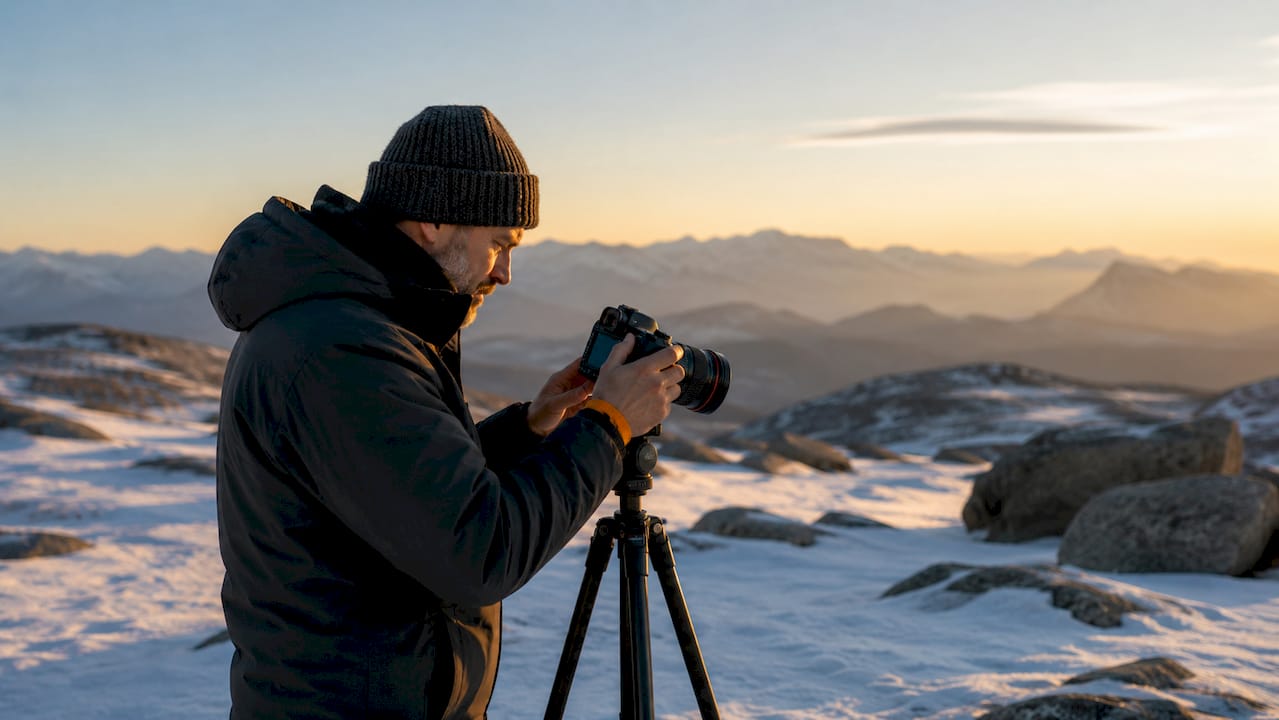
This single adjustment separates flat, lifeless winter shots from luminous ones. Start at +1 stop and review your histogram. If the right edge of the histogram is not close to the bright end, push to +2 stops. Avoid clipping the highlights entirely, which means losing all detail in the snow.
For winter landscape photography, use aperture f/8–f/11 and ISO 100–400 to keep images sharp from foreground to background with minimal noise. These settings give you the depth of field needed to render a snowy field and a distant mountain range in equal clarity.
Pro Tip: Shoot in RAW format during winter outings. Snow’s brightness compresses quickly in JPEG, but RAW files give you the latitude to recover highlights and lift shadows in post-processing without degrading image quality.
2. What gear protects your camera in cold weather?
Cold weather is hard on camera equipment. Battery life drops by at least 50% below freezing, which means a battery that lasts all day in summer may fail within an hour on a cold morning shoot. Carry at least two spare batteries and keep them in an inner jacket pocket against your body heat.
Condensation is the other silent threat. When you move from freezing outdoor air into a warm indoor space, moisture in the warm air condenses instantly on your cold camera body and lens. Sealing your camera in a plastic bag before stepping indoors lets it warm gradually, preventing moisture from locking mechanisms or fogging internal glass elements.
A few other gear essentials for cold weather photography ideas:
- Use a weather-sealed camera body when possible. Canon EOS R5, Nikon Z8, and Sony A7R V all offer solid weather resistance.
- Protect lenses with UV filters. They add a layer of defense against snow and moisture without affecting image quality.
- Carry a microfiber cloth in a warm pocket. A cold cloth smears rather than cleans.
- Use a padded camera bag with a rain cover to shield gear during snowfall.
Pro Tip: Before heading out, reduce the number of times you open your camera bag. Every time cold air rushes in, it chills your spare batteries faster. Keep batteries in a dedicated inner pocket, not the bag.
3. How to dress for a winter photography outing
Layered functional clothing is the foundation of a productive winter shoot. A photographer who is shivering rushes compositions, skips setups, and leaves early. Comfort directly enables creative patience.
The layering system works in three parts. A moisture-wicking base layer keeps sweat away from your skin. A mid-layer fleece or down jacket traps body heat. An outer shell blocks wind and snow. This system lets you add or remove layers as your activity level changes between hiking to a location and standing still to compose a shot.
Hands and feet deserve special attention. Standard winter gloves make operating a camera nearly impossible. Fingerless gloves with a mitten flap, such as those made by Vallerret or Freehands, let you expose your fingertips for controls while keeping the rest of your hand warm. For footwear, insulated waterproof boots rated to at least -20°F keep your feet dry and warm during long sessions in snow.
4. Creative composition for winter landscape photography
Winter simplifies landscapes into graphic, monochromatic scenes that reward intentional framing. Snow acts as a blank canvas, removing visual clutter and directing the viewer’s eye toward your chosen subject. A lone tree, a frozen stream, or a stone wall emerging from white snow becomes a powerful focal point precisely because everything else has been erased.
Embrace the monochromatic palette rather than fighting it. Black tree silhouettes against a pale sky, the blue shadow cast by a snowdrift, and the warm amber of a winter sunrise all gain power from the surrounding white. Side lighting from a low winter sun rakes across snow surfaces and reveals texture that flat front lighting destroys.
“Overcast winter days act as a continent-wide softbox, saturating cool tones and wrapping subjects in soft, even light that is impossible to replicate in summer.” — Winter Photography Guide
Overcast conditions are underrated in snowy scene photography. The diffused light eliminates harsh shadows and brings out the subtle blue and lavender tones in snow that give winter images their distinctive mood. Do not wait for blue skies. Gray days often produce the most atmospheric and emotionally resonant winter photographs.
5. Best lenses and accessories for winter scenes
The right lens changes what is possible in the field. Wide-angle lenses in the 14–24mm range capture the full sweep of a snowy landscape, placing the viewer inside the scene. They work especially well when you have a strong foreground element like ice formations, frost-covered grass, or a winding path through snow.
A standard zoom in the 24–70mm range is the most versatile choice for cold weather photography. It handles landscapes, environmental portraits, and architectural details without requiring a lens change in the cold. Minimizing lens changes also reduces the risk of snow or moisture entering the camera body.
| Lens Type | Focal Range | Best Use |
|---|---|---|
| Wide-angle | 14–24mm | Expansive snowy landscapes |
| Standard zoom | 24–70mm | Versatile all-around shooting |
| Telephoto | 70–200mm+ | Distant wildlife, compressed scenes |
| Macro | 50–100mm | Frost crystals, ice details |
Filters add creative control. A circular polarizer reduces glare on snow and ice, deepening sky tones and adding contrast. A neutral density filter allows longer exposures in bright snow conditions without overexposing. A sturdy tripod is non-negotiable for long exposures, especially around Italian landscapes where winter mist and low light demand slower shutter speeds.
6. How to capture motion in winter scenes
Motion in winter photography falls into two categories: frozen and flowing. Each requires a different shutter speed and a clear intention before you press the shutter.
To freeze individual snowflakes mid-air, set shutter speed to 1/400s or faster. This isolates each flake as a distinct shape against a dark background, such as a pine forest or a shadowed building. The effect is dramatic and immediate.
For soft, flowing motion, the approach reverses:
- Mount your camera on a tripod to eliminate camera shake.
- Set shutter speed between 1/15s and 1/3s to let snowflakes streak across the frame.
- Lower ISO to 100 and narrow aperture to f/11 to compensate for the longer exposure.
- Use a remote shutter release or the camera’s self-timer to avoid touching the camera during the exposure.
- Review the result and adjust shutter speed in half-stop increments until the streak length feels right.
This technique works beautifully on waterfalls that remain partially unfrozen in winter, where the contrast between flowing water and ice-covered rocks creates a scene of quiet drama. The same approach applies to wind-blown snow drifting across an open field.
Key takeaways
Winter photography rewards preparation, patience, and a willingness to see beauty in cold, stripped-down scenes that most people walk past without a second glance.
| Point | Details |
|---|---|
| Correct snow exposure | Apply +1 to +2 stops of exposure compensation to prevent gray, underexposed snow. |
| Protect batteries | Carry spare batteries in inner pockets; cold cuts battery life by at least 50%. |
| Prevent condensation | Seal your camera in a plastic bag before moving from cold outdoors to warm indoors. |
| Dress in layers | Layered clothing preserves warmth and creative patience during long winter shoots. |
| Use overcast light | Gray winter skies produce soft, mood-rich light that flatters snowy scenes. |
What winter photography has taught me about patience and seeing
Preparation matters more than endurance. That is the single most important lesson I have taken from years of shooting in cold conditions. Photographers who dress poorly spend their mental energy managing discomfort rather than reading light. They rush compositions, accept the first angle they find, and leave before the best moment arrives. Dress well and the cold becomes irrelevant. Your mind stays free to see.
Winter also teaches you to frame with intention. When snow covers the ground and strips the trees bare, there is nowhere to hide a weak composition. Every element in the frame must earn its place. I have found that my most disciplined framing habits came directly from shooting winter scenes where the landscape offered no visual shortcuts.
Managing gear in the field is its own craft. I keep a small dry bag inside my jacket for battery swaps, so I never expose warm batteries to cold air longer than necessary. I also never rush the condensation process. Sealing the camera in a bag and waiting 20 minutes feels slow, but it has saved me from fogged lenses and locked aperture blades more than once.
The light in winter is low, directional, and fleeting. The golden hour lasts longer in winter because the sun stays close to the horizon, but it also disappears faster than you expect. Arrive early, set up while the light is still building, and be ready before the moment peaks. That discipline, learned in the cold, carries into every other season.
— Mino
Winter photography experiences with Italyphototour
Italy offers some of the most evocative winter scenes in Europe, from the frost-draped hills of Tuscany to the mist-wrapped canals of Venice in january. Italyphototour brings aspiring photographers into these landscapes with expert guidance, so the technical and creative challenges of the season become opportunities rather than obstacles.

Italyphototour’s photography tours across Italy are led by professional photographer Mino Di Vita, who knows how winter light falls on Italian stone, water, and countryside at every hour of the day. Each tour is designed to place you in the right location at the right moment, with the knowledge to capture it fully. Whether you are drawn to the graphic simplicity of a snow-covered Tuscan vineyard or the atmospheric fog of a Venetian winter morning, these experiences are built for photographers who want to come home with images they are genuinely proud of. Learn more about what Italyphototour offers and find the tour that fits your vision.
FAQ
What is the best exposure setting for photographing snow?
Apply exposure compensation of +1 to +2 stops above your camera’s metered reading. Camera meters calibrate for middle gray, so snow appears underexposed without this correction.
How do I keep my camera safe in cold weather?
Carry spare batteries in an inner pocket to maintain their charge, and seal your camera in a plastic bag before moving indoors to prevent condensation from damaging internal components.
What shutter speed freezes falling snowflakes?
Set shutter speed to 1/400s or faster to freeze individual snowflakes as distinct shapes. For soft motion streaks, use 1/15s to 1/3s with your camera on a tripod.
Is overcast weather good for winter photography?
Overcast conditions are ideal for snowy scene photography. Cloud cover acts as a large diffuser, producing soft, even light that brings out the cool blue and lavender tones in snow.
What lens is best for winter landscape photography?
A wide-angle lens in the 14–24mm range captures expansive snowy landscapes with strong depth. A 24–70mm standard zoom offers versatility for mixed subjects without requiring lens changes in the cold.