

Shooting during Venice’s golden hour can boost color saturation by 30% while reducing harsh shadows by half. This stunning transformation reveals why Venice stands apart as a photography destination. Beyond postcard landmarks, the city offers a masterclass in light, reflection, and storytelling that challenges you to see differently and grow artistically through every frame you capture.
Table of Contents
- Unique Lighting And Reflections In Venice
- Venice’s Cultural And Architectural Elements As Creative Subjects
- Common Misconceptions And Challenges In Shooting Venice
- Framework For Planning A Photography Session In Venice
- How Venice Fosters Artistic Growth For Amateur Photographers
- Comparison Of Venice With Other Italian Photography Destinations
- Conclusion: Unlocking Venice’s Photographic Magic
- Explore Venice With Italy Photo Tour
- FAQ
Key takeaways
| Point | Details |
|---|---|
| Light quality transforms images | Venice’s unique interplay of water and pastel architecture creates soft, dynamic lighting ideal for artistic compositions. |
| Rich subjects fuel creativity | Historic architecture spanning Gothic to Renaissance styles plus vibrant street culture provide endless narrative opportunities. |
| Timing conquers challenges | Strategic shooting during optimal hours reduces crowds while maximizing natural light quality. |
| Technical preparation matters | Weather-sealed gear and proper filters help manage humidity and reflections effectively. |
| Growth through immersion | Venice’s complex environment pushes photographers beyond tourist clichés toward confident, artistic storytelling. |
Unique lighting and reflections in Venice
Venice’s network of canals creates a natural studio where water acts as both mirror and diffuser. The interplay between liquid surfaces and pastel-colored buildings produces soft, wraparound lighting you won’t find in landlocked cities. This combination allows you to craft compositions with depth and atmosphere that feel almost painterly.
Water reflections open doors to abstract and symmetrical compositions unique to this floating city. You can frame gondolas doubled in still canals or capture rippling distortions that transform architecture into impressionistic art. These reflective surfaces give you creative freedom to experiment with visual storytelling beyond traditional landscape rules.
Shooting during golden or blue hours improves color saturation by 30% while decreasing harsh shadows significantly. Morning light bathes stone facades in warm amber tones, while evening blue hour wraps the city in cool, mysterious atmospheres. Each time window offers distinct moods to explore, from romantic warmth to contemplative stillness.
Contrasting light throughout the day presents varied creative opportunities:
- Midday sun creates sharp shadows perfect for architectural geometry
- Overcast conditions produce even, flattering light for street portraits
- Twilight transitions blend artificial and natural light for dynamic urban scenes
- Nighttime reflections on wet pavement add cinematic drama
Pro Tip: Use polarizing filters to manage reflections selectively and enhance sky and water details. Rotate the filter to either eliminate surface glare for clear underwater views or intensify reflections for dramatic mirror effects, giving you control over your creative vision.
Venice’s cultural and architectural elements as creative subjects
Architecture spanning Gothic arches to Renaissance palazzos provides compelling lines, textures, and historical layers. Ornate facades covered in weathered stone tell centuries of stories through patina and detail. You can photograph sweeping grand canal vistas or zoom into intricate doorway carvings that reveal craftsmanship lost to modern construction.
Local markets buzz with authentic human activity ideal for street photography in Venice. Fruit vendors arranging colorful displays, fishmongers hauling morning catches, and neighbors exchanging gossip create genuine moments. These scenes let you document real Venetian life rather than staged tourist performances, building narrative depth into your portfolio.
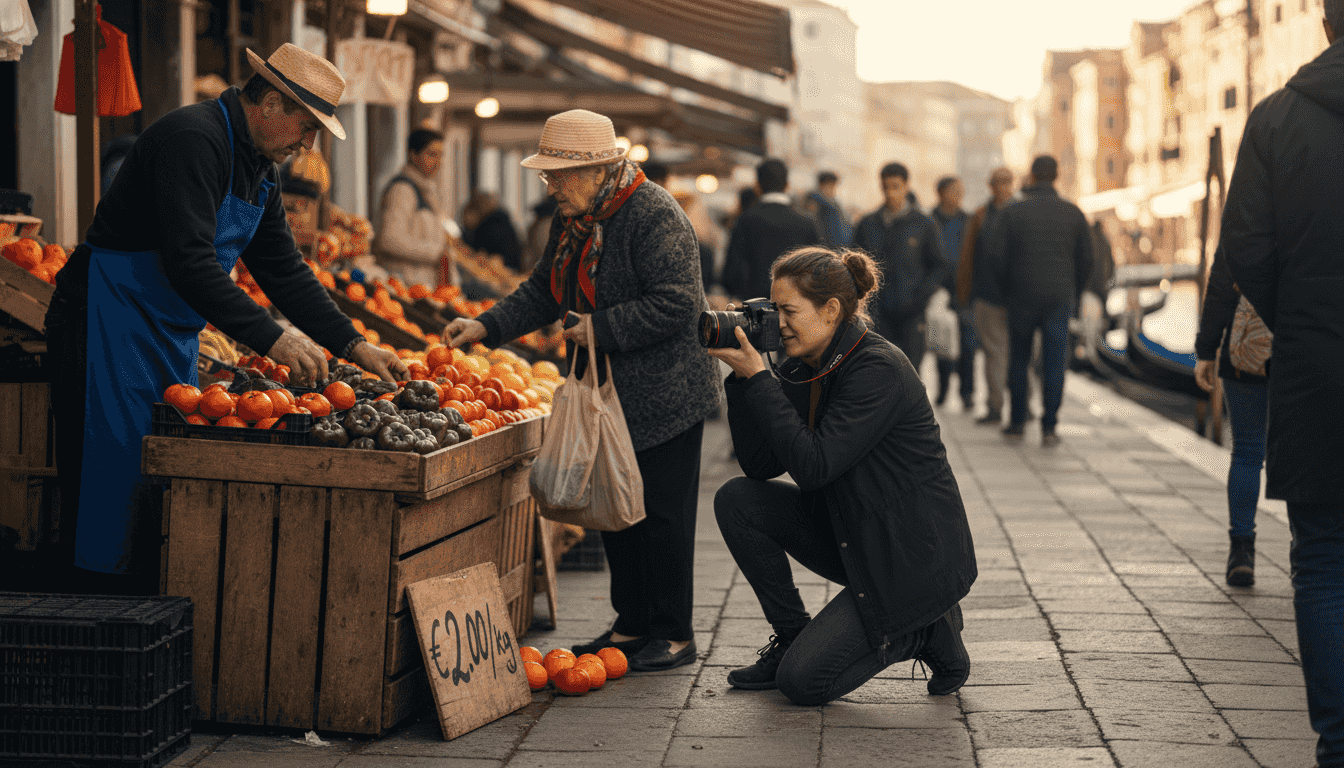
Venice’s ambiance blends historic charm with contemporary urban culture. A grandmother hanging laundry from a medieval window or teenagers texting beneath Byzantine arches creates visual juxtaposition. This collision of eras offers storytelling gold, allowing you to explore themes of continuity, change, and human connection across time.
Combining architectural frames with cultural moments elevates your narrative impact:
- Position street musicians beneath Gothic archways for environmental portraits
- Capture cafe patrons framed by ornate window grilles
- Photograph children playing in ancient campi (squares) for timeless scenes
- Use narrow bridges as leading lines toward human interactions
Street scenes in narrow alleys capture intimate, spontaneous moments impossible in wider European boulevards. The compressed space forces proximity between photographer and subject, creating authentic connection. Early morning deliveries, late afternoon card games, and evening passeggiata (strolls) unfold in these urban corridors, revealing Venice’s rhythm.
Common misconceptions and challenges in shooting Venice
Many believe successful Venice photography means simply photographing the Rialto Bridge and St. Mark’s Square. Novice photographers mistakenly focus only on landmarks, missing rich narrative opportunities in residential neighborhoods. The assumption that iconic locations guarantee compelling images often leads to cliché shots indistinguishable from millions of others.
Crowds and humidity create real technical and logistical obstacles you must anticipate. Tourist masses pack popular spots from mid-morning through sunset, making clean compositions nearly impossible. Venice’s waterfront position generates persistent moisture that fogs lenses, corrodes electronics, and creates haze that dulls distant views.
Overcoming these challenges requires strategic planning:
- Schedule shoots during golden or blue hours when crowds thin and light quality peaks
- Research alternative vantage points offering fresh perspectives on familiar subjects
- Monitor weather forecasts to avoid fog-heavy days that flatten contrast
- Build extra time for location scouting before your main shooting sessions
- Protect gear with weather-sealed bodies and keep silica gel packets in your bag
Equipment choices directly impact your success rate in Venice’s demanding environment. Weather-sealed cameras and lenses resist the constant humidity that plagues unprotected gear. Polarizing filters help you manage the intense reflections from water and glass surfaces. Neutral density filters enable long exposures that smooth choppy canal water into ethereal mist, even in bright conditions.
Pro Tip: Scout lesser-known locations like Cannaregio or Dorsoduro districts to avoid photographic clichés and discover unique compositions. These residential areas offer authentic Venetian scenes, from local bakeries to quiet fondamenta (waterside paths), without the tourist saturation plaguing central zones.
Framework for planning a photography session in Venice
Effective Venice shoots require advance research into optimal locations and timing windows. Study maps to identify promising campi, bridges, and canals before arrival. Planning shoots around golden and blue hours while incorporating cultural elements produces more compelling results than wandering aimlessly during harsh midday light.
Execute your plan systematically:
- Arrive at primary locations 45 minutes before optimal light begins
- Scout multiple angles and compositions while light is still flat
- Position yourself where human activity naturally flows into your frame
- Shoot continuously through the entire golden or blue hour window
- Remain flexible to capture unexpected moments that arise spontaneously
Intentionally weave local culture and human activity into your shot list. A technically perfect canal reflection gains emotional resonance when a gondolier rows through the frame. Market vendors arranging produce or craftsmen repairing boats add narrative layers that pure architectural shots lack. These human elements transform documentary into storytelling.
Adapt your equipment loadout to Venice’s reflective, humid conditions. Bring lens cloths to quickly clear condensation from front elements. Carry backup batteries since cold morning air drains power faster. Select versatile zoom ranges like 24-70mm that let you react quickly to changing scenes without swapping lenses in damp conditions.
Experiment with reflections and abstract compositions using canals as natural mirrors. Try shooting straight down into water to eliminate horizon lines entirely. Capture upside-down architecture wobbling in boat wakes for surreal effects. Wait for moments when reflections create perfect symmetry, then release the shutter precisely as wind stills the surface.
How Venice fosters artistic growth for amateur photographers
Venice’s visually complex environment pushes you beyond comfortable shooting habits toward creative experimentation. The constant interplay of light bouncing off water challenges your understanding of exposure and metering. Narrow alleys with extreme contrast ratios force you to make intentional choices about what to expose for, developing your technical judgment.
Reflections and layered human elements demand improved compositional skills:
- Balancing foreground gondolas against background architecture trains spatial awareness
- Capturing fleeting expressions amid crowds sharpens reaction timing
- Managing multiple focal planes through reflections builds depth perception
- Framing human moments within architectural contexts develops narrative instincts
Engaging with local culture transforms you from observer into storyteller. Photographing a fishmonger requires understanding his routine, respecting his workspace, and waiting for authentic gestures. This patient, empathetic approach builds skills transferable to any street photography situation. You learn to anticipate moments rather than merely react to them.
Photographers report increased skill levels and creative confidence after Venice shooting experiences. The city’s density of visual opportunities means you make more compositional decisions per hour than in typical environments. This accelerated practice loop, combined with immediate feedback from reviewing images, speeds mastery of both technical and artistic fundamentals.
Shooting in Venice expands your artistic vision beyond generic tourist documentation. The city rewards photographers who seek unusual perspectives, from shooting through ornate iron grilles to capturing reflections in rain puddles. Success here requires seeing possibilities others miss, a mindset shift that permanently changes how you approach any photographic subject.
Comparison of Venice with other Italian photography destinations
Venice’s 150 canals generate water reflections and visual effects impossible in landlocked Italian cities. While Florence offers Renaissance architecture and Rome provides ancient ruins, neither delivers the liquid light quality that defines Venetian photography. This water-centric landscape creates a shooting environment unlike anywhere else in Italy or beyond.
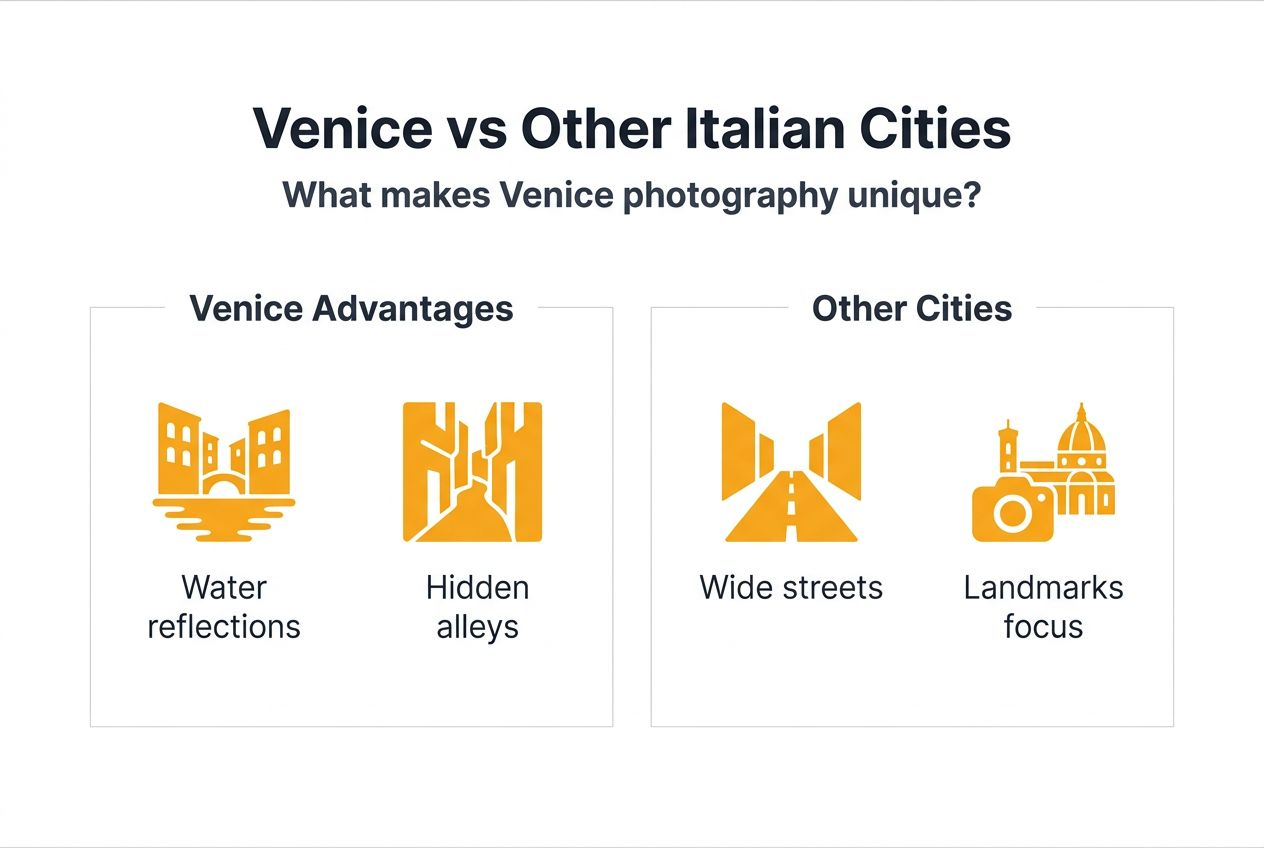
The predominantly pedestrian layout allows easier access to intimate scenes compared to vehicle-dominated cities. You can wander narrow calli (streets) and cross countless bridges without dodging Vespas or navigating traffic. Venice offers unique water-centric advantages and pedestrian-friendly access that Rome’s bustling streets cannot match.
Key differences include:
- Less traffic congestion creates calmer, quieter shooting environments
- Boat-based transportation adds dynamic motion elements unavailable elsewhere
- Compact island geography lets you cover diverse locations efficiently on foot
- Absence of cars eliminates modern visual distractions from historical scenes
| Feature | Venice | Rome | Florence |
|---|---|---|---|
| Water reflections | Abundant canals | Tiber River only | Arno River only |
| Pedestrian access | Entirely walkable | Heavy vehicle traffic | Moderate traffic |
| Architectural variety | Gothic to Renaissance | Ancient to Baroque | Renaissance focus |
| Light quality | Soft, water-diffused | Direct, dramatic | Warm, golden |
| Crowd density | High in tourist zones | Very high citywide | Moderate overall |
| Cultural scenes | Markets, gondoliers | Ruins, religious sites | Art museums, cafes |
Venice boasts numerous quiet alleys and hidden campi perfect for narrative photography. Unlike Rome’s constant tourist flow or Florence’s museum-centric layout, Venice rewards exploration with secluded corners where local life continues undisturbed. These spaces let you capture authentic moments without the visual clutter of modern signage or crowds that plague other Italian destinations.
Conclusion: Unlocking Venice’s photographic magic
Venice combines exceptional light quality, distinctive water features, layered architecture, and vibrant culture into an unmatched photography destination. The city challenges you technically while inspiring you artistically, pushing your skills forward with every shoot. Approach Venice not as a checkbox on your travel list but as a creative journey where each canal turn reveals new visual possibilities. Your camera becomes the tool for deeper engagement with this remarkable place, transforming casual observation into meaningful artistic expression.
Explore Venice with Italy photo tour
Ready to transform your Venice photography from snapshots into art? Italy Photo Tour offers curated photography tours Italy designed specifically for enthusiast photographers seeking creative growth. Professional guides lead you to optimal locations during peak light conditions while teaching composition, exposure, and storytelling techniques that elevate your work.

Our Venice experiences combine technical training with cultural immersion, helping you capture the city’s essence rather than just its landmarks. You’ll learn to read light on water, anticipate human moments, and craft images with genuine emotional impact. Discover what we do and explore our full range of Italy photo tour experiences across this visually stunning country.
FAQ
What is the best time of day to shoot photos in Venice?
Golden hour (first hour after sunrise and last hour before sunset) and blue hour (twilight) provide the best light for rich colors and soft shadows. Early mornings between 6-8 AM are ideal because you’ll avoid crowds while capturing gentle, directional light perfect for reflections.
How can I capture local culture effectively in Venice photography?
Focus on street markets like Rialto, where vendors arrange fresh produce and fish, and observe daily interactions in residential neighborhoods. Approach subjects respectfully, make eye contact, smile, and ask permission when shooting portraits, ensuring your images feel authentic rather than intrusive.
What equipment is recommended for shooting in Venice?
Use weather-sealed camera bodies and lenses to protect against Venice’s persistent humidity and occasional rain. Bring polarizing filters to manage water reflections, neutral density filters for long exposures, and a sturdy tripod for low-light conditions during golden and blue hours.
Why do reflections matter so much in Venice photography?
Reflections transform ordinary canal scenes into layered, abstract compositions that add depth and visual interest. They allow you to create symmetrical images, capture upside-down architecture, or use rippling water to add motion and energy to static subjects.
How does Venice photography improve overall skills?
Venice’s complex lighting, constant motion, and dense visual layers force rapid decision-making about exposure, composition, and timing. This concentrated practice environment accelerates learning, building technical proficiency and creative confidence applicable to any photography situation you encounter afterward.