

TL;DR:
- Urban photography captures city life and architecture, revealing endless visual opportunities for personal and artistic expression. Regular practice sharpens skills like pattern recognition, light reading, and instinctive framing, making it accessible with minimal equipment. Using different lenses and shooting at various times enhances understanding of light and composition, deepening the connection with the urban environment.
Urban photography is defined as the practice of capturing the built environment, its people, and the living energy of city life through a camera lens. The city is one of the most generous subjects a photographer can find. Every street corner holds geometry, light, shadow, and human drama waiting to be noticed. The reasons to shoot in urban scenes go far beyond convenience. They reach into the heart of what makes photography a deeply personal and endlessly rewarding art form.
Why shoot in urban scenes at all?
Urban photography rewards photographers at every level because the city never stops offering new material. Architecture shifts in mood from morning to evening. Strangers move through light in ways that cannot be staged. Weather rewrites the same street entirely. Urban photography needs no specialized gear. A smartphone or a compact mirrorless camera is enough to begin. That low barrier makes the city the most democratic studio in photography.
The city also teaches patience and perception. You learn to read a scene before raising the camera. You start noticing how a shaft of light falls across a doorway, or how a crowd compresses at a crosswalk into a single, graphic shape. These are skills that transfer directly to every other genre of photography, from portraiture to landscape. The city is a classroom that never closes.
What makes urban environments uniquely suited for dynamic photography?
Urban environments offer a density of visual material that no other setting can match. Within a single city block, you find repeating geometric patterns in facades, the organic chaos of foot traffic, reflective glass surfaces, and the constant drama of changing light. Each element layers onto the next, giving photographers the raw material for images with genuine depth and complexity.
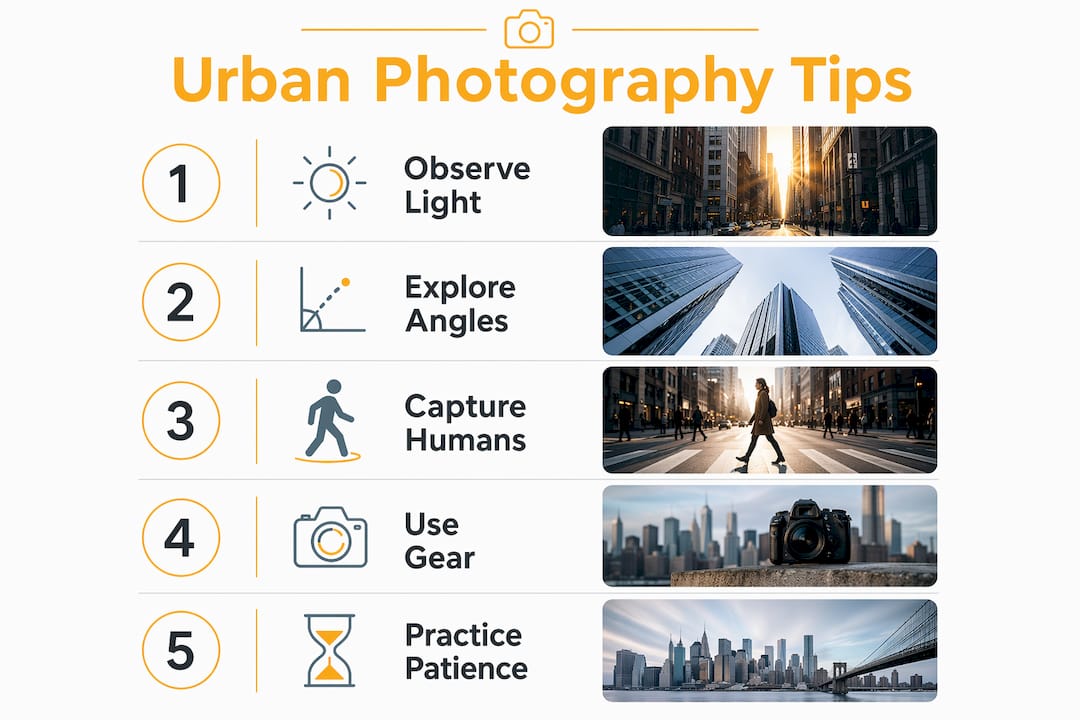
Light is the defining variable in city photography. Golden hour and midday create entirely different moods from the same location. The warm, raking light of early morning turns a plain concrete wall into a canvas of texture and shadow. Midday sun carves hard geometric shadows between buildings. Blue hour wraps the city in a cool, cinematic glow that no other time of day replicates. Returning to the same street at different hours is one of the most effective exercises in urban photography.
Weather adds another layer of creative possibility. Rain transforms urban surfaces into mirrors, reflecting neon signs, headlights, and passing figures in ways that dry pavement never could. Fog softens hard edges and creates a sense of mystery. Snow erases visual clutter and simplifies a scene to its essential shapes. These conditions are not obstacles. They are gifts.
Key qualities that make urban scenes so photogenic:
- Architectural geometry: Repeating windows, arches, and lines create natural leading patterns and graphic compositions.
- Human activity: Candid moments of daily life add emotional weight and narrative to any frame.
- Layered depth: Foreground elements, mid-ground figures, and distant skylines create natural three-dimensional compositions.
- Reflective surfaces: Glass, puddles, and polished stone multiply the visual information in a single frame.
- Constant change: No two visits to the same location produce the same image.
Pro Tip: Visit the same urban location at three different times: golden hour, midday, and blue hour. Shoot the same composition at each visit. The contrast between the three sets of images will teach you more about light than any textbook.
How does shooting regularly in urban scenes improve your skills?
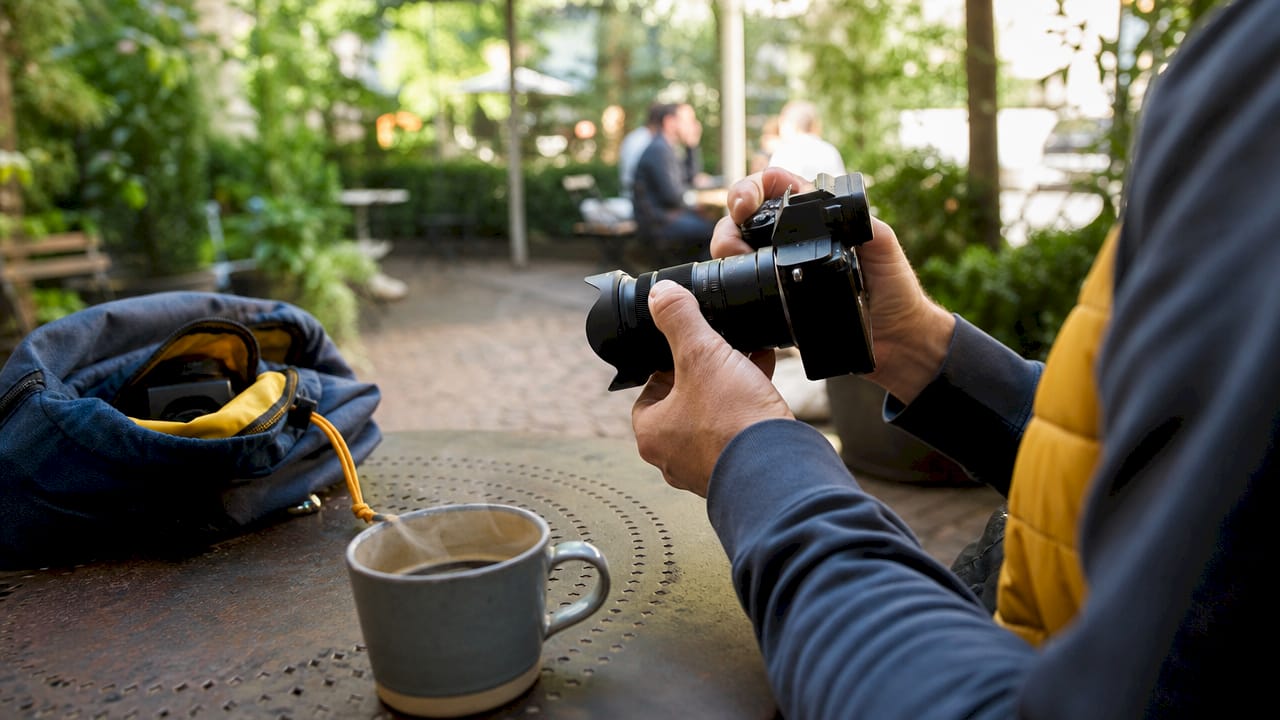
Consistent practice in city environments rewires how you see. Photographers who explore urban settings weekly develop a sharper ability to spot visual opportunities and handle the unpredictability of real-world scenes. The city trains your eye faster than a controlled studio ever could, because it forces you to react rather than plan.
The skill development follows a natural progression:
- Pattern recognition: You begin to see repeating shapes, colors, and rhythms in the urban fabric that were invisible before.
- Light reading: You learn to identify where light will fall at a given hour and position yourself accordingly.
- Instinctive framing: Repeated exposure to fast-moving scenes builds the muscle memory to frame and shoot before a moment disappears.
- Compositional confidence: You stop second-guessing and start trusting your eye to find the frame within the chaos.
- Workflow fluency: Camera settings become automatic, freeing your attention for the scene itself.
Treating the city like an open-world game with visual clues and high-potential zones sharpens this process further. You learn to identify light traps, crowd bottlenecks, and architectural frames before you even raise the camera. That kind of active, exploratory mindset is what separates photographers who grow quickly from those who plateau. The city rewards curiosity above all else.
What are some practical techniques for capturing compelling urban photos?
Strong urban images come from deliberate choices about gear, timing, and angle. The right technique turns a busy, cluttered scene into something cinematic and clear.
- Use a longer lens for compression: A 70–200mm lens compresses urban scenes, isolating your subject and turning a chaotic background into smooth, graphic tones. This is one of the most effective tools for bringing order to a busy street.
- Shoot from unexpected angles: Looking straight up at a canyon of glass towers creates a sense of scale and drama. Looking straight down from a bridge or overpass turns pedestrians into abstract shapes moving through geometric patterns.
- Embrace wet surfaces: After rain, every puddle becomes a mirror. Crouch low and shoot reflections of buildings, signs, or figures for images with a surreal, doubled quality.
- Alternate between wide and tight: A wide shot establishes the environment and its energy. A tight shot isolates a single detail, a worn doorknob, a shadow on a wall, and tells a more intimate story.
Pro Tip: When shooting candid street moments, pre-focus your lens at a fixed distance and use a small aperture like f/8. This gives you a wide depth of field so you can shoot quickly without missing focus on a moving subject.
The comparison below shows how lens choice and timing affect the character of an urban image:
| Variable | Wide lens, golden hour | Telephoto, midday |
|---|---|---|
| Mood | Warm, expansive, inviting | Graphic, compressed, dramatic |
| Subject | Environment and figures together | Isolated subject, clean background |
| Best for | Storytelling and context | Portraits and architectural details |
| Challenge | Managing busy foregrounds | Finding clear sightlines in crowds |
For photographers working in Italy, urban photography in Italian cities like Milan and Venice offers a particularly rich combination of historic architecture, narrow light-filled streets, and vibrant daily life that rewards all of these techniques.
Why is urban photography a form of creative and personal expression?
Urban photography is not simply documentation. It is a process of self-discovery conducted in public. Walking with a camera anchors you to the present moment, sharpening your awareness of light, movement, and human connection in ways that ordinary walking does not. The camera becomes a reason to slow down, to look twice, and to find beauty in the unremarkable.
Photographer Harvey Stein describes this process directly. Urban photography develops personal vision, with the photographer’s own perspective as the true subject of every image. The city is the same for everyone who walks through it. What you choose to photograph, and how you choose to frame it, is entirely your own. That act of selection is the art.
Eric Kim calls this the alchemy of street photography. The mundane becomes extraordinary through the photographer’s instinct and timing. A wet cobblestone, a stranger’s gesture, a shadow falling across a doorway. None of these things are remarkable on their own. Through the lens, with the right light and the right moment, they become something that stops a viewer cold. That transformation is the deepest reason to capture urban life with a camera.
“The city is an open invitation. Every street is a stage, every passerby a character, and every hour of light a different story waiting to be told.”
The importance of urban scenes for storytelling lies precisely in this richness. No other environment offers so many simultaneous narratives. A single frame can hold architecture, culture, weather, and human emotion at once. That density of meaning is what makes urban photography one of the most expressive forms the medium offers.
Key Takeaways
Urban photography is the most accessible and creatively rewarding genre for amateur photographers because the city provides constant, layered, and unpredictable visual material that builds skill and personal vision simultaneously.
| Point | Details |
|---|---|
| Accessibility | A smartphone or compact mirrorless camera is enough to start shooting urban scenes effectively. |
| Light as the key variable | Returning to the same location at golden hour, midday, and blue hour produces dramatically different images. |
| Weekly practice builds skill | Regular urban exploration sharpens pattern recognition, instinctive framing, and compositional confidence. |
| Technique matters | A 70–200mm lens compresses scenes; wet surfaces and unexpected angles add depth and drama. |
| Personal vision is the goal | Urban photography develops your unique point of view, not just your technical ability. |
My honest take on why the city never gets old
I have photographed cities across Italy for years, from the narrow calli of Venice to the grand arcades of Milan, and the city has never once felt exhausted as a subject. What surprises most photographers when they start shooting urban scenes regularly is not the variety of the city itself. It is the variety they discover in themselves. You return to the same piazza ten times and see ten different photographs, because you are a different observer each time.
The challenge most beginners face is not technical. It is perceptual. They walk past the same alley every day and see nothing worth photographing. Then one morning the light falls differently, or a figure pauses in exactly the right place, and suddenly the image is obvious. That moment of recognition is what urban photography workflow practice is really building. You are not learning to use a camera. You are learning to see.
My practical advice: resist the pull of famous landmarks when you are starting out. The real education happens on ordinary streets, in the gaps between monuments. Shoot what confuses you, what you cannot immediately explain. Those are the images that will surprise you most when you review them later. The city rewards the photographer who looks without an agenda.
— Mino
Urban photography experiences with Italyphototour
Italyphototour offers guided photography experiences across Italy’s most visually compelling cities, including Milan, Venice, and Cinque Terre, all led by professional photographer Mino Di Vita.

Each experience is designed to put you in the right place at the right light, with the guidance to understand why that moment matters photographically. Whether you are drawn to the chiaroscuro of Milan’s historic arcades or the shimmering reflections of Venice’s canals, these tours give you the tools and the context to bring your urban photography to a new level. Explore the full range of photography tours in Italy and find the experience that fits your vision. You can also learn more about the approach and philosophy behind each tour on the Italy Photo Tour services page.
FAQ
What is urban photography?
Urban photography is the practice of capturing city environments, including architecture, street life, and human activity, using any camera from a smartphone to a professional mirrorless body.
Why is urban photography good for beginners?
Urban photography requires no specialized equipment and offers constant, varied subject matter, making it the most accessible genre for photographers building their skills.
What is the best time of day for urban photography?
Golden hour and blue hour produce the most dramatic and varied light in city environments. Midday works well for graphic, high-contrast architectural shots.
How does shooting in cities improve photography skills?
Regular urban exploration builds pattern recognition, instinctive framing, and the ability to read light quickly, skills that transfer to every other photography genre.
What lens is best for urban photography?
A 70–200mm telephoto lens compresses scenes and isolates subjects from busy backgrounds. A wide-angle lens in the 24–35mm range works well for environmental storytelling and capturing the full scale of city architecture.