

TL;DR:
- Hidden gems in Italy offer authentic and original photography opportunities away from crowds.
- Exploring lesser-known locations enhances technical skills and encourages personal artistic style.
- Proper research, timing, and respectful approach are essential to successfully capture Italy’s hidden treasures.
There is a quiet truth that many photographers discover only after standing in a heaving crowd at the Trevi Fountain, camera raised, heart sinking: the most famous places are often the hardest places to make a truly original image. Italy dazzles at every turn, and yet the country’s most iconic spots have been captured millions of times, from every conceivable angle, in every season. What if the most powerful photograph of your Italy trip is waiting not at the Colosseum, but down a crumbling alley in a village nobody has heard of? This article explores exactly that possibility, guiding you through the creative, technical, and personal rewards of seeking out Italy’s lesser-known photography locations.
Table of Contents
- Why hidden gems matter for photographers
- How hidden gems boost creativity and skill
- Comparing hidden gems to tourist hotspots
- Tips for discovering and capturing Italy’s hidden gems
- Why true mastery means discovering the unknown
- Unlock Italy’s hidden photography treasures with expert help
- Frequently asked questions
Key Takeaways
| Point | Details |
|---|---|
| Stand out from the crowd | Shooting hidden gems in Italy helps you create photos that are unique and less repetitive. |
| Authentic atmospheres | Photographing lesser-known spots captures Italy’s true spirit free from tourist crowds. |
| Grow creatively | Exploring new places drives skill-building and personal artistic expression. |
| Practical steps | With research and planning, anyone can find and photograph Italy’s most rewarding hidden locations. |
Why hidden gems matter for photographers
When you step away from the tourist trail and wander into quieter corners of Italy, something remarkable happens. The noise fades, the elbowing crowds dissolve, and suddenly the scene in front of your lens belongs entirely to you. This is not a small thing. Composition is one of the most fundamental challenges in photography, and uncluttered scenes give you the freedom to place your subject with intention, to let negative space breathe, and to tell a story without visual chaos competing for attention.
Hidden gems in Italy offer photographers fewer crowds, enabling uncluttered compositions and authentic atmospheres without tourist distractions. That authenticity is deeply important. When you photograph a sunlit piazza in a village that rarely appears on travel itineraries, you are capturing something genuine: the old man nursing his espresso, the cat stretching across worn cobblestones, the peeling ochre paint catching golden afternoon light. These images carry a weight and a warmth that postcard-ready landmark shots rarely achieve.
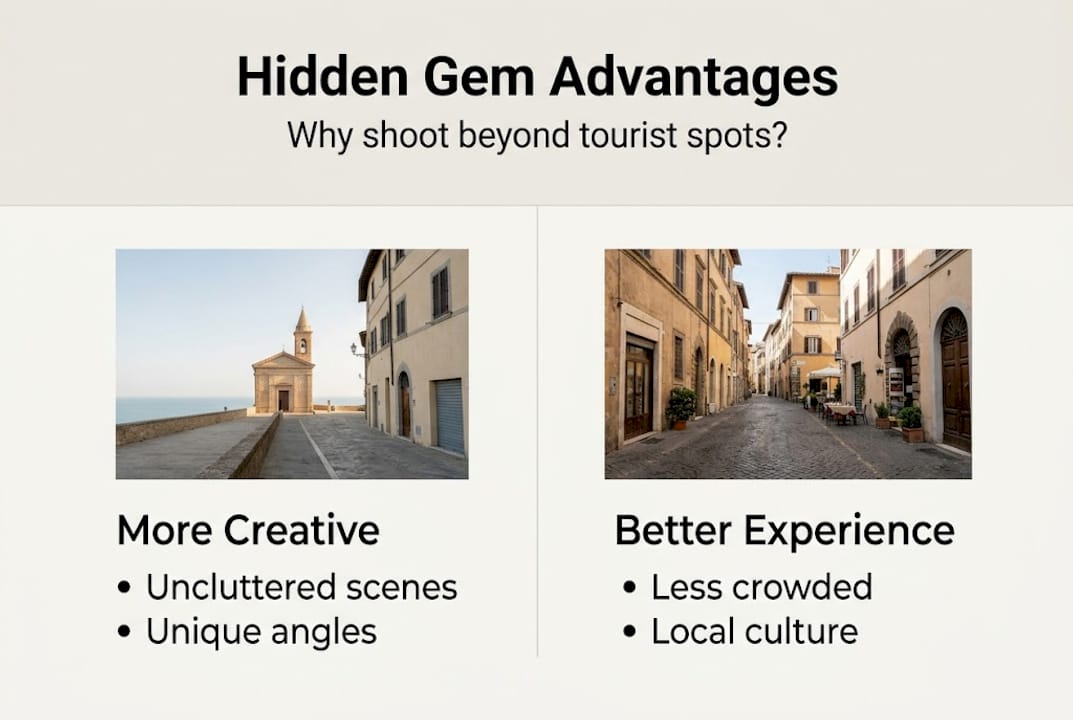
There is also the matter of originality. Every photographer who visits Venice photographs the Rialto Bridge. Fewer venture to the lagoon’s quieter islands or to the sleepy fishing villages along the Adriatic coast. When you pursue finding hidden photo spots in places others overlook, your images stand apart. They become conversation starters rather than familiar scenes. Editors, exhibition curators, and social media audiences alike respond to freshness, and the hidden corners of Italy offer exactly that.
Beyond the practical advantages, there is a deeply personal dimension to this kind of exploration. Venturing beyond the familiar pushes you outside your comfort zone. You must be attentive, observant, and adaptable. You cannot rely on the mental shortcut of “I’ve seen this photo before, so I know what to do.” Every unfamiliar alley, every misty medieval hilltop, every abandoned monastery demands that you approach the scene with fresh eyes. This is where real capturing authentic travel images happens: in the moments of genuine discovery, not rehearsed repetition.
“The camera is an instrument that teaches people how to see without a camera.” — Dorothea Lange. When you remove the crutch of a well-documented subject, you are forced to truly see.
Pro Tip: Before your trip, research five small Italian villages or neighborhoods that rarely appear in major travel publications. Commit to visiting at least two of them, even if they require a small detour. The effort pays dividends in originality and creative fulfillment.
How hidden gems boost creativity and skill
Now that you understand the broader reasons, let’s dig into the specific skills and creative rewards you unlock when you ditch the crowds and explore hidden gems.
Developing your observational eye. When you arrive at an unfamiliar location, you cannot rely on memory or reference images to guide your framing. You must slow down and look, really look, at the quality of light falling across a stone archway, at the geometry of laundry lines strung between buildings, at the way reflections pool in a quiet canal. This heightened attentiveness is one of the most valuable habits a photographer can build. Over time, it transforms the way you see the entire world, not just Italy.
Escaping the postcard trap. At famous landmarks, there is an invisible pressure to recreate the “definitive” shot. Visitors unconsciously follow the same path, stop at the same viewpoint, and press the shutter at the same moment. Hidden locations carry no such expectation. According to fewer crowds in lesser-known spots, you gain the freedom to experiment without judgment, to try an unusual low angle, to wait for an unexpected moment, or to embrace blur and shadow in ways that a mainstream guidebook might never suggest.
Technical growth through adaptability. Lesser-known locations often present challenging and unpredictable conditions. A narrow alley in Matera might plunge you into deep shadow punctuated by bright shafts of noon light. A misty morning in the Apennine hills might wrap everything in a soft, diffuse glow that rewards patience and precise exposure adjustment. These conditions force you to master your camera’s settings rather than relying on automatic modes. You learn to read light intuitively, and that skill travels with you everywhere.
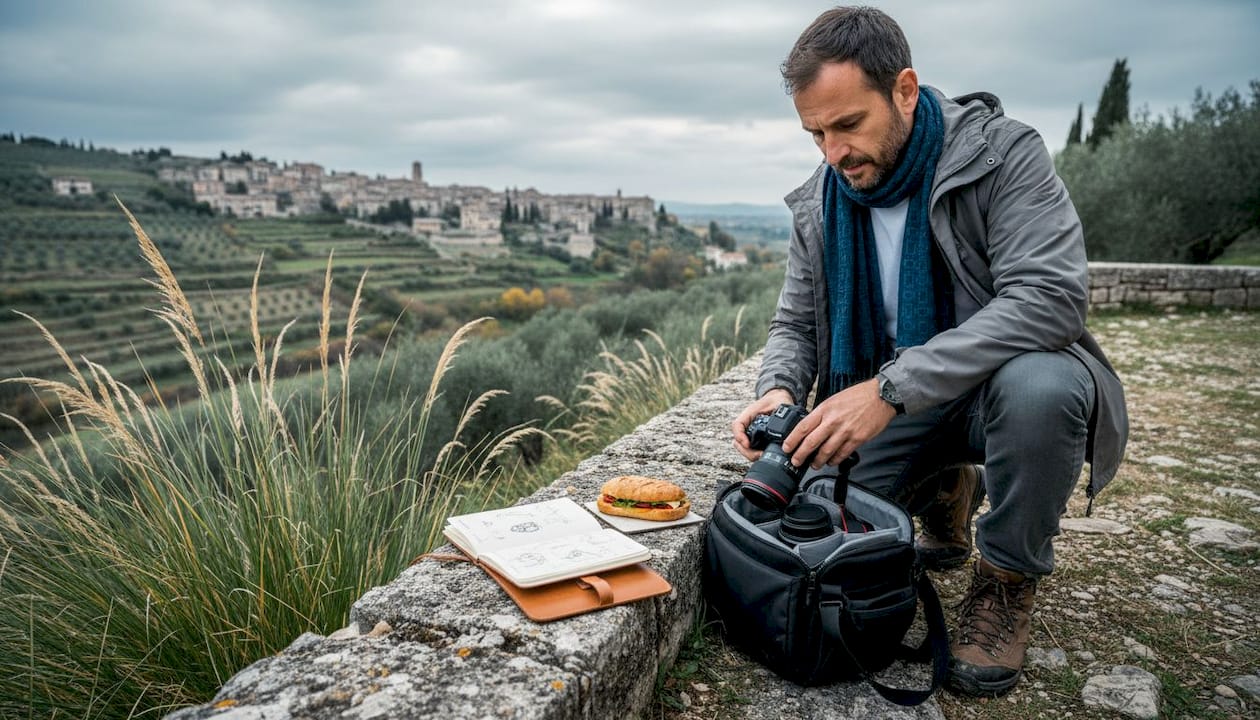
Finding your personal style. Style emerges through repetition in unfamiliar territory. When you are not copying an iconic image, you are free to express your own sensibility. Some photographers discover they are drawn to texture and decay, the beautiful chiaroscuro of crumbling walls and iron gates. Others find their voice in the human element, a farmer, a child, a fisherman, caught in an unguarded moment. Explore essential Italy photo tips to sharpen your technical foundation, then let the hidden gems of Italy be the canvas on which your individual vision takes shape. You can also discover unique Italian photo spots that align naturally with the subjects and moods you feel most drawn to.
Pro Tip: Keep a small notebook or voice memo app handy when scouting. Record not just locations, but the quality of light, the time of day, and how the scene made you feel. These notes become invaluable when you return to shoot with intention.
Comparing hidden gems to tourist hotspots
Of course, seeking out these quieter places isn’t always the easy option. Let’s see how they stack up against classic tourist destinations by the numbers and the experience.
| Factor | Tourist hotspot | Hidden gem |
|---|---|---|
| Crowd density | Very high, especially at peak hours | Low to none |
| Composition freedom | Limited, often obstructed | Full creative control |
| Authenticity of scene | Often staged or heavily managed | Genuine, organic life |
| Originality of output | Repetitive, widely seen | Fresh, rarely documented |
| Planning required | Minimal, well-documented | Moderate to high |
| Emotional connection | Diluted by distraction | Deep and personal |
| Infrastructure | Excellent, tourist-facing | Variable, sometimes absent |
The table above reveals a pattern that many experienced photographers already sense intuitively. Tourist hotspots offer convenience but exact a creative cost. You will not struggle to find the Leaning Tower of Pisa, but you will struggle to make a photograph of it that nobody has seen before. Hidden gems ask more of you in terms of research and preparation, yet they reward that effort with images that feel genuinely yours.
Fewer crowds enable uncluttered compositions and authentic atmospheres, and this difference shows clearly in the final photograph. An image of an ancient Umbrian hilltop at dawn, mist rolling between the stone towers, with no other human being in sight, carries a stillness and a majesty that a busy, tourist-filled landmark simply cannot replicate. That silence has a visual quality. It settles into the frame and speaks to the viewer in a different, quieter language.
It is worth acknowledging the genuine challenges, too. Hidden locations may have poor road access, limited signage, and no nearby amenities. Research becomes essential. Consulting Italy landmark photography tips can help you plan even unfamiliar destinations effectively, balancing ambition with practical preparation.
- Hidden gems reward patience and research with truly original photographs.
- Hotspots offer predictability but yield images your audience has seen countless times.
- The most memorable travel portfolios blend both, but lean heavily toward the unexplored.
- Planning for hidden locations is an investment that pays off in creative satisfaction.
Tips for discovering and capturing Italy’s hidden gems
Ready to start your own adventure off the beaten path? Here’s how to uncover and make the most of Italy’s hidden photography treasures.
Research through local voices. Travel blogs written by Italian residents, regional photography forums, and even casual conversations with locals can open doors to places that no guidebook mentions. Ask a café owner about the oldest street in town. Ask a farmer where the best light falls at sunset on the valley. These conversations are themselves part of the experience, and the information they yield is irreplaceable.
Scout at unconventional times. Many hidden gems are not truly secret; they are simply overlooked because most visitors arrive at noon and leave by three. Dawn and dusk transform even modest locations into something extraordinary. The warm, angled light of golden hour softens textures, deepens colors, and floods narrow streets with a theatrical glow. Arriving an hour before sunrise at a quiet Tuscan vineyard or a sleepy Sicilian fishing port can yield images of breathtaking beauty.
Prepare for limited infrastructure. Carry water, a portable charger, printed maps or offline GPS, and extra memory cards. Many hidden locations have no Wi-Fi, no tourist information offices, and no nearby camera shops. The self-sufficiency you develop on these adventures mirrors the urban photography tips mindset: stay flexible, stay prepared, and treat every unexpected challenge as a creative opportunity.
Bring versatile gear. A single zoom lens that covers a wide to short telephoto range is often more practical than a bag full of primes when you are navigating unknown terrain. Lightweight tripods are invaluable for low-light work in ancient interiors or misty landscapes. Take inspiration from Italian landscape photo inspiration to understand what conditions you might encounter and pack accordingly.
Respect the place and its people. This cannot be overstated. Hidden gems remain unspoiled precisely because fewer people pass through. Always ask permission before photographing individuals. Leave no trace. Do not damage fragile environments for the sake of a dramatic shot. The ethics of travel photography are inseparable from its artistry.
| Strategy | Why it works | Practical action |
|---|---|---|
| Local research | Reveals genuinely off-map locations | Talk to residents, read regional blogs |
| Early or late scouting | Transforms ordinary scenes with golden light | Arrive at least one hour before/after peak sun |
| Offline navigation | Ensures access in remote areas | Download maps before departure |
| Versatile gear | Handles unpredictable subjects and light | One zoom plus lightweight tripod |
| Cultural sensitivity | Preserves the location’s integrity | Ask permission, leave no trace |
Why true mastery means discovering the unknown
With solid strategies in hand, let’s step back and consider the deeper meaning behind seeking out the road less traveled.
There is a prevailing assumption in photography culture that a great portfolio is built from great landmarks. The Amalfi Coast at sunset, Venice in the fog, the Colosseum at blue hour. These images are beautiful, and there is nothing wrong with capturing them. But real mastery, the kind that separates a memorable photographer from a capable one, is not built on recognizable backdrops. It is built on vision.
Vision only develops when you are forced to see without a map. Hidden places in Italy, a forgotten medieval borgo in Abruzzo, the wildflower meadows of Sibillini, the silent salt pans of Trapani, these are the locations where your artistic instincts are tested and sharpened. They offer no easy answers. You must decide what the photograph is about, what emotion it should carry, what light to wait for.
We believe, from long experience leading photographers through Italy’s landscapes and streets, that the images photographers treasure most are rarely the ones taken at the most famous spots. They are the ones taken in a quiet moment of genuine discovery. A single shaft of light through a crumbling archway. A dog asleep in a deserted piazza. The curve of a hillside village seen from an unmarked track. These are the frames that tell your story, not Italy’s postcard version, but your lived, felt, personal encounter with this extraordinary country. Explore beginner tips for photo tours to build the confidence that makes these spontaneous discoveries possible.
Unlock Italy’s hidden photography treasures with expert help
If you’re ready to go beyond the guidebooks and truly elevate your work, here’s your next step.
Discovering Italy’s hidden photography gems on your own is deeply rewarding, but it can also mean days of research, missed opportunities, and the lingering feeling that the best light was just around a corner you didn’t turn. Italy Photo Tour, led by professional photographer Mino Di Vita, exists precisely to bridge that gap.
Our Italy photography tours take you to locations that most visitors never find, places where light and culture and architecture converge in ways that simply take your breath away. As you explore Italian photo tours tailored to your skill level and artistic interests, you will photograph alongside a guide who knows where the morning mist settles and when the last fishermen return to shore. See what we do and discover how a curated tour transforms your photography from practiced to truly inspired.
Frequently asked questions
What is a hidden gem in photography?
A hidden gem is a unique, less-known location that offers fresh perspectives and fewer crowds, resulting in more original and atmospheric images. Fewer crowds in lesser-known spots enable uncluttered compositions and authentic atmospheres that famous tourist sites rarely provide.
How do I find lesser-known photo spots in Italy?
Consult local residents, research enthusiast blogs and regional photography forums, and consider joining a guided photo tour for insider access to locations that guidebooks overlook.
Are hidden gems better for building a creative portfolio?
Yes, shooting lesser-known places encourages you to develop a distinctive style and produce images that stand apart from familiar, widely shared scenes. Hidden gems offer authenticity and originality that help photographers build a portfolio with genuine visual character.
Do I need special gear for photographing hidden gems?
No special gear is required, but carrying versatile, lightweight equipment is wise since facilities and infrastructure may be limited or entirely absent in remote locations.