

TL;DR:
- Urban scene exploration enhances photographers’ visual instincts and emotional depth through deliberate city wandering. It engages curiosity, promotes ego dissolution, and trains physical and perceptual skills essential for creative growth. Viewing cities from different perspectives reveals layered stories and fosters a reflective, patient approach to photography.
Urban scene exploration is the practice of moving through city environments with deliberate attention to light, texture, architecture, and human presence as raw material for artistic and cognitive growth. For photographers, it is one of the most direct paths to sharpening visual instincts, building emotional depth, and discovering stories that no studio can manufacture. The question of why explore urban scenes has a clear answer: cities are the world’s most layered, unpredictable, and generous subjects. Whether you are wandering Milan’s Navigli district or tracing the geometry of a crumbling industrial quarter, every corner offers a new composition waiting to be seen.
Why explore urban scenes: the cognitive and psychological benefits
The mental rewards of exploring and photographing urban environments go far beyond a pleasant afternoon walk. Street photography and urban exploration engage what researchers describe as the brain’s “open-world mode,” a state of heightened curiosity and environmental awareness that sharpens perception across all senses. Sessions of 45–60 minutes optimally sustain this mode, making even a short city walk a genuine cognitive workout. That time window is not arbitrary. It mirrors the attention arc of deep creative focus before mental fatigue sets in.
Urban exploration also offers something rarer: a temporary release from self-obsession. Engaging with ruins and decay quiets the relentless inner monologue that drives burnout and existential anxiety. Psychologists call this ego dissolution, a state where the self recedes and the surrounding world fills your awareness completely. Photographers who have stood inside a crumbling Sicilian farmhouse or a forgotten Milanese factory know this feeling intuitively.
“The city does not ask you to perform. It simply asks you to look.”
The therapeutic dimension of urban exploration is grounded in what researchers call the psychology of decay, the way abandoned spaces reconnect us with a community’s history and invite reflection on impermanence. This is not melancholy for its own sake. It is a form of visual philosophy, a way of asking what endures and what fades, questions that make for far richer photographs than any perfectly staged scene.
Pro Tip: Set a timer for 50 minutes when you begin an urban photography session. Resist the urge to check your phone or review images until the timer ends. This preserves the open-world mental state and keeps your attention fully on the environment.
The benefits of urban exploration extend to emotional regulation as well. Moving through complex, layered environments trains your nervous system to stay calm under sensory overload, a skill that translates directly into better decision-making behind the lens.
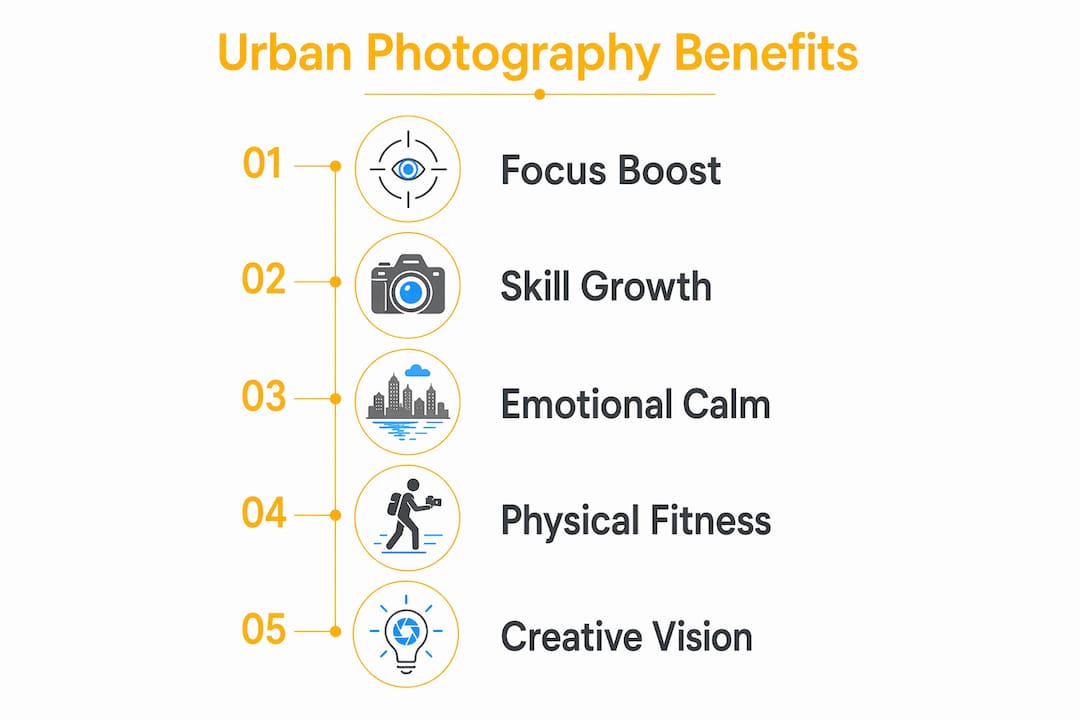
How does urban exploration fuel creativity and photographic skills?
Cities are the most demanding and rewarding teachers a photographer can find. Every street presents a new problem in light, shadow, scale, and human movement. Solving those problems in real time, without the safety net of a controlled studio, builds artistic instincts that no classroom exercise can replicate.
Here is how urban exploration accelerates creative growth in practice:
Discovering compositional juxtapositions. Cities like Hong Kong layer historical and modern elements in ways that challenge photographers to find coherence within visual chaos. A Tang dynasty temple framed by glass towers is not just a pretty contrast. It is a story about time, power, and survival told in a single frame.
Learning to read light dynamically. Urban environments shift light constantly. Morning fog softens Milan’s Duomo into a watercolor. Afternoon sun carves hard shadows across Bologna’s porticoes. Each condition demands a different technical and emotional response from the photographer.
Practicing inductive observation. Wandering without fixed plans allows deeper city reading and authentic visual storytelling. When you release the urge to optimize your route, you begin to notice what is actually there rather than what you expected to find.
Using the Indiana Jones method. The “Indiana Jones” exploration framework divides a session into a short zone-selection phase, an artifact-hunting focus, and a 45–60 minute period of deep archaeological observation. This turns even a dull neighborhood into a rich field of visual discovery.
Accelerating skills through guided practice. Guided urban photography tours lasting 1.5–2 hours accelerate skill-building by providing hands-on practice in interpreting lighting, movement, and human interaction. Working alongside an experienced guide compresses years of solo trial and error into a single afternoon.
The complexity of urban environments, blending eras and functions, teaches photographers to embrace layered storytelling instead of seeking neat, predictable aesthetics. That shift in expectation is the single most important creative leap a photographer can make.
Pro Tip: Before your next city session, choose one block and spend your entire time there. Resist moving on. The Indiana Jones method works because depth beats breadth every time.
Italyphototour’s urban photography tips for Italy offer a practical companion to this approach, with specific guidance on capturing overlooked city details across Milan, Venice, and beyond.
What physical skills does urban exploration develop?
Exploring city landscapes is not a passive activity. Moving through uneven cobblestones, climbing to elevated viewpoints, and navigating the unpredictable geometry of old city quarters all demand real physical engagement. This engagement produces measurable benefits that go well beyond a standard walk in the park.
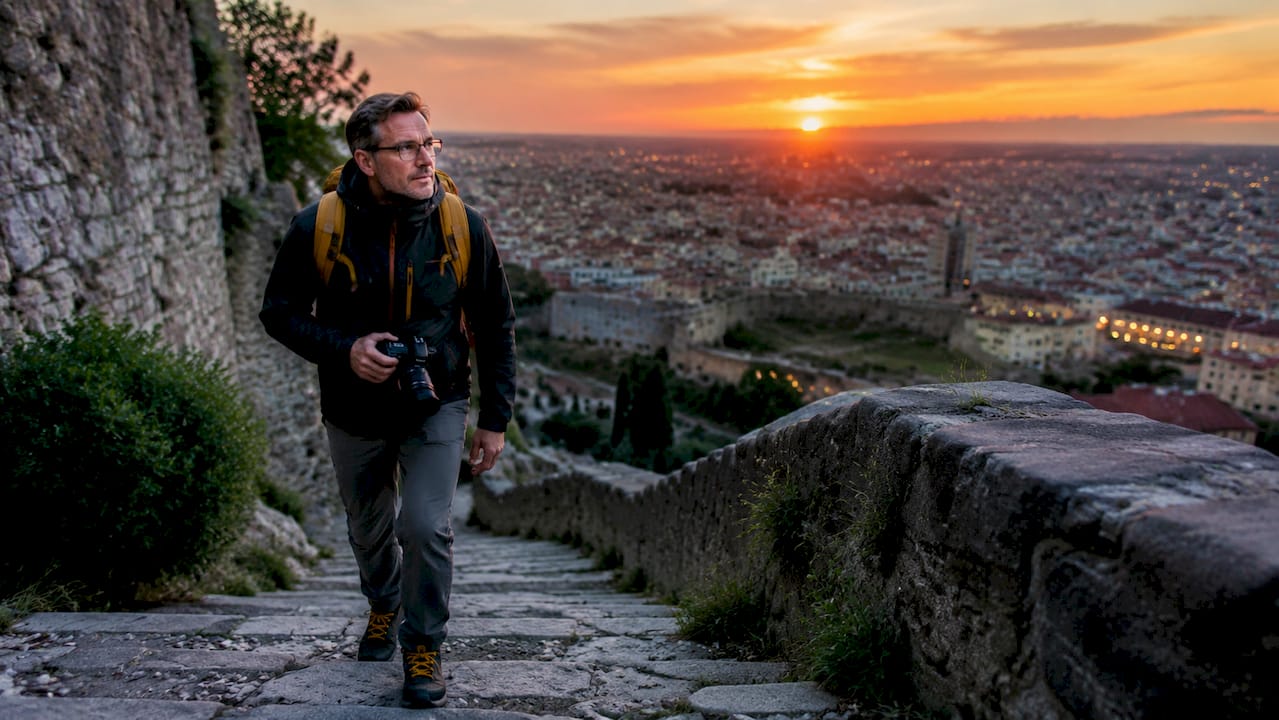
Urban ruins navigation, in particular, functions as proprioceptive training, improving body balance and spatial awareness in ways that conventional fitness routines rarely address. Proprioception is the body’s ability to sense its own position in space. Training it on uneven, unpredictable terrain sharpens the mind-body coordination that also underlies confident, fluid movement with a camera.
The physical skills urban exploration builds include:
- Balance and agility from navigating uneven surfaces, narrow passages, and varied elevations.
- Risk assessment from reading structural stability, crowd density, and changing light conditions in real time.
- Spatial reasoning from mentally mapping complex environments and planning movement through them.
- Sustained endurance from multi-hour sessions that combine walking, climbing, and standing with full sensory attention.
Urban spatial design also plays a role in how your body and mind respond to a city. Concepts like “isovist” (the field of view from a given point) and “continuation” (visual paths that guide the eye naturally) explain why some streets feel restful and others feel chaotic. Understanding these principles helps you choose locations that reward both physical exploration and photographic composition.
Pro Tip: Wear shoes with genuine grip and ankle support on urban exploration sessions. Comfort determines how long you stay present. Discomfort pulls your attention away from the scene and toward your feet.
How do elevated views and ruins offer unique artistic experiences?
The perspective you choose in a city changes not just what you see but how you think. Street-level and elevated views engage the mind in fundamentally different ways, and both are indispensable tools in the urban photographer’s visual vocabulary.
| Perspective | Cognitive Effect | Artistic Opportunity |
|---|---|---|
| Street level | Sequential, immersive, detail-focused | Human stories, texture, candid moments |
| Elevated view | Simultaneous, clarifying, pattern-focused | Geometry, scale, urban rhythm |
| Ruins and decay | Reflective, ego-dissolving, historically resonant | Impermanence, layered narrative, chiaroscuro |
Viewing cities from elevated perspectives triggers intellectual clarity by revealing spatial relationships invisible from street level. That clarity also alleviates existential anxiety, because the city’s chaos resolves into legible geometry when seen from above. For a photographer, this shift is creatively liberating. Patterns emerge. Scale becomes a compositional element rather than an obstacle.
Ruins offer the opposite gift. Where elevated views expand your awareness outward, decayed spaces draw it inward. The psychology of decay reconnects explorers with a community’s history and fosters reflection on impermanence. Photographing a crumbling palazzo in Palermo or a rusted iron bridge in Turin is an act of witnessing. The camera becomes a tool for honoring what time has touched.
“Ruins do not ask to be restored. They ask to be seen.”
Cities like Hong Kong demonstrate how the juxtaposition of eras creates photographic narratives of extraordinary depth. A single frame can hold a century of history, a collision of cultures, and a meditation on change. That is the gift that exploring city landscapes offers to any photographer willing to look past the obvious.
Key takeaways
Urban scene exploration is the most direct path to artistic growth for photographers, combining cognitive clarity, creative challenge, and physical engagement in a single practice.
| Point | Details |
|---|---|
| Cognitive engagement | Sessions of 45–60 minutes activate open-world mode, sharpening curiosity and environmental awareness. |
| Creative depth | Layered urban environments teach photographers to embrace complex, multi-era storytelling over neat aesthetics. |
| Physical development | Navigating uneven urban terrain builds proprioception, balance, and spatial reasoning beyond standard exercise. |
| Perspective variety | Elevated views clarify spatial patterns; ruins invite reflective, historically resonant narratives. |
| Guided acceleration | Structured tours of 1.5–2 hours compress skill development and provide expert frameworks for reading light and movement. |
What urban exploration has taught me about seeing
I have spent years leading photographers through Italian cities, and the lesson that surprises people most is this: the city rewards patience more than speed. Every photographer I have worked with arrives wanting to cover as much ground as possible. The ones who make the strongest images are the ones who stop moving first.
I remember standing with a group in Milan’s Isola neighborhood at dusk, watching a participant spend twenty minutes on a single doorway. The light was shifting from gold to violet. The peeling paint was an artist’s palette of ochre, gray, and rust. She was not looking for the perfect shot. She was learning to see the doorway as a living thing, full of time and story. That image became the best work she had ever made.
Urban exploration changed my own photography by teaching me that uncertainty is not a problem to solve. It is the condition that makes discovery possible. When you release the need for a plan, the city begins to speak. You start noticing the chiaroscuro of a narrow alley, the vivacity of a market at midday, the calm geometry of an empty piazza at dawn. These are not accidents. They are gifts the city offers to anyone who shows up with open eyes and a willingness to wander.
If you are reading this and wondering whether urban exploration is worth your time, the answer is yes. Not because it will make you a technically better photographer, though it will. Because it will make you a more curious, more present, and more emotionally alive human being. And that is what every great photograph is made of.
— Mino
Discover italy’s urban scenes with Italyphototour
Italy’s cities are among the world’s richest subjects for urban photography, and Italyphototour exists to help you see them with fresh, trained eyes. Led by professional photographer Mino Di Vita, Italyphototour’s guided photography tours take you through Milan, Venice, Tuscany, and beyond, with a focus on light, human stories, and the kind of layered urban beauty that rewards slow, attentive looking.

Each tour is designed to accelerate your creative development through hands-on practice in real city environments, not classrooms. You will learn to read light dynamically, compose within complexity, and find the hidden stories that most visitors walk past. Whether you are an enthusiastic amateur or a seasoned explorer, Italyphototour’s experiences offer the structured guidance and artistic inspiration to transform how you see every city you visit. Explore the full range of Italy photo tour experiences and find the one that speaks to your vision.
FAQ
What is urban scene exploration in photography?
Urban scene exploration in photography is the practice of moving through city environments to discover and capture light, architecture, human presence, and cultural layers as artistic subjects. It combines street photography, architectural observation, and documentary storytelling into a single creative discipline.
How long should an urban photography session last?
Sessions of 45–60 minutes optimally engage the brain’s open-world mode for curiosity and environmental awareness. Guided tours typically run 1.5–2 hours to allow deeper skill practice across multiple locations.
Do i need expensive equipment to explore and photograph urban scenes?
No specialized equipment is required to begin exploring city landscapes. A mirrorless camera or even a smartphone, combined with attentive observation and an understanding of natural light, produces compelling urban images.
Why do elevated city views feel so different from street-level photography?
Elevated urban perspectives trigger intellectual clarity by revealing spatial patterns and relationships invisible from street level, shifting the mind from sequential detail-processing to simultaneous pattern recognition. This cognitive shift also reduces existential anxiety and opens new compositional possibilities.
What is the best way to prepare for a first guided city photo tour?
Arriving with comfortable footwear, a fully charged camera, and no fixed agenda gives you the best foundation. Reviewing how to prepare for a guided city tour before your session helps you focus on creative observation rather than logistics once you are in the field.