

TL;DR:
- Visual storytelling involves intentionally arranging images, videos, or graphics in sequence to evoke emotions and convey narratives. It requires a clear narrative arc, deliberate sequencing, and techniques like composition and symbolism to guide viewers’ feelings and understanding. Effective stories are built through planning, ethical awareness, and purposeful image selection, transforming photographs into meaningful, resonant experiences.
Most photographers know the ache of capturing a technically flawless image that somehow leaves viewers cold. The light is perfect, the composition is clean, and yet nothing moves. That gap between a beautiful photograph and a compelling story is precisely where visual storytelling lives. Understanding what is visual storytelling means recognizing that images are not decorations. They are statements, sequences, and emotional invitations. This guide unpacks the definition, the mechanics, and the practical tools you need to transform your photography from a collection of pretty moments into a narrative that genuinely resonates.
Table of Contents
- Key Takeaways
- What is visual storytelling, really
- Building narratives through composition and sequencing
- Techniques that sharpen visual stories
- Misconceptions that hold photographers back
- How to start creating compelling visual stories
- My perspective on what visual storytelling truly demands
- Experience visual storytelling in the field with Italyphototour
- FAQ
Key Takeaways
| Point | Details |
|---|---|
| Visual storytelling has a clear definition | It is the deliberate use of images, video, or graphics in sequence to convey a narrative and build emotional connection. |
| Narrative arc is non-negotiable | Effective visual stories follow a beginning, middle, and end that guide the viewer through a meaningful experience. |
| Sequencing shapes meaning | The order and transitions between images create inferred cause-and-effect, building the story beyond any single photo. |
| Composition serves the story | Tools like the rule of thirds and visual hierarchy must work in service of the narrative, not just aesthetic appeal. |
| Ethics and context matter | Respectful, context-aware storytelling protects both subject and storyteller from misrepresentation. |
What is visual storytelling, really
At its most precise, the visual storytelling definition describes it as the deliberate use of images, video, and graphics arranged in sequence to convey a message and create emotional connections with an audience. The word deliberate carries enormous weight here. A single stunning sunset photograph is an observation. A series of images that moves from the quiet anticipation of golden light, through the warmth of that sunset washing over a weathered fishing village, to the last embers reflected in a fisherman’s eyes, that is a story. The difference lies entirely in intent and structure.
What makes a visual narrative powerful is its ability to guide how a viewer feels and thinks, without ever writing a word of explanation. Visual storytelling is a strategy that creates deliberate emotional journeys, leading an audience toward a reaction or understanding. Think of it as architecture for feeling. Every image is a room, and the sequence is the floor plan that determines how a visitor moves through the space and what they experience in each moment.
The core elements of visual storytelling include:
- Narrative arc: A structured progression with a beginning that establishes context, a middle that develops tension or transformation, and an end that delivers resolution or emotional payoff.
- Emotional resonance: Images chosen and arranged to evoke a specific feeling, not merely to document a scene.
- Visual sequencing: The deliberate ordering of images so each frame builds meaning onto the last.
- Subject and perspective: Who or what is at the center of the story, and through whose eyes the viewer experiences it.
- Context: The setting, culture, and circumstance that give the images their depth and truthfulness.
Effective visual stories have a clear beginning, middle, and end, guiding viewers on a journey rather than presenting them with a series of disconnected moments. That journey is what separates photography that endures from photography that is forgotten by tomorrow.
Building narratives through composition and sequencing
In photography, visual storytelling means curating image series with narrative intent, not simply selecting the most technically perfect frames. A series of images from a Venetian market, for instance, becomes a story when you open with an establishing wide shot of the market at dawn, move into the detail of a vendor’s calloused hands arranging ripe tomatoes, capture the exchange between seller and buyer, and close with an empty stall as the afternoon light retreats. Each image earns its place not because it is beautiful in isolation, but because it advances the narrative.

Composition is where the visual story is constructed, frame by frame. Composition tools like the rule of thirds and visual hierarchy direct viewer attention with precision, guiding the eye toward what matters and away from what distracts. Visual hierarchy, specifically, tells the viewer where to look first, second, and third within a single frame, which means you are already directing interpretation before the viewer consciously processes the image.
Here is a practical sequence for building a narrative photo series:
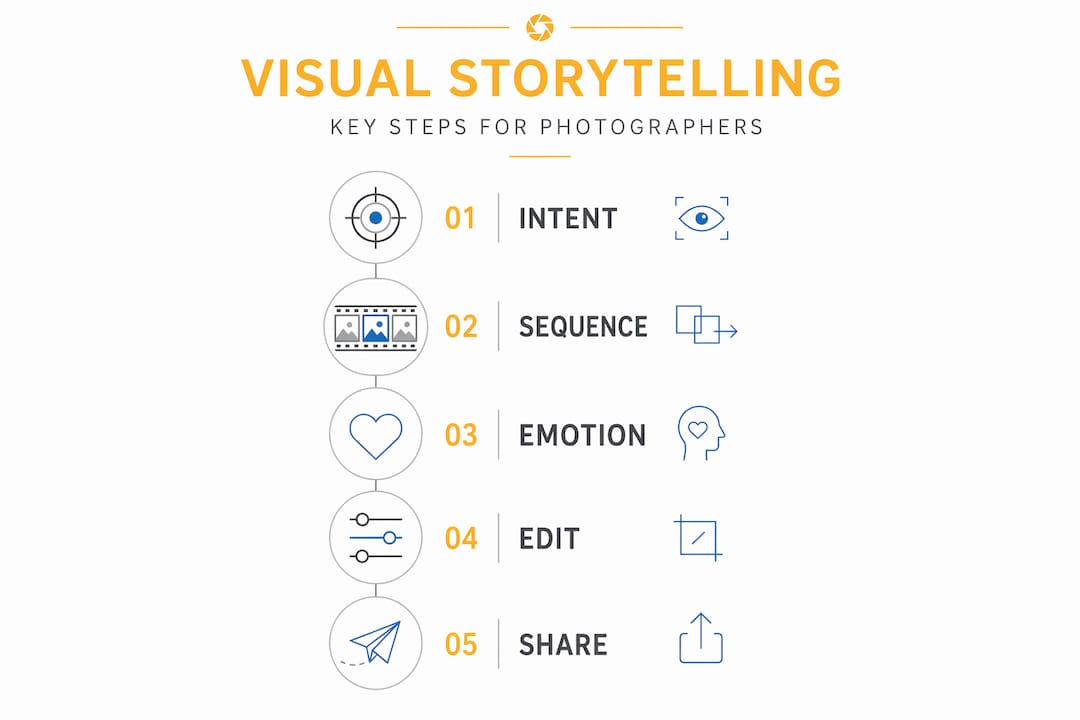
- Define your story before you shoot. Know whose story you are telling, what transformation or journey you want to show, and what emotional tone you are aiming for. This single step separates intentional photographers from casual ones.
- Shoot with sequence in mind. Capture establishing shots, detail shots, transitional moments, and emotional close-ups. Each type serves a different narrative function.
- Edit for story, not just quality. Remove technically strong images that do not advance the narrative. Add less polished images that carry emotional weight or narrative necessity.
- Order images to build momentum. Sequencing creates inferred cause-and-effect, shaping the viewer’s understanding through transitions. A close-up of tears followed by an embrace tells a story your words never need to explain.
- Consider captions or titles sparingly. Brief contextual information can anchor a story without explaining it to death. Let the images carry most of the weight.
Pro Tip: Map your narrative arc on paper before you pick up your camera. Write three sentences: what is the world before, what changes, and what remains after. Then shoot every image in service of those three sentences. This is exactly how building a visual story transforms from guesswork into craft.
Narrative photography allows creative freedom to be fictional or deeply factual, but narrative intent is always what defines it. That is a liberating idea. You do not need to be a photojournalist to tell meaningful stories. You need to be deliberate.
Techniques that sharpen visual stories
The single most powerful technique in visual storytelling is the principle of show, don’t tell. Using light, facial expressions, and symbols communicates meaning and emotion far more effectively than any caption ever could. A shaft of morning light cutting through a cathedral’s stained glass speaks to the sacred. A child’s abandoned shoe on a cobblestone street speaks to loss. These are the images that stay with people for years.
Beyond that foundational principle, the following tools shape how well your visual stories land:
- Light and shadow (chiaroscuro): Contrast between light and dark creates mood, draws the eye, and can suggest the emotional tone of the entire story. Soft, diffused light feels tender and nostalgic. Hard shadows feel dramatic or ominous.
- Color palette: A consistent or deliberately shifting color palette across a series creates visual cohesion and emotional continuity. Warm golden tones suggest warmth and belonging. Cooler, desaturated tones can signal melancholy or distance.
- Facial expressions and body language: Human faces are the fastest conduit to viewer empathy. A half-smile tells a different story than a gaze fixed on the horizon.
- Symbols and recurring motifs: A repeated visual element, such as an open window, an aging hand, or a winding road, weaves a thread through the series and rewards attentive viewers.
- Framing and perspective: Shooting from low angle makes subjects appear powerful. Shooting from above can create vulnerability. These choices are not just compositional. They are narrative positions.
Pro Tip: Before editing your photo series, print or lay out all candidate images on a table and arrange them physically. Seeing the sequence as a whole, rather than clicking through individual files, reveals gaps in the narrative and unexpected emotional rhythms you would never notice on screen.
The purpose of guiding viewer attention and eliciting feeling is what prevents visual stories from becoming mere decorations. Every technique you apply should serve that purpose, or it is just noise. For a deeper look at how emotion shapes lasting travel photographs, the exploration of emotion in travel photos at Italyphototour is worth your time.
Misconceptions that hold photographers back
One of the most common misunderstandings is that visual storytelling and photojournalism are the same thing. They are not. Photojournalism demands factual accuracy and ethical rigor in service of news. Visual storytelling in photography is broader, encompassing documentary, fine art, travel, and even fictional narrative photography. The method may overlap, but the intent and freedom differ considerably.
A second misconception is that any beautiful image tells a story. Beauty is not narrative. An exquisitely lit portrait of a stranger is a study of a face, not a story about a life, unless it sits within a sequence that builds context, tension, and meaning around it. Isolated images can be deeply moving, but moving is not the same as narrative.
Other common pitfalls worth knowing:
- Weak sequencing makes stories feel empty. Even powerful individual images lose their impact when arranged without care or logic. A story that begins in the middle, or ends without resolution, leaves viewers disoriented rather than moved.
- Ignoring ethical context causes real harm. Ethical visual storytelling requires listening to subjects and contextual awareness to tell truthful, respectful stories. Photographing poverty, grief, or vulnerability without the subject’s understanding is not storytelling. It is extraction.
- Over-explaining undermines impact. Long captions that describe what is already visible in the image insult the viewer’s intelligence and dilute the emotional power of the photograph.
- Chasing technical perfection over narrative truth. The sharpest image is not always the right image. A slightly blurred frame that captures raw emotion can carry more story than a technically perfect shot of nothing happening.
How to start creating compelling visual stories
Knowing the theory is one thing. Applying it to your own photography requires a shift in how you plan and execute shoots. Here is a workflow that any photographer can adapt, whether you are capturing the terraced vineyards of Tuscany or the lantern-lit alleys of an old city quarter.
- Choose a subject with inherent narrative tension. The best visual stories emerge from subjects where something is changing, fading, growing, or being discovered. A craftsman in the final years of his practice. A neighborhood being transformed. A festival preparing to begin.
- Write a simple three-act outline before you shoot. Not a script, just a direction. Act one establishes the world. Act two introduces something that shifts it. Act three shows the result or the resonance.
- Shoot more than you think you need. Then edit ruthlessly for narrative purpose, not aesthetic preference.
- Experiment with editing and sequencing. Try starting the story at the end and working backward. Try a non-linear arrangement. See how the emotional experience of the viewer changes with each version.
- Share your story with a trusted viewer and listen. Ask them what they understood, what they felt, and where they felt confused. Their response reveals gaps between the story you intended and the story you actually told.
- Refine and repeat. Visual narrative is a craft that deepens with practice. Each series teaches you something a single image never could.
For photographers who want to apply these ideas in an environment rich with photographic storytelling in Italy, the combination of ancient light, layered history, and vivid human culture makes every street a ready-made narrative waiting to be shaped.
My perspective on what visual storytelling truly demands
I have spent years photographing Italy with photographers at every level of experience, and the single most common mistake I see is treating visual storytelling as something that happens in editing. People take several hundred images and then try to find a story in the pile afterward. That is like writing a novel by randomly assembling sentences and hoping they cohere.
The photographers who genuinely move me, and whose work genuinely moves their audiences, are the ones who arrive at a location with a story already forming in their minds. Not a rigid script, but an emotional intention. They know they are looking for transformation, or tenderness, or the peculiar melancholy of beautiful things ending. Everything they shoot points toward that feeling.
I have also seen how ethical awareness changes the quality of the work. When you approach your subjects with curiosity and respect rather than urgency, something opens up. People show you more. The light seems to cooperate. The story you tell becomes truer, and truth in imagery carries a weight that technique alone never achieves. Contextual awareness in visual storytelling is not just a moral obligation. It is a creative advantage.
My honest advice is this: stop asking whether your images are beautiful. Start asking whether they are doing something. Does this image establish, advance, or resolve? If it does none of those things, leave it on the hard drive.
— Mino
Experience visual storytelling in the field with Italyphototour
Reading about visual narrative is the beginning, but there is no substitute for practicing it in a place that pulses with story at every turn.

Italyphototour offers photography tours across Italy designed specifically to develop your storytelling instincts alongside your technical skills. Led by professional photographer Mino Di Vita, each tour immerses you in the light, culture, and human texture of locations like Venice, Tuscany, Cinque Terre, and Milan. You will not just photograph these places. You will learn to read them for narrative, to find the sequences and emotional arcs that turn a travel album into a body of work. Photographers who have joined previous tours describe a before-and-after quality to how they see. That shift is what Italyphototour is built around.
FAQ
What is the visual storytelling definition?
Visual storytelling is the deliberate use of images, video, or graphics arranged in a sequence to convey a narrative and create emotional connection with an audience. It goes beyond aesthetics to guide how viewers feel and interpret meaning.
How does visual storytelling differ from photojournalism?
Photojournalism requires factual, news-driven accuracy, while visual storytelling in photography encompasses a broader range of creative intent, including documentary, fine art, and narrative photography that may be fictional or poetic in nature.
What are the core elements of a visual story?
The key elements include a clear narrative arc with beginning, middle, and end; emotional resonance; deliberate image sequencing; a defined subject and perspective; and contextual awareness that gives the story truthfulness and depth.
How do I start telling visual stories with my photography?
Begin by defining the emotional intention and three-act structure of your story before you shoot, then capture images in service of that arc, edit for narrative purpose rather than technical quality, and refine based on how viewers actually experience the sequence.
Why does sequencing matter so much in visual storytelling?
The order of images creates inferred cause-and-effect, shaping the story the viewer perceives beyond what any single photograph can communicate. Strong sequencing transforms a collection of images into a coherent, emotionally resonant narrative journey.