

Street photography isn’t about sneaking photos of strangers or randomly clicking your shutter in crowded piazzas. It’s the art of capturing candid, unposed moments documenting human behavior and urban environments without staging subjects. This visual storytelling form reveals the authentic pulse of city life, from a vendor’s weathered hands arranging produce in Rome’s Campo de’ Fiori to lovers sharing gelato on Milan’s Navigli canals. For photographers drawn to Italy’s vibrant urban culture, street photography offers an immersive way to connect with local stories, light, and spontaneous beauty. This guide walks you through essential techniques, stylistic approaches, ethical considerations, and Italy’s most inspiring locations to elevate your street photography practice.
Table of Contents
- Key takeaways
- Understanding street photography: definition and core techniques
- Exploring methodologies and stylistic approaches in street photography
- Street photography in Italy: cultural context and inspirational locations
- Ethics, privacy, and respectful street photography practices
Key Takeaways
| Point | Details |
|---|---|
| Core techniques | Street photography relies on zone focusing, shooting from the hip, and using settings such as f5.6 to f8 with fast shutter speeds and auto ISO to capture candid moments. |
| Lens choices | Prime lenses from 28mm to 50mm provide a natural perspective and help you frame urban scenes with intimacy. |
| Ethics matters | Respect privacy and seek consent when feasible, ensuring street photography documents genuine moments without harming or exploiting subjects. |
| Hip shot practice | Do a 30 minute zone focusing drill in a single location, pre focus at eight feet, set f8, and shoot passersby without looking through the viewfinder. |
| Italy context | Italian cities with shifting light and dense crowds reward quick reflexes and confident camera handling. |
Understanding street photography: definition and core techniques
Street photography captures the unscripted theater of everyday urban life. Unlike portrait or landscape work, this genre thrives on spontaneity, documenting genuine human interactions, emotions, and environmental details as they naturally unfold. You’re not directing scenes or asking permission. You’re observing, anticipating, and preserving fleeting moments that reveal deeper truths about culture, society, and the human condition.
Mastering the technical foundation lets you react quickly when those decisive moments appear. Core mechanics include zone focusing, shooting from the hip, aperture priority at f/5.6 to f/8, shutter speeds of 1/250s or faster, and auto ISO up to 6400. These settings keep subjects sharp while maintaining flexibility in changing light conditions. Zone focusing involves pre-setting your focus distance, typically 6 to 10 feet, so you can shoot without looking through the viewfinder or waiting for autofocus to lock.
Lens choice dramatically affects your visual perspective and shooting style. Prime lenses between 28mm and 50mm deliver natural fields of view that mirror human vision, making compositions feel intimate without distortion. A 35mm lens works beautifully for environmental portraits showing subjects within their urban context. A 50mm creates tighter framing, isolating individuals from busy backgrounds. Wide apertures like f/1.4 or f/2 provide gorgeous background blur but sacrifice depth of field, so many street photographers prefer f/5.6 to f/8 for sharper zone focusing.
Shooting from the hip means holding your camera at waist level and triggering the shutter without raising it to your eye. This technique keeps you discreet, reduces subject awareness, and captures more natural expressions. It requires practice to frame accurately, but modern cameras with tilting screens simplify the learning curve. Start with wider focal lengths and gradually tighten your compositions as your spatial awareness improves.
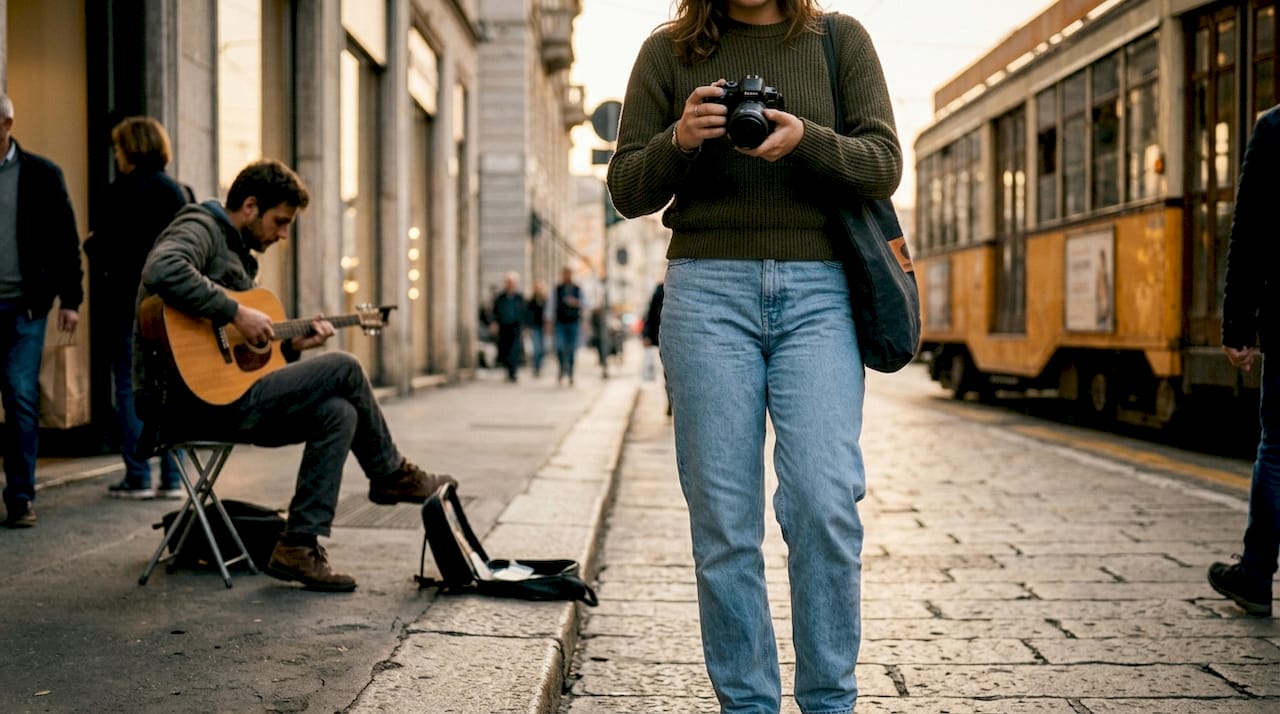
Pro Tip: Spend 30 minutes in a single location practicing zone focusing with manual controls. Pre-focus at 8 feet, set f/8, and shoot passing subjects without adjusting focus. This drill builds muscle memory for anticipating unpredictable street moments and trains your eye to recognize compelling compositions before they vanish.
For photographers exploring urban photography tips in Italy, these technical foundations become even more valuable. Italian cities present constantly shifting light, dense crowds, and architectural complexity that reward quick reflexes and confident camera handling. Understanding your gear inside out frees your creative mind to focus on storytelling rather than fumbling with dials. Whether you’re navigating Rome’s chaotic traffic or Venice’s narrow calli, technical mastery transforms from obstacle to instinct, letting you capture Italy’s urban energy with authenticity and artistry. Check out comprehensive photography tips for beginners to build confidence before hitting the streets.
Exploring methodologies and stylistic approaches in street photography
Different photographers employ distinct methodologies including the decisive moment, fishing, hunting, and structured formulas for storytelling. The decisive moment, popularized by Henri Cartier-Bresson, involves anticipating peak action and pressing the shutter at the exact instant when visual elements align perfectly. This approach demands patience, observation, and split-second timing. You study a scene, predict where interesting interactions might occur, and wait for that magical convergence of subject, light, and composition.
Fishing takes a more passive stance. You identify a visually rich location with great light, interesting backgrounds, or compelling architectural features, then position yourself and wait for subjects to enter your pre-composed frame. This method works brilliantly in high-traffic areas like piazzas, metro stations, or market entrances. You’re essentially setting a visual trap, letting the urban flow deliver subjects into your carefully constructed stage.
Hunting represents the opposite extreme. You actively roam streets, chasing interesting characters, following intriguing light, and reacting to unfolding situations. This energetic approach yields diverse imagery but requires stamina and constant alertness. Hunters cover more ground, encounter more variety, but risk missing subtle moments by moving too quickly.
The three-part formula breaks strong street photographs into design (visual structure and composition), information (context and environmental details), and moment (decisive human action or expression). Balancing these elements creates images that are both aesthetically pleasing and narratively rich. A geometrically interesting doorway provides design. A street vendor’s cart adds information about local commerce. A customer’s animated gesture delivers the moment. Together, they tell a complete story.
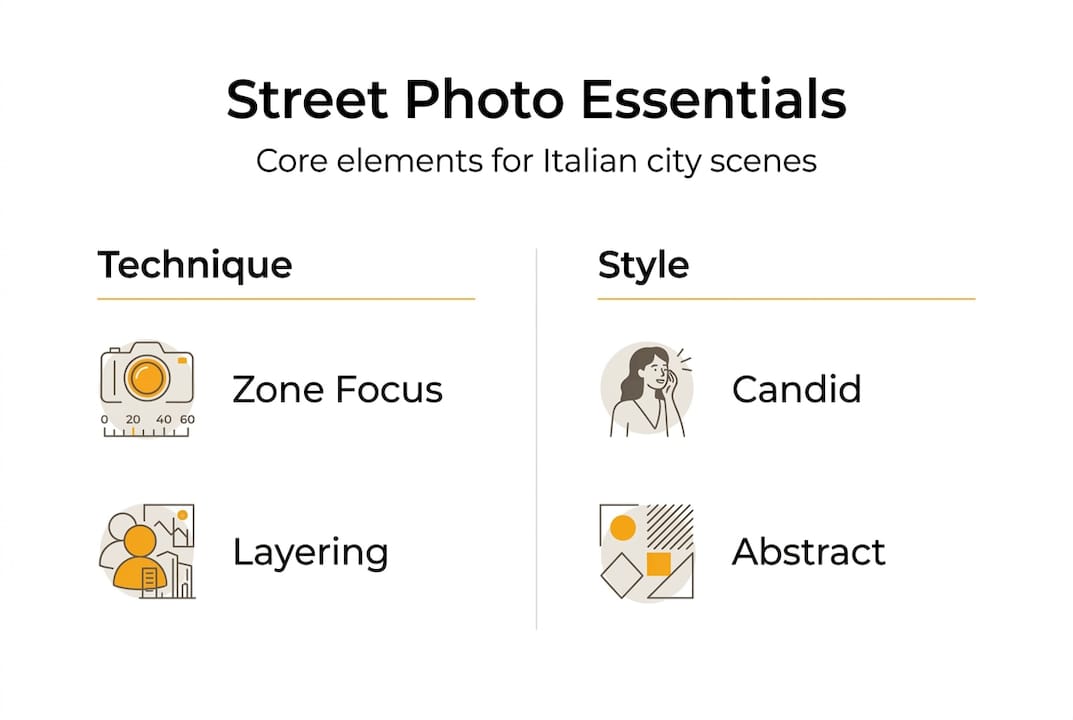
Stylistic variations expand creative possibilities beyond pure candid work. Expert nuances cover differences between candid and street portraits, abstract forms, motion blur, and layering techniques. Candid photography maintains complete invisibility. You never interact with subjects, capturing them unaware in their natural state. Street portraits involve brief acknowledgment or implied consent. You might make eye contact, nod, then photograph, creating a collaborative moment while preserving spontaneity.
Abstract street photography emphasizes shapes, shadows, patterns, and textures over literal documentation. You might photograph a cyclist’s shadow stretching across cobblestones, reflections fragmenting in rain puddles, or geometric interplay between architecture and human silhouettes. This approach prioritizes visual poetry over narrative clarity.
Motion blur techniques use slower shutter speeds, typically 1/15s to 1/60s, to convey movement and energy. Panning with a moving subject keeps them relatively sharp while blurring the background, creating dynamic tension. Static compositions with moving subjects produce ghostly trails suggesting urban flow and temporal passage.
Layering involves positioning multiple subjects at different depths within a single frame, creating visual complexity and narrative richness. Foreground, middle ground, and background elements interact, inviting viewers to explore the image and discover relationships between subjects. This technique works exceptionally well in Italy’s dense historic centers where narrow streets compress spatial depth.
| Approach | Best For | Challenges | Ideal Settings |
|---|---|---|---|
| Decisive Moment | Anticipating peak action | Requires patience and timing | Busy intersections, markets |
| Fishing | Controlled compositions | Limited subject variety | Architecturally rich spots |
| Hunting | Diverse, energetic imagery | Physically demanding | Large urban areas |
| Candid | Invisible, authentic moments | Ethical considerations | Crowded public spaces |
| Street Portraits | Human connection | Requires confidence | Festivals, markets |
Pro Tip: Choose a methodology that fits your personality and local environment to develop your unique style. Introverts often excel at fishing, creating contemplative compositions from a comfortable position. Extroverts thrive while hunting, feeding off urban energy and spontaneous interactions. Experiment with each approach, then commit to one for an entire shoot to understand its strengths and limitations. Over time, you’ll naturally blend techniques, but starting with focused practice accelerates skill development. Explore more about street photography in Italy to see how local culture influences methodological choices.
Street photography in Italy: cultural context and inspirational locations
Italy’s cities offer extraordinary diversity for street photographers, each with distinct character, light quality, and visual rhythms. Rome blends ancient ruins with modern chaos, creating layered compositions where scooters zip past Baroque fountains and tourists mingle with locals in timeless piazzas. The Eternal City’s warm, golden light bathes terracotta buildings and cobblestone streets, especially magical during the golden hour windows.
In cities such as Rome, Milan, Venice, golden hour spans about 90 minutes in spring and autumn, offering extended periods of soft, directional light that sculpts faces and enhances architectural textures. Locations like Trastevere’s winding alleys provide intimate neighborhood scenes, while the Spanish Steps and Trevi Fountain deliver tourist spectacle and human drama on grand scales.
Milan presents sleek modernity mixed with historic elegance. The Navigli district, with its picturesque canals lined with cafes and vintage shops, attracts young crowds during aperitivo hours. Fashion-conscious Milanese create striking subjects against minimalist architecture and designer storefronts. The Duomo’s vast piazza offers geometric patterns formed by crowds and provides dramatic backdrop for silhouettes and reflections.
Venice defies conventional street photography with its car-free streets, constant water reflections, and compressed alleyways. The city’s unique light bounces off canals, creating luminous, ethereal atmospheres. Narrow calli force intimate encounters with subjects, while bridges provide elevated vantage points for layered compositions. Early morning, before cruise ship crowds arrive, reveals authentic Venetian life as residents shop at Rialto Market or sip espresso in neighborhood campos.
Bologna’s endless porticos create natural frames and dramatic shadow play. The city’s university population ensures youthful energy, while its culinary reputation fills markets and streets with food-related stories. The covered walkways allow shooting in various weather conditions, and their repetitive arches provide strong geometric elements for compositions.
| City | Light Quality | Popular Locations | Shooting Styles |
|---|---|---|---|
| Rome | Warm, golden, dramatic shadows | Trastevere, Campo de’ Fiori, Testaccio | Layered compositions, chiaroscuro |
| Milan | Clean, modern, fashion-forward | Navigli, Duomo, Brera | Minimalist, geometric, portraits |
| Venice | Luminous, water-reflected, ethereal | Rialto, Dorsoduro, quiet calli | Reflections, silhouettes, atmospheric |
| Bologna | Arcade-filtered, consistent | Porticos, Piazza Maggiore, markets | Framing, shadows, food culture |
Balancing tourist and local life creates authentic storytelling opportunities. Rather than avoiding tourist areas entirely, look for interactions between visitors and residents. A Roman shopkeeper patiently explaining directions to lost tourists, Venetian gondoliers taking cigarette breaks between rides, or Milanese commuters navigating through selfie-taking crowds all reveal cultural dynamics unique to contemporary Italy.
Techniques emphasize chiaroscuro light, the dramatic interplay of light and shadow rooted in Italian Renaissance painting. Position yourself where strong sunlight cuts through narrow streets, creating pools of illumination against deep shadows. Wait for subjects to move through these light transitions, their faces momentarily revealed before disappearing into darkness.
Spring and autumn provide ideal conditions beyond just golden hour quality. Comfortable temperatures encourage street life, outdoor dining, and leisurely strolls. Summer’s harsh midday sun creates unflattering contrast, though early mornings and late evenings remain productive. Winter offers moody atmospheres, fewer tourists, and interesting weather conditions like fog in Venice or rain-slicked Roman cobblestones.
Pro Tip: Scout locations during midday when you’re less likely to shoot, noting where light falls during golden hour. Mark specific spots on your phone’s map app where architectural elements, interesting backgrounds, or natural frames align with quality light. Return during optimal times with a clear plan, maximizing your productive shooting window. This preparation proves especially valuable in unfamiliar Italian cities where navigation can consume precious golden hour minutes. Dive deeper into urban photography across Italy’s cities and discover cultural photography ideas for creative storytelling.
Ethics, privacy, and respectful street photography practices
Navigating the ethical landscape of street photography requires balancing legal rights with moral responsibilities. Public photography is legal but ethics require respect for privacy and avoidance of exploiting vulnerable people, with local variations in GDPR application across European Union countries including Italy. While you generally have the right to photograph in public spaces, that legal permission doesn’t automatically make every shot ethically sound.
GDPR (General Data Protection Regulation) adds complexity to European street photography. The regulation protects personal data, including photographic images that identify individuals. Artistic and journalistic exemptions exist, but they’re interpreted differently across EU member states. In Italy, street photography for personal artistic purposes typically falls under these exemptions, but commercial use or publication may require model releases, especially if subjects are clearly identifiable and central to the image.
Practical ethical guidelines help you navigate these gray areas with integrity. Avoid photographing children or homeless unless essential, use discretion, and delete images upon request in Italy’s tourist-heavy culture. Vulnerable populations including children, elderly individuals, people experiencing homelessness, or those in distress deserve extra consideration. If your image could cause harm, embarrassment, or misrepresent someone’s circumstances, reconsider taking or publishing it.
Distance and discretion minimize intrusion. Longer focal lengths let you capture candid moments without invading personal space, though they sacrifice the environmental context that wider lenses provide. Being visible but non-threatening often works better than hiding. If someone notices you photographing and seems comfortable or indifferent, continue. If they appear uncomfortable, lower your camera, smile, and move on.
Cultural respect matters especially in tourist-heavy Italian cities where locals face constant photography from visitors. Residents of Venice, Florence, and Rome’s historic centers live in what essentially functions as open-air museums. They navigate daily life amid crowds of smartphone-wielding tourists. As a street photographer, distinguish yourself through respectful behavior. Don’t block sidewalks, doorways, or business entrances. Don’t photograph people in obviously private moments like arguments or emotional distress. Don’t treat locals as exotic subjects or living props for your artistic vision.
Key ethical practices for street photography:
- Photograph in genuinely public spaces, not semi-private areas like restaurant interiors or residential courtyards
- Avoid photographing people in vulnerable situations or emotional distress
- Delete images immediately if someone requests it, without argument or negotiation
- Never photograph children as primary subjects without parental consent
- Be honest if questioned about your intentions; claim artistic or educational purposes truthfully
- Consider the potential impact of publishing images, especially on social media with wide reach
- Respect religious sites and ceremonies; many prohibit photography or require discretion
- Learn basic phrases in Italian to communicate respectfully if approached by subjects
The