

TL;DR:
- Documentary photography is a disciplined art form committed to truthful storytelling that transforms ordinary scenes into lasting testimony. It emphasizes authenticity, ethical decision-making, and long-term engagement, with various styles serving different narrative goals. Today, it shapes societal perceptions and demands patience, honesty, and purposeful observation from practitioners.
Documentary photography is one of the most powerful, misunderstood, and deeply human forms of visual art you can practice. Far from simply pointing a camera at real life and pressing the shutter, it is a disciplined commitment to truthful storytelling, where every image carries the weight of a moment that actually happened. Understanding what is documentary photography means grasping its layered history, its ethical backbone, and its ability to transform ordinary scenes into lasting testimony. This guide walks you through everything you need to know, from the genre’s origins to the practical steps you can take to start your own documentary work.
Table of Contents
- Key takeaways
- What is documentary photography, really?
- From battlefields to social media: a brief history
- Core principles and the ethical frame
- Types of documentary photography
- Practical techniques for starting your own project
- The cultural weight of documentary photography today
- My perspective: patience is the whole practice
- Explore documentary photography with Italyphototour
- FAQ
Key takeaways
| Point | Details |
|---|---|
| It’s disciplined storytelling | Documentary photography goes beyond candid shots, requiring intentional, long-term narrative building. |
| Authenticity is non-negotiable | Staging or manipulating scenes breaks the trust that gives documentary images their power. |
| Multiple styles exist | From hard news to soft documentary, different approaches serve different storytelling goals. |
| Ethics shape every decision | Framing, context, and subject relationships carry a moral responsibility photographers must acknowledge. |
| Amateurs can begin today | With patience, observation, and a clear theme, any enthusiast can develop a meaningful documentary project. |
What is documentary photography, really?
The simplest documentary photography definition is this: it is photography that chronicles real events with a commitment to truth, distinct from staged or posed images. But that short definition barely scratches the surface of what the genre demands and delivers.
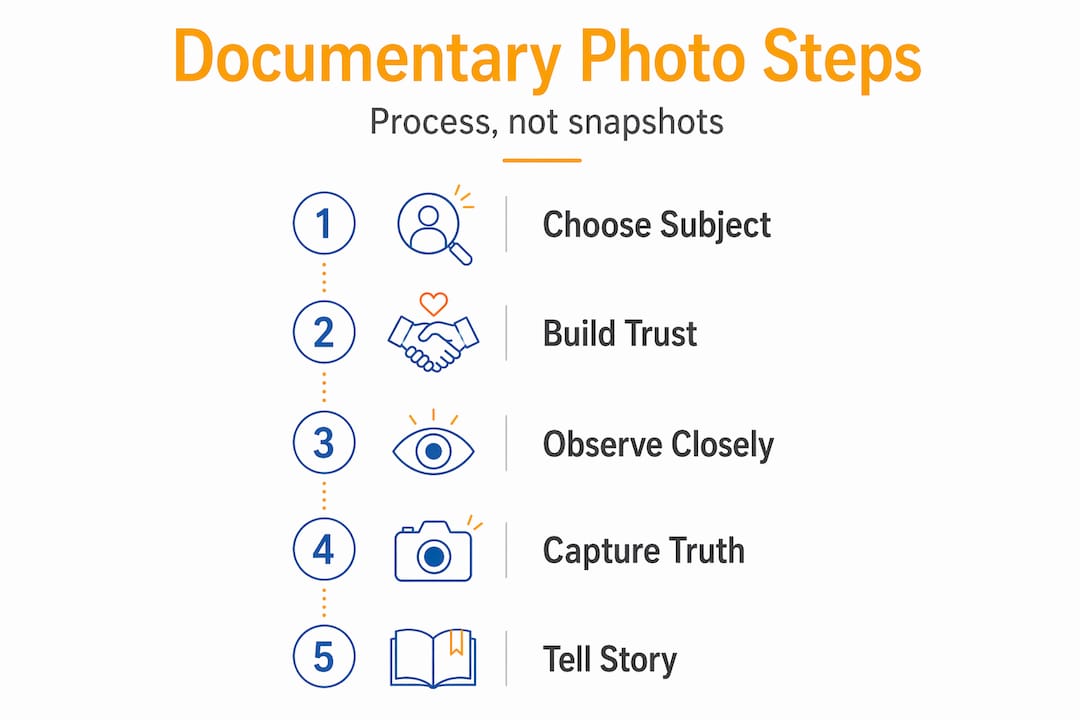
What does documentary photography mean in practice? It means choosing a subject, a community, or a moment in time and dedicating yourself to revealing its truth through a series of images rather than a single striking frame. It means resisting the urge to arrange, direct, or beautify what you find. The camera becomes a witness, not a director.
This is where documentary photography separates itself from the casual snapshot you take at a birthday party or the carefully lit portrait you stage in a studio. Both have value, but neither carries the same moral and narrative weight. Documentary work creates empathy by preserving moments as historical artifacts and inviting viewers to engage emotionally with lives and realities they might never otherwise encounter.
From battlefields to social media: a brief history
Documentary photography was born from urgency. When Mathew Brady sent photographers to the American Civil War in the 1860s, the resulting images shocked a public that had never seen warfare made so viscerally real. Brady’s archives were among the first examples of photography used as evidence, as argument, and as historical record.
By the 20th century, the genre had matured into something richer and more complex. Photographers like Dorothea Lange, whose 1936 “Migrant Mother” became a face for the suffering of the Great Depression, understood that a single image could shift public opinion and government policy. These photographers were not passive observers. They were advocates with cameras, and their work sat comfortably on the border between art and journalism.
The mid-century brought a fascinating shift. Photographers like Diane Arbus began turning the lens on subjects that made audiences uncomfortable: marginalized communities, outsiders, figures society had trained itself not to see. Her approach signaled a move from documentary as neutral witness toward documentary as subjective expression. The photographer’s perspective, their choices about who to photograph and how, became part of the story itself.
“The camera is an instrument that teaches people how to see without a camera.” — Dorothea Lange
Then digital photography and social media arrived and changed everything again. Access expanded dramatically. Anyone with a smartphone could now document a protest, a disaster, or a cultural celebration and share it globally within seconds. This democratization brought richness and diversity to the genre, but it also raised fresh questions about authenticity, context, and intent.
Key milestones in the evolution of documentary photography include:
- Mathew Brady’s Civil War archives establishing photography as historical evidence
- Dorothea Lange and the Farm Security Administration projects of the 1930s
- Diane Arbus reframing the genre as subjective, emotionally charged expression
- The rise of photo essays in magazines like Life creating mass audiences for documentary work
- Digital access and social platforms opening documentary practice to amateurs worldwide
Core principles and the ethical frame
At the heart of every strong documentary project is a commitment to authentic representation without staging or manipulating scenes. This is not a stylistic preference. It is the ethical foundation that gives documentary photography its credibility and its power.
Yet authenticity is more complicated than it first appears. No documentary photograph is truly neutral. Every time you raise the camera, you make choices: where to stand, what to include in the frame, when to press the shutter. These choices reflect your perspective, your assumptions, and your blind spots. Ethical documentary photography does not pretend otherwise. It requires transparency about framing and context rather than a false claim of pure objectivity.
This distinction also separates documentary photography from photojournalism, though the two overlap considerably. Photojournalism tends to focus on breaking news and single decisive images. Documentary photography, by contrast, relates to longer-term projects with complex storylines that unfold across months or even years. The depth is part of the point.
Several principles define ethical documentary practice:
- Photograph people with their knowledge and consent whenever possible, especially in intimate situations
- Resist the urge to arrange subjects or props to create a “better” image
- Present images in context, not stripped of the circumstances that give them meaning
- Acknowledge your own perspective rather than claiming false neutrality
- Build genuine relationships with subjects rather than extracting images and disappearing
Pro Tip: Before you begin any documentary project, write down your intention in one sentence. If you cannot articulate what you are trying to reveal or understand, you are not yet ready to photograph it. Clarity of purpose shapes every image you will make.
Types of documentary photography
Understanding the different types of documentary photography helps you find the approach that fits your temperament and your subject.
| Style | Defining quality | Best suited for |
|---|---|---|
| Hard documentary | Unflinching, direct, minimal aesthetic concern | War, social injustice, crisis reporting |
| Soft documentary | Humane observation, slower pacing, open-ended sequencing | Community life, cultural portraiture, personal projects |
| Reportage | News-driven, fast-paced, event-focused | Protests, elections, public ceremonies |
| Post-documentary | Acknowledges framing and interpretation as part of the work | Conceptual projects, art installations, gallery exhibitions |
Hard documentary and traditional reportage share an urgency. They chase the visible truth of a moment, often under pressure, and favor directness over beauty. Soft documentary, by contrast, shifts emphasis from exposé to reflective storytelling without sacrificing factual grounding. It allows ambiguity and partial views, inviting the viewer to interpret rather than simply react.
Post-documentary approaches are perhaps the most intellectually alive strand of the genre today. Rather than pretending images speak for themselves, post-documentary work openly acknowledges the tension between truthfulness and bias in every photograph. These projects often include text, testimony, and archival material alongside images to build a fuller, more honest picture.
Practical techniques for starting your own project
Knowing how to start documentary photography is less about technical gear and more about developing the right habits of mind. Here is a practical framework:
Choose a subject you can access over time. The depth that makes documentary work meaningful comes from sustained engagement. A neighborhood market, a local craftsman’s workshop, a seasonal festival in your town, these are all rich starting points that do not require a plane ticket.
Build relationships before you build a photo library. Narrative gaps fill naturally when subjects trust you enough to let you into unguarded moments. Spend time without the camera first.
Sequence images around themes, not chronology. The power of a documentary project lies in how images speak to each other. Look for visual echoes, emotional contrasts, and scenes that raise questions the next image begins to answer.
Anticipate, do not direct. Photographing decisive moments honestly requires patience and technical readiness. Know your settings before the moment arrives. Carry the camera like an extension of your body, present but unobtrusive.
Supplement images with testimony. Interviews, written notes, and contextual research deepen your understanding of the subject and provide material to fill narrative gaps when access is limited.
Review and edit ruthlessly. A documentary project’s strength lies in curation. Ten images that build a clear narrative outperform a hundred images that simply record.
Pro Tip: Shoot in documentary travel photography mode even when you are on vacation. Train your eye by documenting the rhythms and textures of everyday life wherever you are, not just the landmark moments.
One pitfall that catches many beginners is confusing documentation with observation. Documentation is passive. You point the camera at things that are happening. Observation is active. You understand why things are happening, what they reveal about the people and culture involved, and how a sequence of images can carry that meaning to someone who was not there.
The cultural weight of documentary photography today
Documentary photography shapes how societies see themselves and understand the issues that define them. This is not a small claim. It is the genre’s defining cultural function, and it is as relevant in 2026 as it was in the 1930s.
When a documentary project illuminates the daily reality of a displaced community, or traces the transformation of a neighborhood over decades, it does something journalism’s words alone cannot do. It makes the abstract tangible. It makes the distant personal. Images serve as both records and argument, and the genre has taught audiences to interrogate photographs based not only on what is shown but on what is deliberately left out of the frame.
The cultural significance of documentary photography today shows up in several ways:
- Museums and galleries now treat long-form documentary projects as major works of art
- Social platforms have created new audiences for documentary storytelling, reaching millions who would never visit a gallery
- Documentary photography increasingly intersects with advocacy, shaping policy conversations around climate, migration, and inequality
- The genre has expanded visual language across film, advertising, and editorial design, leaving traces everywhere
The moral weight of documentary images is also a challenge. Trust, once broken by a manipulated or misleadingly captioned photograph, is extraordinarily difficult to rebuild. Every photographer working in this tradition carries responsibility not just to their subject but to the audience that will interpret what they create.
My perspective: patience is the whole practice
I have spent years walking through Italian villages, sitting in piazzas at strange hours, and waiting for light that might not arrive. What documentary work has taught me is that patience is not a strategy you apply when nothing is happening. It is the whole practice.
Most photographers I mentor want to capture what something looks like. Documentary photography asks you to capture what something means, and those are very different propositions. The image that carries meaning almost never announces itself. It arrives quietly, in the gap between what a subject shows the world and what they reveal when they forget you are there.
The uncomfortable truth I have encountered over and over is that objectivity is a myth we use to comfort ourselves. The moment you decide to photograph a market vendor rather than the one beside her, you have made an editorial choice. The ethical response is not to pretend otherwise but to acknowledge your framing and hold it honestly.
If you are starting out, do not wait until you feel technically ready. The human storytelling in your photos begins the moment you commit to looking truthfully at something. Italy, with its layered history and vivid human texture, has been my greatest teacher in this. Every alley, every face lit by afternoon sun in a Sicilian village, every fisherman pulling nets at dawn carries a story that is simply waiting for a patient, curious eye.
— Mino
Explore documentary photography with Italyphototour
If reading about documentary photography has sparked a desire to practice it in one of the world’s most visually arresting places, Italyphototour offers something genuinely different from a standard tour.

Led by professional photographer Mino Di Vita, Italyphototour’s photography experiences across Italy are built around the same principles explored in this article: authentic observation, cultural immersion, and ethical storytelling. Whether you are drawn to the weathered facades of Tuscany, the canals of Venice at first light, or the vivid street life of Naples, these guided tours place you inside the story rather than outside it. You learn to see before you shoot, and to shoot with intention. Explore the full range of photography tours in Italy and find the experience that fits the photographer you are becoming.
FAQ
What is the documentary photography definition in simple terms?
Documentary photography is the practice of capturing real events, people, and environments with a commitment to truth and authenticity, typically through long-term projects that tell complex, layered stories rather than isolated images.
How does documentary photography differ from photojournalism?
Photojournalism focuses on breaking news events and single decisive images, while documentary photography involves longer-term projects exploring themes and communities in greater depth and complexity.
What are the main types of documentary photography?
The main types include hard documentary, soft documentary, reportage, and post-documentary, each varying in pacing, subjectivity, and relationship to truth claims.
What techniques in documentary photography matter most for beginners?
Building genuine relationships with subjects, anticipating moments without directing them, sequencing images around themes, and supplementing photographs with contextual testimony are the most foundational techniques to develop.
Can amateur photographers do meaningful documentary work?
Absolutely. Meaningful documentary photography begins with a clear intention and a subject you can access consistently over time, not with professional credentials or expensive equipment.