

TL;DR:
- Creative vision is the internal blueprint that guides all artistic decisions and transforms images into meaningful stories.
- Understanding and cultivating this skill through repetition, reflection, and experimentation leads to a distinctive photographic voice.
Creative vision is the internal blueprint that transforms a random collection of images into a unified, emotionally resonant photographic story. Every deliberate choice you make with light, framing, and subject flows from this blueprint. Photographers who grasp this concept stop chasing technically perfect shots and start building a body of work with genuine meaning. Understanding creative vision is the single most important shift an aspiring photographer can make, and neuroscience, artistic frameworks, and real creative practice all point toward the same conclusion: it is a skill you can cultivate, not a gift you either have or lack.
What does understanding creative vision actually mean?
Creative vision, in the language of art direction, is defined as the guiding artistic intent that shapes every decision in a creative project. Artistic vision acts as the blueprint for all creative decisions, transforming a collection of images into a cohesive visual culture. That distinction matters enormously. Without vision, a photo series is just a folder of files. With it, the same images become a conversation with the viewer.
Photographer and educator Chase Jarvis describes a practical measure called the wall test: mix 20 of your photographs with those of 20 other photographers, then ask whether yours stand out through consistent creative intent rather than just technical polish. If they do, your vision is emerging. If they dissolve into the crowd, you have a clear and useful signal about where to focus your growth.
Creative vision is not style alone. Style is the surface. Vision is the reason behind every stylistic choice, the internal logic that makes your work feel like yours even when the subject changes.
What neuroscience reveals about creative vision in the brain
The brain does not generate creative insight through a single region or hemisphere. Creativity requires multiple brain networks interacting simultaneously, specifically the default mode network, the executive control network, and the salience network. This cooperation, not competition, between networks is what produces genuine creative thought.
The timing of insight is surprisingly precise. Gamma brainwave bursts at 30–100 Hz occur about 300 milliseconds before a creative idea fully surfaces in conscious awareness. That pre-conscious spark is the brain integrating concepts across distant neural regions. You feel it as a sudden clarity or a pull toward a particular composition before you can fully explain why.
Alpha waves play an equally important role. Frontal alpha waves suppress external sensory input, functioning like noise-canceling for the mind and allowing internal idea generation to take priority. This is why your clearest photographic ideas often arrive in the shower, on a quiet walk, or in the stillness before sleep. High-stimulation environments actively work against the mental state that produces vision.
“Photographers gain their clearest visions when sensory processing shuts down, often achieved by stepping away from high-stimulation environments and revisiting projects.” — Neuroscience of Creativity
Three practical takeaways emerge from this research:
- Protect quiet time. Silence is not wasted time; it is when your brain does its deepest creative work.
- Revisit old projects. Returning to earlier images with fresh eyes activates the same cooperative network state that produces insight.
- Debunk the right-brain myth. Creativity is not the exclusive domain of one hemisphere. It is a whole-brain, multi-network event that anyone can train.
What are the key elements of creative vision?
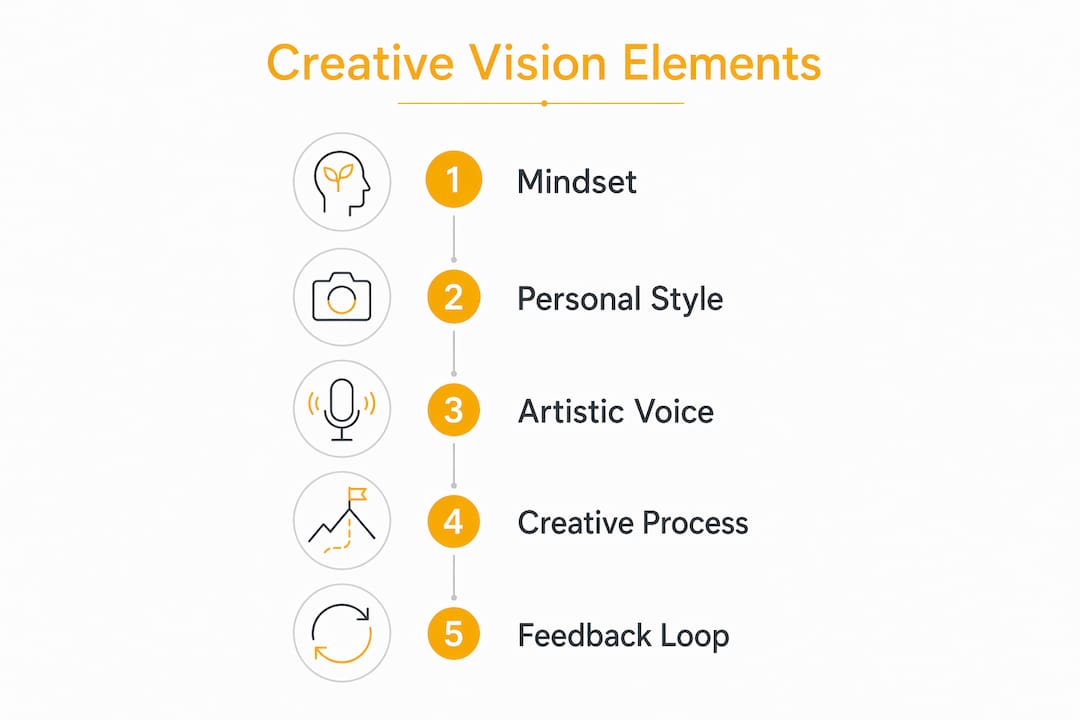
The key elements of creative vision are mindset, personal style, and artistic voice, and they develop together through a continuous loop of making, testing, and refining. The marshmallow challenge research frames this as a three-pillar framework of deconstruction, imagination, and action. Deconstruction means breaking down what you see and feel into its raw components. Imagination recombines those components in new ways. Action tests the result in the real world.
Building a personal visual language
A personal visual language is the grammar of your photographic style. Eric Hatheway’s work on visual identity describes how conflicting influences force personal stylistic choices, and those choices, made repeatedly over time, forge a unique grammar. You might love the warm tones of Italian golden hour and the stark geometry of modernist architecture. The tension between those two loves, resolved through your own choices, is where your visual language is born.
This grammar shows up in the colors you are drawn to, the distance you keep from your subjects, the way you treat shadow, and the stories you choose to tell. It is not something you design in advance. It emerges through practice.
Balancing influence and authenticity
Every photographer absorbs the work of others. Ansel Adams, Sebastião Salgado, and Vivian Maier all studied their predecessors deeply. The risk is imitation without transformation. The goal is to let outside influences pass through your own sensibility until what comes out the other side is unmistakably yours. The wall test is the honest measure of whether that transformation has happened.
Pro Tip: Keep a visual journal, not of photographs, but of the feelings, colors, and textures that move you most. Review it monthly. Patterns will emerge that reveal your vision before your camera does.
How can aspiring photographers develop their creative vision?
Creative vision is not innate but develops through repetition, experimentation, and accepting phases where your output does not yet match your internal image. Ira Glass famously described this as the creative gap: your taste develops faster than your craft, so early work feels disappointing. That gap is not a sign of failure. It is the engine of growth.
Practical methods to develop your artistic vision include:
- Run micro-experiments. Shoot the same subject ten different ways in one session. Change your angle, your light source, your distance. Each variation teaches you something about what you actually prefer.
- Embrace repetition. Consistency reveals patterns. Shooting the same location across seasons, or the same type of subject across cities, shows you what you return to instinctively.
- Circle back to old projects. Revisiting earlier work with the distance of time activates the brain’s insight state and often reveals a thread of vision you did not notice while shooting.
- Externalize ideas quickly. Sketch compositions, write scene descriptions, or use a mood board before you pick up your camera. Getting ideas out of your head and into the world accelerates the feedback loop.
- Protect your authenticity. External validation, likes, shares, and awards, tells you what resonates with an audience. It does not tell you what is true to your vision. Learn to distinguish between the two.
Pro Tip: Set a 30-day project with a single constraint, one color, one location, or one time of day. Constraints force creative decisions that reveal your instincts faster than open-ended shooting.
Developing your visual storytelling is one of the most direct ways to accelerate this process, because narrative structure forces you to make choices about what matters and what does not.
Creative vision myths vs. expert reality
Many photographers stall because they hold beliefs about creative vision that simply do not hold up under scrutiny. The table below compares the most common misconceptions with what research and expert practice actually show.
| Myth | Expert Reality |
|---|---|
| Creative vision is innate and fixed | Vision develops through repetition, experimentation, and accepting imperfect early work |
| Technical skill equals creative vision | Craft serves vision; mastering exposure does not generate artistic intent |
| External validation confirms your vision | Audience response reflects resonance, not authenticity; the two are not the same |
| Creative vision arrives as a single breakthrough | Vision is a muscle built through consistent practice, not a single moment of inspiration |
| Abandoning struggling projects shows efficiency | Abandoning projects too soon stifles real progress; persistence through “lossy” phases is where growth lives |
The most damaging myth is the last one. Many photographers abandon a project the moment it feels difficult or unclear, mistaking confusion for a sign that the idea was wrong. In reality, that friction is often the signal that something genuinely new is trying to emerge.
How to apply creative vision in a real photography project
Translating abstract vision into a concrete photo series requires deliberate creative direction. Creative direction is the process of making every element of a project serve a single unifying intent. Here is how to apply that process in practice.
Begin by defining the emotional core of your project. Ask yourself: what do I want the viewer to feel when they look at this work? That feeling becomes your compass for every decision that follows, from the warmth of your color palette to the pace of your editing.
Then apply the wall test at the end of every editing session. Print or display a selection of images alongside work you admire. Ask whether your images hold their own through consistent intent. If they do not, identify which choices feel borrowed rather than earned and revise accordingly.
Finally, build a feedback loop with people who understand your vision, not just your technique. A mentor, a trusted peer, or a guided creative environment can reflect back what you cannot see in your own work. Cultural photography experiences in rich, layered environments like Italy provide exactly this kind of immersive feedback, where every street, every face, and every shaft of light challenges you to respond with genuine creative intent.
Key takeaways
Creative vision is a cultivated skill, not an inherited trait, and it grows through the disciplined cycle of making, reflecting, and refining.
| Point | Details |
|---|---|
| Vision is a blueprint, not a style | Creative vision guides every artistic decision and gives a body of work its emotional coherence. |
| The brain supports vision through practice | Cooperative networks and alpha wave states that produce insight can be strengthened through quiet reflection and repetition. |
| The wall test measures real progress | Mixing your work with others and checking for consistent intent reveals whether your vision is emerging. |
| The creative gap is normal | Early work rarely matches internal vision; persistence through that gap is what closes it. |
| Abandoning projects too soon kills growth | Holding a vision through difficulty is where the most meaningful creative development happens. |
Why I believe creative vision is the only thing that truly matters
I have spent years walking through the streets of Milan at dawn, standing in Tuscan fields as the light shifts from gold to gray, and watching photographers at every level wrestle with the same question: why does my work not feel like me yet? The honest answer I have arrived at is that most of us spend too long chasing the right gear or the right location, and not nearly enough time sitting quietly with the question of what we actually want to say.
The creative gap is real, and it is uncomfortable. I remember editing entire shoots and feeling that the images were technically sound but emotionally hollow. The temptation is to blame the light or the location. The truth is that vision was not yet clear enough to guide the decisions in the field. The fix was not a better lens. It was more time spent revisiting old work, more quiet mornings without a camera, and more honest conversations about what moved me and why.
What I have found, after years of leading photographers through Italy’s most visually generous places, is that vision does not arrive all at once. It accumulates. Each shoot adds a layer. Each revisited project reveals a thread. The photographers who develop the most distinctive voices are not the most technically gifted. They are the ones who stay curious, stay patient, and keep showing up even when the work feels uncertain.
Creativity is a process. Treat it like one.
— Mino
See your vision come alive in Italy
Italy is one of the world’s most generous creative environments, where chiaroscuro light falls across ancient stone, color saturates every canal and courtyard, and human stories unfold on every corner. Italyphototour designs immersive photography tours in Italy specifically to give aspiring photographers the sensory richness and expert guidance needed to push their creative vision forward. Led by professional photographer Mino Di Vita, each experience is built around artistic growth, not sightseeing checklists.

Whether you are drawn to the geometric drama of Milan, the golden warmth of Tuscany, or the shimmering reflections of Venice, Italyphototour places you inside the kind of environment where vision clarifies naturally. Discover what we offer and take the next step toward work that is unmistakably yours.
FAQ
What is creative vision in photography?
Creative vision in photography is the internal artistic intent that guides every compositional, tonal, and narrative decision in your work. It transforms a collection of images into a cohesive body of work with a recognizable emotional signature.
How do I know if my creative vision is developing?
Apply the wall test: place 20 of your images alongside work by other photographers and check whether yours are identifiable through consistent creative intent. If they are, your vision is taking shape.
Can creative vision be learned, or is it innate?
Creative vision is not innate. It develops through repetition, experimentation, and the willingness to accept imperfect early work while your craft catches up to your taste.
How does neuroscience support creative vision development?
The brain produces creative insight through cooperative activity across the default mode network, executive control network, and salience network. Quiet environments and revisiting past work activate the alpha wave states that support this cooperation.
How long does it take to develop a personal visual language?
There is no fixed timeline, but research on artistic development shows that a personal visual language emerges when conflicting influences force repeated stylistic choices over time. Consistent output and honest self-reflection accelerate the process significantly.