

TL;DR:
- Val d’Orcia defines Tuscany’s photographic identity with its harmonious rolling hills, cypress-lined roads, and solitary farmhouses. The region’s unique light, seasonal changes, and brief fog windows create cinematic landscapes that reward patient photographers who arrive early and plan meticulously. Guided tours enhance the experience by providing expert timing, composition, and a respectful approach to these authentic, living communities.
Tuscany pictures are defined by a rare harmony of sculpted land, ancient stone, and atmospheric light that no other region on earth replicates. Val d’Orcia, a UNESCO World Heritage cultural landscape, anchors the visual identity of Tuscany photography with its rolling clay hills, cypress-lined roads, and solitary farmhouses. Whether you are planning a dedicated tuscany photo tour or simply want to know where to point your lens, this guide delivers the specific locations, timing windows, and compositional strategies that separate a memorable shot from a forgettable snapshot.
1. What makes Val d’Orcia the defining Tuscany photography destination?
Val d’Orcia is the single most photographed region in Tuscany, and its UNESCO designation in 2004 confirms what photographers have known for decades: this landscape is a living artwork. Undulating clay hills, geometric wheat fields, and cypress-lined roads create a natural composition that almost frames itself. The region’s visual coherence is not accidental. Centuries of agricultural shaping have produced a countryside that reads like a painter’s study in depth and proportion.
Seasonal variation transforms Val d’Orcia into a different canvas every few months. Spring brings vivid green fields and wildflowers that carpet the hillsides in gold and crimson. Summer strips the land to warm ochre and amber tones. Autumn wraps everything in soft mist and copper light. Each season rewards a different photographic approach, which is why photographers return year after year.
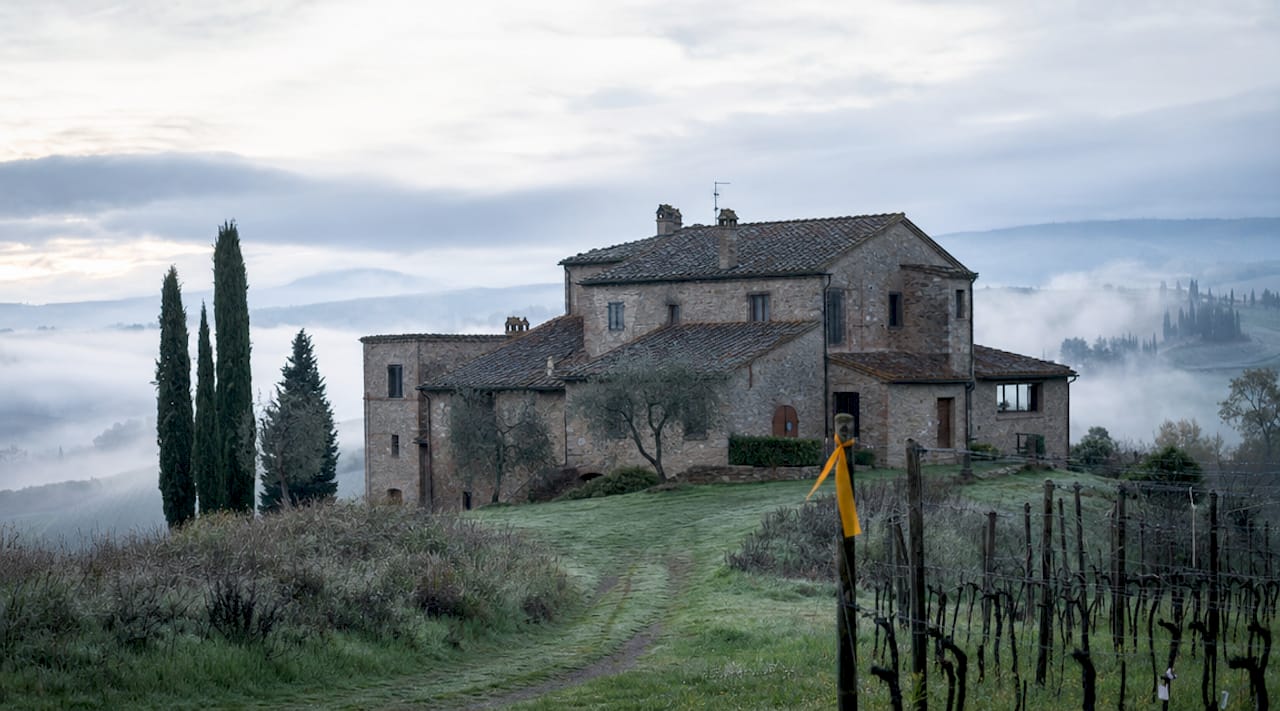
The quality of light here is extraordinary. Morning fog settles into the valleys before sunrise and burns off within an hour, creating a fleeting, painterly atmosphere that rewards early risers. The combination of warm directional light and cool mist produces tonal contrasts that are nearly impossible to replicate in post-processing. Val d’Orcia does not just offer beautiful scenery. It offers a photographic education in light, form, and patience.
Key features that make Val d’Orcia unmissable for Tuscany countryside photography:
- Rolling clay hills with strong geometric field patterns
- Cypress-lined roads creating natural leading lines
- Solitary farmhouses as anchor subjects in wide compositions
- Seasonal fog that adds depth and mood
- Golden hour light that warms stone and wheat to amber tones
- Minimal light pollution for blue-hour and pre-dawn shooting
Pro Tip: Arrive at your chosen viewpoint at least 30 minutes before sunrise. The blue hour before dawn offers a calm, even light that lets you compose without rushing, so you are ready the moment fog and golden light converge.
2. The top 5 must-photograph locations for iconic Tuscany pictures
The five essential spots in Val d’Orcia represent the core portfolio of any serious Tuscany photographer. Each location offers a distinct compositional challenge and a specific window of optimal light.
Podere Belvedere is the most photographed farmhouse in Italy, and for good reason. Perched on a hillside and surrounded by a crown of cypress trees, it distills the postcard image of Tuscany into a single frame. The best vantage point sits along the SP146 road near San Quirico d’Orcia. Arrive before sunrise to catch the farmhouse emerging from morning fog, with warm light raking across the cypress silhouettes.
Cappella della Madonna di Vitaleta is a small Renaissance chapel standing alone on a hilltop between Pienza and San Quirico d’Orcia. Its isolation makes it one of the most evocative subjects in all of Tuscany travel photography. The chapel photographs beautifully from the valley below, with cypress trees flanking it on both sides. Late afternoon light from the west casts long shadows across the hillside and gives the stone facade a warm, golden glow.
Cipressi di San Quirico d’Orcia is a cluster of ancient cypress trees rising from a gentle hill near the town of San Quirico. This group of trees is one of the most recognized images of Tuscany countryside, offering a strong graphic subject that works in both wide and telephoto compositions. Early morning fog wrapping around the base of the trees creates an almost surreal, floating effect.
Agriturismo Poggio Covili offers a more intimate and less crowded alternative to Podere Belvedere. The farmhouse sits amid rolling hills with cypress rows leading the eye toward the building. Because fewer photographers know this location, you are more likely to have the scene to yourself at dawn. The surrounding fields shift dramatically between seasons, from green to gold to bare earth.
La Foce Cypress Avenue is a long, winding road lined with tall cypress trees near Chianciano Terme. This avenue is one of the most dramatic leading-line compositions in all of Tuscany. The road curves gently as it climbs, creating a sense of movement and depth. Misty mornings amplify the drama, softening the distant hills and drawing the eye along the tree-lined path.
Pro Tip: Use local unpaved roads, known as strade bianche, to find elevated vantage points above these famous locations. A slightly higher angle separates the subject from the horizon and adds sky as a clean background.
3. How morning fog and golden light transform pictures of Tuscany countryside
Morning fog in Tuscany is a timed event, not a permanent condition. Fog forms before sunrise and typically burns off within 45 minutes to one hour after the sun clears the horizon. The effective shooting window, when fog and warm light coexist, lasts as little as 20 to 30 minutes. That brevity is what makes these images so rare and so coveted.
The interaction of light and fog produces a tonal palette that is unique to Tuscany mornings. Warm amber light from the low sun contrasts with the cool blue-gray mist in the valleys, softening edges and enriching textures in stone walls, olive bark, and wheat stalks. The result is an image that feels both luminous and intimate, as if the land itself is breathing. No filter replicates this effect. You have to be there.
Tuscany’s natural landscape offers a ready-made three-layer composition: wheat fields or olive groves as foreground texture, farmhouses or cypress rows as the mid-ground anchor, and fog or open sky as the background depth. This foreground-middle-background separation is the structural reason why so many Tuscany pictures feel cinematic rather than flat. Recognizing this structure before you shoot lets you position your tripod with intention rather than instinct.
Practical tips for capturing fog and light in Tuscany:
- Check weather forecasts for overnight temperature drops, which predict fog formation
- Position your tripod and compose your shot during the blue hour before sunrise
- Set your exposure for the fog, not the sky, to preserve mid-tone detail
- Use a telephoto lens to compress layers and intensify the fog effect
- Bracket exposures to protect highlights in the warm light zones
- Stay at an agriturismo near Pienza or Montalcino for direct countryside access without a long pre-dawn drive
Pro Tip: Set your camera on a tripod and lock in your composition the evening before if you are staying nearby. Returning to a pre-scouted spot in darkness is far faster than searching for a frame in the cold pre-dawn light.
4. Beyond Val d’Orcia: other Tuscan landscapes that enrich your photo portfolio
Val d’Orcia holds the crown, yet Tuscany’s photographic richness extends far beyond its famous hills. Pienza, Volterra, Sorano, and Florence each offer a distinct visual register that complements the open countryside and rounds out a full portfolio of photos of Tuscany Italy.
Pienza is a Renaissance town perched on a ridge above Val d’Orcia, and its southern terrace offers one of the most breathtaking panoramic views in all of Tuscany. The town’s warm travertine stone glows at golden hour, and the narrow streets between its palaces frame the countryside below like a series of living paintings. San Quirico d’Orcia, just a few kilometers away, adds medieval church facades and walled gardens to the mix.
Sorano, carved directly into volcanic tufa rock in the Maremma region, offers an entirely different atmosphere. The town feels ancient and slightly otherworldly, with stone buildings that seem to grow from the cliff face. Its textures and shadows reward photographers who favor architectural detail and chiaroscuro over open landscape. Sorano sees far fewer visitors than the Val d’Orcia circuit, which means quieter streets and unobstructed compositions.
“The village of Isola Santa in the Apuan Alps offers one of Tuscany’s most haunting images: a partially submerged medieval hamlet reflected in a still reservoir, surrounded by forested peaks. It is the kind of scene that stops you mid-breath.”
Florence, viewed from the hilltop neighborhoods of Bellosguardo or Fiesole, delivers the Renaissance cityscape in its full grandeur. The terracotta dome of the Duomo rises above a sea of rooftops, framed by cypress trees and olive groves. Volterra adds yet another layer, where contemporary sculptures placed in the surrounding fields create a surreal dialogue between modern art and ancient Etruscan landscape. For photographers building a diverse Italian portfolio, these towns are not secondary stops. They are essential chapters.
Key takeaways
The most rewarding Tuscany pictures come from pairing iconic locations with precise timing, particularly the 20 to 30 minute fog and golden light window that defines the region’s visual identity.
| Point | Details |
|---|---|
| Val d’Orcia is the visual core | This UNESCO landscape offers the cypress roads, rolling hills, and farmhouses that define classic Tuscany imagery. |
| Five spots form the essential portfolio | Podere Belvedere, Cappella di Vitaleta, Cipressi di San Quirico, Poggio Covili, and La Foce cover the full range of iconic compositions. |
| Fog lasts 20 to 30 minutes | Pre-position your tripod and compose during blue hour to maximize the brief golden fog window. |
| Three-layer composition is built in | Use foreground fields, mid-ground farmhouses, and background fog to create natural cinematic depth. |
| Towns extend the portfolio | Pienza, Sorano, Volterra, and Florence add architectural and atmospheric variety beyond the countryside. |
Why Tuscany rewards the patient photographer
I have photographed Tuscany across every season, and the lesson the land teaches every time is the same: patience is the only technique that cannot be faked. You can study composition, master exposure, and memorize every famous viewpoint. But the image that stops people in their tracks is always the one where the fog arrived exactly as the light turned amber, and you were already there, already composed, already waiting.
What moves me most about shooting in Tuscany is the way human history and natural landscape have grown into each other over centuries. The cypress trees were planted by farmers, not nature. The farmhouses were built for function, not beauty. Yet together they create a visual coherence that feels almost sacred. Every frame tells a story of land shaped by human hands and softened by time.
I also believe strongly in respectful presence. These are working farms and living communities, not open-air studios. Staying at a local agriturismo, buying from local markets, and asking permission before entering private land are not just courtesies. They are the foundation of authentic photography. The images you make when you are genuinely welcomed into a place carry a warmth that no amount of technical skill can manufacture.
My honest advice: do not try to replicate the famous shots you have seen online. Use them as orientation, then walk a little further, wait a little longer, and find the angle that is yours alone. Tuscany is generous enough to reward that kind of attention.
— Mino
Capture your Tuscany pictures with expert guidance from Italyphototour
Knowing where to stand and when to press the shutter transforms a Tuscany trip into a genuine photographic experience. Italyphototour designs guided Tuscany photo tours that place you at the right location, at the right hour, with a professional photographer beside you to refine your composition and read the light in real time.

Led by Mino Di Vita, each tour focuses on the atmospheric and artistic qualities that make Tuscany pictures truly memorable, from pre-dawn fog shoots in Val d’Orcia to golden hour sessions above Pienza. Whether you are an enthusiastic amateur or a seasoned traveler with a camera, Italyphototour’s photography tours across Italy offer the local knowledge, timing expertise, and creative mentorship to help you bring home images you will cherish for a lifetime.
FAQ
What is the best time of year for Tuscany countryside photos?
Late April through early June and September through October offer the most photogenic conditions, with green or golden fields, mild temperatures, and frequent morning fog in Val d’Orcia.
Where is Podere Belvedere located?
Podere Belvedere sits along the SP146 road near San Quirico d’Orcia in Val d’Orcia, and it is widely considered the most photographed farmhouse in Italy.
How long does morning fog last in Tuscany?
Morning fog in Tuscany typically lasts one to two hours total, with the optimal shooting window, when fog and warm sunrise light overlap, lasting only 20 to 30 minutes.
Do I need a telephoto lens for Tuscany landscape photography?
A telephoto lens in the 70 to 200mm range compresses the layers of hills and cypress trees beautifully, though a wide-angle lens in the 24 to 35mm range works well for capturing the full sweep of the Val d’Orcia countryside.
Is a guided tuscany photo tour worth it for amateur photographers?
A guided tour provides pre-scouted locations, precise timing advice, and real-time compositional feedback that dramatically shortens the learning curve and increases the quality of images you bring home.