

TL;DR:
- Italy offers diverse landscapes, historic sites, and luminous Mediterranean light that inspire bold, authentic photography.
- Participating in workshops and guided tours accelerates technical skills, storytelling, and personal growth through community critique and cultural immersion.
Finding a destination that sharpens technical skills, stirs the soul, and offers genuine cultural depth is a rare gift for any photographer. Too often, amateurs arrive at a beautiful location only to feel creatively lost, surrounded by scenery but uncertain of the story they want to tell. Italy changes that equation entirely. From the amber light pooling over Tuscan hilltowns at dusk to the vivid kaleidoscope of Venetian canals, every corner of this country seems to whisper an invitation to look more carefully, see more honestly, and shoot more boldly. Here is what awaits you.
Table of Contents
- Why Italy is a photographer’s dream: Diversity, history, and light
- Learning through community: The workshop advantage in Italy
- Heritage sites and authentic access: Navigating permits and regulations
- Personal growth and storytelling: Why Italy takes your skills further
- Perspective: Why photo workshops in Italy accelerate skill building more than solo travel
- Discover Italy’s best photography experiences with expert guides
- Frequently asked questions
Key Takeaways
| Point | Details |
|---|---|
| Unmatched scenery | Italy’s diverse landscapes and cultural richness offer endless creative shots for photographers. |
| Accelerated learning | Workshops and guided critique sessions boost your skill growth much faster than shooting solo. |
| Know permit rules | Proper planning for permits and gear restrictions ensures smooth access to heritage sites. |
| Personal growth | Immersive experiences in Italy build confidence, creativity, and storytelling ability in your photography. |
Why Italy is a photographer’s dream: Diversity, history, and light
With Italy’s potential introduced, let’s break down what makes its landscape and culture especially valuable for photographers seeking both creative and technical growth.
Italy is one of the few countries on earth where you can stand on alpine meadows in the morning, wander through a Roman ruin at noon, and watch fishing boats drift into a Ligurian harbor at sunset, all within a single day’s journey. That extraordinary Italian landscape photography tips variety means your eye is constantly challenged, never allowed to grow lazy or habitual. Coastlines sculpted by centuries of wind and tide, rolling hills stitched with vineyards, volcanic peaks in Sicily, and the baroque grandeur of Sicilian piazzas form an artist’s palette so broad that no two photographers return home with the same portfolio.
The quality of Mediterranean light is genuinely unlike anything you’ll encounter in northern climates. Italy’s light seems almost liquid in the way it clings to stone walls, floods narrow alleyways, and transforms ordinary faces into portraits full of chiaroscuro drama. The golden hours here are longer, warmer, and more forgiving than in many other destinations, giving you precious extra minutes to compose and experiment. Seasonal shifts deepen this experience: winter fog softens Florence’s skyline into something dreamlike, spring wildflowers carpet the Val d’Orcia in painterly abundance, and summer festivals bathe streets in firelight and celebration.
“Italy is not merely a backdrop. It is an active participant in every image you create, pressing its history, color, and humanity into the frame alongside you.”
Cultural storytelling opportunities abound in ways that genuinely benefit amateur photographers beyond the purely scenic. Neighborhood markets, religious processions, harvest festivals, and the unhurried rhythm of daily espresso culture all offer authentic human moments that sharpen your narrative instincts. You can find beautiful walking trails in Italy that lead you through villages where life has barely changed in generations, where old men play cards in sun-drenched squares and children chase pigeons with reckless joy.
Key environmental advantages Italy offers photographers include:
- Diverse landscapes from alpine to coastal, desert to lush valley
- Thousands of UNESCO World Heritage Sites as photographic canvases
- Rich festival culture providing spontaneous, emotive scenes year-round
- Warm Mediterranean light with extended golden hours in spring and summer
- Intimate village life accessible on foot or by bicycle
Pro Tip: Map your trip by light and cultural calendar before you book. Research the sun angle at your specific destination for the dates you plan to visit, and cross-reference local festival schedules. Arriving in Siena during the Palio or in Venice during Carnevale turns a good trip into an unforgettable one.
Learning through community: The workshop advantage in Italy
Beyond Italy’s landscapes, its lively workshop scene creates new dimensions of growth for aspiring photographers that solo travel simply cannot replicate.
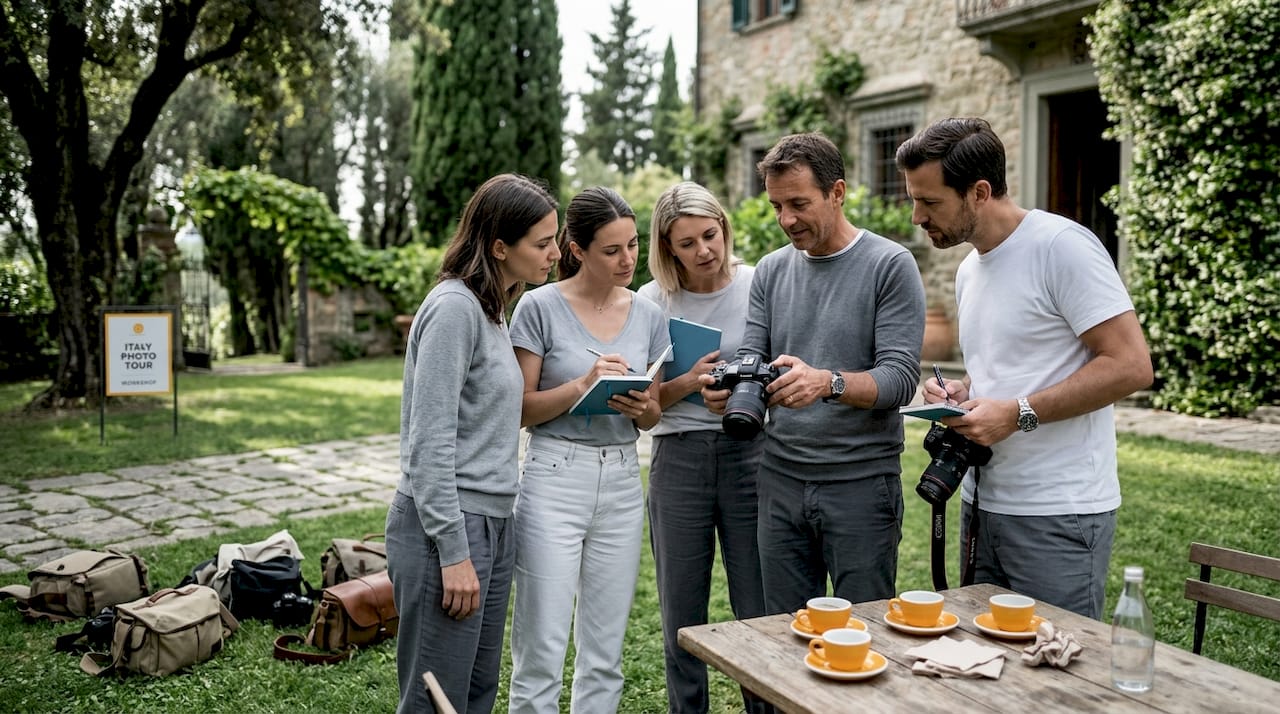
Photography is often practiced in solitude, but it grows fastest in community. Italian residential workshops and photo masterclasses create environments where feedback flows freely, creative risks feel safe, and the combined enthusiasm of a group lifts everyone’s work. Community and critique accelerate learning far more effectively than solo practice because they introduce perspectives you would never generate alone. A tutor watching you frame a shot in a Palermo street market can see the hesitation in your stance, the tightness in your composition, and offer a single observation that reshapes the way you see for years.
Active critique sessions reduce the isolation that so many amateur photographers feel. When you sit with a group reviewing images at the end of a shooting day in Sicily, you begin to understand that your struggles with exposure in harsh midday light or your frustration with candid portraits are shared by nearly everyone at the table. That solidarity is energizing. It builds confidence and pushes you to attempt images you would ordinarily dismiss as too difficult or too personal. Understanding how photo tours work before you commit will help you choose the right structure for your skill level and goals.
“Isolation is the enemy of creative risk. Shared experience is its antidote, and Italy provides the most vivid shared experience imaginable.”
What you can typically expect from an Italian photo workshop:
- An orientation walk through the location to assess light, composition, and cultural context before shooting begins
- Guided shooting sessions with a professional photographer offering real-time feedback on technique and vision
- Evening image reviews where participants share work, discuss decisions, and receive structured critique from tutors and peers
- Cultural immersion activities such as visits to local artisans, food markets, or community events that feed narrative instincts
- Final portfolio review and personal development recommendations tailored to your progress across the workshop
Careful planning a photo tour in advance ensures you choose a workshop matched to your equipment, experience level, and the kind of imagery you most want to create. Some workshops focus on landscapes and natural light, others on street and documentary photography, and the best ones weave both together through Italy’s astonishing settings. If you are researching tools for documenting your travel experience alongside your photography, travel blogger tools offer practical resources for capturing and sharing your journey.
Pro Tip: Even one structured group review session can shift your learning curve more than weeks of solo practice. The simple act of explaining your creative choices aloud forces a clarity of intention that transforms how you shoot from that moment onward.
Heritage sites and authentic access: Navigating permits and regulations
To fully enjoy Italy’s diversity, it’s crucial to understand how to access its iconic and protected sites as a photographer, because preparation here is the difference between a triumphant shoot and a frustrating one.
Italy’s most magnificent photographic canvases are also among the world’s most carefully protected spaces. Shooting in Italy can require permits or restrictions in high-profile heritage settings, and amateur photographers are often caught off guard by rules that feel arbitrary until you understand the reasoning behind them. The Colosseum, the Vatican Museums, the Roman Forum, major basilicas, and countless regional museums each carry their own protocols governing what equipment you may use, at what hours, and for what purpose.
Typical rules and behaviors expected at Italian heritage sites include:
- Tripods are often prohibited or require advance written permission, particularly in indoor museum spaces
- Flash photography is restricted or banned in most churches and museums to protect fragile frescoes and paintings
- Large lighting setups or reflectors are almost universally prohibited without a formal commercial permit
- Drone flight near heritage sites requires permits from Italy’s ENAC aviation authority and is often denied entirely
- Some sites restrict photography to personal use only, prohibiting any form of publication or commercial use without a separate license
| Site | Permit required? | Key restriction | Practical advice |
|---|---|---|---|
| Colosseum | Yes for tripods/lights | No commercial shoots without permit | Apply 2 to 4 weeks in advance |
| Vatican Museums | Yes for professional gear | No flash; restricted shooting zones | Book guided access for better angles |
| Roman Forum | Yes for tripods | No off-path photography | Early morning access is less crowded |
| Florence’s Uffizi | Yes for professional use | Flash banned; no video rigs | Hand-held cameras generally allowed |
| Amalfi Coast villages | Varies by municipality | Drone restrictions apply | Check local comune rules before flying |
Understanding heritage sites photography rules well before your trip saves not only frustration but also potential fines. Many photographers invest weeks preparing their visual concepts and then arrive to discover their tripod is confiscated at the entrance. Thorough travel planning tips for Italian destinations will walk you through the administrative side of accessing protected sites so that logistics never overshadow creativity.
Pro Tip: Treat permit logistics as part of your artistic preparation, not an afterthought. The process of researching restrictions often reveals shooting windows, such as early morning access or special evening openings, that most visitors never know about. Those quiet hours inside a Roman ruin or a medieval church, before the crowds arrive, are among the most cinematically beautiful shooting conditions you will ever encounter anywhere.
Personal growth and storytelling: Why Italy takes your skills further
With practical and logistical considerations covered, it’s time to focus on the personal and creative transformation that occurs behind the lens when Italy becomes your classroom.
Exposure to unfamiliar environments builds technical confidence in ways that comfortable, familiar settings never can. When you are navigating the shadowy, narrow calli of Venice with light shifting unpredictably from brilliant to moody within seconds, you learn to trust your instincts, adapt your settings fluidly, and make decisive compositional choices under pressure. That adaptability becomes a permanent part of your photographic intelligence, one that transfers directly to every other location you ever visit. Exploring inspiring Italian photo locations pushes you to develop flexibility across genres, from architectural to documentary to landscape work.
Photographing Italian culture and daily life strengthens narrative skills in ways that scenic landscape work alone cannot achieve. When you follow a nonna arranging vegetables in a Palermo market, or watch a glassblower on Murano shape molten color with his breath, you begin to understand that photography is fundamentally about time and relationship, not just light and geometry. Those stories, held inside a single frame, are what separate memorable images from merely competent ones.
| Experience type | Technical growth | Storytelling depth | Creative confidence |
|---|---|---|---|
| Solo travel, self-directed | Moderate | Limited | Variable |
| Guided photo tour with expert | High | Strong | High |
| Residential workshop with critique | Very high | Very strong | Exceptional |
The Sicily Photo Masterclass highlights how guided review and peer feedback accelerate learning dramatically compared to independent practice, precisely because narrative choices become conscious and examined rather than intuitive and unexamined.
Top three ways shooting in Italy changes your photographic eye:
- Light literacy expands: Italy’s variable Mediterranean light teaches you to read and anticipate illumination in ways that fixed, single-climate environments simply do not demand, and that literacy becomes a lifelong asset.
- Cultural empathy deepens: Spending time photographing people who live inside centuries of art and tradition cultivates a sensitivity to human dignity and context that elevates every portrait you will ever take.
- Visual patience grows: Italy rewards the photographer who waits. The gondolier who pauses mid-stroke, the shaft of light that falls for exactly forty seconds across an ancient arch, teach you that the most powerful images are earned by stillness and attention, not urgency.
Perspective: Why photo workshops in Italy accelerate skill building more than solo travel
Most photographers who visit Italy alone return with beautiful images. A smaller number return fundamentally changed as visual artists. The difference is almost always whether they worked alongside others, with structure and accountability.
Solo travel offers freedom, but it also offers something less desirable: the freedom to avoid difficulty. When you are on your own schedule, with no one watching your hesitation or challenging your creative choices, it is remarkably easy to retreat to safe compositions, familiar subjects, and comfortable techniques. The images look fine. They do not grow.
Workshop settings in Italy dissolve that comfortable retreat. When a tutor stands beside you in a Sicilian fishing village and asks what story you are trying to tell with this frame, you cannot answer with silence. That gentle pressure to articulate intention is transformative. Community and critique are part of the practical methodology in residential workshops in Italy, reducing isolation and accelerating learning through guided review and peer feedback in ways that independent travel fundamentally cannot replicate.
Italy’s sensory richness can also overwhelm the unprepared solo traveler. The sheer volume of visual beauty, competing light, historic layers, and human activity can leave you paralyzed rather than inspired. A guided experience cuts through that overwhelm by providing focus, context, and a framework for seeing that helps you extract meaning from abundance rather than drown in it. The benefits of photography in Italy are not automatic. They are unlocked through intentional engagement, and workshops provide exactly that intentionality.
There is also something quietly profound about sharing the Italian experience with fellow photographers. The conversations that happen over dinner in a Palermo trattoria, reviewing the day’s images on a laptop screen, build friendships and creative relationships that often outlast the trip itself. Italy has always been a place where art is made in community, and the photographer who joins that tradition brings home far more than photographs.
Discover Italy’s best photography experiences with expert guides
Ready to put these advantages into practice? Here is how you can experience Italy’s photographic richness with expert support at every step of the journey.
Italy Photo Tour offers immersive, artist-led experiences across Italy’s most visually extraordinary destinations, from the golden hills of Tuscany to the shimmering labyrinth of Venice. Led by professional photographer Mino Di Vita, each tour is designed to deepen your artistic voice, sharpen your technique, and connect you with the living culture behind every frame.

Whether you are exploring artistic photography workshops that focus on nuance and creative practice, or studying craftsmanship and storytelling tips that elevate your images from competent to compelling, there is a path here designed for where you are right now and where you want to be. Browse the full range of Italy photo tours and take the first step toward a journey that changes not just your portfolio, but the way you see the world.
Frequently asked questions
Do I need a permit to photograph famous sites in Italy?
Yes, sites like the Colosseum and Vatican often require permits for tripods, professional gear, or after-hours shoots, so it is essential to research each location’s rules well before your visit.
What gear restrictions do Italian heritage sites usually enforce?
Most restrict flash use, tripods, and large lighting setups, particularly indoors or at popular historic locations, with violations sometimes resulting in equipment confiscation.
How do photography workshops in Italy differ from those in other countries?
Italian workshops combine hands-on critique, access to remarkable heritage sites, and immersive local cultural experiences; community and critique are built into the methodology in ways that many other destinations simply cannot match.
Can group tours help me find unique Italian photo locations?
Yes, guided tours unlock hidden local spots and cultural events that an individual traveler would likely miss entirely, from private courtyard access to invitations to local festivals not listed in any guidebook.