

TL;DR:
- Emotion plays a crucial role in travel photography because it creates images that connect deeply with viewers and evoke lasting memories. Authentic feelings captured through presence, composition, and timing transform photographs from simple records into powerful, memorable experiences. Developing emotional awareness and pairing images with sensory notes can enhance both personal recall and the impact of your travel photos.
Most travel photographers obsess over the technical: sharpness, exposure, the perfect golden hour light. Those things matter. But the role of emotion in travel photos is what separates a frame you scroll past from one that stops you cold. A slightly underexposed image of a grandmother’s hands wrapped around a coffee cup in Naples will outlast a technically flawless shot of the same café table, empty and pristine. Emotion is the invisible architecture of every photograph that earns a place on someone’s wall or in someone’s memory. This guide shows you exactly how to find it, feel it, and photograph it.
Table of Contents
- Key takeaways
- The role of emotion in travel photos and how viewers experience it
- Techniques for capturing feelings in travel photos
- Common emotional atmospheres and how to evoke them
- Using emotional storytelling to build lasting travel memories
- My experience with emotion behind the lens
- Discover Italy’s emotional landscape through Italyphototour
- FAQ
Key takeaways
| Point | Details |
|---|---|
| Emotion outweighs technique | An emotionally resonant photo connects more deeply with viewers than a technically perfect but lifeless image. |
| Authenticity cannot be faked | Photographers who feel the moment themselves create images that genuinely move their audience. |
| Sensory details extend memory | Pairing travel photos with voice memos or journal notes sharpens emotional recall of the experience. |
| Composition shapes feeling | Light, color, negative space, and timing each carry an emotional weight that guides the viewer’s response. |
| Storytelling invites imagination | Narrative photos leave interpretive space, allowing viewers to feel transported rather than simply informed. |
The role of emotion in travel photos and how viewers experience it
There is a reason a photograph can make your chest tighten before your mind has formed a single thought about it. Visual imagery triggers stronger and more immediate emotional responses than text, enabling affective evaluations without complex intellectual processing. Your nervous system reads a photograph the way it reads a room. It responds to warmth, stillness, tension, and joy before your conscious mind catches up.
This is why the emotional impact of travel photography extends so far beyond documentation. When a photo carries genuine feeling, it activates memory encoding in the viewer, not just passive observation. Brain imaging research shows that photos act as sensory and emotional memory cues, reconstructing not just what a place looked like but what it felt like to be there. A photograph of Cinque Terre at dusk does not just show colored houses on a cliff. It resurrects the salt air, the sound of waves below, the feeling of being somewhere unrepeatable.
“A great photograph is one that fully expresses what one feels, in the deepest sense, about what is being photographed.” — Ansel Adams
Context and sensory specificity matter enormously here. A photo of a stranger’s face in a Palermo market, lit by the slanted morning sun, communicates more emotional information than a postcard-perfect landscape drained of human presence. The viewer’s brain searches for narrative cues and, when it finds them, responds with genuine feeling. This is the neurological case for treating your camera as an emotional instrument, not a recording device.
| Photo type | Primary emotional effect | Viewer engagement level |
|---|---|---|
| Empty landscape, wide shot | Awe, freedom, solitude | Moderate |
| Human subject with eye contact | Intimacy, connection, curiosity | High |
| Candid street scene with context | Nostalgia, joy, cultural warmth | High |
| Abstract texture or detail | Contemplation, mystery | Low to moderate |
| Weather and atmosphere (fog, rain) | Melancholy, romance, tension | Moderate to high |
Techniques for capturing feelings in travel photos
The first technique is the hardest to teach, and the most important: be present. Emotional authenticity cannot be faked. If you are thinking about your camera settings when a fisherman in Venice laughs at something his grandson said, you will miss the photograph entirely. Or worse, you will capture the physical event but none of its soul. Emotional presence means letting the scene land on you before you raise the camera.
Once you are emotionally present, several concrete tools become available:
- Eye contact and gesture. A subject who looks directly into your lens creates an immediate psychological bond with the viewer. Even without direct eye contact, the position of a person’s hands or the slope of their shoulders tells an entire story.
- Intimacy of distance. Getting physically closer than feels comfortable often produces photographs that feel more honest. Wide establishing shots announce a place. Close frames reveal it.
- Light as mood. The warm amber of late afternoon in Tuscany speaks of leisure and abundance. Gray, diffused light on a foggy Venetian canal carries quiet melancholy. Neither is objectively better. Both are emotionally specific.
- Color temperature. Cool tones suggest isolation or introspection. Warm tones suggest belonging and safety. This is not a rule to follow mechanically, but an awareness to carry with you.
- Decisive timing. Henri Cartier-Bresson called it the decisive moment. Not the peak of action, necessarily, but the moment when meaning is most concentrated. Often it comes just before or just after the obvious shot.
- Negative space. A solitary figure on a wide Sicilian piazza communicates loneliness or freedom depending on how you frame it. Space around a subject is not emptiness. It is emotional weight.
Photographers create stronger images when they respond emotionally rather than intellectually to scenes. The practical implication: put your camera down sometimes. Watch. Feel the scene shift. Then photograph the moment that moves you, not the moment that looks compositionally correct.
Pro Tip: Before you press the shutter, ask yourself what you are actually feeling right now. If the answer is nothing, wait. The photograph will be better for it.
Common emotional atmospheres and how to evoke them
Travel photography speaks in several recurring emotional dialects, and recognizing them helps you choose subjects and settings with intention rather than accident.

Nostalgia and longing arise naturally from certain visual details: peeling paint on a doorway in Rome, an elderly man reading alone at a café, a child chasing pigeons in a square. These images point backward in time. Nostalgia triggered by travel photos can enhance social connectedness and a sense of shared humanity, though the most powerful nostalgic images feel personal rather than generic.
Freedom and awe belong to open landscapes and expansive views. A lone figure on a ridgeline in the Dolomites, the horizon stretching beyond Matera’s ravines, the Mediterranean glittering below the cliffs at Positano. These photographs whisper about scale and possibility. They make the viewer feel small in the best possible way.
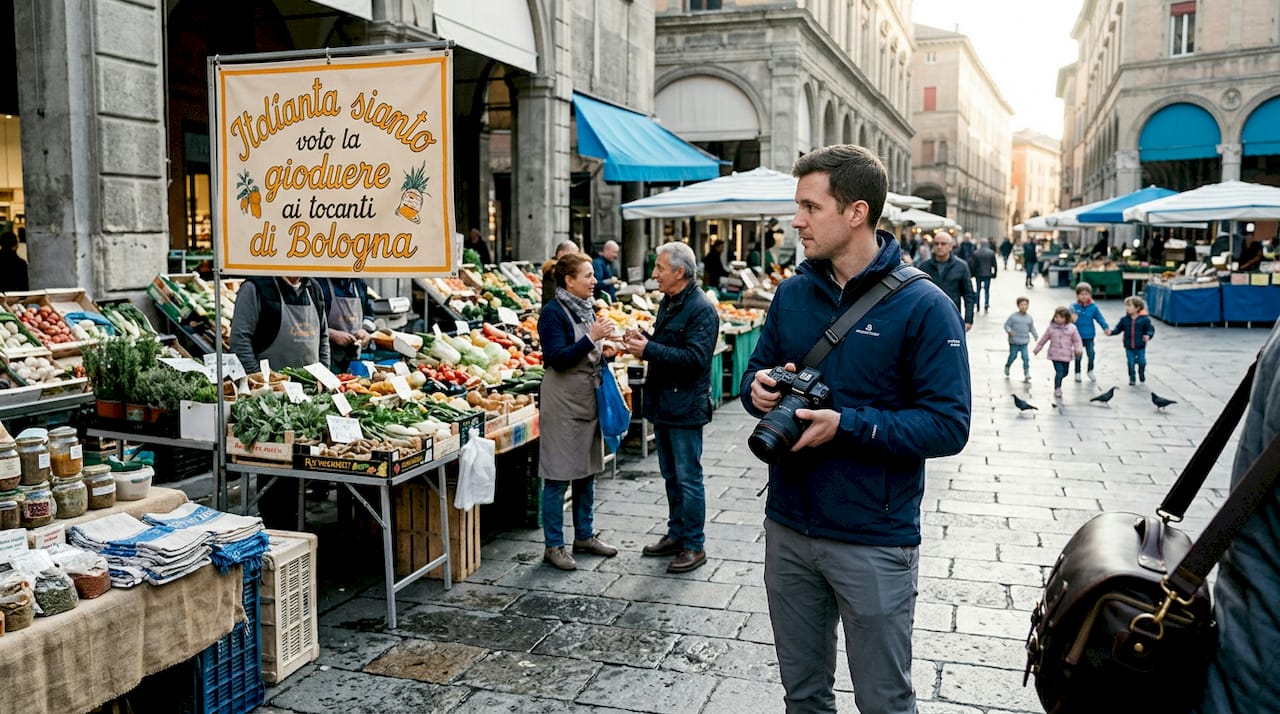
Loneliness and contemplation emerge through isolation and negative space. A single chair on a rain-wet terrace. A figure walking away from the camera down a long alley in Bologna. These images do not demand sadness from the viewer. They invite quiet reflection, a breathing room that most travel photos never offer.
Joy and human connection require candid timing and a willingness to engage with people. A group of locals arguing cheerfully over a card game in a Roman park. A market vendor’s genuine delight when a tourist attempts Italian. Narrative photos linger mentally because they leave room for interpretation, and photographs of human warmth do this beautifully.
Weather and light function as emotional grammar. Golden hour softens and romanticizes. Overcast light flattens shadows and draws out texture and color. Fog creates mystery. Rain adds melancholy and reflections that double the visual world. None of these conditions are inconveniences. They are emotional opportunities that most amateur photographers retreat from.
Using emotional storytelling to build lasting travel memories
There is a practical dimension to all of this that goes beyond making better photographs. Travel photos and feelings are intertwined in memory science. The photographs you take shape how you will remember a trip years from now. With that in mind, these steps will help you build a travel photo practice grounded in emotional storytelling.
Record sensory fragments alongside your images. A 30-second voice memo captured right after a significant photograph, describing what you heard, smelled, and felt, dramatically deepens memory retrieval later. Short voice memos or journal notes alongside photos aid in reconstructing the full atmosphere of a trip, not just its visual surface.
Photograph chapter breaks deliberately. Every trip has emotional transitions: the first morning in a new city, the last espresso before a long train ride, the moment the landscape changes outside the window. Capture these consciously. Research suggests that contextual shots at transition points during travel aid memory clarity and help structure the emotional narrative of the experience.
Curate ruthlessly around emotional peaks. When editing your travel photos, ask which images make you feel something first and explain the setting second. A curated album of 40 emotionally vivid frames tells a more powerful story than 400 competent but interchangeable shots.
Welcome imperfection and candidness. A slightly blurred photo of your travel companion laughing at dinner in Florence carries more emotional truth than a perfectly posed portrait taken moments later. Authenticity reads differently to the viewer’s nervous system than posed perfection. Embrace the grain, the motion blur, the unexpected frame.
Ask what the experience did to you, not just what it looked like. Narrative travel photography focuses on capturing what the experience did to you, turning images into emotional diary chapters. This reframing changes every decision you make with a camera in your hand.
Pro Tip: Build a dedicated folder of your ten most emotionally resonant travel photos. Return to them before your next trip. They will recalibrate your eye toward feeling rather than spectacle.
My experience with emotion behind the lens
I spent years chasing technically perfect images. Sharp foregrounds, precise exposures, compositions that followed every classical rule. The photographs were competent. People appreciated them. But I noticed something uncomfortable: they did not hold my own gaze for very long. They were records, not experiences.
The shift came for me in a small piazza in Matera, where I watched an old woman hang laundry from her window while speaking animatedly on the phone. I did not think about my settings. I felt a wave of quiet tenderness for this woman who had no idea she was poetry. I raised the camera and took one frame. That image, slightly imperfect in its exposure, became one of the photographs I am most proud of in twenty years of shooting.
What I learned is that emotional presence drives connection between subject, photographer, and viewer in a way that no lens or editing technique can manufacture. When I guide photographers through Italy now, I ask them to feel Italy before they photograph it. To sit in a café without the camera. To let a place work on them. The photographs that follow are always different. Quieter. More honest. More alive.
The importance of emotion in photography is not a soft, artistic abstraction. It is the difference between a photograph that gets liked and a photograph that gets remembered. I believe every photographer, regardless of skill level, has the emotional capacity to make the second kind. They simply need permission to feel first and shoot second.
— Mino
Discover Italy’s emotional landscape through Italyphototour
If this way of thinking about photography resonates with you, imagine practicing it in Tuscany at sunrise, or on the canals of Venice at dusk, or wandering the luminous streets of Cinque Terre with someone who knows exactly where the light becomes extraordinary.

Italyphototour, led by professional photographer Mino Di Vita, offers immersive photography experiences designed around exactly this philosophy. The tours are not about ticking off landmarks. They are about learning to capture authentic travel images by slowing down, staying present, and letting Italy’s extraordinary light and human stories move you first. Whether you are drawn to the rolling hills of Tuscany, the atmospheric mist of Venice, or the raw drama of Matera, there is an experience designed to deepen both your technical skills and your emotional range as a photographer. Explore the Italy photo tour options and find the one that speaks to you.
FAQ
What is the role of emotion in travel photos?
Emotion transforms travel photos from visual records into personal and shared experiences. Images carrying genuine feeling trigger immediate viewer responses, deepen memory encoding, and invite the kind of connection that purely technical photography cannot create.
Can emotion in photography be learned or is it natural?
Emotional responsiveness can absolutely be cultivated. The practice starts with being present before shooting, slowing down, and asking what a scene makes you feel before deciding how to frame it.
How do emotions affect travel images technically?
How emotions affect travel images shows up in decisions about light, color, distance, and timing. A photographer responding emotionally will choose softer light, closer framing, and more patient timing than one focused purely on technical execution.
Why are candid travel photos often more powerful than posed ones?
Candid photos capture unguarded moments where genuine emotion lives. Emotionally resonant photos are revisited more often because they feel true, and truth in a photograph comes from moments that were not performed for the camera.
How can I use travel photos to remember experiences more vividly?
Pairing your images with short voice memos describing sensory details at the moment of capture significantly strengthens emotional recall. Context-rich travel photos that include atmosphere, weather, and human presence trigger stronger memories than purely aesthetic compositions.