

TL;DR:
- Authentic photo storytelling in Italy requires patience, awareness, and a focus on human connection and genuine moments.
- Building a compelling narrative involves careful location research, thoughtful sequencing, and respectful engagement with locals to evoke emotion and authenticity.
You’ve stood before the golden facades of Florence, gazed across Venice’s shimmering lagoon, and wandered cobblestone lanes in Cinque Terre with camera in hand. And yet, when you look at your images later, something feels missing. The photos are beautiful, yes, but they don’t quite breathe. They don’t tell the story you felt in those moments. The truth is, transforming travel photos into vivid, emotionally resonant visual narratives is a craft, and like any craft, it can be learned with the right guidance, intention, and structure.
Table of Contents
- What you need for photo storytelling in Italy
- Step-by-step structure for photo storytelling
- Tips for immersion and capturing authentic moments
- Overcoming common photo storytelling challenges in Italy
- Why photo storytelling in Italy is more than gorgeous scenery
- Next steps: elevate your Italian photo storytelling journey
- Frequently asked questions
Key Takeaways
| Point | Details |
|---|---|
| Structured narrative approach | Progress from establishing shots to intimate details builds a compelling visual story. |
| Immersion matters most | Blending in and connecting with your environment leads to more authentic images. |
| Timing is everything | Shooting during golden hour and off-peak times elevates your Italian photo stories. |
| Plan and troubleshoot | Preparing for lighting, crowd control, and permissions avoids common stumbling blocks. |
| Seek expert guidance | Guided tours and workshops accelerate your photography storytelling skills in Italy. |
What you need for photo storytelling in Italy
Now that you know what this guide sets out to accomplish, let’s make sure you have all the tools and knowledge to begin. Great photo storytelling in Italy doesn’t demand the most expensive gear on the market. It demands awareness, preparation, and a willingness to truly observe the world around you.
At its core, you’ll want a camera with interchangeable lenses, ideally a mirrorless or DSLR that gives you manual control over exposure, aperture, and shutter speed. A wide-angle lens for sweeping architectural vistas, a standard 50mm for street scenes, and a short telephoto for candid portraits will cover most storytelling needs. Pair these with ample memory cards, a portable battery pack, and a comfortable shoulder bag that lets you move freely through narrow Italian alleyways without drawing too much attention. The bag matters more than you might think. Reaching for your camera should feel effortless, not like excavating an archaeological site.
Beyond gear, a foundational grasp of core photography concepts is essential. Understanding how exposure, focus, and depth of field interact allows you to respond quickly to fleeting moments rather than fumbling with settings while a scene dissolves before your eyes. As immersive photography workshops demonstrate, crafting short photographic stories through observation and equipment choices is crucial to developing a meaningful visual narrative.
| Gear item | Purpose | Priority level |
|---|---|---|
| Mirrorless or DSLR camera | Full creative control | Essential |
| Wide-angle lens (14-24mm) | Establishing shots, architecture | High |
| Standard lens (50mm) | Street scenes, natural perspective | High |
| Short telephoto (85-135mm) | Candid portraits, compression | Medium |
| Extra memory cards | Shooting without interruption | Essential |
| Comfortable camera bag | Mobility and discretion | High |
| Portable battery pack | All-day coverage | Medium |
A creative mindset rounds out your kit. Italy is a living canvas, and the stories worth telling are rarely the ones that shout. They whisper from a fisherman mending nets at dawn, from a grandmother hanging laundry between ochre walls, from a shadow stretching across ancient stone. Cultivate patience and curiosity in equal measure. Also worth noting: always ask permission before photographing individuals in private settings, and research any restrictions around photographing interiors of churches, museums, or historic buildings. Respect opens doors that a wide-angle lens alone never could. You can start by reviewing the best camera gear for Italy to make sure your kit is travel-ready before you arrive.
Pro Tip: Pack a small notebook or use a phone note to jot down story ideas and location scouting observations the evening before each shoot. A few minutes of reflection will sharpen your visual instincts significantly the next morning.
Step-by-step structure for photo storytelling
With your kit ready, it’s time to dive into the core of photographic storytelling: following a structured sequence that brings scenes in Italy to life. Think of your photo story the way a filmmaker thinks about a short film. Every great narrative has a beginning, a middle, and an emotional payoff at the end.

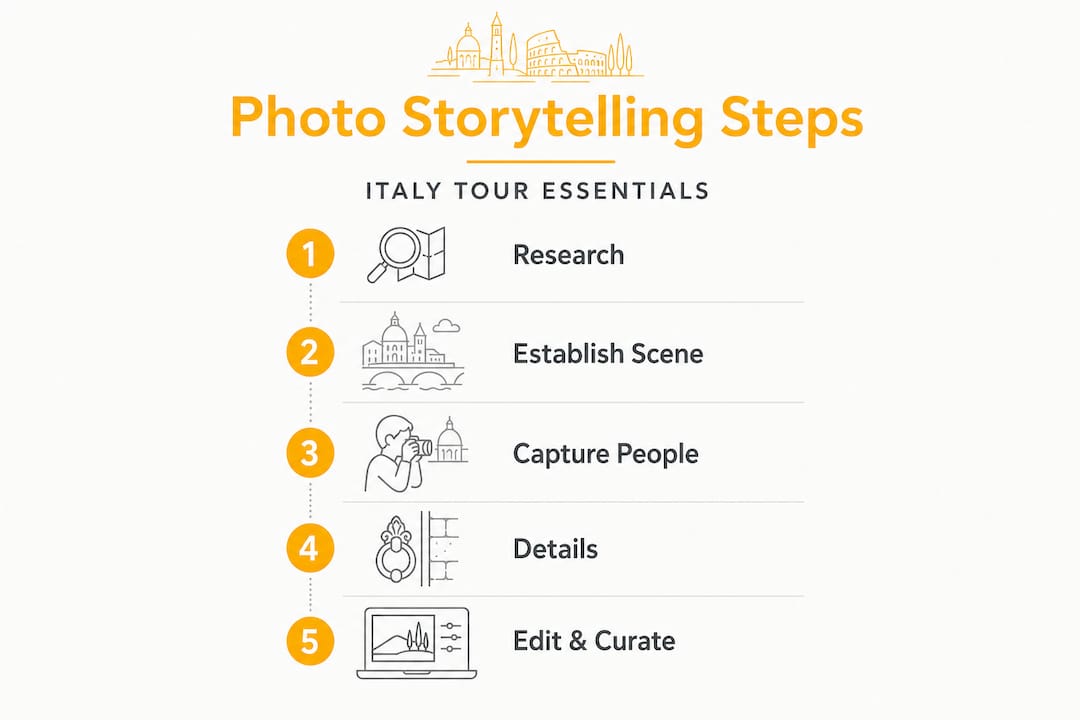
Step 1: Research and choose a compelling location or theme. Before you ever raise your camera, do the work of discovery. Is your story about the morning ritual of a Venetian market? The fading light on a Tuscan hillside? The vivacity of Palermo’s street food scene? Choosing a clear theme anchors your images and gives your collection a soul rather than a scatter of pretty pictures.
Step 2: Begin with wide establishing shots. Your opening images should orient the viewer and set the stage. A sweeping view of rooftops at dawn, a full-length frame of a piazza alive with movement, a long alley disappearing into soft shadow. These images are your visual introduction, placing the audience firmly inside the world you’re about to reveal. As photography guides note, wide to close-up shots create a narrative progression that draws the viewer steadily deeper into the subject.
Step 3: Move to medium shots and human interactions. Once the scene is established, bring in the people and the activity. A fisherman pulling his boat to shore, two elderly men playing cards in afternoon shade, a baker pressing dough behind a flour-dusted window. These medium shots are the heartbeat of your story, connecting the grand landscape to the intimate human scale.
Step 4: Capture detail shots that carry emotional weight. The worn edges of a leather glove. A cracked tile painted with a blue wave. A child’s hand reaching for gelato. Detail shots are the whispered secrets of your narrative. They slow the viewer down and ask them to feel rather than simply see. These images transform a collection of travel snaps into something that lingers in the memory.
Step 5: Sequence, curate, and edit with intent. Gathering images is only half the work. How you arrange them tells a second, equally powerful story. Move from wide to close, from quiet to expressive, from morning light to golden evening. Edit for tonal consistency so the mood carries from frame to frame without jarring shifts. A warm, slightly desaturated edit might evoke nostalgia; a richer, more saturated palette might celebrate vivacity and color. Explore the full Italy travel photography steps for deeper guidance on sequencing your images into a coherent visual essay.
| Story type | Opening shot | Middle focus | Closing image |
|---|---|---|---|
| Market morning | Wide market stall overview | Vendor and customer exchange | Close-up of produce textures |
| Historic district | Landmark establishing shot | Locals navigating streets | Worn architectural detail |
| Coastal village | Panoramic seascape | Fisher working at water’s edge | Rope coils or net patterns |
| Festival | Crowd in plaza | Performer or ritual moment | Face of a captivated spectator |
Learning to create stunning photo essays takes practice, but following this five-step sequence gives you a reliable framework you can apply in any Italian location, from the sun-drenched terraces of Positano to the fog-draped canals of Venice in November.
Pro Tip: Resist the urge to show every image you capture. Edit ruthlessly, selecting only the frames that serve your story’s emotional arc. Ten powerful images will always outshine forty mediocre ones.
Tips for immersion and capturing authentic moments
Having established the framework, let’s focus on techniques that deepen your stories and bring authenticity to every shot. The difference between a photograph that feels staged and one that feels alive almost always comes down to a single quality: presence.
Arrive early. Linger. Watch before you shoot. Italy’s most enchanting scenes reveal themselves to those who are still enough to notice them. A market vendor arranging her citrus with geometric precision, a priest crossing an empty square with his robes catching the wind, a cat curled on a sun-warmed windowsill. These moments don’t announce themselves. They unfold for those with patient eyes.
Color is one of photography’s most powerful emotional tools, and Italy offers it in breathtaking abundance. The terracotta warmth of Siena, the electric blue shutters of Burano, the silvery olive groves of Umbria catching afternoon light. Use color consciously to direct the viewer’s eye and evoke specific moods. A frame dominated by cool blues might suggest solitude or contemplation, while a burst of warm amber invites joy and nostalgia. Learning to read and respond to the color language of each location will enrich your storytelling immeasurably.
Engaging respectfully with locals transforms portraits from documentation into genuine connection. A warm smile, a simple “Posso fare una fotografia?”, and genuine curiosity about someone’s work or life opens a conversation that no telephoto lens can fabricate. Human storytelling in Italian photos is built on exactly this kind of authentic exchange. As photography educators affirm, short photographic stories crafted through observation, color use, sequencing, editing, and group feedback create the most powerful personal narratives about places and people.
“The camera is an instrument that teaches people how to see without a camera.” — Dorothea Lange
Participating in group feedback sessions, whether through a guided tour or a photography community, accelerates growth in ways that solo practice rarely can. Hearing how another set of eyes interprets your sequence, where they feel the story sag or surge, sharpens your instincts and reveals blind spots you couldn’t see alone. Seek out storytelling techniques that help you refine not just your camera skills but your narrative thinking.
Pro Tip: Before shooting a scene, spend at least five minutes simply observing. Note the light direction, the recurring movement patterns, and the emotional tone of the space. This quiet observation often reveals the shot you would have otherwise missed entirely.
Overcoming common photo storytelling challenges in Italy
As you refine your skills, staying aware of pitfalls will ensure a smoother experience and better results in your visual narratives. Italy is generous with beauty but occasionally demanding in its conditions.
Harsh midday light is perhaps the most universal challenge. Between roughly 11 a.m. and 3 p.m. in summer, Italian sunlight is ferocious, flattening texture and creating blown highlights alongside dense, unflattering shadows. The golden hour at dawn and dusk is where the real magic lives, offering warm, directional light that sculpts faces and architecture with extraordinary tenderness. Plan your shooting schedule around these windows, and use midday hours for reviewing images, scouting locations, and resting.
Architectural distortion is another challenge photographers frequently encounter. When you tilt your camera upward to capture a soaring cathedral or a narrow tower, vertical lines appear to converge, making the structure look as though it’s toppling backward. Using a tilt-shift lens or applying perspective correction in post-processing software like Lightroom can restore those vertical lines and lend your architectural images a professional, composed quality.
Tourist crowds at iconic sites can feel like an insurmountable obstacle to authentic storytelling. The Trevi Fountain at noon in July is not the same space as the Trevi Fountain at 6 a.m. in October. Visiting off-peak transforms crowded tourist magnets into intimate, almost meditative spaces. Always scout your chosen locations the day before a planned shoot, noting the light quality at different hours and identifying angles that frame the subject without unnecessary visual clutter. For portraits, remember to seek permission in advance, especially in smaller, more private community settings.
Managing captivating photo storytelling in crowded environments sometimes means reframing your story entirely. Instead of fighting for an unobstructed view of a famous landmark, consider making the crowd itself the subject. A sea of tourists photographing the same thing becomes a meditation on modern travel and collective wonder. Embrace creative storytelling ideas that transform apparent obstacles into narrative opportunities.
Pro Tip: Use the Notes feature on your phone to record the precise timing when light hits your chosen location at its most beautiful. Even a one-week trip gives you multiple chances to return and capture that specific quality of light if you plan ahead.
Why photo storytelling in Italy is more than gorgeous scenery
Italy offers scenery so extraordinary it can almost feel like cheating. The light alone seems to conspire with beauty, and the architecture provides ready-made compositions around every corner. But here is an honest truth we’ve come to understand deeply through years of leading photo tours: the photographers who return home with truly unforgettable images are rarely the ones with the most impressive gear or the most famous locations on their itinerary. They are the ones who arrived with curiosity, openness, and a genuine desire to connect.
An iconic backdrop becomes extraordinary only when something human animates it. The story doesn’t live in the piazza. It lives in the face of the man who has crossed that piazza every morning for fifty years and barely notices the beauty that stops tourists in their tracks. It lives in the child who runs between columns ancient enough to have witnessed emperors. It lives in the quality of attention you bring to what others overlook.
Storytelling through images is ultimately an act of generosity, offering the viewer not just a scene but a feeling, a context, an invitation to wonder. The most technically perfect photograph, without emotional intent, remains merely a record. But an image made with genuine curiosity and care for its subject, even imperfectly exposed, can move people in ways that no filter can manufacture. Human stories through images are what separate travel photography from travel documentation. Chase those stories above all else.
Next steps: elevate your Italian photo storytelling journey
Inspired by this perspective, you may be ready to bring your new approach to life in Italy. There is no substitute for being in the field, light changing around you, a new scene unfolding before your lens.
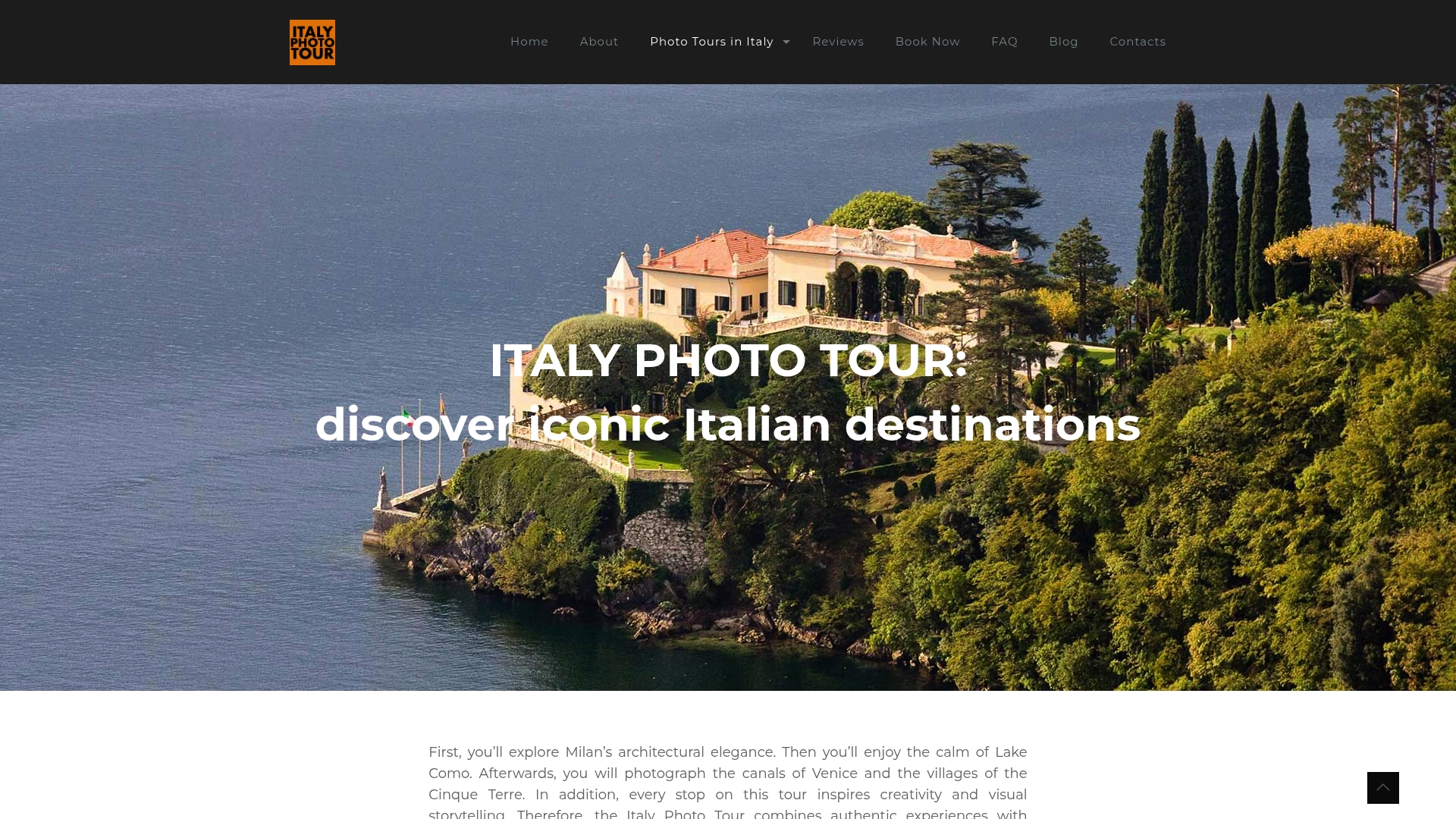
Italy Photo Tour offers immersive, narrative-focused photography tours across Italy designed specifically for photographers who want to do more than collect beautiful images. Led by professional photographer Mino Di Vita, these experiences place you inside the living stories of Italy’s most enchanting locations, from Venetian back canals at dawn to Tuscany’s rolling hills at golden hour. Explore what we do and discover workshops crafted around the storytelling principles in this guide, then take your first step toward enhancing your travel photography skills in one of the world’s most inspiring countries.
Frequently asked questions
What is the best time of day for photo storytelling in Italy?
The golden hour, early morning and late afternoon, offers soft, directional light and fewer crowds, creating ideal conditions for compelling photo stories. Midday harsh light causes blown highlights and heavy shadows that undermine the mood of your narrative.
How do I plan a photo story sequence during an Italy trip?
Begin with wide establishing shots to place the viewer in the scene, then progress through medium and detail images to build emotional depth and narrative flow. Wide to close-up progression is the foundational framework that creates a satisfying visual journey for your audience.
How can I get permission to photograph people in Italy?
Politely ask for consent before photographing people, using a warm smile and a simple phrase in Italian if possible, especially in private or intimate settings. As photography guides recommend, scouting ahead and getting permissions for portraits is an essential part of respectful and authentic storytelling.
Do I need special equipment for photo storytelling tours in Italy?
A camera with interchangeable lenses and a comfortable, lightweight bag are genuinely sufficient to tell powerful visual stories. As workshops confirm, crafting short photographic stories depends far more on observation, sequencing, and creative intent than on specialized or expensive equipment.