

TL;DR:
- Local culture deeply influences photographic composition, symbolism, and emotional resonance across borders.
- Ethical engagement and community collaboration are essential for authentic images that communities recognize as their own.
The role of local culture in images is defined as the extent to which cultural customs, values, symbols, and social context shape how photographs are composed, interpreted, and felt by audiences. Every frame you capture carries invisible cultural weight. The traditions of a Venetian festival, the geometry of a Tuscan courtyard, the unspoken rituals of a Sicilian market — each one tells you where to stand, what to include, and what to leave out. Understanding this influence is not a soft skill. It is the foundation of visual storytelling that resonates across borders and generations.
How does local culture shape visual storytelling and composition?
The role of local culture in images goes far deeper than choosing a colorful backdrop or a traditional costume. Culture shapes the very grammar of a photograph: what counts as a subject, how space is used, and what emotional register the image speaks in.
Research by psychologist Richard Nisbett reveals that analytic versus holistic vision divides how people literally see the world. Western viewers tend to focus on a central object, isolating it from its surroundings. East Asian viewers scan the full scene, reading relationships and context as primary information. This means a photograph composed for one cultural audience may feel incomplete or overly cluttered to another. Knowing your subject’s cultural visual language helps you compose images that feel instinctively right.
Cultural symbolism adds another layer. In many parts of Italy, the color red signals celebration and vitality. In parts of East Asia, white carries mourning. A flower arrangement, a hand gesture, or the direction a figure faces can carry meanings invisible to an outsider but immediately legible to a local viewer. When you understand these codes, your compositions gain a quiet authority.
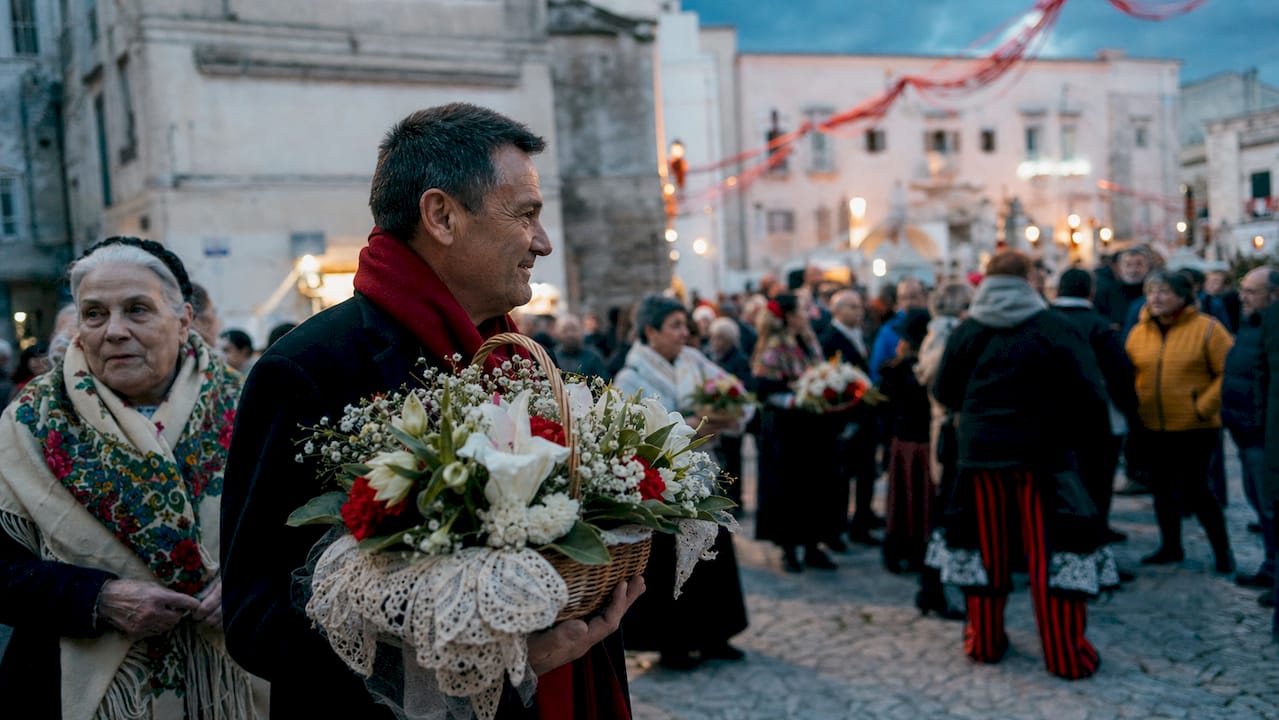
Cultural hybridity creates some of the most dynamic images in contemporary travel photography. Research on Malaysian Chinese art shows how the tension between adaptation and cultural roots produces compositions that express evolving identities rather than static traditions. You can apply this same awareness when photographing immigrant neighborhoods in Milan or the fusion architecture of Palermo, where Arab, Norman, and Baroque influences layer visibly on a single street.
Pro Tip: Before you shoot in a new location, spend 30 minutes simply watching. Observe how locals move through the space, what they look at, and what they ignore. That observation will tell you more about cultural composition than any guidebook.
The cultural influence on imagery also governs narrative tone. A photograph of a religious procession in Naples reads very differently from a street parade in New York, even if the technical elements are identical. The meaning lives in the cultural context, not the camera settings.
Does ethical engagement with local culture improve authenticity?
Ethical photography and authentic imagery are inseparable. The impact of local culture on photography is most powerful when the photographer earns genuine access rather than extracting surface appearances.
The concept of the “ritual of extraction” describes what happens when photographers treat cultural events as visual resources without engaging the community. Photographing rituals without consent risks objectifying subjects and stripping ceremonies of their meaning. The resulting images may be technically beautiful but culturally hollow. Audiences who know the tradition will feel the absence immediately.
Photographer Yulissa Mendoza offers a compelling counter-model. Her practice involves collaborating with local organizations to verify cultural accuracy and build trust before a single frame is captured. The result is imagery that communities recognize as their own rather than a foreign interpretation of their lives. That recognition is what separates a memorable photograph from a forgettable one.
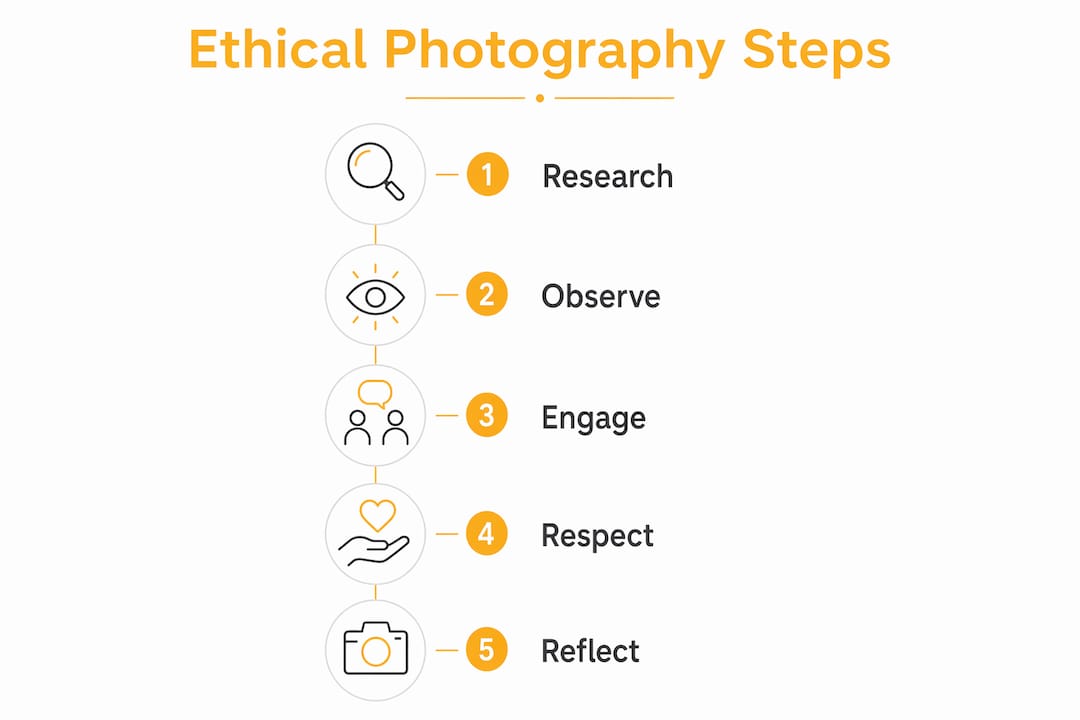
Building ethical relationships with communities follows a clear sequence:
- Research the cultural context before you arrive. Read local histories, speak with cultural liaisons, and understand what is considered sacred or private.
- Ask for permission openly and explain your intentions. Consent is not just polite. It changes the energy in the frame.
- Share your images with the community when possible. This closes the loop and builds the trust that makes future access richer.
- Credit cultural contributors in your captions and publications. Visibility honors the people who made the image possible.
- Accept refusals gracefully. Some moments are not meant to be photographed, and respecting that boundary deepens your integrity as a photographer.
Authenticity in photography derives more from engagement and trust than from camera technology. A photographer with a modest mirrorless camera and genuine community relationships will consistently produce more resonant images than one with the finest gear and no cultural connection.
Pro Tip: Learn five to ten words in the local language before a shoot. Greeting someone in their own language shifts the dynamic from observer to guest, and that shift shows in every portrait you take.
What are the biggest pitfalls in representing local cultures accurately?
Misrepresentation is the most common failure in cultural photography, and it affects both human photographers and the AI tools many of us now use for editing and generation.
The CULTIVate benchmark, which evaluated 19,000 images across 16 countries, found systematic disparities in cultural faithfulness favoring Global North cultures. Models trained predominantly on Western data consistently fail to depict non-Western social activities, clothing, and spatial arrangements with accuracy. This matters to you as a travel photographer because any AI editing tool you use may quietly Westernize your images without you noticing.
A separate evaluation across six countries found that image editing models rely on superficial cues, such as palette shifts and generic props, rather than making context-aware cultural adjustments. A tool asked to make an image “look more Italian” might add warm tones and a pasta dish rather than capturing the specific light quality of a Ligurian afternoon or the architectural restraint of a Milanese courtyard. The difference between surface cue and deep cultural context is exactly the difference between a postcard and a photograph.
Knowledge-graph-guided generative frameworks represent one promising solution. One such framework achieved cultural fidelity scores of 4.6 out of 5 and improved semantic similarity by 18.1% over prior methods. The improvement comes from encoding cultural relationships rather than just visual patterns. Human photographers who understand cultural relationships have always done this intuitively.
The practical lesson is clear. AI tools can assist with technical adjustments, but cultural accuracy requires human interpretation. No algorithm yet understands why a particular gesture in a Neapolitan street scene carries warmth rather than aggression, or why the silence in a Venetian calle at dawn feels sacred rather than empty.
Practical ways to incorporate local culture into your photography
Understanding local traditions in visual art is the starting point, but translating that understanding into compelling images requires deliberate practice.
Before you travel, build a cultural foundation. Study the history of your destination through documentary photography, local art, and ethnographic writing. Look at how local photographers frame their own communities. Notice what they choose to show and what they leave outside the frame. This pre-shoot research shapes your eye before you even arrive.
On location, let the culture guide your composition rather than imposing a formula. If you are photographing a morning market in Catania, resist the urge to center every shot on a single dramatic face. The relationships between vendors, the choreography of exchange, the way light falls across stacked citrus — these relational elements carry the cultural story. Photo storytelling on location is about reading the scene as a local would read it.
Building relationships with local communities transforms your access. A brief conversation with a fisherman in Cinque Terre or a lace-maker in Burano opens doors that no telephoto lens can reach. People who feel seen as individuals rather than subjects will offer you expressions and moments that candid shooting never captures.
Consider these practical approaches when you are in the field:
- Arrive early and stay late. The edges of events and the quiet moments before and after ceremonies reveal cultural texture that the peak moment often obscures.
- Use environmental context deliberately. A doorway, a worn threshold, a wall of faded paint — these architectural details carry generations of cultural memory.
- Photograph the ordinary alongside the spectacular. A grandmother hanging laundry in a Palermo courtyard tells as rich a cultural story as any cathedral facade.
- Vary your perspective. Get low, step back, and include the crowd. Cultural identity in images lives in the relationship between individuals and their environment, not just in isolated faces.
- Review your images with a cultural lens. Ask yourself whether someone from that community would recognize their own life in your photographs.
Preparing well before a guided experience, such as understanding what to expect on a first guided city tour, also sharpens your cultural attentiveness from the first hour.
Key takeaways
Cultural context is the single most powerful determinant of whether a travel photograph resonates as authentic or reads as a superficial impression.
| Point | Details |
|---|---|
| Culture shapes composition | Analytic versus holistic visual perception means composition choices must reflect the cultural context of your subject. |
| Ethics produce authenticity | Community collaboration and informed consent produce images that communities recognize as genuinely their own. |
| AI tools have cultural limits | Benchmarks show current editing models rely on surface cues and systematically favor Western visual norms. |
| Research precedes the shoot | Understanding local customs, symbols, and social codes before arrival transforms how you see and frame a scene. |
| Relationships open doors | Trust built with local communities gives access to moments and expressions that no technical skill alone can capture. |
Why i believe culture is the most underrated element in travel photography
After years of leading photography experiences across Italy, from the golden canals of Venice to the chiaroscuro streets of Milan, I have come to one firm conclusion: the photographers who grow fastest are not the ones who upgrade their gear. They are the ones who slow down and listen to a place.
I have watched talented photographers arrive in Burano with the finest lenses and leave with images that look like every other Burano photograph on the internet. The colors are vivid, the reflections are sharp, but something is absent. What is missing is the sense that the photographer understood why those houses are painted the way they are, what the fishing families who live there feel when they look at their own street, and how the light at 6 a.m. in october tells a completely different story than the same light at noon.
The research on analytic versus holistic vision confirmed something I had felt intuitively for years. We do not all see the same scene when we look at the same place. Culture writes the first draft of perception. As a photographer, your job is to read that draft before you start composing.
My honest advice is to treat every new location as a conversation rather than a performance. Go in curious, not confident. The images that have moved me most, and that have moved the people in them most, came from moments of genuine exchange. That exchange is the real art.
— Mino
Capture italy’s culture through the lens of Italyphototour
Italy is one of the world’s most layered cultural canvases, where every piazza, festival, and weathered facade holds centuries of living tradition. Italyphototour’s photography tours across Italy are designed specifically to help you move beyond the postcard and into the authentic visual story of each place.
Led by professional photographer Mino Di Vita, each experience in Venice, Milan, Tuscany, and Cinque Terre is built around cultural immersion and ethical engagement with local communities. You will learn to read a scene the way a local reads it, compose with cultural awareness, and bring home images that carry genuine meaning. Explore the full range of immersive photography experiences and find the tour that matches your creative vision.
FAQ
What is the role of local culture in images?
The role of local culture in images is defined as the way cultural customs, symbols, and social values shape composition, subject selection, and the emotional meaning an image carries. Culture determines what a photograph says as much as any technical choice.
How does culture affect photographic composition?
Research shows that Western viewers focus analytically on central objects while East Asian viewers process scenes holistically, reading context and relationships. Photographers who understand this difference compose images that communicate more effectively across cultural audiences.
Why is ethical engagement important in cultural photography?
Photographing rituals or communities without consent risks objectifying subjects and producing culturally hollow images. Collaboration with local organizations, as practiced by photographers like Yulissa Mendoza, produces images that communities recognize as authentic representations of their own lives.
Can AI tools accurately represent local cultures in images?
Current AI editing and generative models show systematic bias toward Global North visual norms, as revealed by the CULTIVate benchmark across 19,000 images. Human cultural knowledge and community engagement remain necessary for genuine cultural accuracy.
How can amateur photographers learn local culture before a shoot?
Study documentary photography, local art, and cultural histories before traveling. On location, observe how locals move through spaces, learn basic phrases in the local language, and build relationships before raising your camera.