

TL;DR:
- Italy’s heritage sites require legal awareness to ensure responsible photography and avoid sanctions.
- Advanced imaging methods like RTI reveal surface details that enhance scientific understanding and artistic expression.
- Immersive digital experiences improve engagement but are most effective when paired with expert guidance and photographic preparation.
Italy’s heritage sites whisper stories through ancient stone, painted domes, and cobblestone piazzas that seem to hold the light differently at every hour. Most photographers arrive with full memory cards and high hopes, assuming their lens can roam freely wherever beauty calls. Yet the reality is richer and more nuanced than that romantic image suggests, weaving together legal frameworks, cutting-edge imaging methods, and immersive guided experiences that transform a simple snapshot into something truly extraordinary.
Table of Contents
- Understanding Italy’s rules for heritage site photography
- Essential techniques for capturing heritage sites in challenging light
- Cutting-edge imaging methods for heritage documentation
- Immersive photographic tours: enhancing engagement and comprehension
- A fresh perspective: what most photo guides miss about heritage sites
- Ready to experience Italy’s heritage through your lens?
- Frequently asked questions
Key Takeaways
| Point | Details |
|---|---|
| Understand photo rules | Photography at heritage sites in Italy often depends on your intended use—check if permits are required for commercial sharing. |
| Master low-light techniques | Shooting at night or indoors demands specialized camera settings for the best results. |
| Explore new imaging methods | Modern techniques like RTI help document details without damaging precious sites. |
| Use immersive tours wisely | Digital and AR tours can boost your experience but may involve a learning curve. |
| Balance creativity and care | Great heritage photography means blending legal, technical, and artistic awareness for memorable images. |
Understanding Italy’s rules for heritage site photography
With this context, it is essential to understand not just the beauty but also the responsibilities of photographing Italy’s historic places. Italy holds one of the world’s densest concentrations of UNESCO World Heritage Sites, and the nation protects its visual legacy with genuine legal rigor. The governing framework is the Code of Cultural Heritage and Landscape, formally known as Legislative Decree 42/2004, which establishes when and how images of publicly owned heritage assets may be captured, shared, and reproduced.
The distinction between personal and commercial use is the heart of the matter. Photographing the Colosseum for your travel album, or sharing a single image on a personal social media profile, generally falls within acceptable personal use. However, Italy’s image laws explained make it clear that reproducing images of cultural heritage assets can require authorization from the managing public body, and unauthorized commercial uses may trigger real sanctions. That means selling prints, licensing images to editorial clients, or republishing in a commercial publication all carry different weight than a holiday memory pinned to a personal board.
| Use case | Authorization required | Potential consequences |
|---|---|---|
| Personal travel photos | Usually not required | None |
| Social media (personal, non-monetized) | Usually not required | None |
| Editorial publication | Often required | Sanctions, fees |
| Commercial licensing or print sales | Required | Sanctions, legal liability |
| Academic or non-profit documentation | Case by case | Possible fees |
Many photographers, understandably, find this landscape confusing. Here are some of the most common legal mistakes travelers and photography enthusiasts make at heritage sites:
- Assuming that a freely accessible public space means free image rights for commercial use.
- Sharing photos on monetized platforms or blogs without checking whether authorization applies.
- Using drone photography inside or immediately around protected sites without separate civil aviation and cultural heritage permits.
- Photographing private artworks displayed temporarily within a public heritage building and then republishing without clearing rights from the artwork’s owner.
- Ignoring site-specific regulations that individual museums or archaeological parks may post at entry.
“Italy’s rules for reproducing images of cultural heritage assets can require authorization from the managing public body, and unauthorized uses may trigger sanctions.” Understanding this principle before you raise your camera is not a limitation. It is the foundation of responsible, artistically mature photography.
Knowing the rules actually frees you creatively. When you understand precisely what you can and cannot do, you stop second-guessing every frame and start focusing on the light, the texture, and the story that only your eye can tell.
Essential techniques for capturing heritage sites in challenging light
Once you are confident about the legal landscape, technical skill becomes the next frontier for compelling heritage photography. Italy’s historic locations present some of the most demanding and rewarding lighting conditions you will ever encounter. Sunlight ricochets off marble at midday into nearly blinding contrasts; candlelit churches glow amber against deep shadow; and the blue hour dissolves entire cityscapes into something dreamlike and impermanent.
Working in low-light or nighttime conditions at these sites demands both patience and preparation. Following well-established night shooting tips for historic locations, these practical fundamentals will help you manage exposure under difficult lighting and bring home images full of atmosphere:
- Choose the right moment. Arrive just after sunset or just before sunrise. The sky still holds color, ambient light sources become more expressive, and crowds are thinner.
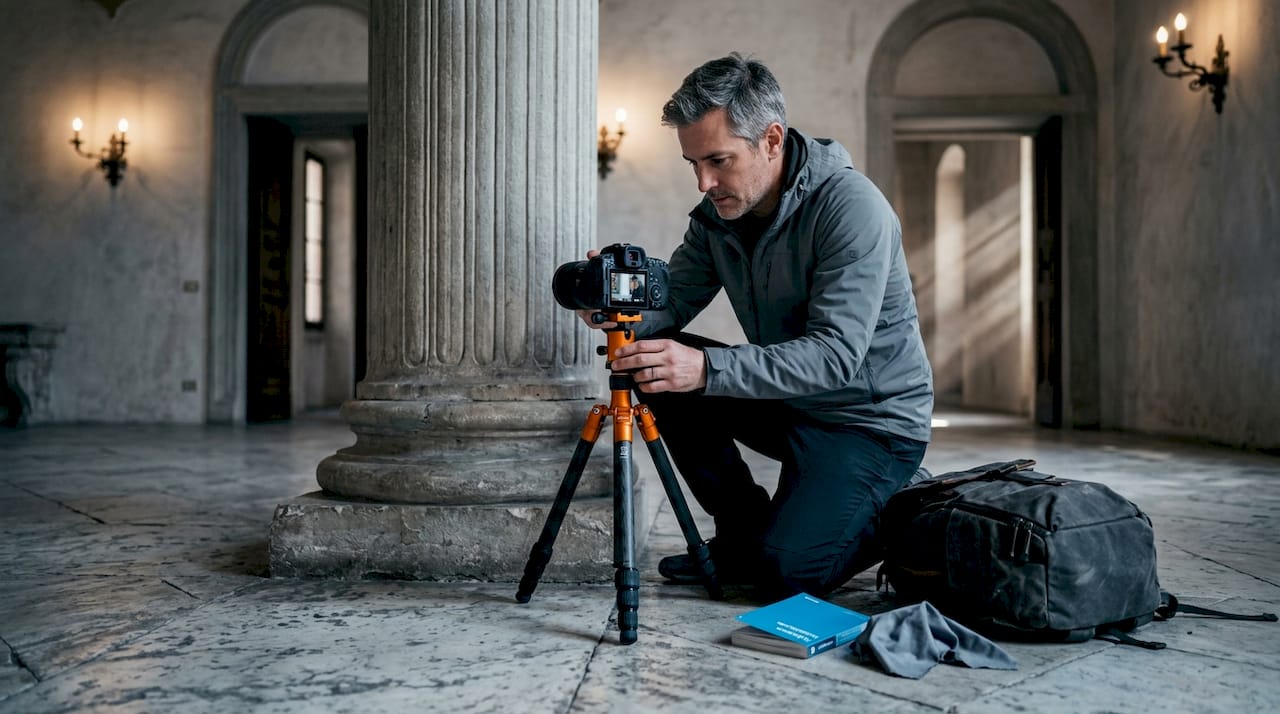
- Stabilize deliberately. Use a tripod when permitted, or press against a wall, column, or railing. Heritage sites offer extraordinary natural supports if you look for them.
- Set your aperture first. A wide aperture (f/1.8 to f/2.8) captures more light and creates gorgeous background separation that isolates stone carvings or frescoed ceilings beautifully.
- Raise ISO thoughtfully. Modern cameras handle ISO 1600 to 6400 with impressive grace. Push higher only when motion blur is the greater threat.
- Use a slower shutter for still subjects. Even one to four seconds on a stabilized camera can yield silky, luminous images of interiors and night-lit facades.
- Shoot in RAW format. This preserves the full tonal range of a dimly lit interior, giving you far more latitude in post-processing to recover detail in shadows and highlights.
Pro Tip: A fast prime lens with a maximum aperture of f/1.8 or wider is one of the most impactful investments you can make for heritage site photography. It replaces the need to carry heavy tripod equipment into spaces where tripods are restricted, and it renders that enchanting chiaroscuro light with genuine depth and warmth.
Our heritage landmark tips explore specific locations and timing in greater detail, while our photographer’s lighting guide digs into how Italy’s unique geography shapes the quality of natural light across seasons. For city-based shooting, urban Italy photo tips address the particular dance of artificial and ambient light that makes Italian cities unforgettable at night.
Never underestimate experimentation. Heritage architecture was built to be experienced by candlelight, torchlight, and open sky. When you photograph it under those original conditions, something honest and deeply moving comes through in every frame.
Cutting-edge imaging methods for heritage documentation
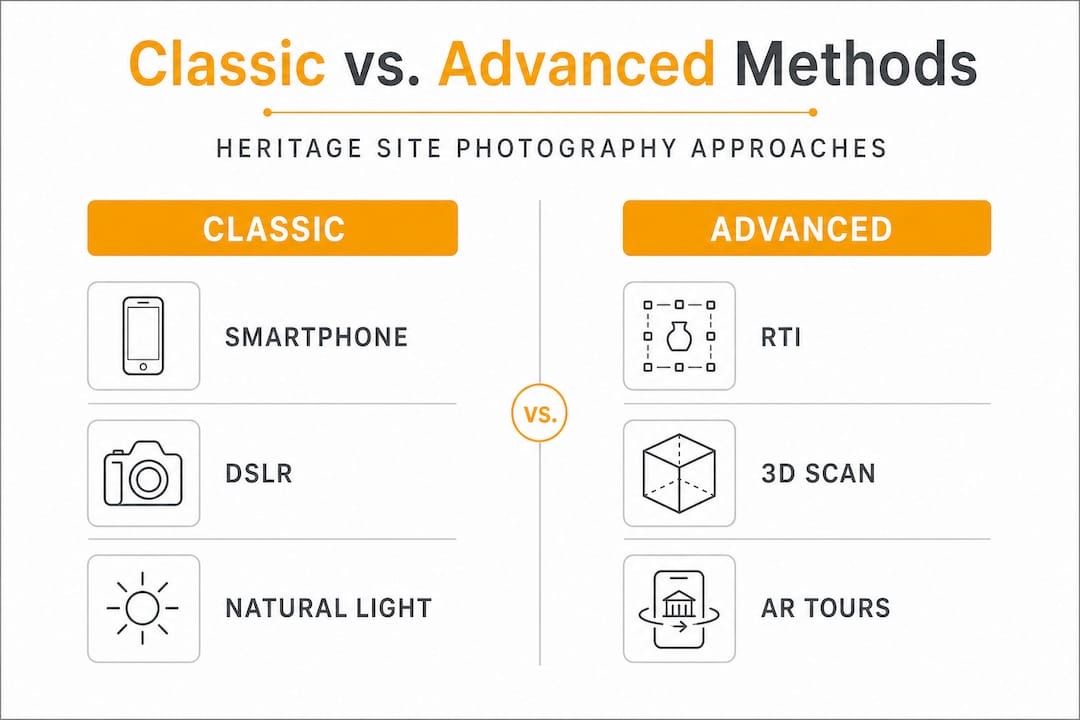
Alongside classic photography, technology offers advanced methods to understand and preserve heritage sites, opening new creative possibilities for even the most curious amateur. One technique that has quietly reshaped the field is Reflectance Transformation Imaging, known as RTI.
RTI is a non-invasive imaging technique) that captures the surface of an object under light coming from many different directions. These captures are then computed together to create a relightable, interactive image model that reveals surface details invisible to standard photography, such as faint inscriptions, tool marks, and deterioration patterns on ancient stone or bronze. It requires no physical contact and no alteration of the object whatsoever.
| Method | Contact required | Detail revealed | Interactive output | Accessibility for amateurs |
|---|---|---|---|---|
| Traditional photography | No | Visual color and texture | No | High |
| RTI | No | Sub-surface texture, micro-detail | Yes, relightable | Low (specialist equipment) |
| 3D photogrammetry | No | Full 3D geometry | Yes, rotatable model | Medium (software needed) |
| Multispectral imaging | No | Invisible layers, pigments | Specialist review | Very low |
For conservation professionals, RTI serves purposes that range from condition monitoring over time to making fragile objects accessible to researchers worldwide without physical transport. Standards bodies such as FADGI (Federal Agencies Digital Guidelines Initiative) and METAMORFOZE, cited by cultural heritage digitization guidelines, provide frameworks that ensure imaging quality can be objectively verified and repeated across institutions.
Pro Tip: While operating RTI equipment yourself requires specialist training, several museums and guided heritage tours are now presenting RTI-generated visualizations on interactive screens. If you are visiting a site that offers this feature, spend time with it. Understanding how surface light interacts with stone or bronze will fundamentally change the way you see and photograph texture in your own images.
For photographers on guided tours, the real value of knowing about RTI lies in sensitivity. When you understand that a worn inscription or a seemingly plain stone surface holds incredible hidden detail, you begin to see surfaces rather than just scenes. Your compositions shift from the grand and obvious to the intimate and revelatory.
Immersive photographic tours: enhancing engagement and comprehension
As new technologies and interactive experiences become integrated into heritage site visits, your role as a photographer evolves too. The emergence of augmented reality (AR), holographic displays, and digitally reconstructed environments within heritage contexts is reshaping how visitors engage with history, and those shifts directly affect the quality and character of the photographs you can make.
Recent research shows that immersive digital reconstructions significantly outperform traditional informational panels in several measurable ways.
A study evaluating mixed-reality in heritage contexts found that 75% of users reported improved comprehension and 65% found the experience more engaging compared to standard presentations. However, 30% of participants also reported navigational difficulties, underscoring the need for thoughtful, guided strategies when using these tools on location.
| Experience type | Comprehension improvement | Engagement increase | Reported difficulties |
|---|---|---|---|
| Traditional panels | Baseline | Baseline | Minimal |
| AR/holographic displays | 75% higher | 65% higher | 30% navigation issues |
| Guided immersive photo tour | High (contextual) | Very high | Low (guide-assisted) |
Those navigation difficulties are worth taking seriously. When 30% of visitors feel disoriented during digital heritage experiences, it signals that technology alone is never enough. A knowledgeable guide who can bridge the digital reconstruction and the physical space makes all the difference between a confusing overlay and a genuinely transformative encounter.
Here are some ways to make the most of immersive heritage experiences as a photographer:
- Use AR reconstructions to understand the original spatial layout of a site before choosing your camera position. Knowing where an ancient temple portico once stood helps you frame the ruins with intentionality rather than guesswork.
- Pay attention to the emotional narrative that digital reconstructions suggest. The story they tell becomes the story your photographs can amplify.
- Do not let the screen replace your eye. Absorb the digital layer, then set it aside and look at the actual stone, actual light, and actual texture in front of you.
- Visit with an expert who knows both the historical layers and the photographic opportunities that emerge when those layers are made visible.
For photographers interested in the broader landscape around these sites, our guide on landscape photography essentials offers context on reading terrain and light in ways that complement immersive heritage experiences.
A fresh perspective: what most photo guides miss about heritage sites
Having explored the main frameworks and techniques, here is a big-picture view grounded in hands-on experience. Most photography guides treat legal rules as obstacles and technology as shortcuts. We see them differently.
The rules around heritage photography in Italy, when you truly understand their rationale, become a creative constraint in the best possible sense. Constraints force you to look harder. They push you toward angles, moments, and compositions you would never discover if the site were simply open territory. A photographer who knows exactly what is permitted finds freedom inside those boundaries rather than frustration.
Similarly, advanced tools like RTI and AR reconstructions are only as valuable as the guided strategies you pair with them. A stunning holographic overlay does not produce a stunning photograph on its own. The photographer who understands the history being reconstructed, who has studied the light at that specific site at that specific hour, and who arrives with both technical preparation and genuine curiosity is the one who walks away with images that endure. You can advance your landmark photography through both technical practice and a deepened relationship with the places you photograph.
The most important thing most guides miss is this: the best heritage photographs are made at the intersection of preparation and presence. You do your research, you understand the rules, you choose your equipment thoughtfully, and then you put it all aside and simply be in the place. Italy’s heritage sites are alive. They breathe differently at dawn than at dusk. A guided tour that weaves together legal awareness, technical mentorship, and immersive historical context gives you the confidence to be truly present in those moments. That is where the extraordinary images live.
Ready to experience Italy’s heritage through your lens?
Imagine standing in the amber warmth of a Tuscan courtyard as the last light dissolves into shadow, knowing exactly how to frame the scene, exactly what the rules allow, and exactly how the history of that stone wall informs your composition.

That kind of confidence comes from more than reading articles. It grows from standing beside an expert who has done it a thousand times, on the very ground where history still breathes. Our Italy photography tours offer guided, legally informed, and artistically curated experiences across Milan, Tuscany, Venice, Cinque Terre, and beyond. Each tour is designed by professional photographer Mino Di Vita to give you insider knowledge, technical support, and access to the kinds of moments that only local expertise can reveal. Explore our tours or learn more about the vision behind Italy Photo Tour and find the experience that speaks to your creative journey.
Frequently asked questions
Do I need a permit to photograph heritage sites in Italy?
For personal photography, a permit is usually not required, but commercial use or publication often requires authorization from the managing body of the site. According to Italy’s legal framework, unauthorized commercial uses may trigger sanctions.
What is RTI and can I use it as an amateur?
RTI is a non-invasive imaging method) for examining fine surface details through relightable digital outputs. Amateurs can experience RTI results at select museums and on guided tours, but operating the equipment itself is typically a specialist undertaking.
Are phone cameras adequate for low-light heritage site shots?
A modern smartphone can yield impressive results in low-light when stabilized properly and with manual settings engaged. However, established low-light technique guidance consistently shows that dedicated cameras with interchangeable lenses offer significantly more creative control.
Will immersive AR or digital tours help me take better photos?
They can meaningfully boost your contextual understanding and creative engagement, as mixed-reality heritage studies show improvements of 75% in comprehension and 65% in engagement. To avoid the navigational difficulties that 30% of users report, pair any digital experience with an informed human guide.