

TL;DR:
- Milan’s architecture features clean lines, symmetry, and contrasts ideal for minimalist photography.
- Using a lightweight camera with prime lenses and scouting locations enhances minimalist compositions.
- Focus on negative space, deliberate exposure, and simple elements to create powerful, quiet images.
Arriving in Milan with a camera in hand can feel like stepping into a visual storm. The city pulses with ornate facades, sleek towers, cobblestone alleys, and rushing crowds, all competing for your attention at once. Yet within that apparent chaos lies one of Europe’s most rewarding stages for minimalist photography. Strip away the noise, and Milan reveals a city of extraordinary geometry, quiet symmetry, and breathtaking contrasts. This guide will walk you through the exact steps, gear choices, and compositional instincts you need to distill Milan’s electric energy into images that are clean, powerful, and deeply personal.
Table of Contents
- What makes Milan a minimalist’s playground
- Essential gear and preparation for minimalist shots
- Step-by-step: Creating minimalist photos in Milan
- Troubleshooting and common mistakes
- What you’ll achieve: Results and next steps
- Minimalism as creative empowerment in Milan
- Enhance your Milan photography journey
- Frequently asked questions
Key Takeaways
| Point | Details |
|---|---|
| Milan’s minimalist potential | The city’s architecture provides rich opportunities for clean, powerful photography. |
| Gear and mindset matter | Lightweight equipment and pre-scouting help simplify your process. |
| Techniques for simplicity | Focus on lines, symmetry, and negative space for compelling minimalist images. |
| Mistakes to avoid | Stay mindful of clutter and over-editing when composing your shots. |
| Growth and sharing | Your Milan portfolio will grow through practice, feedback, and exploring new perspectives. |
What makes Milan a minimalist’s playground
Milan is a city that rewards the patient eye. On the surface, it appears dense and layered, but look closer and you begin to notice how Milan’s visual appeal is rooted in architectural discipline. The city’s builders, across centuries, favored proportion, symmetry, and purposeful ornamentation. That instinct for order is your greatest ally as a minimalist photographer.
The interplay between historic and contemporary structures is particularly striking. Renaissance courtyards sit within walking distance of Zaha Hadid’s curved towers at CityLife. Neoclassical arches frame glass-and-steel facades. This tension creates a visual language of contrasts that translates beautifully into minimalist compositions. As modern Milan architecture demonstrates, the city’s built environment offers a rare blend of clean lines, geometric shapes, and the kind of tonal restraint that minimalist photographers dream about.
Color palettes across Milan’s neighborhoods tend toward the muted and elegant. Warm stone, pale plaster, and dark iron repeat across the city’s older districts, while the newer business quarters offer cool grays and reflective glass. Both palettes lend themselves to compositions that feel deliberate rather than accidental.
“Milan’s architecture offers excellent opportunities for minimalist photography through clean lines, geometric shapes, and contrasts between historical and modern structures.”
The table below captures some of Milan’s most visually distinctive zones and what they offer the minimalist eye.
| Location | Visual quality | Best for |
|---|---|---|
| Brera district | Warm stone, ivy, narrow alleys | Texture and shadow |
| CityLife towers | Curved glass, bold geometry | Modern abstraction |
| Galleria Vittorio Emanuele II | Ornate symmetry, glass ceiling | Pattern and reflection |
| Navigli canals | Reflections, repetition | Water and light |
| Duomo rooftop | Spire repetition, sky isolation | Vertical rhythm |
Beyond the iconic landmarks, Milan’s backstreets offer equally compelling material. A lone doorway framed by shadow, a row of identical shutters, a single figure crossing an empty piazza — these are the unique Milan photo spots that often produce the most memorable minimalist work. The city does not shout its simplicity. It whispers it, and you have to slow down to hear it.
Essential gear and preparation for minimalist shots
Minimalism begins before you raise the camera. The gear you carry shapes how freely you move and how quickly you respond to fleeting moments. For Milan’s streets and piazzas, a lightweight mirrorless camera or even a high-end smartphone will serve you better than a heavy DSLR kit. Mobility keeps your creative options open.
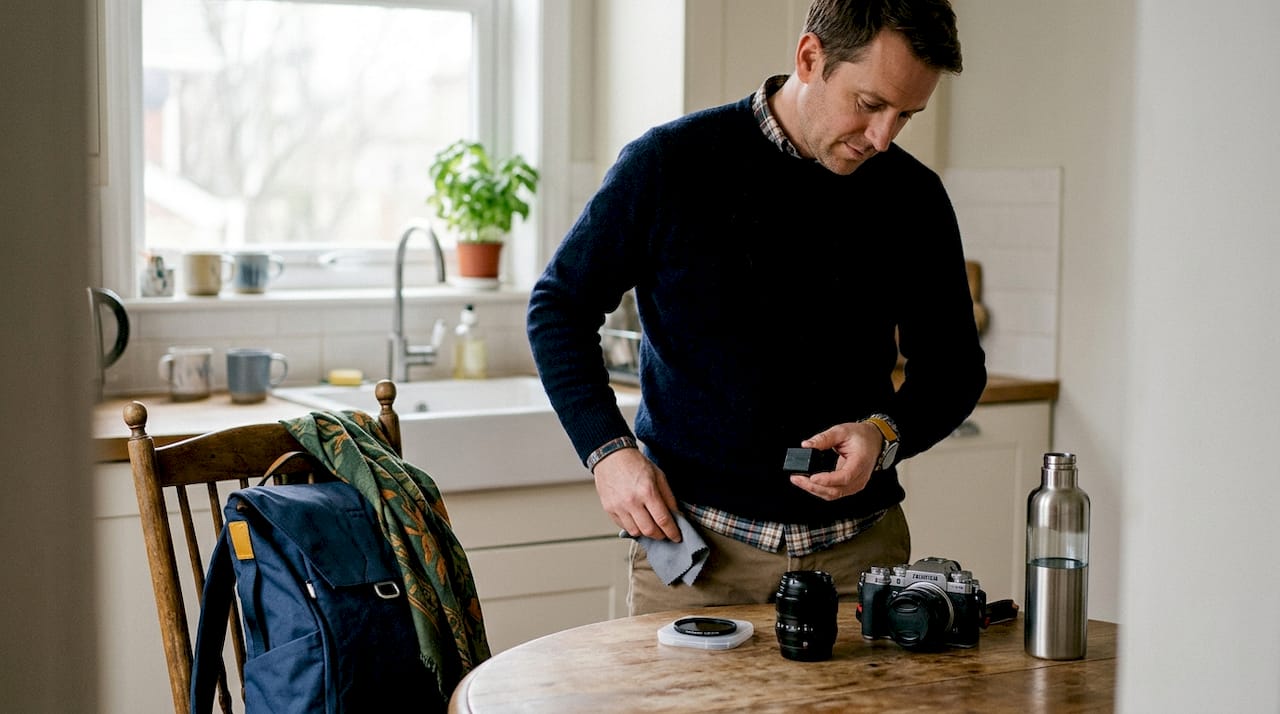
For lenses, prime options in the 28mm to 35mm range are ideal. They render straight lines with honesty, resist the barrel distortion that can undermine geometric compositions, and force you to move your feet rather than zoom your way to a lazy frame. That physical engagement with the scene is itself a minimalist discipline.
A polarizing filter is worth its modest weight in Milan. The city’s glass facades, canal surfaces, and polished stone floors create reflections that can either elevate or clutter a composition. A polarizer lets you choose. A clean lens cloth matters just as much — smudged glass destroys the crispness that minimalist images depend on.
The table below compares two common gear approaches for urban minimalist photography.
| Approach | Pros | Cons |
|---|---|---|
| Mirrorless with prime lens | Sharpness, control, low profile | Slightly heavier than phone |
| Smartphone with manual mode | Ultra-light, discreet, fast | Limited in low light |
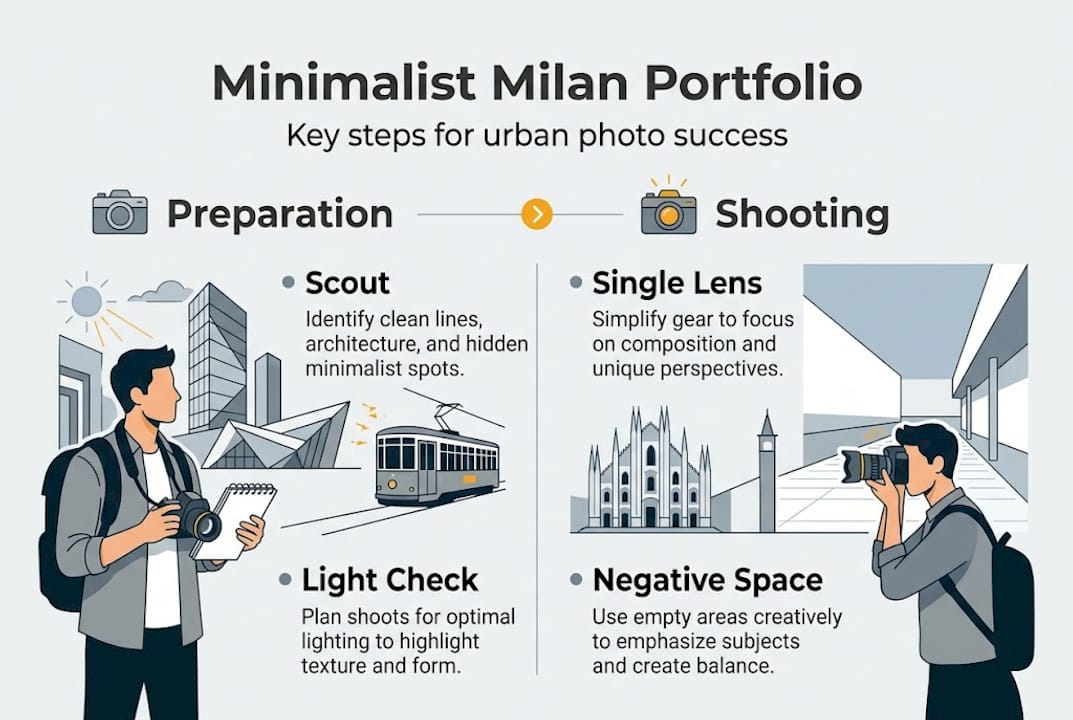
Preparation extends to scouting. Walking city photography tips consistently emphasize the value of visiting a location before your main shoot. Daytime scouting reveals where shadows fall, where crowds gather, and which angles offer the cleanest backgrounds. The Arco della Pace, for instance, rewards those who arrive knowing exactly where to stand for its neoclassical symmetry to resolve perfectly in the frame.
Pro Tip: Visit your chosen Milan location at midday on a weekday to map the light and crowd patterns. Return at dawn or dusk for the actual shoot, when the scene is quieter and the light is far more sculptural.
Keep your bag light. One camera, one lens, one filter, and a spare battery. Everything else is distraction.
Step-by-step: Creating minimalist photos in Milan
The process of making a strong minimalist image is less about luck and more about a repeatable sequence of decisions. Here is a clear workflow you can apply across Milan’s many photogenic spaces.
- Choose your location with intention. Start with Milan’s most geometry-rich sites: Bosco Verticale for its organic vertical lines, the Galleria for its soaring glass ceiling, Brera’s alleys for shadow and texture, CityLife for bold curves, and the Duomo rooftop for its forest of spires.
- Identify the single strongest element. Before composing, ask yourself what one shape, line, or form you want to anchor the image. A lone arch. A repeated window. A vanishing corridor.
- Compose for negative space. Let the subject breathe. Position it off-center, surrounded by sky, shadow, or plain wall. Negative space is not emptiness — it is the silence that makes the subject speak.
- Adjust your exposure deliberately. As expert minimalism guidance notes, overexposing the sky isolates structures against a clean white field, while shooting in monochrome sharpens the viewer’s focus on geometry and contrast.
- Shoot a sequence, then simplify. Take several frames, each time asking what you can remove from the composition. Step closer, shift your angle, raise or lower your perspective.
- Review with fresh eyes. After each sequence, pause and examine your frames critically. The strongest minimalist image is usually the one that surprises you with how little it needs.
You can deepen this urban photography workflow by keeping a small notebook of compositions you want to revisit. Milan rewards return visits.
Pro Tip: Early morning light in Milan, especially around the Galleria and Duomo, casts long shadows across the stone floors that create natural leading lines. These fleeting patterns disappear by mid-morning.
Troubleshooting and common mistakes
Even experienced photographers stumble when approaching minimalism for the first time in a new city. Milan, with its richness of detail, makes certain mistakes especially tempting.
The most common error is including too much. A beautiful archway loses its power when a parked scooter, a tourist sign, and a litter bin compete for attention in the same frame. Train yourself to scan every edge of the viewfinder before pressing the shutter. Move your feet before you reach for the crop tool.
Over-processing is the second great threat to minimalist work. It is tempting to push contrast, clarity, and texture sliders in post-production, but each adjustment adds visual weight. As monochrome enhances geometry rather than color noise, converting to black and white is often a more honest solution than layering filters.
“In minimalist photography, less not only means less in the frame — but also fewer editing choices.”
Here are the most frequent compositional pitfalls to watch for:
- Unbalanced symmetry: If you are shooting a symmetric subject, even a slight tilt destroys the effect. Use your camera’s grid overlay.
- Competing focal points: Two strong shapes pulling in opposite directions create tension rather than calm. Choose one.
- Ignoring the background: A clean subject against a busy background is not minimalist. The background is half the image.
- Relying on color to do the work: If your composition only works in color, it is likely not truly minimalist. Test it in black and white.
For those seeking hidden Milan spots that naturally offer cleaner backgrounds, the quieter courtyards of the Università degli Studi and the arcaded walkways near Porta Venezia are worth exploring. These spaces offer the kind of architectural restraint that makes Italy cityscape mastery feel genuinely within reach.
What you’ll achieve: Results and next steps
Commit to this process across a full day in Milan and you will return home with something genuinely valuable: a portfolio of images that feel considered, quiet, and distinctly yours. Not postcards. Not snapshots. Photographs that ask the viewer to pause.
The Arco della Pace’s neoclassical symmetry, the Galleria’s geometric glass ceiling, Bosco Verticale’s organic vertical rhythm — each of these locations rewards a minimalist approach with images that feel both timeless and modern. The table below maps what each site typically yields.
| Location | Typical minimalist result |
|---|---|
| Bosco Verticale | Vertical lines, plant textures against sky |
| Arco della Pace | Perfect symmetry, neoclassical calm |
| Galleria Vittorio Emanuele II | Geometric ceiling, floor reflections |
| Brera alleys | Shadow play, ivy patterns |
| Duomo rooftop | Spire repetition, sky isolation |
Once you have your images, share them. Enter them in photography competitions, post them to communities like 500px or Instagram with thoughtful context, and seek honest critique. Growth accelerates when you expose your work to other eyes.
Here are four concrete next steps for deepening your minimalist practice:
- Commit to one minimalist shoot per week, in any city, to build compositional instinct.
- Study the work of photographers like Fan Ho or Michael Kenna, whose urban minimalism set a high standard.
- Join a workshop or Italian photo tour experiences to receive real-time feedback in the field.
- Build a dedicated minimalist portfolio, separate from your general work, to track your evolution clearly.
The journey does not end in Milan. Every city you visit afterward will look different to you. You will see Italian landscape inspiration and urban geometry everywhere, because Milan will have trained your eye to find it.
Minimalism as creative empowerment in Milan
There is a quiet revolution that happens when you commit to minimalism in a city as visually dense as Milan. You stop trying to capture everything and start choosing what truly matters. That shift is not just aesthetic — it is a form of creative discipline that sharpens every aspect of your photography.
Milan’s architecture is an exceptional teacher. Its mix of the ornate and the austere forces you to make active decisions about what belongs in the frame and what does not. That filtering instinct, once developed here, travels with you. You will apply it in Venice, in Tuscany, in any city you photograph afterward.
True mastery in photography rarely comes from adding more. It comes from learning when and how to subtract. The photographers whose work endures are almost always those who understood restraint. Exploring creative practice in photography through a minimalist lens in Milan is not just a technique — it is a way of seeing that will quietly transform everything you make.
Enhance your Milan photography journey
If this guide has stirred your creative appetite, imagine what a full day in Milan’s streets could do for your eye when guided by a professional photographer who knows every hidden courtyard and golden-hour angle the city holds.

Italy Photo Tour offers personalized Milan Photo Tour experiences designed to help you build a genuine portfolio while developing your compositional instincts in real time. Whether you want to explore Milan’s geometry up close or expand your vision across the country with a broader Italy Photo Tour, there is a curated experience waiting for you. You can also explore landscape photography tips to carry your minimalist eye beyond the city and into Italy’s breathtaking natural spaces.
Frequently asked questions
Which locations in Milan are best for minimalist photography?
Top spots include Bosco Verticale, Arco della Pace, Galleria Vittorio Emanuele II, Brera alleys, CityLife towers, and the Duomo rooftop — all offering clean lines, bold shapes, and repeating patterns that reward a minimalist eye.
What camera settings are best for minimalist architecture shots?
Use a low ISO for maximum clarity, set a narrow aperture around f/8 to f/11 for edge-to-edge sharpness, and as overexposing isolates structures against a bright sky, adjust exposure deliberately to simplify the scene.
How can I make my Milan photos look more minimalist?
Focus on clean lines, generous negative space, and convert to black and white to let geometry lead, since monochrome enhances geometry by removing color as a distraction.
What are common mistakes in minimalist urban photography?
Including visual clutter, over-editing in post-production, and ignoring geometric balance are the most frequent errors, since neglecting symmetry weakens the calm, intentional feeling that minimalist images depend on.