

TL;DR:
- Composition is the key factor that makes travel photos feel alive and emotionally impactful.
- Techniques like the rule of thirds and leading lines help create depth, balance, and visual storytelling.
- Guided tours and deliberate practice accelerate skill development by providing feedback and scene challenges.
Most travelers believe stunning shots in Italy come down to having a great camera or being in the right place at the right moment. The truth is more liberating than that. Composition is the real force behind images that stop a viewer mid-scroll, pulling them into a Tuscan hillside or a sunlit Venetian canal. Deliberate composition practice can rapidly sharpen an amateur photographer’s eye in ways that no lens upgrade ever could. This guide walks you through the essential composition principles, how to adapt them across Italy’s breathtaking variety of scenes, and how to build genuine skill that travels with you.
Table of Contents
- Why composition matters more than your camera
- Essential composition techniques for Italian travel photos
- Adapting composition for Italy’s landscapes, cities, and culture
- Building strong travel shots through practice and guided photo tours
- Our take: The secret to composition most articles miss
- Experience Italy and elevate your composition with guided tours
- Frequently asked questions
Key Takeaways
| Point | Details |
|---|---|
| Composition trumps equipment | How you compose a scene impacts your Italy photos far more than which camera you use. |
| Practice boosts skill growth | Deliberate, focused composition practice accelerates improvement for amateurs and enthusiasts. |
| Tailor composition to context | Adjust your techniques for landscapes, cities, and cultural events to tell richer stories. |
| Guided tours enhance learning | Expert-led photo tours provide feedback and curated practice, speeding up your progress. |
Why composition matters more than your camera
Composition is simply the arrangement of visual elements within your frame. It is the decision of where to place your subject, what to include, what to leave out, and how to guide the viewer’s eye from one part of the image to another. It sounds almost too simple to be powerful. Yet it is the single greatest factor separating a forgettable snapshot from a photograph that feels alive.
Even a modest smartphone camera can produce extraordinary images when the photographer frames the scene with intention. Consider two photographs taken from the same spot in Florence, looking toward the Ponte Vecchio. One is shot straight on, with the bridge centered and a cluttered foreground of tourists. The other uses a low angle, places the bridge along the upper third of the frame, and lets the shimmering Arno River lead the eye naturally toward the ancient stone arches. Same location. Same light. Completely different emotional impact.
This is why composition deserves your full attention before you ever think about upgrading your gear. The essential travel photo tips that experienced photographers return to again and again are almost always about framing, not megapixels.
Eye-tracking research tells us something fascinating about how viewers experience photographs:
Strong composition leads the viewer’s gaze and helps tell visual stories, confirming that intentional framing is not just an artistic preference but a measurable, scientific advantage.
When your composition is purposeful, viewers linger. Their eyes follow the path you have laid out for them, moving through the image the way a reader moves through a well-written sentence. A poorly composed image, by contrast, leaves the eye wandering without purpose, and the viewer moves on.
In Italy, where every piazza and every hillside vineyard offers a feast of visual information, the risk of a cluttered, unfocused frame is real. Learning to compose deliberately is what transforms the overwhelming richness of Italy into photographs with clarity, mood, and meaning.
- Strong composition creates visual hierarchy, telling viewers what matters most.
- Intentional framing isolates beauty from visual noise in busy Italian scenes.
- Thoughtful arrangement of elements adds depth and dimension to flat images.
- Composition choices directly influence the emotional tone of a photograph.
Essential composition techniques for Italian travel photos
Understanding why composition matters gives you motivation. Now let’s break down the essential techniques you can start using right away, even on your very first photo walk through a medieval Italian village.
- Rule of thirds. Imagine your frame divided into a three-by-three grid. Place your main subject along one of the grid lines or at an intersection point rather than dead center. In Tuscany, this might mean positioning a lone cypress tree at the right vertical third, letting the rolling hills breathe across the rest of the frame.
- Leading lines. Roads, canals, colonnades, and rows of grapevines all create natural lines that draw the eye deeper into the scene. Venice’s narrow calli (alleyways) are extraordinary for this, pulling the viewer forward into shadow and light.
- Framing within the frame. Use archways, doorways, windows, or overhanging branches to create a natural border around your subject. This technique adds layers and a sense of discovery, as if the viewer is peeking into a private world.
- Symmetry and reflection. Italy’s grand architecture and still canal waters offer perfect symmetry. Centering a symmetrical subject can feel bold and intentional, especially in formal spaces like Milan’s Galleria Vittorio Emanuele II.
- Negative space. Leaving open sky, empty cobblestones, or still water around your subject creates breathing room and amplifies mood. Less is often more in a country where visual richness is everywhere.
| Technique | Primary effect | Best use in Italy |
|---|---|---|
| Rule of thirds | Balanced, dynamic tension | Tuscan landscapes, portraits |
| Leading lines | Depth and movement | Venetian canals, Roman streets |
| Framing | Layered storytelling | Archways, doorways, windows |
| Symmetry | Grandeur and order | Baroque architecture, reflections |
| Negative space | Mood and minimalism | Misty mornings, open seascapes |
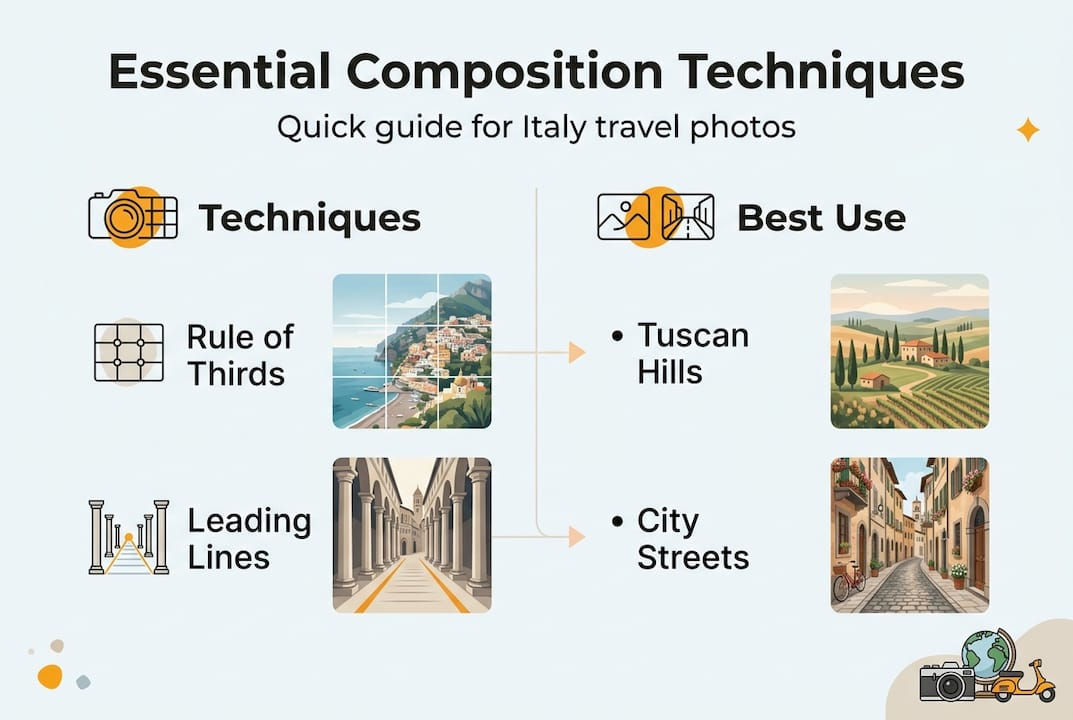
Focusing on one compositional rule per scene and reviewing the results afterward fosters rapid skill improvement. This is why we encourage photographers to master composition in Italy by dedicating each session to a single technique rather than trying to apply everything at once.
Pro Tip: During your first photo walk in any Italian city, choose just one technique, such as leading lines, and apply it to every single shot. Review the images that evening and notice which worked and why. This focused approach, recommended for beginner travel photo tips, builds intuition faster than any other method.
Adapting composition for Italy’s landscapes, cities, and culture
With your core techniques in hand, here is how to adapt your composition choices to Italy’s wonderfully diverse photo opportunities.
Italian landscapes present a particular challenge because they are so generously beautiful. The light shifts quickly, especially in Tuscany and Umbria, where golden hour can last mere minutes before the sky transforms entirely. Purposeful compositional choices let photographers capture both grand vistas and intimate moments, heightening the sense of place in ways that reactive, unplanned shooting simply cannot.
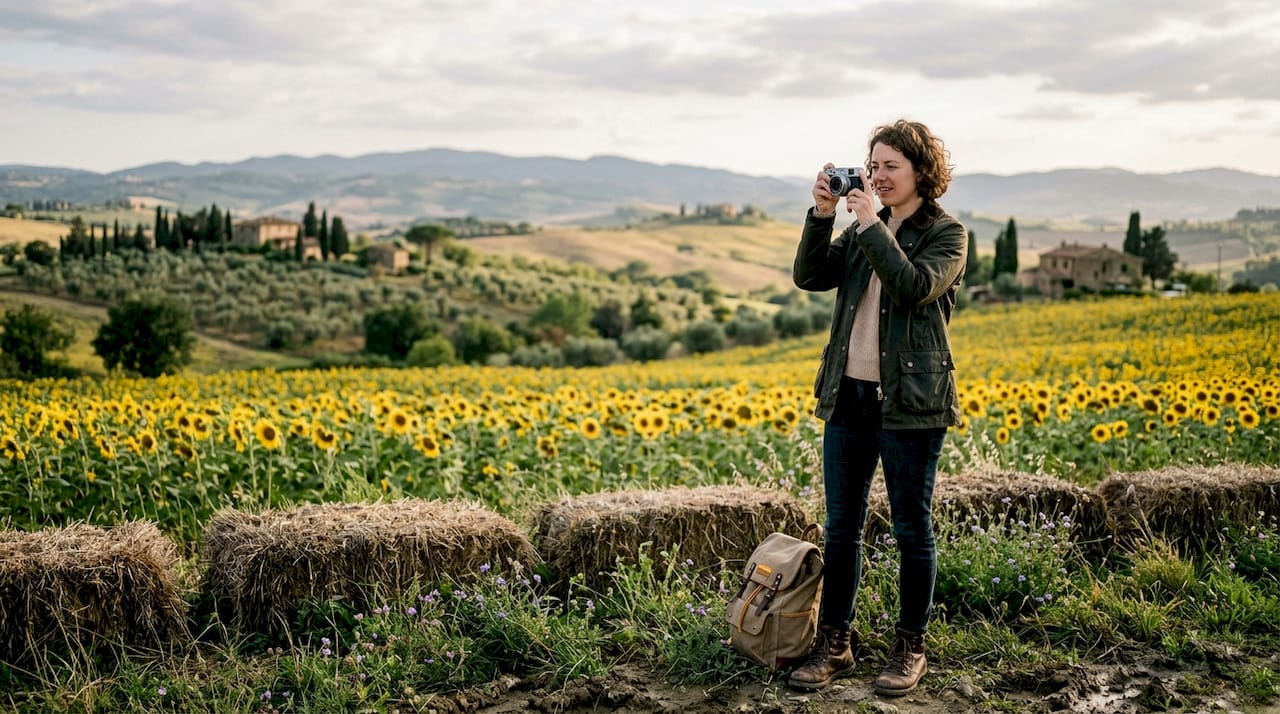
For landscapes, your priority is depth. Layer your foreground, midground, and background with intention. A field of sunflowers in the foreground, a farmhouse in the middle distance, and a soft ridge of hills behind it creates a painting-like quality that flat, single-plane shots never achieve. Use the landscape photo checklist to build this habit before you even raise your camera.
City scenes demand a different sensitivity. Italian urban environments are layered with geometry: the repetition of shuttered windows, the diagonal thrust of a baroque staircase, the unexpected symmetry of a market stall. Look for urban geometry and use it as your compositional scaffold. The city composition tips that work best in places like Naples or Bologna often involve finding the hidden order within apparent chaos.
Cultural moments, festivals, and daily life scenes call for a storytelling approach. Here, composition is about relationship: between people, between a subject and their environment, between light and shadow on a face. Place your subject off-center to include context. Let the scene breathe around them.
| Subject type | Composition priority | Key technique |
|---|---|---|
| Landscape | Depth and layers | Rule of thirds, leading lines |
| City street | Geometry and rhythm | Symmetry, framing |
| Cultural moment | Relationship and story | Negative space, rule of thirds |
- For landscapes: arrive early, scout your foreground, and wait for the light to shift.
- For city streets: shoot from low angles to emphasize geometry and reduce sky clutter.
- For cultural scenes: stay patient, observe before shooting, and let moments develop.
- For architecture: use vertical framing to honor the full grandeur of Italian structures.
Building strong travel shots through practice and guided photo tours
You know what to practice. But how do you build real-world skills and get the most out of your travel experience? The answer lies in structured, deliberate repetition combined with honest review.
- Morning walk-arounds. Before the crowds arrive, spend 20 minutes walking a single block or piazza with your camera. Apply one composition rule only. This quiet, focused time trains your eye without the pressure of capturing everything.
- Post-session review. Each evening, select your five strongest images and five weakest. Ask yourself: what compositional choice made the strong ones work? What was missing in the weaker ones? This reflection is where real learning happens.
- One rule per location. When you move from Venice to Cinque Terre to Rome, assign a different composition technique to each destination. By the end of your trip, you will have practiced every major technique in genuinely varied environments.
- Sketch before you shoot. Spend 60 seconds mentally framing the scene before raising your camera. Visualize where the lines fall, where your subject sits in the frame, and what you want the viewer to feel. This slows you down in the best possible way.
- Seek feedback actively. Share images with fellow photographers or a guide and ask specifically about composition, not just overall quality. Targeted feedback accelerates growth.
Guided tours with structured practice accelerate improvement by providing expert feedback and curated scenes that present genuine composition challenges. The Italy photography practice steps built into a guided experience give you a framework that is hard to replicate alone.
Pro Tip: After each photo session, analyze your images and identify one specific compositional weakness to target the following day. Pair this with the photo tour essentials checklist to ensure you are covering every dimension of your practice.
Our take: The secret to composition most articles miss
Most guides on composition hand you a list of rules and send you on your way. Learn the rule of thirds. Use leading lines. Find your frame. These are genuinely useful tools, and we teach them with care. But here is what most articles miss: the rules are not the destination. They are the vocabulary. The real fluency comes from something slower and harder to teach.
We have watched photographers arrive in Italy with notebooks full of techniques, only to rush from landmark to landmark chasing the same shots they saw on Instagram. The images come back technically correct and emotionally hollow. Then there are photographers who slow down. Who sit with a scene for twenty minutes. Who notice how the light moves across a doorway, how a cat settles into a patch of sun, how a conversation between two elderly men creates a perfect triangle of shadow and gesture.
Those photographers, the ones who practice artistic travel approaches rooted in observation rather than rule-following, produce images that feel genuinely alive. Composition rules give you the grammar. Patient, mindful observation gives you the voice. The two together are where memorable photography begins.
Experience Italy and elevate your composition with guided tours
Ready to take the next step from theory to practice? Italy’s landscapes, cities, and cultural moments are endlessly generous to photographers who know how to see them. The most powerful way to accelerate your composition skills is to shoot in the field with expert guidance, real-time feedback, and scenes chosen specifically to challenge and inspire you.

Our Italy photography tours are designed for exactly this kind of growth. Led by professional photographer Mino Di Vita, each experience places you in locations where composition decisions feel natural and rewarding. Whether you are drawn to the kaleidoscope of Burano, the chiaroscuro of Roman streets, or the sweeping vistas of Tuscany, our artistic exploration tours offer the perfect environment to put everything you have learned into vivid, memorable practice.
Frequently asked questions
What is the most important composition rule for travel photography in Italy?
The rule of thirds is widely considered the most valuable starting point, as it creates natural balance between subject and background across Italy’s varied and visually rich scenes. Compositional rules like rule of thirds measurably improve travel shots by giving the eye a clear path through the image.
How can I practice composition while traveling in Italy?
Dedicate 5 to 10 minutes at each location to a focused walk-around exercise, applying one composition rule per scene and reviewing your images that evening to identify what worked. Deliberate composition practice builds intuitive skill far faster than casual, unstructured shooting.
Will a guided photo tour help me improve my composition faster?
Yes, because guided tours provide both expert feedback and carefully selected scenes that present real compositional challenges in a supportive environment. Guided tours with feedback are proven to accelerate the learning curve significantly for amateur photographers.
Does composition matter more than camera equipment?
Strong composition has a far greater impact on the emotional power and storytelling quality of your travel photos than any camera upgrade can offer. Composition over camera type is a consistent finding among photography researchers and experienced educators alike.