

Many photographers assume chiaroscuro belongs exclusively to Renaissance paintings, but this dramatic interplay of light and shadow transforms modern photography into powerful visual storytelling. Understanding chiaroscuro as a tool for dramatic photographs unlocks creative potential for capturing Italy’s landscapes, architecture, and cultural scenes with depth and emotion. This guide reveals practical techniques for applying chiaroscuro to your Italian photography, from camera settings to location strategies that enhance artistic impact.
Table of Contents
- Key takeaways
- What is chiaroscuro and why it matters in photography
- Core lighting techniques and camera settings for chiaroscuro
- Practical applications: Using chiaroscuro in Italy’s landscapes and cultural scenes
- Expert nuances and advanced tips for mastering chiaroscuro photography
- Explore Italy through professional photography tours
- Frequently asked questions
Key Takeaways
| Point | Details |
|---|---|
| Chiaroscuro defined | Chiaroscuro uses strong contrasts between light and shadow to create depth and mood, turning flat scenes into immersive visual narratives. |
| Lighting and exposure | Position a single dominant light at 30 to 90 degrees from the subject, shoot in manual, meter the highlights, and apply negative exposure compensation of 2 to 3 stops to preserve detail while deepening shadows. |
| Ambient control tips | Control ambient light by shooting in darker spaces or using flags or gobos to block light, and time outdoor shoots for lower ambient conditions to deepen contrast. |
| Italy application opportunities | In Italy amateurs can chase dramatic scenes by targeting dawn or dusk lighting around Tuscan valleys, Roman architecture, coastal villages, and cultural events to reveal texture and atmosphere. |
What is chiaroscuro and why it matters in photography
Chiaroscuro in photography uses strong contrasts between light and shadow to create three-dimensional space, depth, drama, and emotional impact in two-dimensional images. This technique originated from Renaissance art masters like Caravaggio and Rembrandt, who manipulated light to guide viewer attention and evoke powerful responses. When applied to photography, chiaroscuro transforms flat scenes into compelling visual narratives that feel tangible and immersive.
The artistic power of chiaroscuro lies in its ability to sculpt subjects with light, revealing form and texture while concealing distracting elements in shadow. Your brain interprets these tonal gradations as dimensional information, making photographs feel more real and engaging. This perceptual trick becomes especially valuable when photographing Italy’s rich visual environments, where architectural details, landscape contours, and human expressions benefit from dramatic emphasis.
Modern photographers leverage chiaroscuro to separate subjects from backgrounds, direct viewer focus, and establish mood through lighting choices. The technique works across genres, from portrait work emphasizing facial structure to landscape photography highlighting terrain textures. Understanding Italian photography styles 2026 reveals how contemporary artists blend traditional chiaroscuro principles with digital tools for striking results.
Italy’s diverse lighting conditions create natural opportunities for chiaroscuro photography. Morning sun streaming through Tuscan valleys, afternoon shadows across Roman architecture, and golden hour illumination on coastal villages all provide ready-made dramatic lighting scenarios. Mastering chiaroscuro allows you to recognize and exploit these moments, transforming ordinary travel snapshots into gallery-worthy artistic statements.
“Chiaroscuro photography transcends technical execution to become a visual language communicating emotion, atmosphere, and narrative through the strategic placement of light and absence of light.”
Core lighting techniques and camera settings for chiaroscuro
Achieving chiaroscuro effects requires specific lighting mechanics involving a single dominant directional light positioned at 30-90 degrees from your subject. This angle creates the essential shadow gradation that defines form while maintaining enough illumination for detail. Position your light source to one side, allowing shadows to fall naturally across the opposite plane and create dimensional depth.
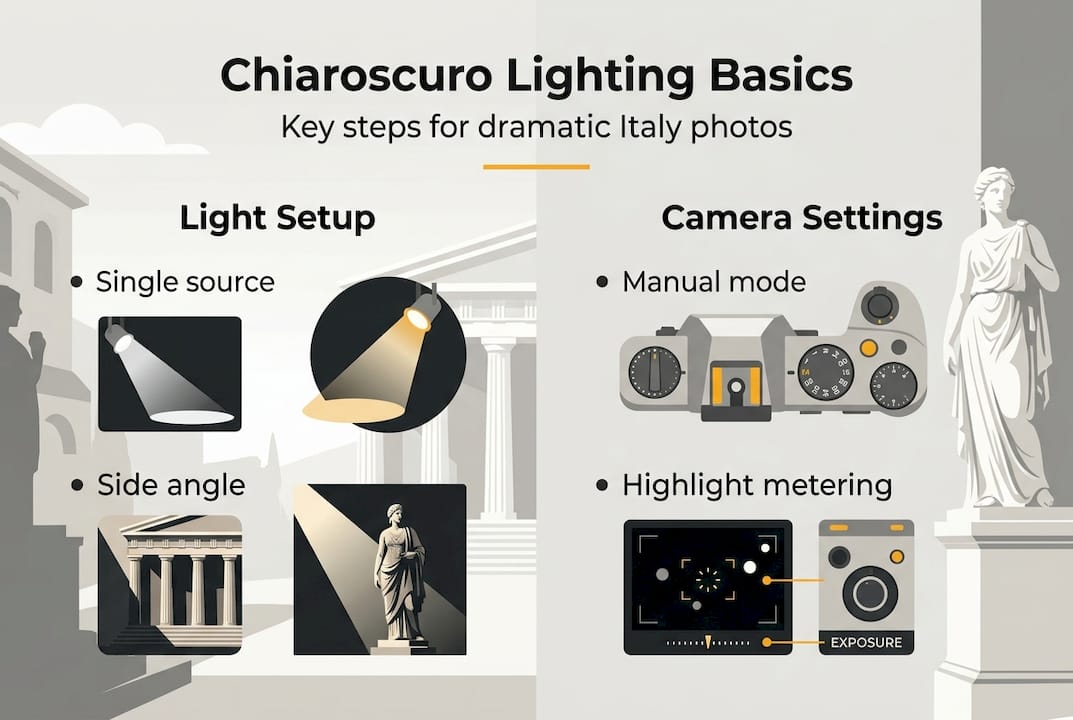
Exposure strategy becomes critical for chiaroscuro success. Switch to manual mode and meter for your highlights, then apply negative exposure compensation of 2 to 3 stops below the meter reading. This approach preserves detail in illuminated areas while allowing shadows to deepen naturally. Your camera’s histogram should show a strong peak toward the left side, indicating rich shadow tones without complete black clipping.
Controlling ambient light determines shadow depth and overall contrast. Reduce environmental illumination by shooting in darker spaces, using flags or gobos to block unwanted light, or timing outdoor shots for lower ambient conditions. The less competing light you allow, the more dramatic your chiaroscuro effect becomes. Mastering light and shadow travel photography provides additional context for managing natural illumination in various scenarios.
Recommended light sources for chiaroscuro include:
- Natural window light filtered through curtains for soft directional illumination
- Speedlight with snoot attachment for focused hard light control
- Continuous LED panels with barn doors for precise shadow placement
- Reflected sunlight using white cards or mirrors for outdoor applications
Pro Tip: Apply the inverse square law by positioning your subject close to the light source while keeping the background distant. Light intensity drops exponentially with distance, naturally darkening backgrounds and enhancing subject separation without additional equipment.
| Shadow Quality | Light Source | Best Application |
|---|---|---|
| Hard edges | Small direct light (bare flash, direct sun) | Dramatic portraits, architectural details |
| Soft transitions | Large diffused light (window, softbox) | Landscape textures, subtle mood work |
| Mixed gradation | Partially modified light (gridded softbox) | Balanced scenes with controlled contrast |
Understanding capturing natural light Italy helps you adapt these controlled studio principles to outdoor photography situations where environmental conditions constantly shift.
Practical applications: Using chiaroscuro in Italy’s landscapes and cultural scenes
Italy’s geography and architecture provide exceptional opportunities for chiaroscuro photography. Golden hour lighting on Tuscan hills creates dramatic side illumination that emphasizes rolling terrain textures and cypress tree silhouettes. The low sun angle produces long shadows that define landscape contours, transforming familiar scenes into sculptural compositions with depth and atmosphere.
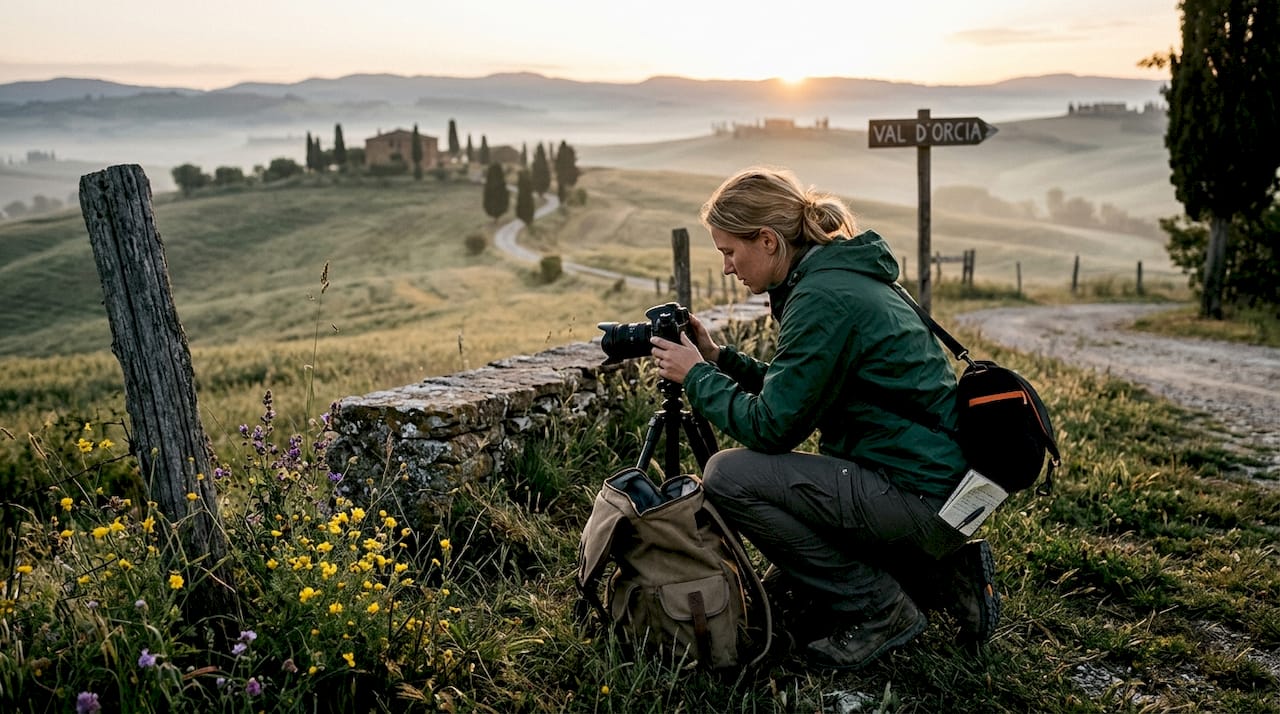
Specific Italian locations ideal for chiaroscuro work include Val d’Orcia’s undulating farmland, where morning light rakes across hills creating alternating bands of illumination and shadow. The Nottolini aqueduct near Lucca offers repeating arches that cast geometric shadow patterns, perfect for exploring light and form relationships. Urban settings like Florence’s narrow streets channel directional light between buildings, creating natural chiaroscuro scenarios throughout the day.
Position yourself so the primary light source strikes your subject from the side or slightly behind, allowing shadows to fall toward your camera position. This placement reveals texture and form while maintaining enough frontal illumination for detail. For landscape work, include shadowed foreground elements that frame sunlit background features, creating visual depth through tonal contrast.
Applying chiaroscuro outdoors without studio control requires adapting to available conditions:
- Scout locations during different times to identify optimal sun angles and shadow patterns
- Use natural reflectors like light-colored walls or water surfaces to fill shadows selectively
- Position subjects relative to directional light sources for desired shadow placement
- Expose for highlighted areas and allow shadows to deepen naturally
- Incorporate environmental elements that block or channel light for controlled effects
Pro Tip: Photograph architectural subjects when the sun aligns perpendicular to facade planes, casting strong directional shadows that reveal surface texture and ornamental details. Many Italian churches and palazzos face cardinal directions, making solar position predictable for planning shoots.
Landscape photography tips Italy expands on location-specific strategies for maximizing natural lighting conditions. Understanding how to photograph Italy essential tips provides broader context for integrating chiaroscuro techniques into comprehensive shooting approaches.
Expert nuances and advanced tips for mastering chiaroscuro photography
Light ratios between 6:1 and 10:1 produce optimal sculptural depth in chiaroscuro photography, balancing dramatic contrast with retained shadow detail. These ratios mean your highlight areas receive six to ten times more illumination than shadow regions. Ratios below 6:1 appear too flat, while ratios exceeding 10:1 risk losing recoverable information in dark tones.
Lens selection influences shadow edge characteristics and tonal transitions. Longer focal lengths compress perspective and create harder shadow edges, emphasizing separation between light and dark areas. Wider lenses expand spatial relationships and soften shadow transitions, producing more gradual tonal gradations. Choose focal lengths based on your desired aesthetic impact and subject matter requirements.
Post-processing enhances chiaroscuro effects through targeted adjustments. Crush blacks slightly by lowering the black point in your tone curve, increasing shadow density without destroying detail. Apply dodging to highlights and burning to shadows, mimicking traditional darkroom techniques that emphasize dimensional form. Reduce clarity or structure in shadow areas to maintain smooth tonal transitions rather than introducing noise or artifacting.
| Challenge | Solution Approach |
|---|---|
| Excessive ambient light | Use faster shutter speeds, smaller apertures, or ND filters to reduce overall exposure |
| Color temperature conflicts | Shoot RAW and adjust white balance independently for highlights and shadows |
| Lost shadow detail | Expose slightly brighter and darken in post while preserving tonal information |
| Inconsistent outdoor lighting | Wait for cloud patterns or use scrims to control direct sunlight intensity |
Color photography presents unique chiaroscuro challenges because color information competes with tonal contrast for viewer attention. Desaturate non-essential hues or work with monochromatic color schemes that support rather than distract from light and shadow relationships. Many photographers convert chiaroscuro work to black and white, eliminating color as a variable and focusing purely on tonal drama.
Common mistakes include:
- Insufficient contrast between highlights and shadows, resulting in muddy mid-tones
- Completely blocked shadows with no recoverable detail or texture
- Multiple competing light sources that confuse dimensional reading
- Over-processing that introduces halos or unnatural tonal breaks
Pro Tip: Create repeatable lighting systems by documenting successful setups with diagrams showing light positions, power settings, and subject placement. This approach allows you to recreate effective chiaroscuro results across different subjects and locations.
Exploring artistic travel photography Italy 2026 guide connects these technical refinements to creative vision, helping you develop a personal aesthetic that leverages chiaroscuro principles effectively.
Explore Italy through professional photography tours
Applying chiaroscuro techniques in Italy’s diverse environments becomes more rewarding with expert guidance and curated locations. Photography tours Italy offers immersive experiences designed specifically for photographers seeking to enhance their artistic skills through hands-on practice in exceptional lighting conditions. Professional instruction helps you recognize optimal moments, refine technical execution, and develop your creative voice.
Our workshops focus on practical application rather than theoretical discussion, placing you in authentic Italian settings where light, shadow, and cultural richness converge. You’ll work alongside experienced photographers who understand both technical requirements and artistic vision, receiving personalized feedback that accelerates your learning. Discover what we do Italy photo tour to understand our approach to photography education and cultural immersion.
Join Italy photo tours immersive experiences that combine technical skill development with access to locations chosen specifically for their photographic potential. From Tuscan landscapes at golden hour to Venetian architecture in dramatic side lighting, these tours position you for success while providing the support needed to capture truly exceptional images.
Frequently asked questions
What is chiaroscuro in photography?
Chiaroscuro in photography uses strong contrasts between light and shadow to create dimensional depth, drama, and emotional impact in images. This technique originated from Renaissance painting but translates effectively to photographic art through controlled lighting and exposure strategies.
What camera settings work best for chiaroscuro photography?
Use manual mode with exposure metered for highlights, then apply negative 2 to 3 stop compensation. Set ISO to base value for maximum dynamic range, choose apertures based on desired depth of field, and adjust shutter speed to control ambient light contribution while maintaining proper highlight exposure.
Can chiaroscuro techniques work for color photography?
Yes, but color adds complexity because hue information competes with tonal contrast. Work with monochromatic color schemes, desaturate non-essential colors, or convert to black and white in post-processing to emphasize light and shadow relationships without color distraction.
What are common challenges when shooting chiaroscuro outdoors?
Excessive ambient light reduces contrast, changing sun positions alter shadow placement, and unpredictable weather affects lighting consistency. Solutions include timing shoots for optimal sun angles, using natural blockers to control light, and working during golden hour when directional illumination naturally creates dramatic effects.
Which Italian subjects work best for chiaroscuro photography?
Tuscan landscapes during golden hour, architectural details with strong directional shadows, narrow urban streets channeling side light, and cultural portraits using window illumination all provide excellent chiaroscuro opportunities. Look for subjects with interesting textures and forms that benefit from dimensional lighting emphasis.