

TL;DR:
- In 2026, travel photography in Italy emphasizes storytelling through atmospheric conditions, not just iconic sights. Photographers focus on emotional depth and sequences, capturing genuine moments and unique weather effects for more authentic images. AI tools support workflow efficiency but require careful use to preserve image integrity and provenance.
Most photographers arrive in Italy with a checklist of iconic images already formed in their minds. The gondolas of Venice, the rolling hills of Tuscany at harvest, the Colosseum bathed in afternoon gold. And while those images are genuinely beautiful, the truth is that in 2026, the photographers creating the most resonant work are no longer chasing postcards. According to emerging travel imaging trends, the field is shifting decisively toward “when were you there?” storytelling, where unique atmospheric conditions and narrative sequences define the shot, not the destination alone. What follows is your guide to that shift, and how to embrace it across Italy’s enchanting landscapes and living streets.
Table of Contents
- What’s new in photography trends for 2026
- From classic scenes to story-driven sequences
- Leveraging weather, light, and timing in Italy
- AI and computational photography: friend or foe?
- Authenticity, provenance, and the backlash against over-perfection
- Why chasing perfection won’t win in 2026 — embrace the real Italian experience
- Ready to capture the new era of Italian photography?
- Frequently asked questions
Key Takeaways
| Point | Details |
|---|---|
| Shift to timing and atmosphere | Unique moments and atmospheric conditions are more valued than classic postcard locations. |
| Storytelling with sequences | Multi-image stories (not just single shots) are the signature approach for capturing Italy’s culture and landscapes. |
| Use AI as an assistant | AI is best for workflow and subtle quality improvements, not creative replacement. |
| Prioritize authenticity | Respect the need for provenance when editing images, especially for public or contest sharing. |
| Real moments matter most | Chasing imperfect, real-life experiences leads to more compelling and memorable images. |
What’s new in photography trends for 2026
The single “hero shot” still has its place, but it no longer carries the weight it once did. In 2026, the most compelling travel images ask a different question: not “what did you photograph?” but “what did you feel when you were there?” This is a meaningful distinction, and it’s reshaping how photographers plan their Italy journeys.
The 2026 landscape and travel imaging shift prioritizes atmospheric timing over pure location. Think mist curling over the Arno at dawn, a sudden shaft of winter light piercing the fog above the Tuscan hills, or the blurred kaleidoscope of an umbrella-dotted piazza caught mid-rain. These are the images that make viewers feel transported, not just informed.
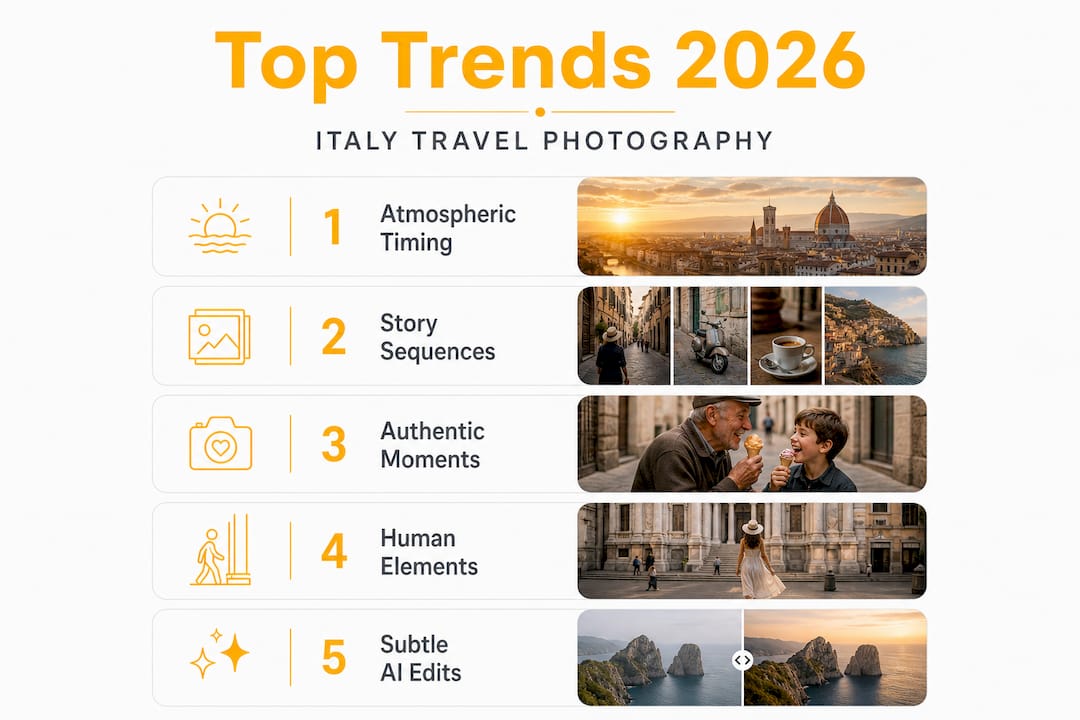
Alongside this shift, multi-image storytelling is rising powerfully across travel photography. Pairs, triptychs, and short sequences are replacing the single frame as the preferred way to share a place’s soul. A morning market in Bologna, for example, becomes far richer across three frames: the still, misty street before opening; the vivid burst of color as vendors arrange their wares; a quiet vendor’s face at closing time. Together, those images breathe.
You can explore how this applies specifically to Italian photography styles in 2026 to understand the range of visual voices finding their way through Italy’s landscapes and cities right now. The country’s sheer diversity of climate, light, and culture makes it a uniquely generous stage for this new approach.
Here are the key trends shaping what it means to photograph Italy well in 2026:
- Atmospheric timing over landmark chasing: fog, snow, rain, and low winter light create unrepeatable images
- Multi-image narratives (triptychs, pairs, sequences) as the new standard for storytelling
- Hyper-local detail: textures, shadows, and overlooked corners valued over wide signature shots
- Human presence and emotion woven naturally into landscapes and street scenes
- Intentional restraint with editing, favoring honest tones over over-saturated processing
- Seasonal specificity: planning shoots around Italy’s winter light and spring wildflower windows, not just peak tourist season
The 2026 Italy photo tour trends reflect all of this beautifully. Photographers who arrive with curiosity rather than a rigid shot list tend to return home with images that genuinely surprise even themselves.
From classic scenes to story-driven sequences
Understanding what’s trending is one thing. Putting it into practice on cobbled Venetian streets or golden Umbrian hillsides is another. Let’s look at how to actually build a compelling narrative sequence during your time in Italy.
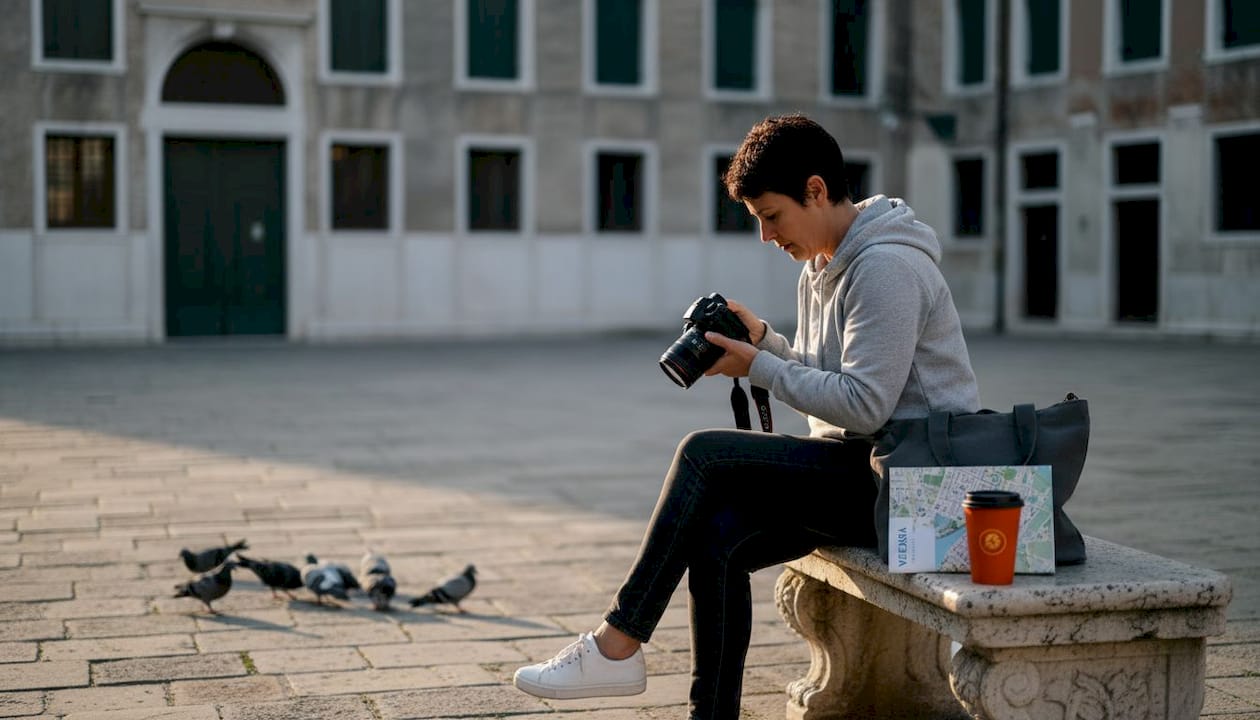
The contrast between a single iconic shot and a well-constructed sequence is stark. This table illustrates the difference clearly:
| Approach | Goal | Typical result | Emotional impact |
|---|---|---|---|
| Single hero shot | Capture a famous scene | Beautiful but familiar | Aesthetic appreciation |
| Story-driven sequence | Capture atmosphere and moments | Personal, layered, unique | Emotional connection |
| Triptych narrative | Show context, detail, and emotion | Rich, publishable, memorable | Immersive storytelling |
Multi-image storytelling is rising precisely because a single frame rarely holds the full weight of a place. Italy, with its sensory richness, seems almost to demand more than one image to be fairly represented.
Here is a step-by-step approach to planning your own three-frame Italian travel story:
- Choose a specific scene or moment, not just a location. “The morning fish market in Catania” is richer than “Sicily.”
- Shoot a wide establishing frame that places the viewer in context, showing scale and atmosphere.
- Move in for a detail shot that reveals texture, craftsmanship, or an intimate moment within the larger scene.
- Capture an action or emotional frame: a gesture, a glance, or movement that pulses with life.
- Review the three together and ask whether they tell a coherent, emotionally resonant mini-story.
- Edit them consistently so that light, tone, and color feel like pages from the same visual journal.
Learning to tell stories through Italian travel photos is a skill that grows quickly once you begin looking for sequences rather than standalone frames. The key is patience and presence, both of which Italy rewards generously.
Pro Tip: Every strong sequence includes at least one frame with a human element, even if it’s just a pair of hands, a passing silhouette, or a figure dwarfed by architecture. That human presence gives viewers an emotional anchor. Explore more cultural photo story ideas and approaches to human storytelling in Italy photos to deepen your practice. For a broader foundation, this image storytelling guide is also well worth your time.
Leveraging weather, light, and timing in Italy
Italy’s light is legendary, and rightly so. But the photographers who consistently bring home the most powerful images are the ones who understand that unexpected Italian light, the kind that arrives with a storm front or lingers after rain, is even more extraordinary than the predictable golden hour.
Landscape and travel photographers are increasingly prioritizing unique atmospheric conditions, and Italy offers them in stunning variety. Fog in the Po Valley in November turns familiar farmland into something dreamlike and mysterious. Low winter light in Tuscany from December through February rakes across cypress-lined ridges with a warmth and oblique angle that summer simply cannot match. Rome’s ancient streets after a January rain become mirror-bright, reflecting light in ways that feel almost impossibly cinematic.
This table summarizes some of Italy’s most photogenic regional and seasonal conditions:
| Region | Season | Atmospheric condition | Photographic opportunity |
|---|---|---|---|
| Tuscany | Winter (Dec to Feb) | Low golden light, morning frost | Rolling hills with dramatic raking shadows |
| Venice | Autumn (Oct to Nov) | Acqua alta floods, mist | Surreal reflections and isolation |
| Po Valley | Autumn to Winter | Dense fog | Minimalist, painterly landscapes |
| Cinque Terre | Spring (Apr to May) | Wildflower bloom, clear air | Vivid color contrast against sea |
| Rome | Winter, after rain | Wet cobblestones, low clouds | Reflection-rich street scenes |
| Sicily | Summer dusk | Hot haze, dramatic sunset | Warm, saturated golden-hour light |
To understand the full range of what Italy’s atmosphere can offer your lens, the Italy atmospheric photography guide is an essential resource. Pairing it with a deeper knowledge of natural light in Italian landscapes will sharpen your planning considerably.
When conditions shift unexpectedly on tour, consider these quick approaches to making the most of them:
- Reframe toward reflective surfaces: puddles, windows, and wet stone become compositions in themselves
- Shoot into the light during fog or haze for soft, luminous silhouettes
- Use clearing weather: the 10 minutes after a storm passes often deliver the most dramatic skies
- Embrace blue hour, the quiet period just after sunset or before sunrise, when Italy’s architecture glows with warmth against a cool sky
- Stay flexible with your schedule, allowing space to return to a location if conditions improve
Pro Tip: Never pack your camera away the moment clouds gather or rain begins. The most enchanting images often emerge in the transition, when weather changes and light does something briefly extraordinary. Study light and shadow in Italy to train yourself to see these moments before they pass.
AI and computational photography: friend or foe?
Artificial intelligence has arrived fully in the photographer’s workflow, and in 2026, the question is no longer whether to use it but how to use it wisely. For photographers on Italy tours, the distinction matters: AI can genuinely free you to shoot more and stress less, but it can also nudge you toward images that feel manufactured rather than witnessed.
The Zenfolio 2026 State of the Photography Industry Report makes the landscape clear: many photographers are using AI primarily as a workflow accelerator for administrative tasks rather than as a creative replacement. That is exactly the right approach.
“Nearly half of photographers now use AI tools weekly primarily for administrative tasks such as culling, keywording, and batch editing, not for generating or replacing original creative work.” — Zenfolio 2026 State of the Photography Industry Report
Meanwhile, AI denoising tools like DxO’s DeepPRIME XD3 are now sophisticated enough to recover detail from high-ISO shots taken in Italy’s dim cathedrals or evening festivals, without the artificial smoothing that plagued earlier generations of software. That is genuinely useful for travel photographers pushing their cameras in low light.
Here is a practical workflow for efficiently processing a full day’s worth of Italian tour images:
- Back up immediately to two separate drives the moment you return from shooting.
- Use AI culling tools to flag your best exposures, saving hours of manual review.
- Apply AI denoising to high-ISO images from indoor locations or nighttime scenes.
- Make creative edits manually: exposure, color, and composition decisions should stay yours.
- Export a selects folder and review your sequences as a group before finalizing any edits.
- Label and log edits for any images you may submit to competitions or publications.
However, authenticity and provenance concerns are growing in 2026. AI-enhanced imagery is increasingly pushing disclosure and taxonomy practices in editorial, contest, and commercial contexts. Knowing where the line sits matters.
Pro Tip: If you plan to share your Italy images beyond personal albums, keep your RAW files and a basic log of what AI processing was applied. This simple practice protects you and your work’s credibility.
Authenticity, provenance, and the backlash against over-perfection
There is a quiet but real backlash forming in 2026 against images that have been processed into a kind of frictionless, glossy unreality. For travel photographers exploring Italy, this is actually good news. It means the imperfect, the honest, and the genuinely felt are gaining in value, not losing it.
The question of what counts as “authentic” in 2026 photography deserves a clear answer:
- Authentic: In-camera decisions, natural light captured as experienced, minor exposure and color corrections
- Acceptable with disclosure: AI denoising, light sharpening, sky enhancement that reflects actual conditions
- Requires clear disclosure: Significant sky replacements, subject removal, composite elements from separate shoots
- Not authentic: Fully AI-generated scenes presented as photographs, heavy compositing that misrepresents the scene
“As AI-enhanced imagery becomes more prevalent, editorial and competition contexts are pushing harder for documentation and provenance practices, especially in higher-liability sectors.” — Fstoppers, 11 Predictions for the Photography Industry in 2026
Reputable photography tours and communities are embracing stricter authenticity standards not as restriction but as creative discipline. The challenge of capturing Italy’s real light, real weather, and real human moments as they actually appeared is the richest creative challenge there is. It demands skill, patience, and presence, qualities that no AI can replicate.
Practical steps for managing provenance on your Italy tour: keep your original RAW files always, maintain a simple edit log for significant processing, and consider enabling your camera’s GPS tagging feature to document location and time automatically.
Why chasing perfection won’t win in 2026 — embrace the real Italian experience
Here is an honest perspective, shaped by years of guiding photographers through Italy’s extraordinary light and living streets: the obsession with technical perfection is the single greatest obstacle to meaningful travel photography.
The 2026 immersion and creativity trends confirm what every thoughtful photographer eventually discovers on their own. The shift happening now is not primarily technical. It is philosophical. It is a movement toward honesty in storytelling, toward images that carry the actual weight of a place rather than a polished simulation of it.
Some of the most memorable images from Italy tours come from unexpected moments: a sudden downpour that sends everyone rushing for shelter in a Florentine arcade; a fisherman in Sicily whose expression holds an entire season of weather; a candlelit church interior so dim the camera struggles and yet somehow captures something ineffable. These are not technically perfect images. They are truthful ones, and that makes them unforgettable.
The practical wisdom here is simple: resist the urge to delete your imperfect frames immediately. What feels like a failed shot in the field often reveals itself, in quieter review, as the most alive image from the entire day. Motion blur can suggest energy. Grain can suggest intimacy. Overcast skies can deliver a softness and mood that brilliant sunshine simply cannot. Italy’s character lives in its imperfections, and the best photography honors that.
Ready to capture the new era of Italian photography?
Italy offers something rare for photographers right now: a landscape and culture so visually rich that every new technique, every shift in approach, and every moment of honest attention pays back tenfold. If these ideas have stirred something in you, the most direct path from inspiration to practice is stepping into Italy with a guide who understands both the craft and the country.

At Italy Photo Tour, our curated Italy photo tour experiences are designed precisely for photographers who want to move beyond the postcard and into genuine storytelling. Whether you are drawn to the textured warmth of Italian landscapes or the vivid human drama of Italy’s urban scenes, our tours place you in the right light, at the right moment, with the right guidance to bring your best images home. Led by professional photographer Mino Di Vita, each experience blends technical coaching with deep cultural immersion, so your photography grows alongside your love for Italy.
Frequently asked questions
How important is timing compared to location in 2026 travel photography?
Timing is now equally important as location, with atmospheric conditions and unique light often defining the strength of an image far more than simply standing in a famous place. For Italy tours, planning around weather windows and seasonal light pays enormous creative dividends.
Can I use AI editing tools for my Italy travel photos without risking authenticity?
Yes, provided you use AI for technical quality improvements like noise reduction rather than altering or generating elements of the scene. AI denoising tools enhance what you captured without replacing it, which keeps your work both strong and honest.
What’s the best way to organize and select my images on tour in 2026?
Use AI-assisted culling tools to quickly identify your strongest frames each evening, freeing your mental energy for shooting and creative decisions the next day. Nearly half of photographers now rely on AI weekly for precisely these administrative tasks.
Are there new requirements for documenting image edits due to AI in 2026?
In contest, editorial, or commercial contexts, yes. AI-enhanced imagery is driving new disclosure and provenance documentation expectations, so keeping your RAW originals and a simple edit log is becoming standard practice for serious photographers.