

Planning a photo tour in Italy is one of the most rewarding creative decisions you can make as a photographer. Yet the sheer number of moving parts, from navigating Italian power outlets to understanding Schengen entry rules, can quietly unravel even the most enthusiastic traveler’s plans. Miss one item on your packing list and you might find yourself in Tuscany without a working adapter, or in Venice without the right lens for golden-hour reflections. This checklist was built specifically for American photographers who want a frictionless, inspiring experience across Italy’s kaleidoscope of landscapes, cities, and coastal light.
Table of Contents
- How to use this checklist for your Italian photo tour
- Travel documents: What American photographers need for Italy
- Essential photography gear to pack for Italian landscapes
- Health, safety, and practical travel tips
- On-the-go workflow: Managing files and charging in Italy
- Quick comparison: Must-pack gear for city, countryside, and coast
- Checklist for capturing Italy’s cultural stories
- Tips for adjusting your checklist based on the time of year
- Plan your dream photo tour with Italian experts
- Frequently asked questions
Key Takeaways
| Point | Details |
|---|---|
| No visa hassle | US photographers don’t need a Schengen visa for trips under 90 days. |
| Pack smart for Italy | Select versatile gear and adapters, and bring essentials to be ready for different landscapes and cities. |
| Stay healthy and prepared | Carry your preferred medications, use travel insurance, and know Italy’s safety basics to stay stress-free. |
| Backup your images daily | Plan an easy workflow to safeguard your photos every day on tour. |
| Pay in EUR, not USD | Always choose euros for purchases to avoid extra conversion fees. |
How to use this checklist for your Italian photo tour
Think of this guide as a living document you can customize before, during, and after your journey. It covers everything from travel documents and photography gear to on-the-ground workflow and cultural storytelling. The 2026 photography checklist on Italy Photo Tour’s site is a great companion resource to bookmark alongside this one.
US photographers face a distinct set of considerations that travelers from other countries simply don’t encounter in the same way. Power adapters, passport validity windows, and medication availability all require specific attention. As a starting point, review USA-specific travel requirements to understand what’s unique to your situation before diving into the sections below.
Here’s how to approach each section:
- Before your trip: Focus on documents, gear assembly, and health prep.
- During your tour: Prioritize workflow, cultural engagement, and daily backups.
- After your tour: Organize files, review images, and reflect on storytelling.
Pro Tip: Tailor the gear section based on your primary shooting style. A street photographer heading to Rome needs a very different kit than a landscape enthusiast bound for the Dolomites.
Travel documents: What American photographers need for Italy
Once your planning framework is set, the next step is making sure your paperwork is airtight before you board. A missing document at the airport is the kind of story no photographer wants to tell.
Your passport must be valid for at least six months beyond your return date. Americans under 90 days do not need a Schengen visa for tourism, which includes photography tours. That’s a genuine relief for spontaneous planners, but it doesn’t mean you travel light on documentation.
Here’s what to prepare when planning Italy photo tours:
- Passport: Valid for six months past your return date.
- Travel insurance: Covers gear theft, medical emergencies, and trip cancellations.
- Digital and paper copies: Store copies in cloud storage and a separate bag.
- International driving permit: Required if you plan to rent a car in rural areas.
- Health documentation: Vaccination records if relevant to your itinerary.
Carry a printed copy of your travel insurance policy. In an emergency, digital access isn’t always guaranteed, and Italian hospitals will appreciate having clear documentation on hand.
Essential photography gear to pack for Italian landscapes
With documentation checked off, the focus shifts to assembling your core kit. Italy’s visual richness demands versatility. You’ll move from narrow cobblestone alleys to sweeping coastal cliffs within a single day, and your gear needs to keep pace.
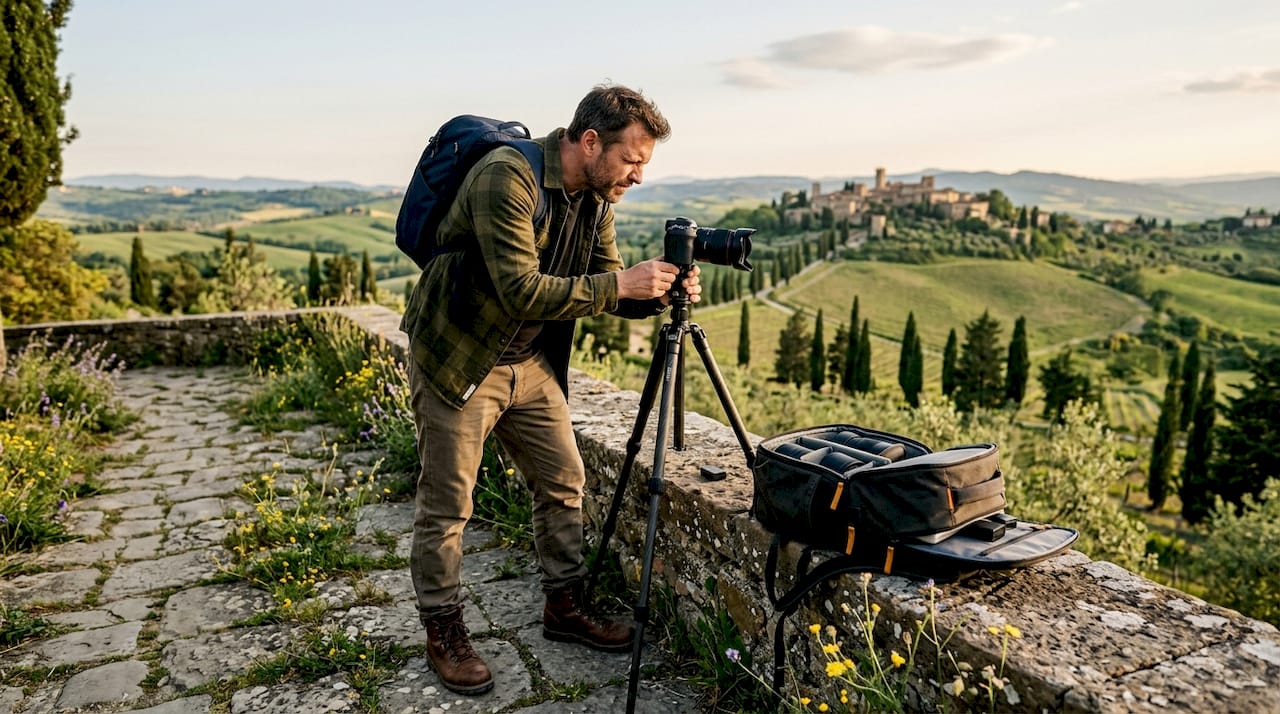
Explore the best camera gear for Italy to see curated recommendations for different shooting environments. For a broader overview, the essential photo tour gear guide covers the six items no photographer should leave home without.
Here’s a practical gear list:
- Camera body: A mirrorless or DSLR with good low-light performance.
- Lenses: A wide-angle (16-35mm) for landscapes, a 50mm for street, and a short telephoto for portraits.
- Travel tripod: Lightweight carbon fiber works beautifully for long exposures.
- Power adapter: Italy uses EU Type C, F, and L plugs. American gear won’t work without one.
- Extra memory cards and batteries: Plan for full shooting days without reliable charging access.
- Rain cover and lens cleaning kit: Italian weather is unpredictable, especially in spring and fall.
- Optional: Drone (check local regulations), portable SSD, and a laptop for evening edits.
Pro Tip: Pack preferred medications from home. Italian pharmacies are excellent, but they may not carry your specific brand or formulation, and explaining a prescription in a foreign language adds unnecessary stress.
Health, safety, and practical travel tips
Once your gear is secure, don’t overlook the everyday essentials that keep your travels smooth. Italy is a safe and welcoming country, but a few practical habits will protect both your health and your images.
Pharmacies, known as farmacie, are widely available across Italian cities and towns. Still, bring any prescription or preferred over-the-counter medications from home. Tap water in major cities is safe to drink, though many locals prefer bottled water, especially in smaller towns.
Follow this step-by-step Italy photography guide for on-the-ground advice that goes beyond gear. A few additional tips worth noting:
- Currency: Always pay in EUR, not USD. Dynamic currency conversion, where a merchant offers to charge you in dollars, almost always results in a worse exchange rate.
- Safety: Organized photo tours reduce the risk of getting lost or entering restricted areas unknowingly.
- Power disruptions: Italy occasionally experiences brief strikes or outages. Carry a fully charged power bank every day.
- Dress codes: Many churches and historic sites require covered shoulders and knees. Keep a light scarf in your bag.
On-the-go workflow: Managing files and charging in Italy
With health and safety covered, protecting your images becomes the next priority. Losing a day’s worth of shots to a corrupted card is a heartbreak no photographer should experience.
Italy uses EU Type C, F, and L plugs, so your American chargers need adapters. Bring at least two adapters and keep one in your camera bag at all times. Here’s a daily workflow that keeps your files safe:
- Morning: Format a fresh memory card before heading out. Label used cards clearly.
- Midday: If you have a break, transfer morning shots to a portable SSD.
- Evening: Back up all files to both a portable drive and cloud storage.
- Before bed: Charge all batteries and confirm your adapter is working.
- Weekly: Review and cull images to free up storage and keep your archive organized.
Pro Tip: Use the urban photography workflow tips from Italy Photo Tour to build a rhythm that fits your shooting pace. A consistent routine prevents the chaos of arriving home with thousands of unsorted, unbacked images.
Quick comparison: Must-pack gear for city, countryside, and coast
Once you understand the basics of an organized workflow, tailoring your kit to each Italian environment becomes intuitive. Italian landscapes and urban stories genuinely require different core gear setups, and packing smart saves weight without sacrificing creative range.
For a deeper breakdown of location-specific shooting strategies, the Italy photography essential tips guide is an excellent resource.
| Environment | Must-have gear | Key consideration |
|---|---|---|
| City (Rome, Milan) | Wide-angle lens, lightweight body, extra batteries | Compact kit for crowded streets and quick movement |
| Countryside (Tuscany) | Telephoto lens, sturdy tripod, weather protection | Long distances between subjects; unpredictable weather |
| Coast (Amalfi, Cinque Terre) | ND filter, waterproof bag, portable cleaning kit | Salt air and spray require frequent lens cleaning |
Checklist for capturing Italy’s cultural stories
After gear and logistics, the most transformative element of any photo tour is the human and cultural layer. Italy’s streets, markets, and festivals are alive with stories waiting to be told through your lens.
Cultural immersion amplifies the storytelling power of your images in ways that no lens upgrade ever could. Explore the artistic travel photography in Italy guide for inspiration on weaving narrative into every frame.
Here’s a storytelling checklist to carry with you:
- Ask permission before photographing individuals, especially in intimate or religious settings.
- Visit local markets early in the morning when vendors are setting up and light is soft.
- Attend a local festival or sagra (food festival) for authentic, unscripted moments.
- Study the light at your location before shooting. Notice how shadows fall across ancient stone.
- Dress respectfully at churches, monasteries, and heritage sites to gain access and build trust.
The most powerful images from Italy are rarely of landmarks alone. They are of the fisherman mending nets at dawn, the grandmother hanging laundry above a sun-drenched alley, the child chasing pigeons in a piazza. Seek the human story within the landscape.
Tips for adjusting your checklist based on the time of year
To get the most from your Italian photo adventure, adapt your plans to what each season brings. Seasonal variations genuinely impact both your packing priorities and your shooting opportunities. Review the 8 key Italy photo checklist steps for a season-by-season breakdown.
- Spring (April to June): Layers are essential. Rain showers arrive without warning, but they also create dramatic skies and reflective puddles that are a gift to photographers.
- Summer (July to August): Pack sun protection, a wide-brimmed hat, and a hydration plan. Crowds peak at major sites, so arrive before 8 a.m. for cleaner compositions.
- Fall (September to October): Golden light, harvest colors in Tuscany, and thinner crowds make this many photographers’ favorite season.
- Winter (November to February): Bring a sturdy tripod for long exposures in low light, warm layering, and rain covers. The reward is an Italy that feels intimate and unhurried.
Each season paints Italy in a different palette, and your checklist should reflect that shift in mood, light, and weather.
Plan your dream photo tour with Italian experts
Building your own checklist is a powerful first step, but there’s something irreplaceable about exploring Italy alongside someone who knows its light, its rhythms, and its hidden corners intimately. Italy Photo Tour, led by professional photographer Mino Di Vita, offers curated experiences designed specifically for photographers who want more than a sightseeing trip.

Learn how Italy Photo Tour works to understand the philosophy behind each journey. Whether you’re drawn to the golden fields of Tuscany, the shimmering canals of Venice, or the vivid facades of Cinque Terre, there’s a tour shaped around your creative vision. Browse the full range of Italian photo tour options or visit the main explore Italy photo tours page to find the experience that speaks to you. Every detail, from gear guidance to cultural storytelling, is handled with care so you can focus entirely on making images that matter.
Frequently asked questions
Do I need a visa for a short photography trip to Italy from the USA?
No, US citizens under 90 days do not need a Schengen visa for tourism, including photo tours. Just ensure your passport is valid for at least six months beyond your return date.
What are the best months for an Italian photo tour?
Spring (April to June) and fall (September to October) offer the most rewarding combination of soft light, manageable crowds, and varied seasonal landscapes for photographers of all levels.
Can I buy camera equipment or medications easily in Italy?
Camera stores and pharmacies are common in Italian cities, but it’s always wiser to bring your preferred medications and any critical gear from home to avoid compatibility or availability issues.
How can I keep my images safe during an Italian photo tour?
Back up your files daily to both a portable drive and cloud storage, and always carry extra memory cards and batteries to protect against data loss from corrupted cards or unexpected power issues.
Is it better to pay in USD or EUR for purchases in Italy?
Always pay in EUR. Dynamic currency conversion offered at point of sale almost always applies an unfavorable rate, costing you more than simply paying in the local currency.