

TL;DR:
- Italy offers diverse landscapes, including mountains, coastlines, hills, and lakes, ideal for varied photography.
- Capturing iconic scenes requires careful planning around season, timing, weather, and equipment.
- Less-known details and off-the-beaten-path locations often yield more compelling and memorable images.
Italy is an artist’s palette stretched across an entire country, where every turn reveals a new masterpiece waiting to be captured. From the jagged, rose-tinted peaks of the Dolomites to the sinuous cypress-lined hills of Tuscany, the sheer diversity of Italian landscapes can feel as overwhelming as it is enchanting. Knowing where to point your lens, when to arrive, and how to frame the scene makes the difference between a snapshot and a story. This guide takes you through the most inspiring Italian landscapes for photographers, paired with practical, expert-tested tips to help you bring home images that truly sing.
Table of Contents
- How to choose your Italian landscape targets
- Majestic mountains: Photographing the Dolomites
- Timeless hills: Capturing Tuscany’s Val d’Orcia
- Spectacular coasts: Amalfi, Cinque Terre, and Sardinia
- Serene lakes: Northern Italy’s reflections and villas
- Our perspective: The landscapes you overlook matter most
- Bring your vision to life with Italy Photo Tour
- Frequently asked questions
Key Takeaways
| Point | Details |
|---|---|
| Choose by region and season | Italy’s landscapes offer different magic depending on the region and time of year. |
| Gear and timing matter most | The right lens, filters, and shooting at golden hour can turn good locations into great shots. |
| Lake, coast, mountains variety | Italy uniquely combines alpine drama, rolling hills, seascapes, and serene lakes for photographers. |
| Plan ahead for crowds | Reaching locations early and off-season results in more rewarding photography experiences. |
How to choose your Italian landscape targets
Now that you’re inspired to capture Italy’s beauty, let’s start with how to select the perfect landscapes for your photography journey. Italy’s geography is strikingly varied, offering mountains, rugged coastlines, rolling countryside, and glassy northern lakes all within the same country. That variety is a gift, but it also demands a clear-eyed approach to planning. Before you book a flight, ask yourself what kind of light, mood, and subject matter speaks most deeply to your creative vision.
The country’s artistic impact of Italian landscapes is shaped by iconic elements: the sentinel cypress trees of Val d’Orcia, the candy-colored cliffside villages of Cinque Terre, the turquoise bays of Sardinia. Each region rewards a different lens choice and a different state of mind. Think about whether you crave the drama of altitude or the calm of a lakeside morning.
Seasonality matters enormously. Spring and autumn bathe the countryside in warm, golden tones and softer light, while winter strips the landscape to a quiet minimalism that rewards patient, contemplative photographers. Summer brings vivid colors but also harsh midday shadows and thick crowds.
Here are key criteria to guide your selection:
- Geography: Mountains, coastlines, countryside, or lakes — each demands different gear and timing.
- Iconic elements: Cypress trees, cliffside villages, turquoise waters, and ancient chapels anchor the most memorable compositions.
- Seasonality: Spring wildflowers, autumn mist, and winter minimalism each offer distinct moods.
- Crowds: Popular spots like Positano peak in July and August. Off-season visits reward you with solitude.
- Equipment: Wide-angle lenses for mountains and seascapes, telephoto for compressing Tuscany’s rolling hills, and a sturdy tripod for low-light golden hour work.
Pro Tip: Shoot during golden hour (30 to 60 minutes after sunrise or before sunset) to bathe your scenes in warm, directional light. Arrive pre-dawn at popular spots to claim your position before the crowds arrive. Explore more ideas in our Italy landscape photography tips guide.
Majestic mountains: Photographing the Dolomites
Once you’ve defined your criteria, the Dolomites stand out as a first must for mountain lovers. Here’s why. These UNESCO-listed peaks in northeastern Italy are unlike any other mountain range on earth. Their pale limestone towers glow amber and rose at alpenglow, a phenomenon that turns the entire sky into a cathedral of color. No filter needed.
Dramatic mountain landscapes define the Dolomites, with legendary spots including Tre Cime di Lavaredo, Lago di Braies, Alpe di Siusi, Seceda, and Lake Misurina each offering a completely different visual character. Tre Cime di Lavaredo delivers raw, towering drama. Lago di Braies mirrors the surrounding peaks in its emerald waters. Alpe di Siusi offers sweeping alpine meadows that feel almost surreal in morning light.
“The Dolomites at alpenglow are one of those rare photographic experiences where reality genuinely surpasses imagination. The mountains seem to radiate their own inner light.”
Best seasons for the Dolomites are summer and autumn, when hiking trails are accessible and alpenglow is most reliable. Avoid the flat, shadowless light of midday. Instead, plan your shoots around the first and last hours of daylight.
Key shooting tips for the Dolomites:
- Wide-angle lens: Ideal for capturing the full sweep of peaks and meadows.
- Tripod: Essential for low-light alpenglow and long-exposure lake reflections.
- Polarizing filter: Deepens the blue of alpine skies and cuts glare on water.
- Weather awareness: Alpine conditions change fast. Always carry a rain cover for your gear.
- Altitude: Some viewpoints sit above 2,000 meters. Acclimatize and pace yourself.
Pro Tip: Before heading out, review our landscape photography checklist to make sure you have everything you need for a full day in the mountains.
Timeless hills: Capturing Tuscany’s Val d’Orcia
From mountain heights, immerse yourself in the gentle, rolling landscapes of Tuscany’s Val d’Orcia. This UNESCO World Heritage valley is perhaps the most painted, sketched, and photographed landscape in all of Italy, and for good reason. Its soft, undulating hills seem to breathe in the morning mist, while rows of cypress trees march across the ridgelines like dark, elegant sentinels.
Iconic rolling hills, cypress trees, and chapels define Val d’Orcia’s visual identity, with the Cappella della Madonna di Vitaleta and Podere Belvedere among the most beloved compositions. Both reward early arrivals who catch the low-angle light painting long shadows across the furrows.
Spring and autumn are the finest seasons here. Spring brings wildflowers and vivid green fields, while autumn drapes the hills in amber and gold. Midday light in summer flattens the landscape and washes out the subtle tonal gradations that make Val d’Orcia so enchanting.
For framing, try both the classic wide-angle view that sweeps across multiple ridgelines and a telephoto approach that compresses the layers of hills into a rich, painterly tapestry. The telephoto perspective, often overlooked, creates a sense of depth and intimacy that feels almost three-dimensional. Check our full collection of Italy photo tips for more framing strategies.
Key locations and tips:
- Cappella della Madonna di Vitaleta: Best at sunrise with a 70 to 200mm lens.
- Podere Belvedere: Classic S-curve road framed by cypress trees.
- Morning mist: Arrive before 7 a.m. in spring for atmospheric fog layers.
- Telephoto compression: Use 135mm or longer to stack the rolling hills dramatically.
Pro Tip: For an immersive guided experience in Val d’Orcia, consider the Tuscany landscape tours led by professional photographer Mino Di Vita, where light and storytelling take center stage.
Spectacular coasts: Amalfi, Cinque Terre, and Sardinia
Italy’s coastal regions offer a very different mood from the countryside. Let’s see where and how to shoot the best seaside scenes. The Italian coastline is a theater of contrasts: pastel villages clinging to vertical cliffs, ancient fishing boats bobbing in turquoise coves, and limestone arches framing the open sea.
The Amalfi Coast delivers coastal cliffs and colorful villages like Positano and Ravello, with the Path of the Gods trail offering dramatic elevated seascapes that stretch to the horizon. Meanwhile, Cinque Terre’s five cliffside villages, including Riomaggiore, Manarola, Corniglia, Vernazza, and Monterosso, stack their painted houses above the sea in compositions that feel almost impossibly picturesque. Eastern Sardinia’s Gulf of Orosei and Cala Goloritzé showcase turquoise seas, limestone cliffs, and the dramatic Gorropu canyon.
Here’s a quick comparison to help you choose:
| Location | Landscape type | Crowd level | Best season | Accessibility |
|---|---|---|---|---|
| Amalfi Coast | Cliffs, villages, sea | High | Spring, autumn | Moderate |
| Cinque Terre | Cliffside villages, trails | Very high | Spring, autumn | Easy |
| Sardinia (Gulf of Orosei) | Wild coast, canyons, coves | Low to moderate | Summer, early autumn | Challenging |
For coastal shooting, a wide-angle lens captures the full sweep of sea and cliff, while a polarizing filter is indispensable for cutting glare and revealing the jewel tones beneath the water’s surface. Explore different Italian photography styles to find the approach that resonates with your vision. For a deeper look at Cinque Terre’s photographic potential, the Cinque Terre photo guide by Mino Di Vita is an invaluable resource.
Serene lakes: Northern Italy’s reflections and villas
Besides the coasts and hills, Northern Italy’s lakes provide a tranquil, reflective canvas for photographers. Lake Garda, Lake Como, and Lake Maggiore each possess a distinct character, but all share that quality of stillness that turns the water into a mirror, doubling the beauty of the mountains and villas that line their shores.
Lake Garda, Lake Como, and Lake Maggiore feature serene waters backed by mountains and elegant villas, offering a painterly elegance that feels timeless. At Lake Como, the village of Varenna and the gardens of Villa del Balbianello are perennial favorites. Lake Maggiore’s Borromean Islands rise from the water like a dream. Lake Garda’s southern shores blend soft light with olive groves and medieval towers.
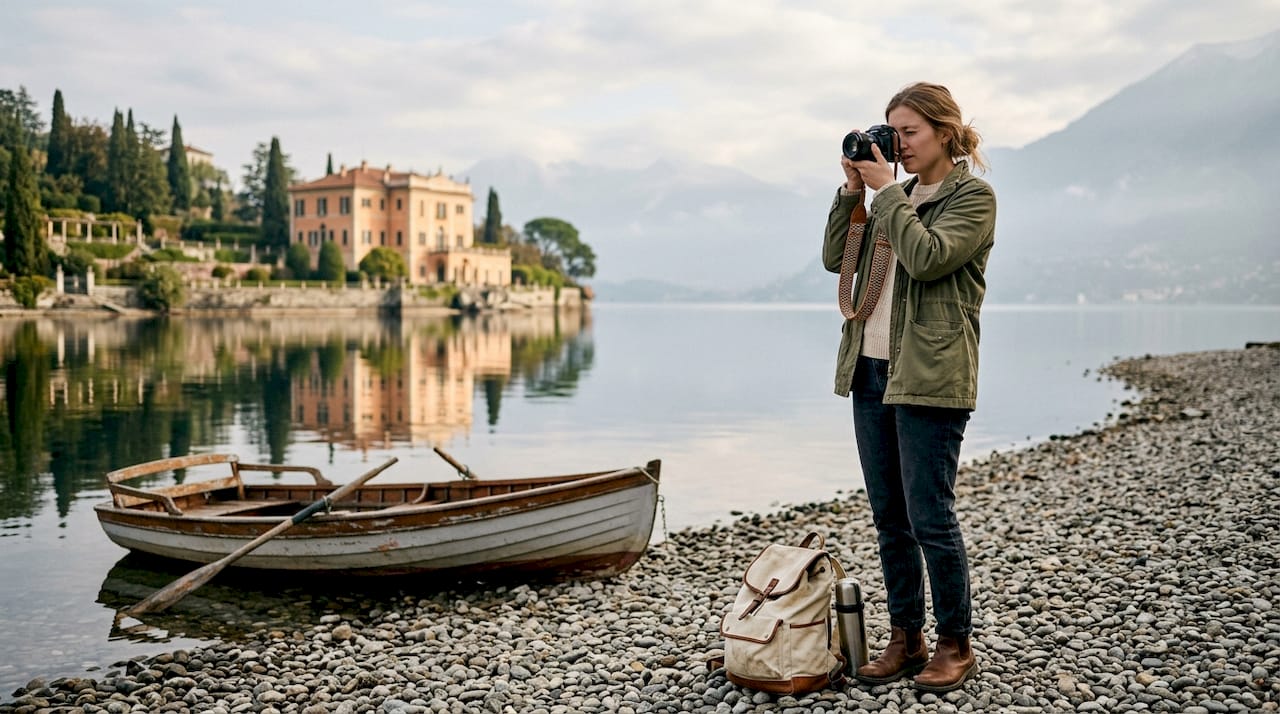
Here’s a comparison of the three lakes:
| Lake | Key photographic appeal | Best time | Ease of access |
|---|---|---|---|
| Garda | Olive groves, medieval towns, wide vistas | Spring, autumn | Very easy |
| Como | Villas, mountain backdrops, narrow villages | Spring, autumn | Easy |
| Maggiore | Borromean Islands, formal gardens, mist | Autumn, early spring | Easy |
For reflections, still water is everything. Early morning, especially in autumn when mist lingers on the surface, produces the most ethereal results. An ND filter allows you to extend your exposure and smooth out any gentle ripples. Study the art of capturing natural light in Italy to make the most of those luminous lakeside mornings.
Key tips:
- Arrive early: Still water and soft light last only 30 to 45 minutes after sunrise.
- Use a tripod: Long exposures smooth the water and deepen the reflection.
- Off-season visits: October and November bring mist, color, and near-empty promenades.
- Lake Como inspiration: Explore Lake Como landscape inspiration for curated viewpoints and seasonal guidance.
Pro Tip: Shoot from a low angle at the water’s edge to maximize the reflection and create a sense of immersive depth in your frame.
Our perspective: The landscapes you overlook matter most
Every photographer who visits Italy for the first time gravitates toward the same postcard images, and there is nothing wrong with that. The cypress-lined road at sunrise, the Dolomites at alpenglow, Manarola reflected in the sea. These images endure because they are genuinely extraordinary. But here is what years of photographing Italy have taught us: the images that move people most deeply are rarely the ones taken at the most famous viewpoint.
The real magic tends to happen in the quiet moments between iconic shots. A weathered farmer’s gate in Val d’Orcia. A fishing net drying on a wall in Vernazza. The way fog clings to a hillside vineyard at 6 a.m. before anyone else has arrived. These details carry the soul of a place in a way that a wide-angle panorama sometimes cannot.
We encourage you to use this guide as a starting point, not a checklist. Let the famous locations draw you in, then allow yourself to wander. Italy rewards curiosity. The less-traveled path beside the lake, the unmarked chapel on the ridge, the village square at dusk. These are the frames that will define your portfolio and, more importantly, your memory of the journey.
Bring your vision to life with Italy Photo Tour
Capturing Italy’s landscapes at their finest takes more than a great camera. It takes knowing where to stand, when to arrive, and how to read the light as it shifts across the hills and water.

Italy Photo Tour, led by professional photographer Mino Di Vita, offers intimate, curated photography experiences across Tuscany, the Dolomites, Cinque Terre, and the northern lakes. Each tour is designed to sharpen your eye, deepen your connection to the landscape, and help you return home with images that genuinely tell a story. Whether you are picking up a camera for the first time or refining a practiced craft, there is a journey here waiting for you.
Frequently asked questions
What is the best time of year to photograph Italian landscapes?
Spring and autumn offer the best light, colors, and fewer crowds across most Italian landscapes, with spring wildflowers in Tuscany and autumn alpenglow in the Dolomites standing out as seasonal highlights.
What gear should I bring for landscape photography in Italy?
A wide-angle lens, tripod, polarizing filter, and ND filters are essential for most Italian landscapes. Use polarizing and ND filters for skies and water, and consider focus stacking techniques for maximum depth of field in wide scenes.
How can I avoid crowds when photographing popular Italian spots?
Arrive pre-dawn or shoot on weekdays and during the off-season to find the landscapes quieter and the light far more rewarding than the midday rush.
Are Italian landscapes accessible for beginner photographers?
Many iconic Italian landscapes are easily accessible by car or public transport, and stunning images are absolutely within reach using basic gear and a willingness to wake up early for the light.
Which Italian landscape region offers the most variety for photographers?
Northern Italy, including the Dolomites and the lakes, offers remarkable diversity, from dramatic mountain peaks and alpine meadows to tranquil lake reflections and elegant lakeside villas, all within a relatively compact area.