

TL;DR:
- Preparation with the right tools and local insights transforms Milan photography into an intentional experience.
- Timing, research, and patience are key to discovering both iconic and hidden Milan photo spots.
- Respecting access rules, privacy laws, and adapting to weather conditions ensures safe, ethical, and creative shooting.
Milan rewards photographers who are willing to look past the obvious. Yet arriving in this layered, ever-shifting city with a camera and no plan can feel genuinely overwhelming. Where do you begin when every piazza seems crowded, every rooftop requires a code, and every neighborhood is mid-renovation? This guide is built for photographers who want more than tourist snapshots. It walks you through preparation, scouting strategy, access etiquette, weather adaptation, and how to document your finds so every Milan photo walk feels intentional, alive, and full of possibility.
Table of Contents
- Scout preparation: Tools, planning, and inspiration sources
- Step-by-step: How to find standout Milan photo locations
- Navigating Milan’s access, safety, and privacy barriers
- Adapting to Milan’s weather and cityscape changes
- Documenting, verifying, and sharing your finds
- Our perspective: The real magic of Milan location scouting
- Ready to elevate your Milan photography? Explore more
- Frequently asked questions
Key Takeaways
| Point | Details |
|---|---|
| Plan with purpose | Pre-scouting with tools and local knowledge maximizes your time and results in Milan. |
| Respect rules and privacy | Understand local regulations for drones, tripods, and portrait photography to avoid trouble. |
| Stay flexible on location | Adapt to weather, crowds, or construction by having backup spots and being open to surprise moments. |
| Document and verify finds | Keep detailed notes and check access or changes before returning for your main photo session. |
| Enjoy the process | The most memorable Milan photos often result from exploration, patience, and connecting with the local scene. |
Scout preparation: Tools, planning, and inspiration sources
Before you step onto a single cobblestone, preparation transforms a wandering walk into a purposeful creative expedition. Milan is one of those cities that rewards the photographer who arrives curious but not empty-handed. Understanding why Milan attracts photographers helps you frame your research with the right artistic lens from the very start.
Your toolkit matters. A reliable weather app like Weather Underground or Windy helps you predict fog, golden light, and overcast conditions. A mapping app with offline capability, such as Maps.me or Google Maps with saved layers, lets you annotate locations even without signal. Carry a small notebook for sketching compositions and jotting crowd observations. Extra batteries and a portable charger are non-negotiable in a city where you may walk for six hours straight. Comfortable shoes are, honestly, as important as your lens choice.
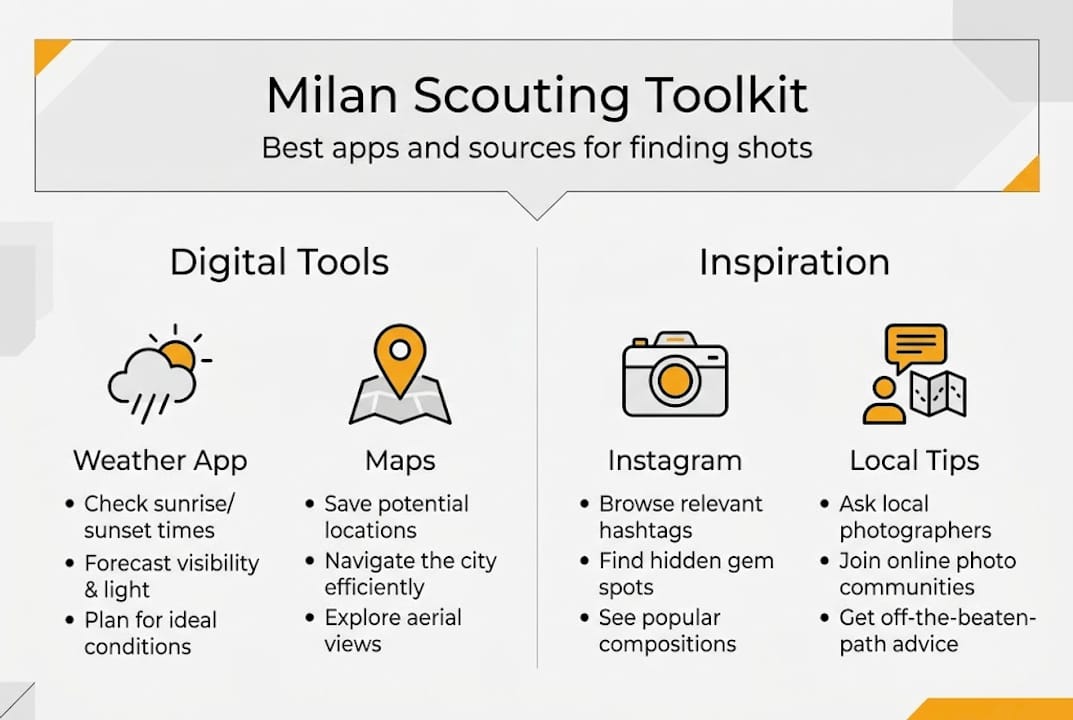
For digital inspiration, Instagram geo-tags tied to Milan neighborhoods are a goldmine. Search hashtags like #MilanoPhotography, #MilanoStreet, or #MilanHiddenGems to surface recent, location-specific work. Photo blogs and curated Pinterest boards reveal angles that guidebooks overlook. Exploring unique Italian photo spots online before your trip gives you a visual vocabulary for what you are seeking.
Local knowledge is irreplaceable. Experts use network-building and online tools to scout elusive and private locations in Milan, and you can borrow from that same spirit. Befriend a barista near the Navigli canals. Visit an independent bookstore in Brera. Shopkeepers often know which courtyard is unlocked on weekday mornings or which terrace has a view that no app has indexed yet.
| Tool type | Example | Best use |
|---|---|---|
| Weather app | Windy, Weather Underground | Predict fog, golden hour |
| Mapping app | Google Maps, Maps.me | Save and annotate locations |
| Social discovery | Instagram geo-tags | Find recent, local shots |
| Local intel | Baristas, bookshops | Access private or semi-private spots |
| Notebook | Any pocket journal | Sketch compositions, note light |
Pro Tip: Save Instagram posts from Milan photographers to a private collection, then cross-reference their locations on a map before your walk. You will arrive with a mental library of angles, not just addresses.
Step-by-step: How to find standout Milan photo locations
Once equipped and inspired, apply this step-by-step system to uncover both iconic and unexpected Milan photo locations.
Step 1: Set your theme. Decide before you leave whether you are chasing modernist architecture, old-world courtyards, street life, or minimalist geometry. A clear theme sharpens your eye and prevents the paralysis of too many choices.
Step 2: Start with the known, then branch outward. Visit the Galleria Vittorio Emanuele II or the Duomo early, then walk the surrounding side streets. The famous spots anchor your route; the unexpected ones define it. Following a minimalist photography Milan guide can help you see even iconic locations with fresh restraint.
Step 3: Layer your research. Cross-reference Instagram hashtags, Google Maps reviews, and local photography forums. Each source reveals a different layer of the city’s visual character.
Step 4: Visit at different times. Golden hour bathes Milan’s stone facades in amber warmth. Evening brings neon reflections in the Navigli canals. Off-peak hours, particularly weekday mornings before nine, transform busy piazzas into quiet, breathable compositions.
Step 5: Take test shots and adapt. Your first visit to a location is a rehearsal. Shoot freely, note what works, and adjust your return visit accordingly. Amateurs can succeed with public alternatives and local tips compared to pros with access to private sites, and that creative problem-solving often produces the most original images.
To help you weigh your options, here is a comparison of location types:
| Location type | Access | Crowd factor | Photo flexibility |
|---|---|---|---|
| Public (piazzas, streets) | Open | High | Moderate |
| Semi-private (courtyards, passages) | Ask permission | Low to medium | High |
| Private (rooftops, interiors) | Network or permit | Very low | Very high |
Pro Tip: Use Google Street View to pre-walk a route and identify potential foreground elements, leading lines, and shadow patterns before you arrive in person. It saves enormous time on the day.
Knowing how to find hidden photo spots across Italy applies beautifully to Milan’s labyrinthine neighborhoods, where a single arched doorway can open onto an entirely different visual world.
Navigating Milan’s access, safety, and privacy barriers
Now that you have a scouting process, it is vital to anticipate and work within the rules and etiquette specific to Milan. The city is generous with beauty but firm about boundaries.
Drones are strictly regulated in Milan, and privacy laws apply for portraits and use of equipment in public spaces. Flying without a permit risks fines and confiscation. Instead of a drone, consider elevated vantage points: the rooftop of the Duomo, the Palazzo Lombardia observation deck, or upper-floor windows of cooperative cafes. A sturdy gorilla-style flexible tripod is a quieter, legal alternative for stable shots in tight spaces.
For street portraits, Italy’s privacy framework requires that recognizable individuals give consent before their image is used commercially or published. In practice, a warm smile and a gesture toward your camera go a long way. Learning a few words of Italian, “Posso fare una foto?” (May I take a photo?), builds immediate goodwill and often leads to richer, more relaxed portraits.
When approaching semi-private spaces like shared courtyards or building passages, knock or ring the intercom, explain your artistic intent briefly, and accept a refusal gracefully. Many Milanese residents are proud of their architectural heritage and genuinely enjoy sharing it with respectful visitors.
For personal safety, keep your camera strap secure and your bag zipped in crowded areas like the Centrale train station or busy market streets. Scout alone during daylight; return for your main shoot with a companion if the location feels isolated at night. Reviewing urban photography tips Italy can help you balance creative ambition with practical awareness.
“The most memorable Milan photographs are rarely taken in defiance of the city’s rhythms. They emerge from patience, courtesy, and a willingness to ask.”
Adapting to Milan’s weather and cityscape changes
Even with careful planning, Milan’s weather and ever-changing cityscape demand flexibility. This is a city that renovates constantly, where a beloved alley can disappear behind scaffolding overnight.
Fog is Milan’s most dramatic atmospheric gift. Weather events like fog change the city’s look entirely and provide creative opportunities, particularly from elevated spots above the mist. The rooftop of the Duomo on a foggy November morning offers a surreal, almost dreamlike panorama that no summer postcard can replicate.
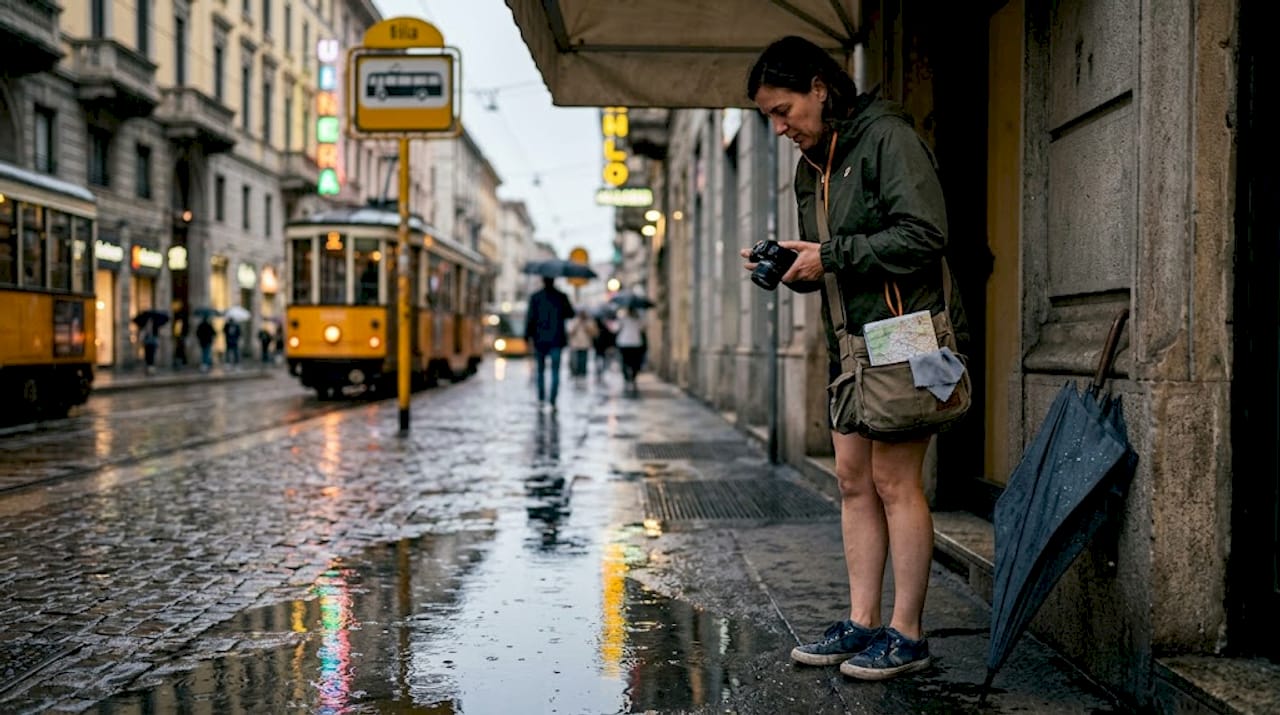
For rain, embrace it rather than retreat. Wet cobblestones mirror streetlights and neon signs with extraordinary vividness. A small umbrella and a weather-sealed camera body or a simple rain sleeve transform a gray afternoon into a session full of chiaroscuro richness.
Seasonally, late autumn and early winter bring fewer tourists, softer light, and the possibility of fog. Spring offers blooming courtyards and long golden hours. Summer is vibrant but crowded; early mornings are your salvation. Understanding urban photography workflow Italy helps you build seasonal flexibility into your planning from the start.
Here is a quick action list for last-minute weather pivots:
- Check your weather app the night before and identify the best two-hour window.
- Prepare a backup indoor location, such as the Galleria or a covered market.
- Identify one elevated viewpoint for fog or overcast conditions.
- Pack a rain sleeve and a microfiber cloth for lens protection.
- Adjust your white balance and ISO presets before leaving the hotel.
For golden hour timing in Milan, the Milan golden hour tips resource offers precise seasonal guidance that can anchor your entire day’s schedule around the best available light.
Documenting, verifying, and sharing your finds
With your photos and notes in hand, the final step is organizing your discoveries so they serve you again and again.
Annotate every location you scout with at least four details: the quality and direction of light at the time of your visit, the crowd level, any physical obstacles (parked vehicles, construction), and the best time window to return. Apps like Notion, Google Keep, or even a voice memo work beautifully for this. The key is consistency.
Pro scouts’ methods can be adapted by amateurs using digital tools and local tips for location tracking, and building your own personal Milan location library is one of the most rewarding long-term habits a photographer can develop.
Before returning to a location for your main shoot, verify conditions. Check whether access has changed, whether construction has begun, and whether the light you loved in autumn still behaves the same way in spring. A quick Google Maps street view update or a message to a local contact can save a wasted journey.
Sharing your finds with the photography community is a generous act, but do it thoughtfully. Posting precise GPS coordinates of a fragile or semi-private location can overwhelm it with visitors. Instead, describe the neighborhood and the mood. Invite curiosity without handing over a map. Joining Milan photo walk workshops connects you with a community that understands this balance instinctively.
Key habits for documenting your scouting sessions:
- Note light direction and quality at the time of visit
- Record crowd level and best visiting window
- Flag any access restrictions or permission requirements
- Back up notes to cloud storage immediately
- Share responsibly: neighborhood context, not exact coordinates
Pro Tip: Create a simple spreadsheet with columns for location name, neighborhood, best time, light quality, crowd rating, and access notes. After ten Milan visits, you will have a personal scouting atlas that no app can replicate.
Our perspective: The real magic of Milan location scouting
Here is something worth saying plainly: no list of locations, however carefully researched, guarantees a great photograph. Milan is a living, breathing city, and it will surprise you regardless of how meticulously you have planned.
The most extraordinary images we have seen from Milan were not taken at the “best” spots. They were taken by photographers who paused when something felt right, who struck up a conversation with a stranger in a doorway, who waited twenty minutes for the light to shift. Understanding Milan’s unique photo appeal is ultimately about recognizing that the city’s soul reveals itself to those who are patient enough to receive it.
Scouting is not a checklist. It is a practice of attention. The courtyard that disappoints you on a Tuesday afternoon may stun you on a foggy Friday morning. The alley you almost skipped may hold the most honest portrait of Milanese daily life you will ever capture. Trust the process, stay curious, and let the city lead sometimes.
Ready to elevate your Milan photography? Explore more
Putting these strategies into practice is far more rewarding when you have an experienced guide beside you, someone who knows which courtyard door to knock on, when the light falls perfectly on a forgotten facade, and how to read the city’s ever-shifting mood.

Italy Photo Tour offers immersive Milan photo tours led by professional photographer Mino Di Vita, designed to bring these scouting principles to life in real time. Whether you are drawn to the grandeur of the Duomo or the quiet poetry of the Navigli at dusk, our guided walks reveal the city’s true character. Explore our full range of Italy photography tours for inspiration beyond Milan, and browse our best camera gear tips to ensure you are perfectly equipped for every session.
Frequently asked questions
Is it legal to use drones for photography in Milan?
Drone use is strictly regulated in Milan; permits are required and many central and residential areas are designated no-fly zones, so always check current ENAC regulations before your trip.
How can I access Milan’s rooftops or private courtyards for photos?
While professionals rely on established networks, amateurs succeed via local tips by politely approaching bookstores, cafes, and small shops, whose owners sometimes share entry codes or direct you to accessible terraces.
When’s the best time for crowd-free street photography in Milan?
Early weekday mornings and off-season months like late autumn and winter offer the quietest, most atmospheric conditions for cityscape and street photography.
Are there special privacy rules for photographing people in Milan?
Yes. Italy’s privacy laws for portraits are strictly enforced, requiring consent for recognizable individuals, especially when images are published or used for commercial purposes.
How do weather conditions like Milan fog affect photo scouting?
Fog can obscure or transform familiar Milan landmarks entirely; elevated locations above the mist, such as the Duomo rooftop, offer hauntingly beautiful and rarely replicated perspectives.