

TL;DR:
- Milan offers an overwhelming array of photo opportunities within its walkable historic core and surrounding districts. Proper planning, including advance booking for the Duomo rooftop and flexible route design, enhances the quality and creativity of your photo walk. Guided workshops and seasonal timing further refine your experience, ensuring memorable images and enjoyable exploration.
Milan greets you with a dizzying mix of Gothic spires, Art Nouveau arcades, and gleaming modern towers, and figuring out how to plan Milan photo walks through all of it can feel genuinely overwhelming. The challenge is not a shortage of subjects. It is the opposite: too many iconic scenes packed into a compact urban core, combined with timed-entry sites, unpredictable crowds, and the constant question of where to stand next. This guide gives you a clear, practical framework for organizing your route, booking critical access points, choosing the right season, and building in the creative breathing room that turns a rushed sightseeing loop into a truly memorable photo walk.
Table of Contents
- Understanding Milan’s photo walk geography and key landmarks
- Booking and timing your visit to the Duomo rooftop for prime shots
- Scheduling your Milan photo walk: duration, group size, and guided options
- Choosing the best seasons and lighting for your Milan photo walks
- Designing your walking itinerary and managing time for creative photo stops
- Why typical Milan photo walk tips miss the mark, and what really works
- Enhance your Milan photo walks with Italy Photo Tour experiences
- Frequently asked questions
Key Takeaways
| Point | Details |
|---|---|
| Group landmarks geographically | Plan your Milan photo walk by clustering nearby landmarks to minimize walking time and maximize photo opportunities. |
| Book Duomo rooftop early | Reserve timed tickets online well in advance to access the Duomo rooftop and avoid long waits or denied entry. |
| Choose the best season | Spring and early autumn offer the best weather and crowd conditions for comfortable and clear photography. |
| Use guided walks to learn | Participate in guided photo walks to improve your skills with tailored tips on composition, lighting, and camera settings. |
| Build buffer time | Include extra time for transit and unexpected delays to ensure timely arrival at scheduled photo spots like the Duomo rooftop. |
Understanding Milan’s photo walk geography and key landmarks
The first thing to appreciate about Milan is how generously walkable its historic heart really is. The Duomo, the Galleria Vittorio Emanuele II, and the Sforza Castle form a walkable 20-minute cluster, meaning you can move between three of the city’s most photographically rewarding sites without ever hailing a cab. That geographic fortune is the backbone of any smart itinerary.
Understanding which neighborhoods belong together changes the entire character of your planning. The historic core rewards a slow, foot-based exploration where you can circle back, try a different angle on the Galleria’s glass ceiling, or wait for a shaft of morning light to cut across the cathedral’s marble facade. The Milan photography hotspots farther afield, like the Porta Nuova district with its shimmering UniCredit Tower and vertical garden buildings, require a metro or tram ride and belong on a separate half-day session rather than crammed onto the same morning as the Duomo.
Grouping locations by neighborhood does something less obvious but equally valuable: it preserves your creative energy. When you are not burning attention on navigation and transit, your mind stays open to the unexpected. The way a pigeon lands on a gargoyle. The chiaroscuro of a narrow medieval lane beside a Renaissance palazzo. These are the images that outlast the standard postcard shots.
| Neighborhood cluster | Key photo subjects | Best transit |
|---|---|---|
| Historic core | Duomo, Galleria, Piazza Mercanti | On foot |
| Castello Sforzesco area | Castle towers, moat gardens | On foot from core |
| Porta Nuova | UniCredit Tower, Bosco Verticale | Metro line 2 or 5 |
| Navigli canals | Canal reflections, street art | Tram 2 or 9 |
Pro Tip: Download an offline map before your walk. Cell service inside the Galleria can be patchy, and having your route cached saves frustrating pauses mid-composition.
With a clear picture of Milan’s photo walk geography, next we examine crucial planning considerations for must-see sites.
Booking and timing your visit to the Duomo rooftop for prime shots
Nothing derails a carefully planned photo walk faster than arriving at the Duomo rooftop without a reserved slot. Time-slot tickets must be booked online in advance, and late arrivals are frequently denied entry regardless of circumstances. Treat this booking as the fixed anchor of your entire itinerary, not an afterthought.
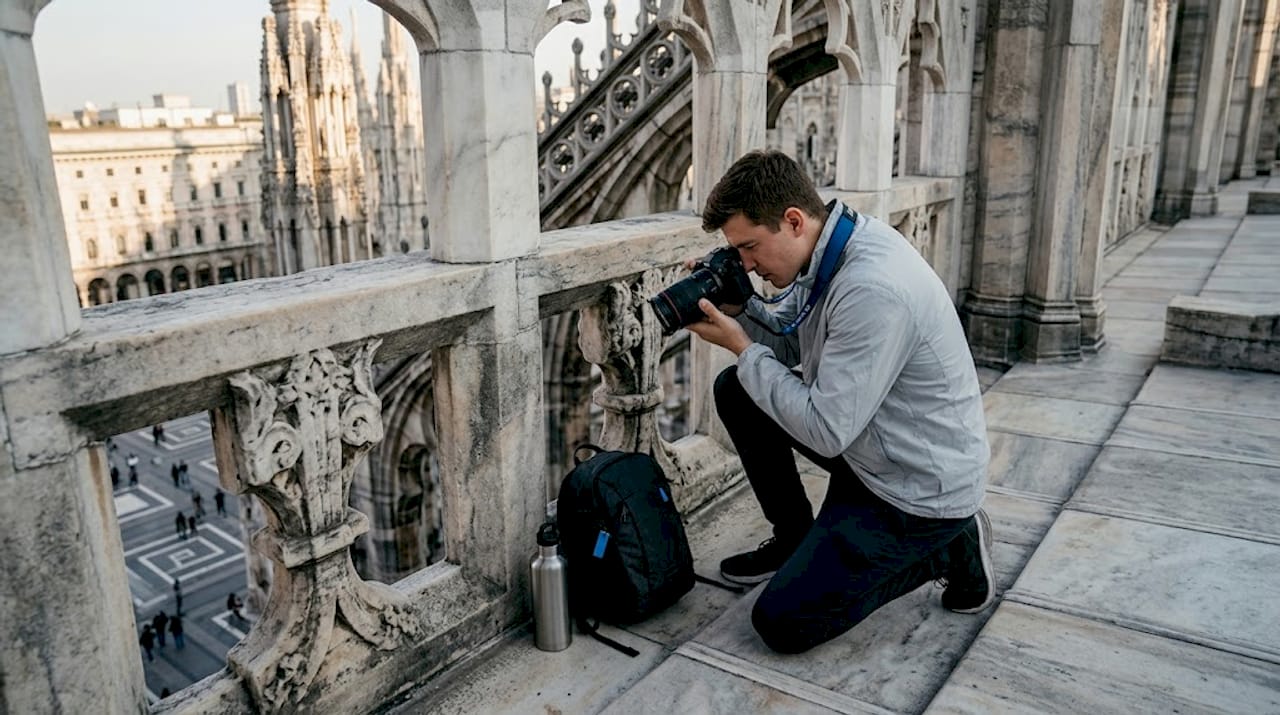
The rooftop is where Milan reveals its true scale. From up there, the marble forest of spires reaches toward the sky while the city’s rooftops and the distant Alps (on clear winter days) spread across the horizon. Getting the most from that view means timing your slot thoughtfully. Rooftop hours run from 09:00 to 19:00, with last admission roughly one hour before closing. An early morning slot catches softer light and thinner crowds. A late afternoon slot bathes the spires in warm golden tones that feel almost painterly.
Arriving at least 20 minutes before your time slot is not just courtesy. Security screening, bag checks, and the queue to ascend can absorb time quickly, and entry staff will turn you away if your window has passed.
Here is a sequence that works well for building your Duomo visit into a broader photo walk:
- Book your rooftop slot for 09:00 or 09:30 during spring or autumn.
- Arrive at the north or south entrance by 08:40 to clear security comfortably.
- Spend 45 to 60 minutes on the rooftop, moving between the east and west ends for different compositions.
- Descend and allocate another 30 to 45 minutes inside the cathedral, where the stained glass casts extraordinary colored light on the nave floor.
- Exit onto the Piazza del Duomo and photograph the facade from multiple distances before the tour groups arrive in force around 10:30.
Total time from arrival to departure: roughly two to three hours. Planning this block into your Milan photo tour schedule before adding any other stops ensures you never have to rush or skip the rooftop because something earlier ran long.
Pro Tip: The south terrace of the rooftop faces the piazza below. Shooting down into the geometric pavement patterns with a wide-angle lens creates a dramatically different image from the typical skyline shot most visitors take.
Now that you understand how to access the Duomo rooftop, let’s consider how to optimize your photo walk scheduling and duration.
Scheduling your Milan photo walk: duration, group size, and guided options
One practical question many photographers avoid asking until too late is: how long should this actually take? A guided Milan photo walk typically lasts about two hours and accommodates groups of 8 to 20 participants. That two-hour frame is a useful benchmark even when you are planning independently, because it represents a realistic window to cover a focused cluster of landmarks without fatigue setting in.
Guided Milan photo walk workshops offer something self-directed wandering rarely provides: real-time feedback on composition and camera settings while you are standing in front of the actual subject. A guide pointing out how to use the Galleria’s radial geometry as a leading line is far more effective than reading about it afterward. For amateur photographers especially, this kind of hands-on instruction in a live environment accelerates learning in ways that tutorials simply cannot replicate.
When deciding between guided and self-directed walks, a few practical considerations shape the choice:
- Skill level: Beginners and intermediates benefit most from guided walks where compositional and technical feedback is immediate.
- Time constraints: A structured two-hour walk guarantees you cover the essentials without decision fatigue about where to go next.
- Group dynamics: Smaller groups (8 to 12 people) allow more individual attention from the guide and less waiting for others to finish at each stop.
- Flexibility: Self-directed walks suit experienced photographers who want total freedom over timing, angle, and duration at each location.
- Budget: Guided options vary widely in price but often include logistical planning that saves you research time.
Knowing the typical session length helps you slot a photo walk neatly into your broader Milan itinerary without sacrificing an afternoon museum visit or an evening in the Navigli canal district.
With an idea of scheduling, next we look at how to select the best seasons and lighting conditions for your Milan photo walks.
Choosing the best seasons and lighting for your Milan photo walks
Timing is one of the most underappreciated variables in urban photography. Spring and early autumn offer the most forgiving conditions for photo walks in Milan: mild temperatures, manageable crowds, and the kind of soft, angled light that makes stone facades glow without harsh midday contrast.
July and August bring punishing heat that drains creative energy and fills every piazza with tourists. December is equally tricky, not because of cold, but because the holiday shopping crowds around the Duomo and Galleria make clean compositions almost impossible. January and February are quieter, but flat gray skies limit the drama available in your shots.
For the best light at specific times of day, these principles hold consistently:
- Early morning (07:00 to 09:00): Near-empty piazzas, long shadows, and warm raking light across textured stone surfaces. This window is worth a sunrise alarm.
- Late afternoon (16:00 to 18:30): The golden hour light in Milan during spring and autumn can be spectacular, especially on the Galleria’s gilded ironwork and the Castello’s terracotta towers.
- Midday: Avoid for most outdoor subjects. The overhead light flattens texture and creates unflattering shadows. Use this time for interior photography inside the Galleria or the cathedral.
Pro Tip: Check urban photography lighting cues for Milan specifically before your trip. The city’s orientation means the Duomo facade catches the best morning light from the east, while the Galleria interior glows most vividly in the afternoon when sunlight filters through the roof.
Understanding timing helps you now plan your actual walking itinerary to cover Milan’s photo essentials efficiently.
Designing your walking itinerary and managing time for creative photo stops
The most common mistake photographers make when planning a photo walk is treating it like a sightseeing checklist: arrive at landmark A, photograph it, move to landmark B, repeat. That approach produces competent record shots and very little else. A more rewarding structure builds in what you might call micro-stops, short pauses every few paces to reassess framing, try a lower angle, or simply wait for the right pedestrian to walk through the frame.
Milan’s pedestrian-friendly layout makes this micro-stop approach genuinely practical. Within a roughly 20-minute walking radius, you can shift from the cathedral steps to the Galleria entrance to the Piazza della Scala without ever feeling rushed. The key is designing your route to flow rather than jump.
A practical sequence for the historic core might look like this:
- Begin at Piazza del Duomo at 08:00 for the empty square and cathedral facade.
- Enter the Galleria Vittorio Emanuele II at 08:30 and work the mosaic floor, the vaulted ceiling, and the octagonal crossing from multiple positions.
- Ascend the Duomo rooftop at your booked slot (ideally 09:00 or 09:30).
- Descend and walk west toward the Sforza Castle, using the Via Dante pedestrian street for street photography with the castle tower as a background.
- Spend 30 minutes in the Parco Sempione behind the castle for softer, nature-framed architectural shots.
- Return via tram to the Navigli canal district for late afternoon reflections.
The comparison below illustrates why a relaxed micro-stop approach consistently produces stronger results than a tight point-to-point schedule:
| Approach | Creative output | Energy cost | Risk of missing timed entry |
|---|---|---|---|
| Tight point-to-point | Predictable, limited angles | High | High |
| Relaxed micro-stop | Varied, experimental, richer | Moderate | Low (with buffer time built in) |
A creative photography guide for Milan will reinforce this principle: the images that surprise you are almost always the ones captured between planned stops, not at them.
Why typical Milan photo walk tips miss the mark, and what really works
Most advice about planning Milan photo walks focuses on listing the best spots and suggesting morning visits. That is not wrong, but it leaves out the operational detail that separates a smooth, creatively rich day from a stressful scramble. The single biggest oversight? Not treating the Duomo rooftop as an anchor, not an option.
The Duomo rooftop requires strict timed-access, and the consequence of missing your slot is not just inconvenience. It disrupts the entire rhythm of your day. Build your whole itinerary outward from that fixed point. Everything else is flexible. The rooftop is not.
The second oversight is the assumption that rigidly following a planned route is disciplined photography. In reality, Milan’s walkability is an invitation. The city rewards photographers who pause, backtrack, and explore a shadow pattern on a wall that catches the eye. Downtime waiting for your rooftop slot to open becomes a creative opportunity if you are willing to work the piazza rather than scroll your phone. The architecture at your feet, the merchants setting up their stalls, the morning light shifting every eight minutes as the sun climbs. That is where expert Milan photo tour guidance makes a tangible difference: it trains you to see the in-between moments, not just the monuments.
A flexible itinerary with these realities built in does not feel less planned. It feels more alive.
Enhance your Milan photo walks with Italy Photo Tour experiences
If all of this planning feels like a lot to navigate alone, that is precisely where a guided experience earns its place. Italy Photo Tour offers curated Milan photo walk workshops crafted for photographers at every level, from those still learning to read a histogram to enthusiasts ready to push their compositional instincts further. Led by professional photographer Mino Di Vita, each walk weaves together iconic landmarks, hidden urban gems, and real-time instruction on light, shadow, and storytelling.

The workshops are designed to feel less like a tour and more like a creative collaboration, moving at a pace that allows genuine exploration rather than a breathless checklist. Personalized attention within small groups means your specific camera and your specific questions get addressed on the ground, not in a post-session email. Explore the full range of photography tours in Italy or discover the complete Italy Photo Tour offerings to find the experience that best matches your creative ambitions and your time in Milan.
Frequently asked questions
Do I need to book tickets in advance for the Duomo rooftop?
Yes, time-slot tickets must be booked online in advance to avoid long queues and secure your rooftop access at the Duomo. Arriving without a reservation means you risk being turned away entirely.
What is the ideal season for a Milan photo walk to avoid crowds and harsh weather?
Spring and early autumn offer the best balance of mild weather and fewer crowds, making April to June and September to October the optimal windows for photo walks in Milan.
How long does a typical guided Milan photo walk last?
Most guided photo walks last about two hours, which is enough time to explore key landmarks and receive practical photography tips without fatigue.
Can I use any camera on a Milan photo walk?
Yes, you can bring any camera including a smartphone, and experienced guides tailor their advice to your specific equipment for more useful, practical results.
What should I bring on a Milan photo walk?
Pack comfortable shoes, sunscreen, water, and a spare battery or memory card alongside your camera. Comfortable footwear matters more than most photographers expect after three to four hours on cobblestones.