

TL;DR:
- Composing a travel photo story involves creating a deliberate sequence of images that emotionally and sensorially represent a journey. It requires defining a clear theme, building a structured shot list, and sequencing images with an intentional emotional arc to craft a compelling narrative. Effective editing, sequencing, and presentation transform individual images into a powerful storytelling experience that resonates with viewers.
Composing travel photo stories is the art of arranging a deliberate sequence of images that together capture the full emotional and sensory truth of a journey. Unlike a random slideshow, a photo story, known in professional circles as a photo essay, builds meaning through structure: a clear theme, varied shot types, and a sequence that carries the viewer from arrival to revelation. Master this craft and your travel images stop being a collection of memories and start becoming a narrative that moves people.
How to compose travel photo stories: what you need first
Before you raise your camera, the most important work happens in your mind. Defining a focused theme or emotional angle before shooting guides every decision you make in the field, from which alley to walk down to which stranger to photograph. Jot down three or four words that capture the spirit of your destination. “Quiet mornings in Tuscany” or “the vivacity of a Palermo market” gives you a filter for every frame.
A structured shot list is the second prerequisite. A complete shot list covers establishing shots, detail images, portraits, action shots, and transitional context images, each playing a distinct role in keeping the story immersive. Think of these as the chapters of your visual book: the establishing shot opens the world, the detail shot whispers its texture, the portrait gives it a human face.
Here is a quick reference for the five core shot types every travel photo story needs:
| Shot type | Role in the story |
|---|---|
| Establishing shot | Sets the scene and orients the viewer to place |
| Detail shot | Reveals texture, color, and sensory depth |
| Portrait | Humanizes the story with a face and emotion |
| Action shot | Creates movement and energy within the sequence |
| Transition shot | Links scenes and maintains narrative flow |
For gear, a mirrorless camera paired with a versatile 24-70mm lens covers most storytelling situations. A wide prime like a 16mm captures sweeping piazzas; a 50mm or 85mm brings portraits to life with natural compression. Editing and sequencing happen in tools like Adobe Lightroom for tonal consistency and Lightroom’s grid view or Capture One for arranging the sequence visually before export.
Pro Tip: Write your theme on a small card and keep it in your camera bag. Every time you hesitate over a shot, pull it out and ask: does this image serve the story?

How to plan and shoot photos that build your travel story
Shooting with narrative structure in mind transforms how you move through a destination. Travel storytelling is easier when planned as a timeline, beginning, middle, and end, because it gives your shooting day a purposeful rhythm rather than a reactive scramble. Here is a practical sequence to follow on location:
- Open with arrival energy. Shoot the first impression: a train platform, a harbor at dawn, a city gate. This frame sets tone without revealing everything.
- Build the middle with variety. Alternate wide environmental shots with tight details and candid portraits. A cobblestone close-up after a sweeping canal view creates visual breathing room.
- Seek the human layer. A fisherman mending nets in Cinque Terre or a baker dusting flour in a Milanese bakery adds warmth no landmark can replicate.
- Chase light, not just subjects. Golden hour in Venice turns ordinary water into liquid amber. Blue hour in Milan wraps the Duomo in a cool, contemplative glow. Light is not a bonus; it is the atmosphere of your story.
- Capture transitions. Doorways, bridges, staircases, and moving vehicles connect scenes and give the sequence a sense of passage through time and space.
- End with intention. Look for a closing image that provides emotional closure: a setting sun, a child running from the frame, a door swinging shut.
Small details and cultural elements beyond iconic landmarks deepen the sensory and emotional impact of any travel photo story. The cracked paint on a Venetian shutter, the steam rising from a street-side espresso, the shadow of a campanile stretching across a piazza floor: these are the images that make viewers feel they were there.
Pro Tip: Spend the first 20 minutes at any new location without shooting. Observe the light, the movement, the mood. The images you take after that pause will be far more intentional than anything captured in the first excited rush.
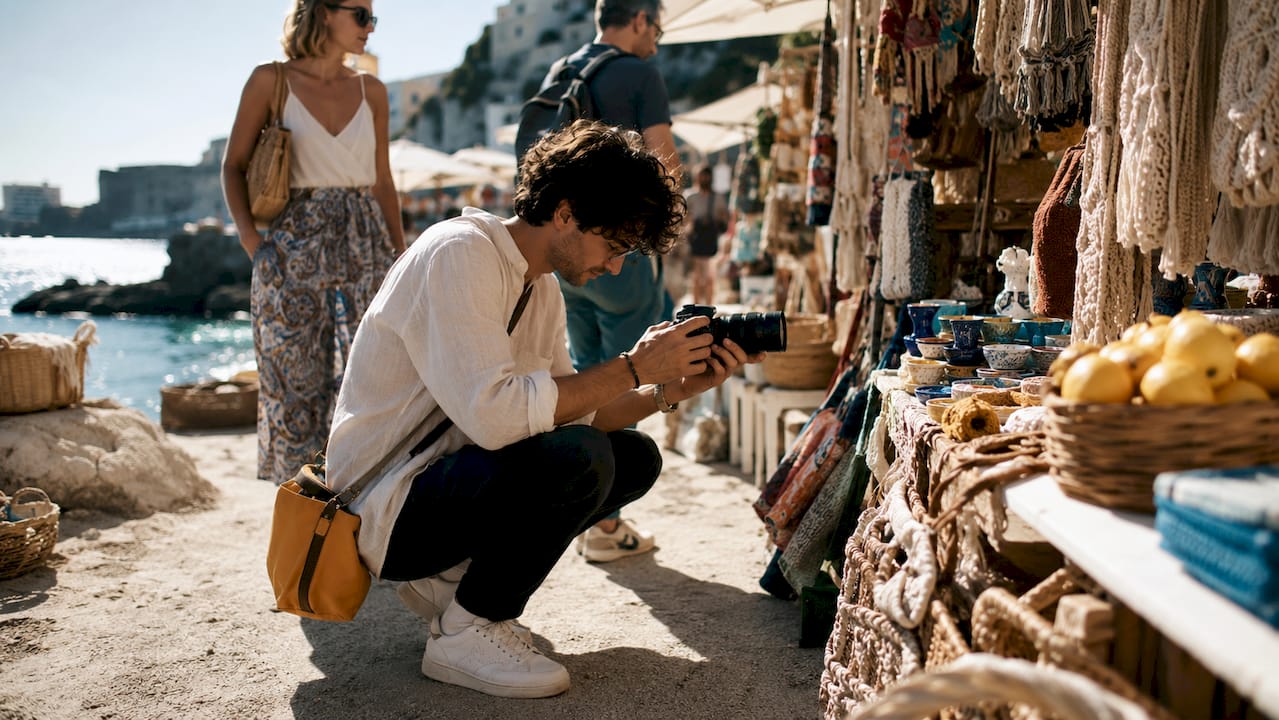
How to curate and sequence images for emotional impact
Editing a travel photo story is where the real storytelling begins. Most photographers return home with hundreds of frames; the craft lies in reducing them to the twenty or thirty that actually advance the narrative. Editing with narrative intent avoids the “random slideshow syndrome” where even beautiful individual images fail to cohere into a meaningful whole.
Start by culling ruthlessly. Remove any image that does not serve the theme you defined before shooting. A technically perfect shot of a famous fountain means nothing if your story is about the quiet life of a Sicilian fishing village. Then group the survivors by their functional role: establishing, development, human connection, climax, and closing.
Sequencing follows a proven rhythm. The first frame sets tone subtly without revealing everything; frames two through eight develop the story with varied pacing; the ninth frame delivers the emotional peak; and the final frame offers reflective closure. This structure mirrors the arc of a short film and gives viewers a satisfying sense of progression.
Here is how intentional sequencing compares to an unstructured approach:
| Approach | Result |
|---|---|
| Unstructured: all wide shots grouped together | Monotonous pacing, viewer fatigue, no emotional build |
| Intentional: alternating wide, detail, portrait | Rhythm and contrast keep the viewer engaged throughout |
| Unstructured: strongest image placed first | Anticlimactic sequence with nowhere to go emotionally |
| Intentional: strongest image near the end | Emotional crescendo followed by a resonant closing frame |
Captions deserve the same care as the images themselves. Effective captions clarify time, place, emotional nuance, or behind-the-scenes anecdotes without restating what the viewer can already see. “Dawn, Rialto Bridge, before the first vaporetto” tells you something the image alone cannot. A caption that reads “a beautiful bridge in Venice” adds nothing.
Pro Tip: Lay your selected images out in a grid on Lightroom or even on a physical table. Step back and look at the color palette, the tonal rhythm, and the visual weight of each frame. A sequence that feels right on screen often reveals its flaws at a glance when seen as a whole.
Common mistakes to avoid when composing travel photo stories
The most frequent error aspiring photographers make is assembling a collection rather than composing a story. A collection says “I was here.” A story says “this is what it felt like.” The distinction lives entirely in the editing and sequencing decisions you make after the shoot.
Over-including photos dilutes narrative momentum. Forty images of Florentine architecture, however beautiful individually, exhaust the viewer and blur the emotional thread. Fight the urge to include every strong frame. A sequence of fifteen images with clear purpose outperforms fifty images with none.
Watch for these specific pitfalls in your own work:
- No narrative arc. If your sequence has no discernible beginning, middle, or end, the viewer has no emotional journey to follow.
- Tonal monotony. A sequence of all golden-hour warm tones or all overcast gray frames feels flat. Contrast in light and mood creates visual energy.
- Caption overload. Writing a paragraph beneath every image smothers the photographs. Let the images carry the weight; captions add only what the image cannot say.
- Ignoring the closing frame. Many photographers obsess over the opener and neglect the closer. The final frame leaves a lasting impression and determines how the viewer feels when the story ends.
- Prioritizing technical perfection over emotional truth. A slightly soft image of a grandmother laughing in a Venetian market carries more narrative weight than a tack-sharp photo of an empty canal.
How to share and present your travel photo stories
A beautifully composed photo story deserves a presentation format that honors its structure. The platform you choose shapes how the narrative lands with your audience.
For print, tools like Blurb or Artifact Uprising let you design photo books where the physical page turn mirrors the narrative rhythm you built in editing. For digital audiences, Adobe Express and Canva offer storyboard templates that preserve sequence and allow caption integration without technical complexity. Instagram’s carousel format is surprisingly well-suited to ten-frame photo essays, and guided city tour preparation principles apply here too: knowing your audience shapes every presentation decision.
Consider these presentation best practices:
- Write a brief introductory paragraph (two to three sentences) that states the theme and emotional intention of the story before the first image appears.
- Match caption tone to platform. A photo book caption can be lyrical and unhurried; an Instagram caption should be direct and evocative within the first line.
- Invite feedback actively. Share your story in photography communities like Flickr groups or dedicated Facebook groups for travel photographers, and ask specifically whether the sequence felt coherent and emotionally resonant.
- Revisit your story six months later. Distance reveals sequencing decisions you were too close to see at the time.
For photographers drawn to storytelling through images, the presentation stage is where the story finds its audience and completes its purpose.
Key takeaways
Composing a travel photo story requires a defined theme, a structured shot list, intentional sequencing, and disciplined editing to transform individual images into a coherent emotional narrative.
| Point | Details |
|---|---|
| Define your theme first | Write three to four words capturing the journey’s spirit before you shoot a single frame. |
| Build a diverse shot list | Cover establishing, detail, portrait, action, and transition shots to maintain narrative rhythm. |
| Sequence with emotional arc | Place your strongest image near the end, not the beginning, to build toward a resonant peak. |
| Edit ruthlessly | Remove any image that does not advance the theme, even if it is technically beautiful. |
| Captions add unseen context | Write captions that reveal time, place, or anecdote, never what the viewer can already see. |
Why storytelling changed everything I shoot
I spent years returning from trips with thousands of frames and a vague sense of dissatisfaction. The images were technically sound. The light was often beautiful. But when I sat down to share them, something felt hollow, like a sentence with no verb. The turning point came when I started treating every trip as a story assignment rather than a photo opportunity.
The shift was not about gear or technique. It was about intention. When I arrived in a Sicilian coastal village with a theme already written in my notebook, every decision on location became sharper. I stopped photographing everything and started photographing the story. The images I came home with were fewer and far more powerful.
What I have learned after years of crafting photo stories in Italy is that the editing table is where most photographers either find their story or lose it. The temptation to include a beautiful image that does not serve the narrative is real and persistent. Resist it. The images you leave out are as important as the ones you keep.
My honest encouragement: do not wait until you feel technically ready to start thinking like a storyteller. Bring a theme to your next shoot, build a simple shot list, and sequence ten images with a beginning, middle, and end. The first attempt will be imperfect and instructive. That is exactly where the craft begins.
— Mino
Bring your travel photo story to life in Italy
Italy offers one of the richest canvases on earth for photographers learning to craft compelling visual narratives. From the chiaroscuro light of Milanese courtyards to the kaleidoscope of color along the Cinque Terre coast, every location presents a complete story waiting to be composed.

Italyphototour designs immersive photography experiences across Italy specifically for photographers who want to move beyond snapshots and into genuine storytelling. Led by professional photographer Mino Di Vita, each tour focuses on thematic planning, light awareness, and the sequencing techniques covered in this guide, applied in real locations with real light. Whether you are drawn to Venice’s reflective canals or the golden hills of Tuscany, Italyphototour offers the guided context to transform your travel photographs into stories that endure.
FAQ
What is a travel photo story?
A travel photo story, also called a photo essay, is a curated sequence of images structured around a clear theme and narrative arc, with a beginning, middle, and end, designed to convey the emotional and sensory essence of a journey.
How many photos should a travel photo story include?
Most effective travel photo essays contain between ten and thirty images. Fewer than ten can feel incomplete; more than thirty risks diluting the narrative momentum and exhausting the viewer.
How do I choose a theme for my travel photo story?
Write three or four words or a short phrase that captures the emotional core of your destination before you shoot. That phrase becomes your editorial filter for every image you include or discard.
What makes a strong opening image for a photo essay?
The opening frame sets tone without revealing everything. It should hint at the theme and invite the viewer forward without summarizing the entire story in a single shot.
How do captions improve a travel photo story?
Captions add unseen context such as location, time of day, or an emotional anecdote that the image alone cannot communicate. They should never describe what the viewer can already see.