

TL;DR:
- Effective travel photography captures the emotional essence of Italy by combining deliberate preparation, mindful observation, and responsive technique. Timing during golden or blue hour, utilizing composition tools like leading lines and layers, and including human stories enhance authenticity. Reviewing images on location and fostering inner emotional connection ensure the final photos truly convey the scene’s soul.
You’ve stood before the rolling hills of Tuscany at sunset, or watched a gondolier glide through Venice’s amber-lit canals, clicked the shutter, and felt certain you’d captured something extraordinary. Then you open the file on your laptop and the magic is gone. The composition is clean, the exposure is correct, and the colors are vivid, yet the image feels hollow, like a postcard someone else already made. That gap between what you felt and what the camera recorded is one of the most frustrating experiences in travel photography, and it has a solution. This guide walks you through every stage of the process, from preparation and mindset to in-the-moment execution and final verification, so your Italian images carry the soul of the place.
Table of Contents
- Essential preparation: Tools, timing, and mindset
- Step-by-step: Shooting for genuine emotion
- Mastering light and weather: Italy’s mood swings
- Storytelling tips: Conveying culture and connection
- Verifying the shot: How to know you captured the emotion
- Beyond technique: Why emotion matters most in Italian photography
- Ready to capture emotion in Italy? Take the next step
- Frequently asked questions
Key Takeaways
| Point | Details |
|---|---|
| Golden hour magic | Shooting shortly after sunrise or before sunset adds warmth and mood to Italian scenes. |
| Mindful composition | Pausing to sense emotion before composing helps your photos tell a resonant story. |
| Weather as mood tool | Embrace overcast or rain for unique emotional tones rather than avoiding them. |
| Human presence counts | Adding a person to a scene increases emotional connection and narrative depth. |
| Continuous review | Regularly check your photos for feeling as well as clarity, and adjust while on location. |
Essential preparation: Tools, timing, and mindset
Now that you know what you’ll learn, let’s start with the prep work that ensures every photo opportunity counts. Great emotional photography rarely happens by accident. It is the result of deliberate choices made before you ever raise the camera to your eye.
Gear that supports expressive shooting does not need to be expensive or heavy. A mirrorless or DSLR camera with manual controls, a versatile 24-70mm equivalent lens, and a prime lens in the 35mm or 50mm range will carry you through most Italian scenes beautifully. A circular polarizer filter tames glare on water and deepens sky color, while a graduated neutral density filter helps balance bright skies against shadowed foregrounds in Tuscan hill towns. Add a compact travel tripod, a remote shutter release, and extra batteries, and you are ready for anything the Italian light offers.
Essential gear checklist for emotional landscape photography in Italy:
- Mirrorless or DSLR camera with full manual mode
- 24-70mm zoom and one fast prime (35mm or 50mm)
- Circular polarizer and graduated ND filter
- Compact travel tripod (essential for low-light emotional shots)
- Extra batteries and memory cards
- Lens cleaning cloth for coastal humidity in Cinque Terre or Venice
- A notebook or voice recorder app for capturing emotional impressions on location
Timing matters enormously. Shooting during golden hour, those 30 to 60 minutes after sunrise or before sunset, gifts you soft, warm light that wraps Italian architecture and landscapes in a luminous, emotional glow, dissolving harsh midday shadows that flatten depth and strip scenes of warmth. Beyond golden hour, the blue hour, that brief window after sunset when the sky turns a deep cobalt, creates a painterly chiaroscuro effect that transforms Venice’s reflections and Cinque Terre’s harbor lights into something otherworldly. Learning to harness these windows is foundational to Italy light techniques.
Mental readiness is equally important. Before you shoot, pause. Breathe. Notice the smell of fresh espresso drifting from a bar, the sound of church bells marking the hour, the warmth of cobblestones radiating under your feet. Intention and presence are not soft concepts; they are practical tools that focus your creative eye on what actually moves you rather than what the travel brochure told you to photograph.
Pro Tip: Pack a compact tripod even for city walking days. At dawn in Florence or dusk in a Venetian alley, a steady base transforms shaky low-light attempts into sharp, emotionally resonant frames.
Step-by-step: Shooting for genuine emotion
Once you’re prepared, it’s time to step into the field and put emotion front and center in your technique.
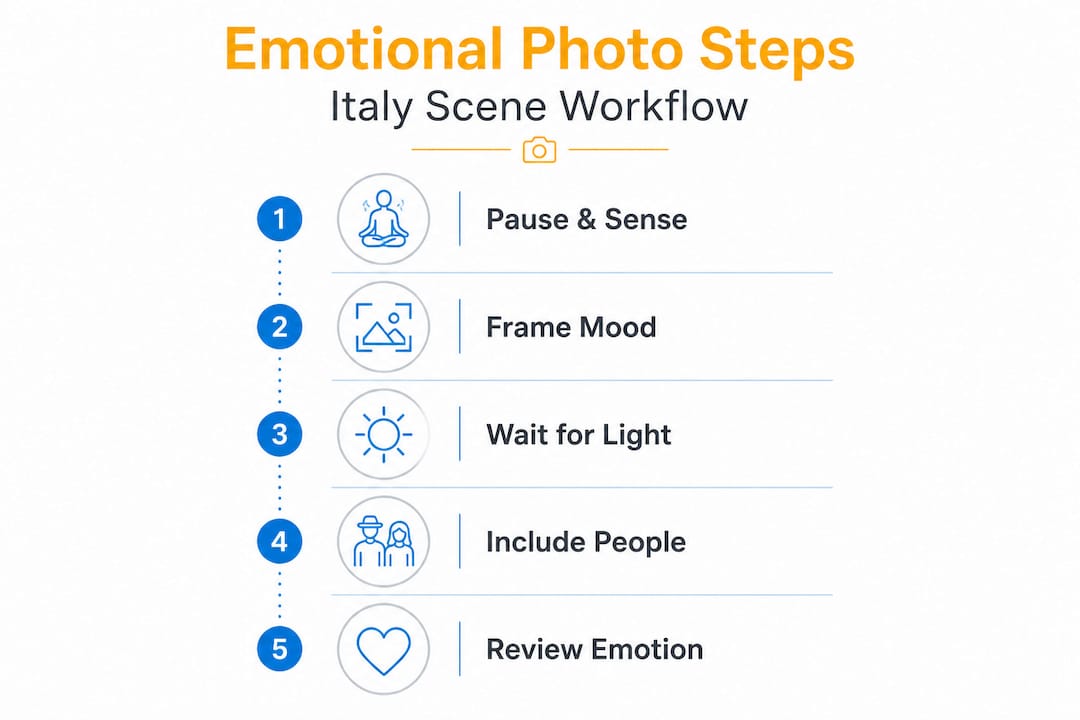
Step 1: Pause and sense the emotional tone of the scene. Before lifting your camera, ask yourself what feeling the place is radiating right now. Is it solitude, vivacity, melancholy, or warmth? That single question orients every decision that follows.
Step 2: Look for color contrasts, geometry, and leading lines to amplify mood. A warm ochre wall beside a cool blue shadow in a Siena alley creates visual tension. A row of cypress trees drawing the eye toward a distant Tuscan farmhouse builds anticipation. These compositional tools are not decorative; they are emotional amplifiers. Authentic travel images are built on this kind of deliberate seeing, not just pointing the lens at beauty.
Step 3: Wait for expressive moments with people or gestures. A fisherman mending nets in Burano, an elderly couple sharing a pastry on a Milanese piazza, a child chasing pigeons near the Pantheon in Rome. These unscripted moments breathe life into any scene. Patience is not wasted time; it is an investment in authenticity.
Step 4: Frame with intention, using foreground and background for narrative layers. A close-up of a sun-bleached fishing boat in the foreground with a cascade of Burano’s pastel houses behind it tells a layered story. The technique, often called depth framing, creates a three-dimensional sense of place that flat, centerpoint compositions cannot achieve. Mastery of light and shadow deepens this layered effect further.
“Practice mindfulness to observe emotions evoked by scenes first, then compose; use color contrasts and geometry for abstract emotional impact.” This approach, inspired by the evocative style of Italian photographer Franco Fontana, shifts your mindset from documenting to genuinely feeling before you press the shutter.
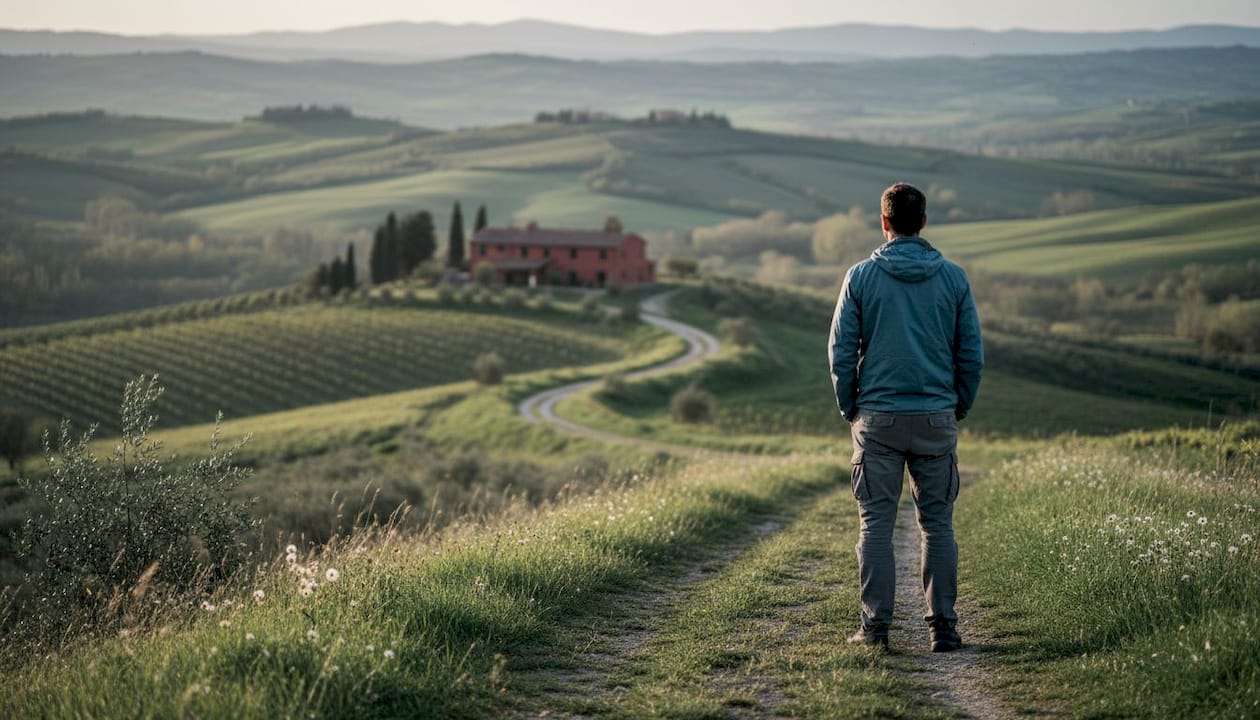
Pro Tip: Including a single human figure in a sweeping Tuscan valley or along a Venice fondamenta instantly transforms a beautiful scene into a story. The viewer feels scale, solitude, and connection all at once.
Mastering light and weather: Italy’s mood swings
Capturing authentic emotion isn’t just about timing, it’s about mastering Italy’s ever-changing lighting and adapting to the scene.
Italy is a country that wears its moods openly. The light shifts from gilded warmth to steel-gray drama within hours, and learning to read and respond to those shifts separates good photographers from extraordinary ones. Here is a comparison of how different light conditions shape emotional tone.
| Light condition | Emotional tone | Best Italian scenes |
|---|---|---|
| Golden hour | Warm, nostalgic, intimate | Tuscan hills, Venetian canals, Cinque Terre |
| Blue hour | Mysterious, painterly, serene | City skylines, harbor reflections, piazzas |
| Midday sun | Bold, dramatic, graphic | Roman ruins, Sicilian coastlines, markets |
| Overcast | Reflective, even, melancholic | Street scenes, portraits, forest trails |
| Fog or rain | Ethereal, moody, isolated | Venice, the Dolomites, Lombardy lakes |
Crowded landmarks like the Trevi Fountain demand dawn shoots or elevated angles to find intimacy, while harsh midday light suits dramatic shadow play at Roman ruins but flattens skin tones in portraits. Knowing which condition serves which scene is a crucial form of creative capturing natural light intelligence.
Weather conditions and their emotional opportunities:
- Heavy overcast: Diffused, shadowless light ideal for intimate street photography and candid portraits without squinting subjects
- Light rain: Reflections on cobblestones double the visual world, adding dreamlike depth to every frame
- Morning fog: Softens backgrounds and isolates subjects, creating a hushed, timeless mood
- Storm light: The dramatic contrast just before or after a storm produces electric, cinematic skies over Italian hilltop towns
- Full sun at midday: Creates stark geometry and graphic shadows on ancient stone, excellent for architectural abstraction
Never dismiss a gray morning in Venice or a drizzly afternoon in Florence. These are not obstacles; they are invitations to photograph a quieter, more introspective version of Italy. Exploring natural light locations with this flexible mindset opens doors that rigid, sunshine-only thinking keeps firmly shut.
Storytelling tips: Conveying culture and connection
Armed with technical and artistic skills, it’s time to think like a storyteller in each shot.
Every great Italian photograph is, at its core, a story about human connection, whether to the land, to history, to each other, or to something ineffable in the air. To tell those stories, you need to think beyond the frame and consider the narrative of each image. What happened before this moment? What will happen after? What does this scene say about the people who built it and live in it?
Using scale and human presence is one of the most reliable storytelling tools available. A lone figure walking through the colonnade of a Tuscan farmhouse, or a market vendor arranging blood oranges in the early Sicilian light, grounds the viewer in a human reality that no landscape alone can provide.
Capturing everyday moments is where the real magic lives. Forget the posed shots at famous monuments. Seek instead the old man reading La Gazzetta dello Sport at a cafe table, the nun hurrying across a Florentine piazza with a tote bag, the teenage girls laughing over gelato in Naples. These are the moments that transport viewers because they recognize something universally human in them. Street photography in Italy is the art of being invisible enough to witness these scenes and present enough to catch them.
Quick storytelling setups to practice in every Italian city:
- Layered compositions: Place a colorful detail like a flower pot or a street sign in the sharp foreground, with a blurred scene of life happening behind it
- Reflected scenes: Use cafe windows, puddles, or canal surfaces to show two worlds at once
- Framing with arches and doorways: Italy is full of natural frames. A Venetian archway framing a gondolier, or a Romanesque doorway opening onto a sunlit courtyard, creates a picture-within-a-picture effect that draws the eye and deepens narrative
- Following the light: Let a shaft of light falling through a narrow vicolo (alley) guide your composition rather than imposing your own structure on the scene
Urban photography in Italian cities rewards patience and curiosity. Wander without agenda and let the city reveal its stories. A neighborhood that seems unremarkable at noon can transform into something extraordinary when the afternoon light pours through a gap between buildings and turns the everyday golden.
Pro Tip: Before photographing someone, make brief eye contact and smile. Italians are remarkably warm and expressive. A simple posso fare una foto? (may I take a photo?) often results in genuine, unscripted expressions that no amount of staged portraiture can replicate.
Verifying the shot: How to know you captured the emotion
After catching those emotional photos, here’s how to check if your images truly communicate what you felt.
Reviewing your images on location is a habit that separates thoughtful photographers from impulsive ones. A thirty-second chimp (reviewing images on the camera’s LCD screen) immediately after a sequence helps you assess not just exposure and sharpness but emotional clarity.
Signs you have captured genuine emotion:
- The image makes you pause, not just nod
- A viewer unfamiliar with the location would feel something specific: wonder, longing, warmth, or intimacy
- There is a clear subject, but also a surrounding world that enriches rather than distracts
- Light and shadow are working together to direct the eye toward what matters
- The human element (if present) feels natural, not posed or aware of the camera
Common emotional misses to watch for:
- The composition is centered and symmetrical but feels static and report-like
- Light is technically correct but tonally cold or flat
- The scene is beautiful but empty of life or context
- The framing includes too many competing focal points, diluting the story
- The image documents the place rather than expressing how it feels to be there
When you are on a guided photo tour, your guide or fellow photographers become a valuable resource for real-time feedback. Share a frame you are uncertain about. Sometimes another set of eyes notices immediately what you felt but could not quite articulate. Mindfulness in reviewing means looking for personal resonance first, then assessing technical qualities, not the other way around.
Building a post-shoot workflow that includes deliberate emotional review, asking what story does this tell? before asking whether the sharpness is adequate, reshapes how you approach Italian photography at every level.
Beyond technique: Why emotion matters most in Italian photography
Here is the perspective that years of photographing Italy with intention will teach you: the photographers whose work stops you in your tracks are rarely the ones with the best cameras or the sharpest eyes for technical perfection. They are the ones who learned to feel first and compose second.
Italy is uniquely unforgiving of emotional detachment. Its light is too generous, its architecture too layered with centuries of human longing, and its people too vivid for technically clean but soulless images to do it justice. When you bring a detached, checklist approach to a Venetian morning or a Cinque Terre harbor at dusk, the resulting images feel like someone else’s memories.
The photographers who consistently create images that move people have internalized one truth: emotion is not something you add in post-processing or find in a better lens. It is something you arrive at a scene already carrying. You carry it through preparation, mindfulness, cultural curiosity, and the willingness to wait for the moment when place and feeling align. Exploring artistic nuance in photography is fundamentally about developing that inner readiness, not accumulating more gear.
The most memorable image from any Italian journey is rarely the one you planned. It is the unexpected shaft of copper light on a wet Florentine paving stone, or the gesture of a grandmother to a child in a Naples market doorway. Staying emotionally present and technically ready is the only combination that captures those moments. Technique is the vehicle. Emotion is the destination.
Ready to capture emotion in Italy? Take the next step
Feeling inspired to bring more depth and soul to your images of Italy? The techniques explored here come alive most vividly when practiced in the field, with a mentor beside you who knows exactly where the light falls in a Venetian alley at blue hour, or which Tuscan hillside resonates most deeply at dawn.

At Italy Photo Tour, we offer immersive guided photography experiences designed specifically for photographers who want to move beyond technically correct and toward genuinely emotional storytelling. Led by professional photographer Mino Di Vita, our photography tours in Italy include real-time mentoring, location scouting based on light and mood, and a community of fellow photography enthusiasts who share your passion. Whether you are drawn to Venice’s ethereal waterways, Tuscany’s painterly hills, or the vivacity of Milan’s urban canvas, explore our Italy photo tours and let Italy’s soul become the heartbeat of your images.
Frequently asked questions
What is the best time of day for capturing emotion in Italy photos?
Golden hour, 30 to 60 minutes after sunrise or before sunset, offers the warmest, softest light for emotional depth, making it the preferred window for most landscape and cultural photography in Italy.
How do I make crowded tourist sites in Italy look more intimate in my photos?
Arriving at dawn and using elevated angles are the most effective strategies, as crowded sites like Trevi Fountain thin out dramatically in the early morning hours and gain fresh emotional intimacy from above.
Does weather really affect emotional impact in photography?
Absolutely. Overcast conditions produce diffused, even light ideal for street photography and portraiture, while rain and fog layer Italian scenes with a moody, reflective atmosphere that sunny skies simply cannot replicate.
Why is mindfulness important for capturing emotion?
Mindfulness slows your pace and sharpens your awareness of a scene’s atmosphere before you compose, and practicing it actively means your compositions flow from genuine feeling rather than habit or reflex.
Can a single person in a landscape make photos feel more emotional?
Yes. One person in a scene provides immediate scale, relatability, and narrative tension, transforming a beautiful but impersonal landscape into a story that viewers feel personally connected to.