

TL;DR:
- Landscape photography captures natural environments with organic lines and atmospheric light. Cityscape photography emphasizes geometric patterns, artificial lighting, and cultural elements in urban settings. Both share principles of framing and light manipulation, with hybrid scenes blending natural and urban features.
Landscape photography is defined by natural environments where mountains, forests, water, and open skies take center stage, while cityscape photography is defined by human-made urban structures, architectural geometry, and street life. Both genres share wide-angle framing and treat the sky as a compositional anchor, yet they demand entirely different creative instincts. Explaining landscape vs. cityscape is not simply a matter of subject matter. The distinction runs through composition, light, rhythm, and artistic intent. Understanding where these two genres diverge, and where they quietly overlap, sharpens your eye and expands your creative range as a photographer.
What are the distinct compositional elements of landscape vs. cityscape?
Landscape photography is defined by natural features and atmospheric conditions, while cityscape photography is shaped by cultural overlays and urban design. That difference changes everything about how you compose a shot.
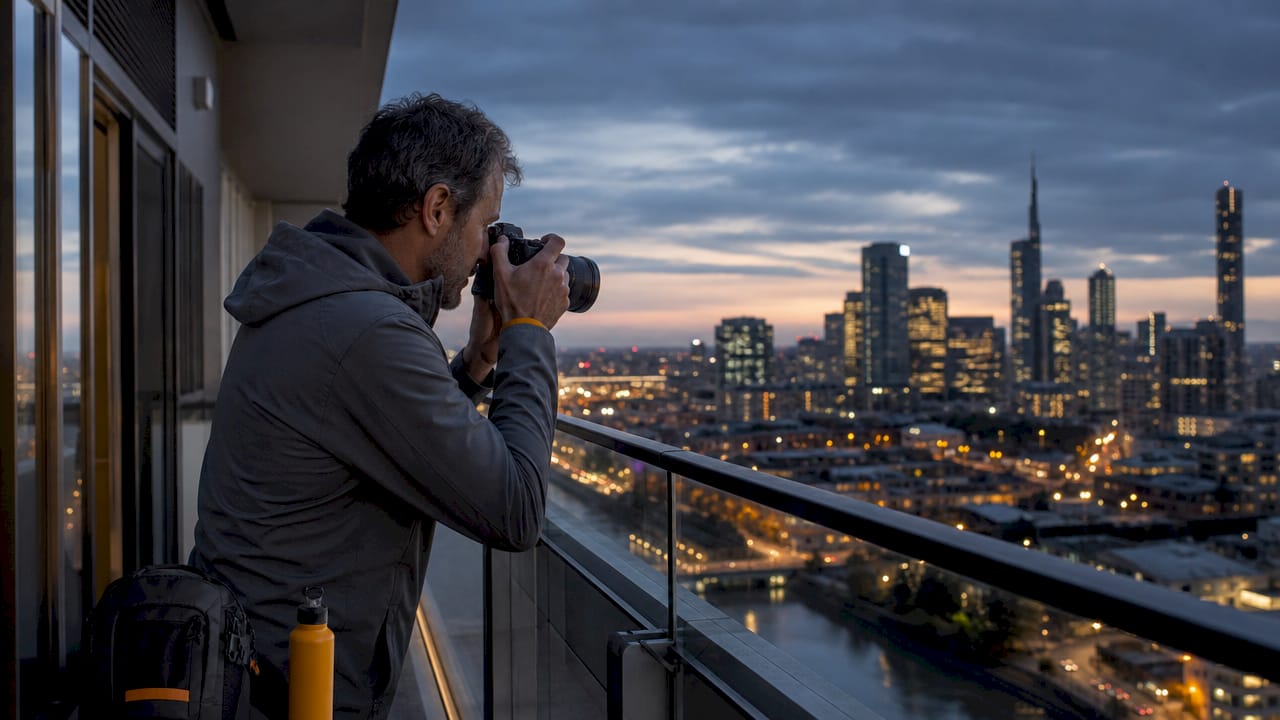
In a natural scene, your compositional anchors are organic. Rolling hills in Tuscany, the mirrored surface of Lake Como, or the jagged cliffs of Cinque Terre all offer fluid, unpredictable lines. Light shifts with clouds, fog rolls in without warning, and the scene breathes. You respond to nature rather than direct it.
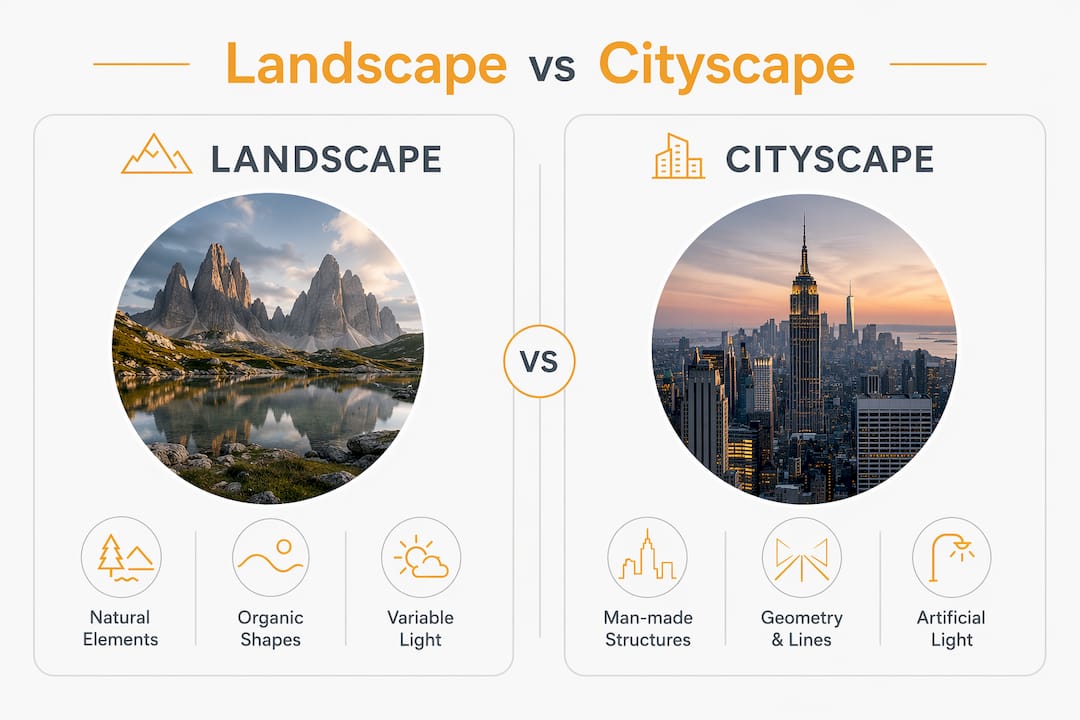
Cityscapes operate on a different visual grammar. Geometric and repetitive patterns dominate. Milan’s Galleria Vittorio Emanuele II offers soaring arches and symmetrical tile floors. Venice’s canal facades stack horizontal and vertical lines in precise rhythm. The photographer’s job is to find the angle where those patterns sing rather than simply document them.
Key compositional differences between the two genres:
- Natural lines vs. geometric lines. Landscapes offer curves, diagonals, and organic flow. Cityscapes offer grids, verticals, and repeating modules.
- Atmospheric light vs. artificial light. Landscapes depend on golden hour, overcast diffusion, or dramatic storm light. Cityscapes gain depth from neon reflections, lit windows, and street lamps.
- Cultural overlay. Cityscape composition carries the weight of human history. Architecture, signage, and street texture all tell a cultural story that pure nature cannot.
- Human presence. A lone figure on a Venetian bridge transforms a building shot into a narrative. Natural landscapes can be empty and still feel complete.
- Color palette. Urban environments often carry bold, saturated local colors. Landscapes tend toward softer, more variable tones dictated by season and weather.
Pro Tip: Shoot cityscapes during golden hour or at night to activate artificial lighting and add visual depth. A 90-minute window around sunset in a city like Milan produces light that no midday shot can replicate.
How have historical perspectives shaped understanding of landscapes and cityscapes?
The term veduta, Italian for “view,” was used as early as the 18th century to describe detailed urban representations. Painters like Canaletto produced vedute of Venice that were prized across Europe. Museums broadly classify these urban views under the wider “landscape” umbrella, which explains why the two genres are so often grouped together.
“Historically, landscapes were considered fine art while cityscapes were labeled ‘topographical.’ Modern artists and photographers have dissolved that boundary entirely, exploring both to study light, geometry, and human emotion.” — Britannica, The Impressionist Landscape and Its Impact
For centuries, natural landscapes held the higher artistic rank. The Romantic tradition celebrated the sublime, that overwhelming sense of nature’s power, and the picturesque, a composed, painterly beauty. Constable’s English countryside and Turner’s stormy seas were considered the pinnacle of artistic ambition. Urban views were seen as records, not art.
The Impressionists changed that. Monet painted the Gare Saint-Lazare, a Paris train station, with the same reverence he gave his water lilies. Modernist art recognized cityscapes as equal to landscapes in artistic value. The subject shifted from nature’s grandeur to the quality of light, the geometry of form, and the emotional charge of a scene. That shift is the foundation of how photographers approach both genres today.
The practical implication for you as a photographer is significant. Aesthetic frameworks like the sublime and the picturesque apply equally to a Dolomites sunrise and a rain-slicked Milan street at midnight. The genre does not determine the art. Your intent and execution do.
What practical techniques differentiate landscape and cityscape shooting?
Mastering both genres requires adapting your equipment, timing, and compositional thinking to the specific demands of each subject.
Choose your lens with purpose. Wide-angle lenses, typically 16mm to 35mm, serve both genres well for expansive scenes. For cityscapes, a tilt-shift lens corrects converging verticals in tall buildings. For landscapes, a longer focal length like 70mm compresses distant mountains and creates a sense of depth.
Time your shoot deliberately. Golden hour and night shooting are the two most productive windows for cityscapes. Artificial lighting at dusk creates a warm, layered glow that separates foreground buildings from the sky. Landscapes reward early morning light, when mist sits in valleys and shadows are long and soft.
Include human or environmental context in cityscapes. Focusing on skyscrapers alone misses the soul of the city. A market vendor in Bologna, a gondolier in Venice, or a cyclist crossing a Milanese piazza transforms a static architectural record into a living image. Beginners consistently underuse this technique.
Embrace local color rather than neutralizing it. Retaining regional color palettes preserves a city’s distinct identity. The warm terracotta of Siena, the vivid blues of Positano, and the gray-green canals of Venice each carry cultural meaning. Desaturating these tones in post-processing strips the image of its sense of place.
Frame with foreground interest. Both genres benefit from a strong foreground element. In landscapes, this might be wildflowers or a rocky shoreline. In cityscapes, a wrought-iron railing, a café table, or a rain puddle reflecting a cathedral facade all anchor the composition and create visual depth.
Pro Tip: For urban photography in Italy, scout your location the day before your shoot. Walk the streets at the time of day you plan to photograph and note where light falls, where crowds thin, and where the most compelling foreground elements appear.
What are the overlaps and distinctions between landscape and cityscape photography?
Framing, light manipulation, and narrative creation are universal to both genres. That shared foundation means skills transfer directly between them. A photographer who understands how to read light in the Tuscan hills will apply that same sensitivity to the canals of Venice.
The clearest distinction is visual rhythm. Natural scenes pulse with organic, variable movement. A forest changes with every breeze. A coastline reshapes itself with every wave. Cityscapes move to a more predictable beat. Architectural lines repeat. Street grids impose order. That geometric regularity demands a different compositional response: precision over spontaneity.
Urban environments also frequently contain natural features, creating hybrid compositions. The Arno River flowing through Florence, the pine forests framing Rome’s Villa Borghese, or the sea visible at the end of every street in Genoa all blend the two genres. These hybrid scenes are among the most rewarding to photograph because they carry both the warmth of nature and the cultural weight of the city.
A persistent misconception is that cityscapes are not landscapes. Art history and museum practice say otherwise. The veduta tradition places urban views firmly within the landscape family. The difference is emphasis, not category.
Landscape vs. cityscape: a side-by-side comparison
| Characteristic | Landscape | Cityscape |
|---|---|---|
| Primary subject | Natural features: mountains, forests, water | Human-made structures: buildings, streets, bridges |
| Visual rhythm | Organic, fluid, unpredictable | Geometric, repetitive, structured |
| Light source | Natural: sun, moon, weather | Mixed: natural plus artificial lighting |
| Best shooting time | Sunrise, golden hour, overcast conditions | Golden hour, blue hour, night |
| Color palette | Seasonal, soft, variable | Bold, saturated, culturally specific |
| Human presence | Optional, often absent | Adds narrative depth and soul |
| Historical classification | Core “landscape” genre | Sub-genre: veduta, urban landscape |
Both genres reward patience, compositional discipline, and a genuine curiosity about the world in front of your lens. The Italian landscapes that stretch from the Alps to Sicily, and the cities that rise from them, offer an almost inexhaustible range of subjects for practicing both.
Key takeaways
Landscape photography centers on natural environments and organic visual rhythms, while cityscape photography centers on human-made structures, geometric patterns, and cultural identity. Both genres share universal compositional principles and reward the same patient, light-aware approach.
| Point | Details |
|---|---|
| Core distinction | Landscapes feature natural elements; cityscapes feature human-made urban structures. |
| Visual rhythm | Landscapes are organic and fluid; cityscapes are geometric and repetitive. |
| Shared principles | Framing, light, and narrative creation apply equally to both genres. |
| Cityscape technique | Include human context and embrace local color to capture a city’s soul. |
| Historical overlap | The veduta tradition places urban views within the broader landscape family. |
What I have learned shooting both genres across Italy
After years of photographing everything from the Dolomites at dawn to Milan’s Navigli district at midnight, I have come to believe that the sharpest photographers do not choose between landscape and cityscape. They move fluidly between them, carrying the same reverence for light and story into every scene.
The most common mistake I see is treating cityscapes as architectural documentation. A building is not a subject. The relationship between a building, the light falling across its facade, the person walking beneath its archway, and the sky above it: that is the subject. The same thinking applies in nature. A mountain alone is just geology. A mountain at the moment a shaft of light breaks through storm clouds, with a shepherd’s path winding toward it, becomes something worth stopping for.
I also find that human stories transform travel photos in ways that pure technical skill cannot. In 2026, the photographers whose work resonates most are those who bring emotional intelligence to their compositions, whether they are standing in a wheat field in Umbria or on a rooftop in Naples. My advice is simple: shoot both genres on every trip. Let the city teach you precision. Let nature teach you patience. Bring both lessons to every frame.
— Mino
Photography tours that put these techniques into practice
Italy offers one of the world’s richest laboratories for comparing natural and urban environments through a camera lens. Tuscany’s rolling hills sit an hour from Florence’s Renaissance facades. Venice’s canals blend water, stone, and sky into scenes that defy easy classification.

Italyphototour designs guided photography experiences across Italy that place you inside both worlds. From the photography tours across Italy that move through Cinque Terre’s dramatic coastline to Milan’s architectural precision, each tour is led by professional photographer Mino Di Vita. You practice the compositional techniques covered here in real locations, with real light, and with expert guidance on how to read each scene. Whether you are drawn to open skies or city streets, these experiences are built to deepen your craft and sharpen your artistic instincts.
FAQ
What is the core difference between landscape and cityscape photography?
Landscape photography focuses on natural environments with minimal human structures, while cityscape photography emphasizes human-made urban settings. Both genres use wide-angle framing and treat the sky as a key compositional element.
Are cityscapes considered a type of landscape?
Art history and museum practice classify cityscapes as a sub-genre of landscape. The 18th-century term veduta described detailed urban views, and modern museums broadly use “landscape” to include urban representations.
What lens works best for cityscape photography?
Wide-angle lenses in the 16mm to 35mm range work well for expansive urban scenes. A tilt-shift lens corrects converging verticals in tall buildings and is particularly useful for architectural precision.
When is the best time to photograph a cityscape?
Golden hour and night are the most productive windows for cityscape photography. Artificial lighting at dusk creates warm, layered tones that separate buildings from the sky and add visual depth.
How do landscape and cityscape photography overlap?
Both genres share universal principles: framing, light manipulation, and narrative creation. Urban environments often include natural features like rivers and parks, creating hybrid compositions that blend the strengths of both genres.