

TL;DR:
- Effective photography relies more on intentional composition than on gear upgrades, with deliberate arrangement guiding viewers’ attention. Mastering seven core tools and applying a simple observation-decide-frame framework enhances visual storytelling, while deliberate practice and understanding when to break rules produce compelling images. Patience and subtraction are key, requiring photographers to develop intuitive instincts and focus on what truly matters in every scene.
Most photographers spend hundreds of dollars chasing better gear when the real gap between a forgettable snapshot and a compelling image has nothing to do with the camera. Composition is the single most impactful skill for beginners, outweighing lens purchases or camera upgrades in shaping the final result. Explaining composition in photography is not about memorizing rules written on a grid overlay. It is about making deliberate, thoughtful decisions before your finger ever touches the shutter. This guide walks you through what composition really means, the tools that shape it, a simple framework to apply it, and the practice habits that make it second nature.
Table of Contents
- Key Takeaways
- Explaining composition in photography: what it really means
- Seven composition tools that transform your shots
- A three-step framework for intentional composition
- Practical exercises to build your composition eye
- Common composition mistakes and how to avoid them
- My perspective on composition as a creative practice
- Put your composition skills to work in Italy
- FAQ
Key Takeaways
| Point | Details |
|---|---|
| Composition beats gear | Intentional arrangement of visual elements creates stronger images than any camera upgrade. |
| Seven core tools | Mastering Rule of Thirds, Leading Lines, Negative Space, and four more gives you a reliable creative toolkit. |
| Use a three-step framework | Observe the scene, decide the story, then frame the shot to remove distractions and support your intention. |
| Practice in isolation | Focusing on one composition technique at a time builds visual fluency faster than applying all rules at once. |
| Subtraction is the secret | Strong composition is about removing what doesn’t belong, not adding more elements to the frame. |
Explaining composition in photography: what it really means
At its heart, understanding composition in photography means understanding intentional arrangement of visual elements before the shutter fires. It is the photographer’s invisible hand, guiding the viewer’s eye from one part of the image to another, creating emotion, establishing clarity, and telling a story without words.
Composition is not a checklist you run through after pointing the camera. It is the reason one photograph of the Colosseum makes your breath catch while another feels flat. Same landmark, same afternoon light. Different compositional decisions.
To understand composition fully, you need to recognize the visual elements you are working with:
- Lines: Straight, curved, diagonal, or converging lines lead the eye and create a sense of movement or depth within the frame.
- Shapes: Geometric or organic forms create structure and give the viewer something to anchor their attention.
- Light and shadow: The distribution of brightness across the frame creates mood and defines the subject.
- Color: Contrasting or harmonious colors carry emotional weight and draw attention to specific areas.
- Texture: Surface detail adds richness and tactile quality, especially in close-up work.
- Space: Both filled and empty areas of the frame carry meaning. Space around a subject can feel peaceful or isolating depending on context.
The role of composition in photography is to control where the viewer looks and what they feel. When these elements work together with a clear intention behind them, the result is an image that communicates rather than simply records. That is the difference worth chasing.
Seven composition tools that transform your shots
Understanding photography composition gets much more tangible when you connect each tool to the specific problem it solves. Think of these not as rules you must obey, but as instruments in a creative orchestra. You choose which ones to play depending on the scene in front of you.
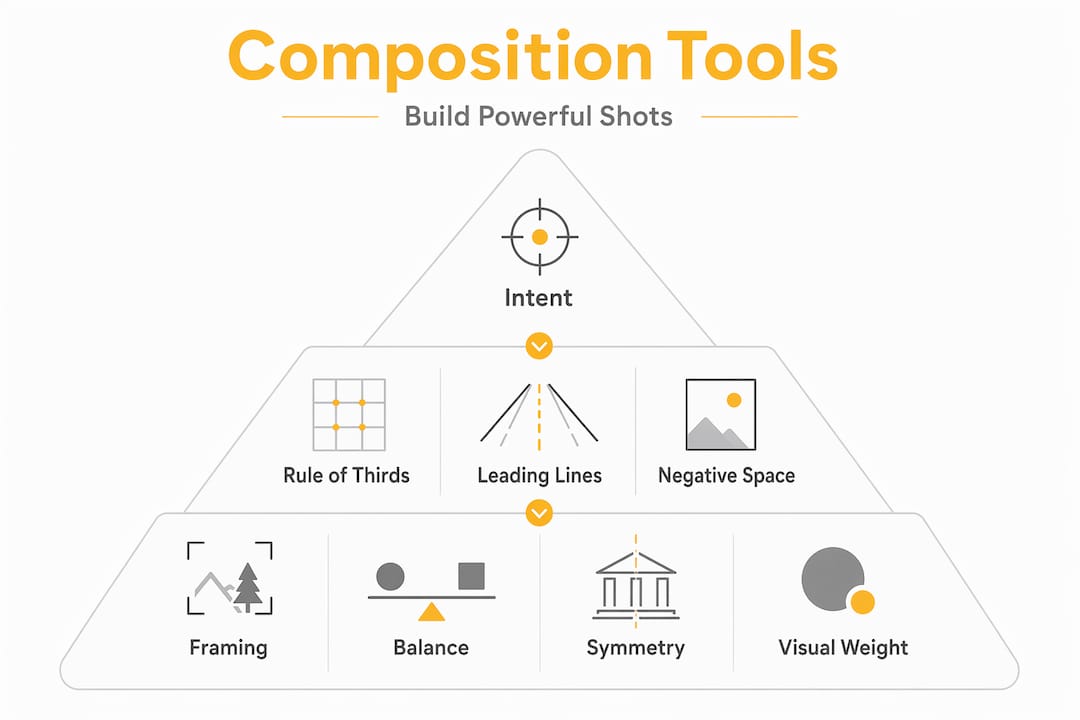
Mastering these seven tools gives you a reliable toolkit regardless of your camera type.
| Tool | Problem it solves | Best used when |
|---|---|---|
| Rule of Thirds | Avoids static, centered subjects | Landscapes, portraits, street scenes |
| Leading Lines | Creates depth and draws the eye inward | Roads, rivers, corridors, fences |
| Negative Space | Emphasizes subject, reduces visual noise | Minimalist portraits, sky-heavy shots |
| Framing Within a Frame | Adds depth and contextual storytelling | Archways, windows, doorways |
| Symmetry and Pattern | Conveys order, calm, and visual rhythm | Architecture, reflections, nature |
| Rule of Odds | Creates more natural visual interest | Group portraits, still life, flora |
| Fill the Frame | Reveals detail and emotional intimacy | Textures, faces, bold graphic subjects |
Each tool changes the relationship between your subject and the space around it. Leading Lines, for example, pull the viewer’s eye through the frame rather than letting it rest at the center. A long Venetian canal, a cypress-lined road in Tuscany, a colonnade stretching into shadow — these are natural leading lines that give your photo a sense of journey.
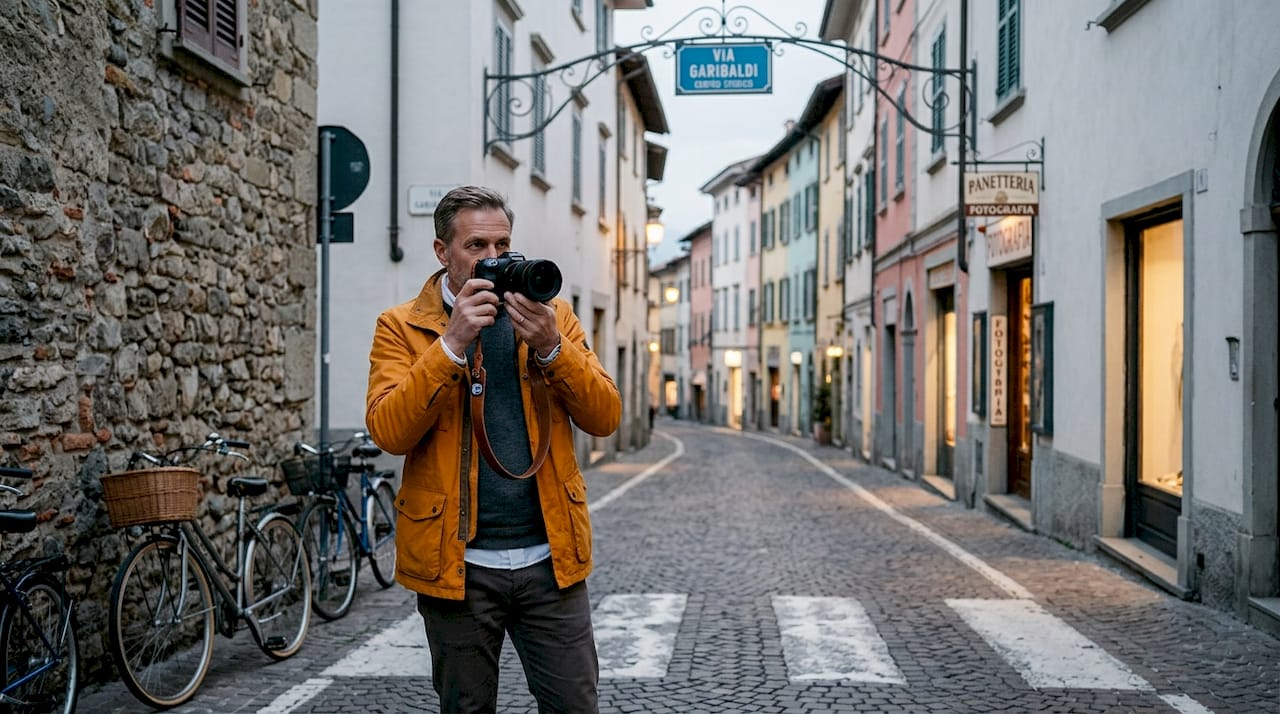
Negative space works in the opposite direction. By leaving generous empty areas around your subject, you create breathing room that actually intensifies focus on the thing that matters. A lone gondolier on gray water. A red door against a pale wall. The silence around the subject becomes part of the image.
Visual weight governs balance in ways that go beyond simple placement. Darker, larger, or more textured areas pull the viewer’s gaze more strongly. This means you can balance a heavy subject on one side of the frame with generous negative space on the other, and the image will feel complete rather than lopsided.
Pro Tip: When you first arrive at a location, before raising the camera, identify which of these seven tools the scene naturally offers. A long staircase suggests Leading Lines. A doorway or archway suggests Framing Within a Frame. Let the environment guide your compositional choice rather than imposing one on the scene.
A three-step framework for intentional composition
Composition rules are guidelines, not laws. The photographers who produce genuinely compelling images have moved past mechanical rule-following into something more deliberate. They use a mental framework that turns composition into a decision process rather than a checklist.
Here is a simple, three-step approach that works across every type of photography:
Observe. Before touching any camera setting, scan the entire scene. Where is the light falling? What is pulling your attention? What distractions live in the background? What shapes, lines, or colors are present? This step is about seeing everything before deciding what matters.
Decide. Ask yourself one clear question: what is this photograph about? Not what is in it, but what is it about. A market stall is a subject. The relationship between a vendor and an elderly customer is a story. Defining the story or emotional intent of the photo tells you what to include and what to leave out.
Frame. Now physically position yourself to support the decision you made. Move closer. Crouch lower. Step to the side to clear a cluttered background. Tilt the camera to align a leading line. Practicing one composition technique at a time is far more effective than trying to apply every rule simultaneously, so in this step, commit to one compositional choice and execute it deliberately.
This framework works beautifully across vastly different photography types. In street photography, observation means watching how people move through light. The decision might be to capture solitude in a crowd. The frame then becomes about finding the clean background and the right moment of stillness. In landscape photography, observation reveals where the golden light is raking across the hills. The decision is to honor that light. The frame builds leading lines toward it.
Composition is about controlling viewer attention through decisions anchored in photographic intention. When you internalize this framework, you stop reacting to scenes and start responding to them. That is where creativity lives.
Pro Tip: Before every shot, whisper or think the sentence: “This photo is about ___.” Fill in the blank before you raise the camera. If you cannot complete that sentence, you are not ready to shoot yet.
Practical exercises to build your composition eye
Knowing the tools is one thing. Building the instinct to use them without thinking is another. Experienced photographers compose by feel, having internalized composition principles below the level of conscious thought. You get there through targeted, deliberate practice.
These exercises are designed to accelerate that internalization:
Single-rule sprints. Spend an entire shoot focused on one composition tool only. No Rule of Thirds today. Only Leading Lines. Every frame you take must contain a strong leading line or it does not get captured. Isolated technique practice builds visual fluency faster than trying to apply everything at once.
The 10-angle challenge. Pick one subject and commit to taking ten photographs of it without moving more than a few steps in any direction. Force yourself to vary the height, distance, angle, and framing with each shot. The 10-composition drill reveals creative options you would never have noticed by stopping at the first pleasing angle.
Frame-in-frame hunt. Walk through any environment with the specific goal of finding natural frames: doorways, windows, tree branches, archways, gaps in walls. Photograph subjects through these natural borders. This exercise trains your eye to see compositional opportunities rather than just subjects.
Weight shift exercise. Take a photograph, then deliberately recompose to shift the visual weight. If your subject is centered, move it to the left third and fill the right with negative space. Notice how the emotional tone changes. Understanding visual weight and balance prevents technically correct images from feeling emotionally flat.
The subtraction game. After taking a shot you like, ask what you can remove from the frame without losing the story. Step closer. Adjust the angle to eliminate a distracting element. Simplify. Composition as subtraction is one of the most powerful mental shifts you can make as a photographer.
These exercises are not glamorous. They feel repetitive on purpose. Repetition is exactly what converts conscious technique into unconscious artistry. Carry one exercise into every shoot for a week and watch your eye change.
Common composition mistakes and how to avoid them
Even with strong theoretical knowledge, common beginner mistakes slip into practice. Recognizing them is the fastest way to eliminate them.
Starting with the grid before defining the subject. Many photographers open the rule-of-thirds grid overlay and start placing things on it before deciding what the image is actually about. The grid is a tool, not a starting point. Define your subject and story first, then use the grid to support that intention.
Including too many competing subjects. A cluttered frame forces the viewer’s eye to wander without landing. Strong composition is about one clear visual destination. If you have two equally weighted subjects fighting for attention, you have not yet made a compositional decision.
Ignoring the edges and background. Telephone wires, random passersby, harsh shadows from an unseen source — the edges of your frame reveal everything you did not consciously choose. Scan the entire frame before shooting, not just the center where your subject lives.
Refusing to move physically. Many photographers zoom with the lens and never move their feet. But physical repositioning changes perspective, separates subject from background, and often reveals compositional relationships invisible from the original position. Move. Crouch. Step left. Climb higher.
Failing to establish a visual hierarchy. Every strong image has a clear pecking order: a primary subject that commands attention, secondary elements that add context, and background that supports without competing. When everything in the frame appears equally important, nothing is.
Pro Tip: After every shoot, review your images and ask one question per frame: “Where does my eye go first, and is that where I intended it to go?” This single habit rewires your compositional instincts faster than any other form of self-critique.
My perspective on composition as a creative practice
I spent years thinking composition was about getting the rules right. Centering subjects correctly. Placing horizons on the proper third. Checking every box before pressing the shutter. My images were technically acceptable and creatively hollow. The turning point came not from learning a new rule, but from letting go of them long enough to ask what I actually wanted to say.
What I have learned is that composition mastery requires shifting from mechanical rule-following to an intuitive feel developed through persistent practice. And it requires accepting that composition is fundamentally an act of subtraction. The hardest thing to do as a photographer is leave something out. The beautiful church façade, the colorful scooter, the interesting face in the corner of the frame. All of them compete. Most of them distract. The best images I have ever made were the ones where I removed everything I loved except for one thing.
I also want to say this plainly: breaking the rules deliberately often produces the most compelling images. A centered portrait can feel like a confrontation rather than a flaw. A horizon placed at the very bottom of the frame can make a sky feel overwhelming and vast in exactly the right way. Composition rules are guidelines describing patterns that tend to work. The expert skill is knowing when the opposite of the pattern works even better. You cannot break a rule with confidence until you have practiced it enough to feel what it does. Explore composition techniques for travel photography to see how this plays out in real landscapes and urban scenes.
Patience matters more than most photographers admit. The strongest compositions often reveal themselves only after you have stood in a place for ten minutes, watching the light shift, observing how people move, waiting for the moment when everything aligns. That patience is itself a compositional act.
— Mino
Put your composition skills to work in Italy
There is a profound difference between studying composition in theory and practicing it in a place that makes you feel something. Italy offers that feeling in abundance. The golden hour light spilling across the cobblestones of Florence, the geometric reflections of Venice’s canals, the graphic interplay of color and shadow in Cinque Terre’s terraced villages. Every corner is a composition waiting to be discovered.

Italyphototour offers guided photography tours across Italy designed specifically for photographers who want to deepen their creative vision in real-world environments. Led by professional photographer Mino Di Vita, each experience combines compositional coaching with immersive time in Italy’s most evocative locations. You will not just visit landmarks. You will learn to read light, frame stories, and compose images that carry genuine emotional weight. Discover the full range of experiences at Italyphototour and take your composition practice somewhere it can truly breathe.
FAQ
What is composition in photography?
Composition in photography is the intentional arrangement of visual elements within the frame before the shutter fires. It includes decisions about lines, shapes, light, space, and subject placement that guide the viewer’s eye and communicate a story or emotion.
What are the basic rules of composition in photography?
The most widely used rules include the Rule of Thirds, Leading Lines, Negative Space, Framing Within a Frame, Symmetry and Pattern, Rule of Odds, and Fill the Frame. Each solves a specific visual problem and can be applied depending on the scene and the photographer’s intention.
How do you compose a photograph effectively?
Use the Observe, Decide, Frame approach. Scan the scene for light, distractions, and opportunities. Define what the photograph is about. Then physically position yourself to support that intention and remove anything that competes with the main subject.
How do I improve my composition skills quickly?
Practice one composition technique at a time through focused exercises like single-rule sprints or the 10-angle challenge. Reviewing your images with the question “Where does my eye go first?” accelerates self-correction and builds stronger compositional instincts.
When should I break the rules of composition?
Break composition rules deliberately once you understand what each rule does and why it works. A rule broken with intention creates tension, emotion, or surprise. A rule broken out of ignorance simply produces a weak image. Mastery begins when you know the difference.