

TL;DR:
- Emotion is the key factor that elevates place photography from ordinary to memorable, surpassing technique.
- Authentic feeling and deliberate composition grounded in place and atmosphere create images that resonate emotionally.
There is a quiet truth that separates unforgettable photographs from technically perfect ones: emotion. The emotional impact of place photography is not a happy accident that skilled photographers stumble upon. It is a deliberate, deeply felt conversation between you, the location, and everyone who will ever view that image. Many photographers chase sharper lenses and faster shutter speeds, believing gear will close the gap between ordinary and extraordinary. It rarely does. What actually moves people is something far less mechanical and far more human.
Table of Contents
- Key takeaways
- The emotional impact of place photography explained
- How places influence feelings
- Techniques to capture emotional resonance
- The power of hyper-local and mindful photography
- My perspective on emotional depth in place photography
- Experience the emotional depth of Italy through a lens
- FAQ
Key takeaways
| Point | Details |
|---|---|
| Emotion outranks technique | Emotional resonance is the primary factor that makes an image memorable, not sharpness or exposure. |
| Place shapes feeling | Environmental psychology confirms that settings actively trigger emotional arousal in both photographer and viewer. |
| Authenticity cannot be fabricated | You must genuinely feel the emotion of a place before your camera can communicate it to anyone else. |
| Patience reveals hidden stories | Spending extended time in one location uncovers emotional and compositional subtleties invisible to the hurried eye. |
| Structure your sessions intentionally | Paul Nicklen’s 20-60-20 rule gives photographers a framework to move from technical shots into genuine emotional risk-taking. |
The emotional impact of place photography explained
Photography has always been a technical discipline. Aperture, ISO, focal length — these are the grammar of the craft. But grammar alone does not make a poem. Emotional impact is the most critical skill in photography, surpassing technique and equipment as the primary factor that separates memorable images from mere visual records.
“The camera is an instrument that teaches people how to see without a camera.” — Dorothea Lange
What this means in practice is that photography and emotional connection must be woven together from the moment you raise the viewfinder. A photograph of the Venetian lagoon at dusk is technically easy to take and emotionally easy to forget. But a photograph that captures the particular stillness of that water — the way silence seems to press down on it — becomes something a viewer carries with them. That transformation depends entirely on what you bring to the scene, not what the scene offers on its own.
Emotional storytelling through photography draws on intimacy, tension, mystery, and longing. These are not abstract concepts. They are specific choices: where you stand, when you shoot, what you choose to exclude from the frame. Every element in your composition is either building or dissolving the emotional spell you are trying to cast.
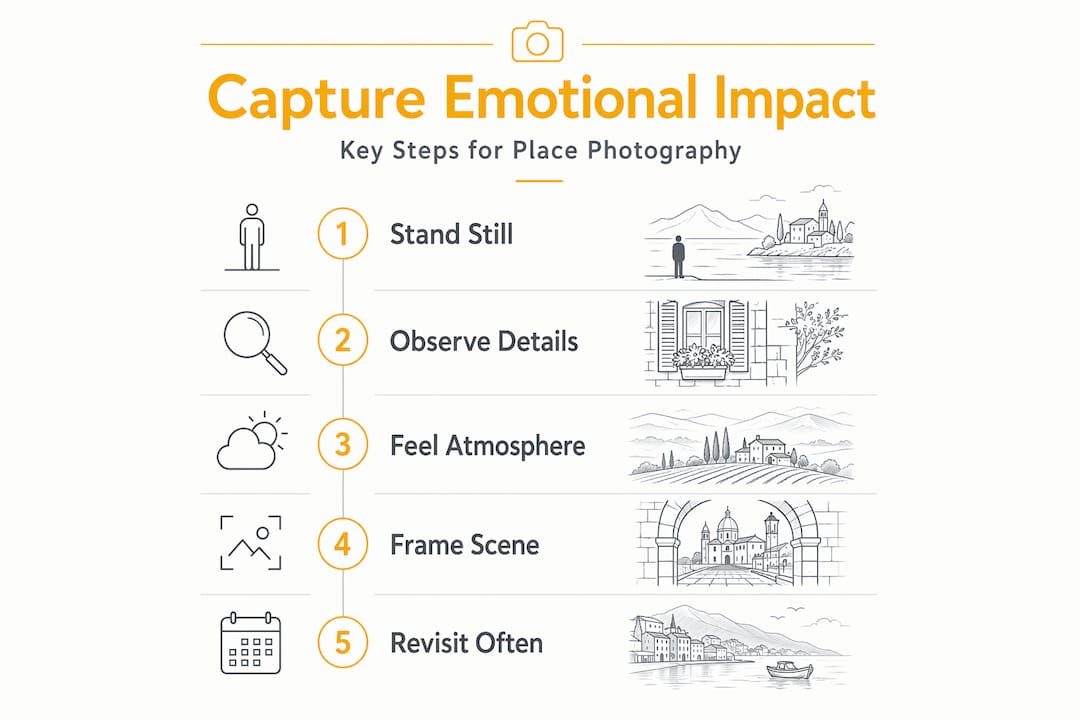
Pro Tip: Before you shoot, spend three minutes simply standing in the location without touching your camera. Let the atmosphere register in your body. Notice what you feel, not just what you see.
How places influence feelings
Not all locations carry the same emotional weight, and the difference is not accidental. Environmental psychology tells us that places actively shape our inner state. Research using wearable sensors confirms that urban environments trigger measurable emotional arousal, which photographers can consciously channel into their work. The density, texture, light quality, and human activity of a place are not neutral backdrops. They are active emotional forces.
Consider the places that evoke emotions almost involuntarily: a crumbling monastery courtyard, a fog-laced harbor at first light, the narrow alleys of a medieval hill town. What makes these places feel charged is rarely their visual complexity. It is the layering of sensory information. Sound, smell, the temperature of light, the roughness of old stone underfoot. These details combine with memory and cultural meaning to produce something immediate and felt rather than simply observed.
The Santuario de Las Lajas in Colombia offers a striking example of this principle in action. Visitors consistently report profound emotional responses shaped by narrative and atmosphere rather than by the architecture alone. The collective weight of stories, devotion, and centuries of human longing transforms a magnificent building into something that photographs differently than anything else on earth. The emotion is baked into the place itself.

Local culture and history function as invisible emotional amplifiers. When you understand that a Sicilian piazza has hosted two thousand years of human gathering, that knowledge changes how you frame the old man sitting at its edge. The photographic representations of places that resonate most deeply are often those where the photographer understood the story behind the surface.
Here is how different sensory and environmental elements translate into emotional qualities in your images:
| Environmental element | Emotional quality it creates |
|---|---|
| Warm, low-angle light | Nostalgia, tenderness, belonging |
| Deep shadow and silhouette | Mystery, solitude, unease |
| Open, expansive landscapes | Awe, freedom, vulnerability |
| Tight, enclosed spaces | Intimacy, tension, claustrophobia |
| Water reflections | Dreamlike ambiguity, transience |
When you also select locations that align with personal values, the emotional fluency you bring to a scene becomes palpable. Sensory harmony produces a sense of instant belonging, both in the photographer and, through the image, in the viewer.
Techniques to capture emotional resonance
Knowing that emotion matters and knowing how to manufacture it in a photograph are very different conversations. Here is where practical method meets artistic vision.
Feel it first. This is non-negotiable. Photographic emotional impact cannot be faked; it must be genuinely felt by the photographer before it can reach anyone else. If a place leaves you cold, your images will too. Wait for the moment when something in the scene genuinely moves you. That is your starting point.
Use foreground as an invitation. Foreground elements serve as doorways into a photograph, drawing the viewer physically into the scene rather than leaving them as distant observers. A weathered cobblestone, a fisherman’s rope, the hem of a red dress. These grounding objects create scale and tactile presence. They replace passive looking with something closer to being there.
Embrace psychological tension. Maryam Eisler’s photography of the American West demonstrates how tension between the visible and the felt produces images that linger. Not everything needs to be explained. Ambiguity invites the viewer to project their own emotional experience into the image, creating a personal connection that resolved, tidy compositions rarely achieve. Leave something open. Let the image breathe with questions.
Allocate your session time with intention. National Geographic photographer Paul Nicklen developed a framework worth studying. His 20-60-20 rule for creative sessions divides a session as follows: the first 20% covers technical setup and standard shots, the middle 60% explores emotional storytelling and compositional experiments, and the final 20% commits to creative risk. This structure moves you past the safe shots most photographers stop at and into the territory where genuinely affecting work lives.
Choose your light like you choose a word. Light is mood made visible. The impact of imagery on emotions is largely determined by the quality and direction of light before any other compositional decision is made. Soft, diffused overcast light creates an entirely different emotional world than the same scene bathed in golden-hour warmth.
Pro Tip: Try photographing the same location in radically different light conditions over a single day. You will often discover that the emotional story of a place changes completely with the light, revealing layers you would otherwise miss entirely.
The power of hyper-local and mindful photography
One of the most liberating ideas in place photography is that emotional resonance can flourish without traveling far. The richest emotional territory may be a room you sit in every morning, a courtyard you pass daily without stopping, or a neighborhood square you have always thought of as unremarkable.
Photographer Giles Thurston explored this beautifully with his “one chair, one room” approach: spending extended time in a single spot, returning repeatedly, observing how light changes, how shadows shift, how the same space tells a different story at different hours. The results were startling in their emotional depth. What looked plain in a quick visit became layered and rich through patient attention. This is the promise of hyper-local photography. Depth, not distance.
“It is not where you are but how long and how deeply you are willing to look.” — Giles Thurston
Slowing down also changes what you notice. The emotionally impactful details in a scene are rarely the obvious ones. They are the crack of light beneath a door, the particular way an elderly woman’s hands rest in her lap, the single poppy growing through a ruined wall. These are the details that extend sensory belonging between image and viewer. They are found only by those who stay.
For photographers drawn to exploring how local culture deepens an image’s emotional register, the practice of photographing local culture rewards exactly this kind of patient attention. Culture is not a backdrop. It is a living emotional language, and immersion is the only way to learn it.
Mindful photography also means resisting the pull to fill memory cards. Shoot less. Observe more. The photographic representations of places that endure longest are almost never the product of volume shooting. They emerge from a moment of genuine alignment between what you feel and what the scene offers.
My perspective on emotional depth in place photography
I have spent years photographing Italy’s most storied locations, from the fog-wrapped canals of Venice to the golden hills of Tuscany at harvest time. If I have learned one thing, it is this: technical perfection is only the table stakes. Every competent photographer can produce a sharp, well-exposed image of a beautiful place. Very few can produce an image that makes someone feel they need to be there.
What I have come to trust is the practice of surrender. Not surrender to laziness, but surrender to the place itself. I let a location speak before I decide what I want to say about it. I stand in it, breathe with it, and wait for the moment when something shifts and I feel the specific emotion the place carries. That feeling becomes my guide for every compositional choice that follows.
I also believe strongly in the value of ambiguity. Some of my most resonant images are the ones that do not give everything away. They leave a shadow unexplained, a face partially turned, a space only half-filled. Viewers bring their own longing and memory to those openings, and the photograph becomes theirs in a way that a fully resolved image never can.
If you take one thing from my experience: be patient with yourself and patient with the places you photograph. Emotional truth in an image cannot be rushed. It arrives when you are still enough to receive it.
— Mino
Experience the emotional depth of Italy through a lens
What you absorb through an article and what you carry home from a morning spent in a Tuscan borgo at dawn are two entirely different kinds of knowledge. Reading about the emotional impact of place photography opens the door. Standing inside the right place, at the right hour, with an experienced guide beside you, is what walks you through it.

At Italyphototour, the guided experiences are designed precisely around this idea. Each tour, whether you find yourself in the ancient light of Siena or along the dramatic coast of Cinque Terre, is led by Mino Di Vita with a focus on atmosphere, cultural storytelling, and the kind of patient attention that produces images you will genuinely cherish. These are not sightseeing excursions with cameras. They are immersive sessions built to help you feel each place and translate that feeling into photographs that endure. Explore the full range of photography experiences in Italy and find the one that speaks to the kind of photographer you want to become.
FAQ
What makes a photograph emotionally impactful?
Emotional impact in photography comes from the genuine feeling the photographer brings to a scene, expressed through intentional composition, light, and subject choices. Technical skill supports this, but it cannot replace authentic emotional engagement.
Why do some places feel more emotionally charged to photograph?
Places accumulate layers of cultural history, sensory atmosphere, and collective human narrative that trigger emotional arousal in visitors. Research confirms that environmental settings actively shape feelings, which translates directly into a photograph’s emotional register.
How can I make my place photography more emotionally resonant?
Spend more time in fewer locations, use foreground elements to pull viewers into the scene, and practice Paul Nicklen’s 20-60-20 rule to push your sessions beyond technical shots into genuine creative and emotional exploration.
Does hyper-local photography really work for emotional storytelling?
Absolutely. Returning repeatedly to a familiar place and observing it across different hours, seasons, and conditions reveals intimate emotional details that a quick visit never could. Depth of attention consistently produces more emotionally resonant images than breadth of travel.
How does light affect the emotional impact of place photographs?
Light is the primary carrier of mood in any image. Its direction, warmth, and quality alter the entire emotional character of a scene, transforming the same location into a vehicle for nostalgia, mystery, awe, or intimacy depending on when and how you capture it.