

TL;DR:
- Historic landmarks in Italy carry deep cultural and emotional narratives that enhance photographic impact.
- Planning, timing, and understanding light are more important than expensive gear for capturing compelling images.
- Engaging with local history and culture transforms technical shots into meaningful stories.
Many photographers assume you need a top-tier camera to capture Italy’s historic landmarks beautifully. That belief, while understandable, misses the real secret. Italy’s ancient ruins, sun-warmed piazzas, and storied cathedrals are not simply backdrops. They are living narratives waiting to be read through your lens. Whether you carry a mirrorless camera or a smartphone, understanding how history, light, and culture converge at these sites will sharpen your eye and deepen every image you create. This guide will show you how to harness Italy’s heritage as your greatest creative tool.
Table of Contents
- Why historic landmarks matter in photography
- Choosing the best Italian landmarks for unforgettable photos
- Techniques for capturing the essence of historic sites
- Telling a story: connecting culture, history, and artistry
- Workshops, tours, and continuous learning for amateurs
- A fresh perspective: why the heart of Italian photography isn’t in your camera
- Ready to transform your Italian landmark photography?
- Frequently asked questions
Key Takeaways
| Point | Details |
|---|---|
| Story-rich backdrops | Historic landmarks in Italy provide layers of visual and cultural stories that enrich your photography. |
| Technique over gear | You can capture impressive images with smart planning, timing, and composition, regardless of your equipment. |
| Continuous learning | Hands-on workshops and peer collaboration accelerate your growth far beyond solo practice. |
| Cultural connection | Understanding the significance of a site helps you produce photographs with emotional impact. |
Why historic landmarks matter in photography
Now, let’s explore what makes historic sites such rich subject matter for your photographs. A landmark is never just a building or a ruin. It carries centuries of human experience, conflict, devotion, and daily life within its stones. When you photograph a site like the Pantheon or the medieval towers of San Gimignano, you are not simply framing architecture. You are channeling all of that accumulated meaning into a single image, and your audience feels it.
This narrative depth is one of the most powerful tools available to any photographer, amateur or seasoned. Exploring landmark photography tips can help you understand how to read a site before you even raise your camera. The more you know about a place, the more intentional your framing becomes, and intentionality is what separates a memorable photograph from a forgettable snapshot.
“Amateurs succeed without pro gear via timing and planning; workshops provide hands-on mechanics at historic sites, making skill development accessible to everyone.”
Historic landmarks also accelerate your learning curve in ways that studio practice simply cannot. Every site presents a new puzzle: shifting light, complex geometry, crowds, shadows that fall unexpectedly. Solving these puzzles in real time builds instincts that no textbook can teach. The benefits of photography in Italy go far beyond beautiful images. They include a genuine sharpening of your artistic vision.
Here is what historic sites offer that ordinary locations cannot:
- Narrative richness: Every stone, arch, and mosaic carries a story that adds emotional weight to your frame.
- Varied textures and tones: Aged surfaces, worn marble, and weathered facades create natural chiaroscuro that rewards careful observation.
- Changing light: Italy’s Mediterranean light transforms the same site dramatically across different hours of the day.
- Cultural energy: Local life flows around and through these landmarks, offering spontaneous human moments.
- Structured learning opportunities: Guided workshops at real sites give you immediate feedback in dynamic, unpredictable conditions.
Choosing the best Italian landmarks for unforgettable photos
Understanding the impact of landmarks sets the stage for making informed choices about where and when to shoot in Italy. Not every famous site will suit your photographic style, and that is perfectly fine. The key is matching a landmark’s character to the story you want to tell.
When you plan photo tours across Italy, consider the balance between iconic and intimate. The Colosseum in Rome delivers grandeur and historical gravitas. A quiet cloister in Assisi offers stillness and contemplative beauty. Both are extraordinary, but they demand different approaches and emotional registers from the photographer.
| Landmark | Visual character | Best for | Crowd level |
|---|---|---|---|
| Colosseum, Rome | Monumental, dramatic | Wide-angle storytelling | High |
| Piazza del Campo, Siena | Curved, communal | Street and people photography | Moderate |
| Matera cave dwellings | Ancient, textured | Detail and shadow work | Low |
| Ponte Vecchio, Florence | Intimate, layered | Reflections and golden hour | High |
| Valle dei Templi, Agrigento | Serene, mythic | Landscape and long exposure | Low |
Factors worth weighing before you choose a site include accessibility, typical crowd density, the quality of urban photography lighting at different hours, and the depth of the site’s history. A less-visited location like Matera or Civita di Bagnoregio can yield images of extraordinary intimacy precisely because the atmosphere is undisturbed.
As the artsy-traveler notes, blending planning with timing allows you to capture both iconic and lesser-known sites under the most favorable conditions. Spontaneity has its place, but preparation is what turns a good shot into a great one.
Pro Tip: Research the orientation of your chosen landmark before you visit. Knowing which direction it faces tells you exactly when the light will fall most beautifully, saving you hours of guesswork on location.
Techniques for capturing the essence of historic sites
Once you’ve identified your landmark, the next step is mastering techniques that let its story shine through. The most transformative skill you can develop is sensitivity to light. Italy’s golden hour, that warm window just after sunrise and before sunset, bathes stone facades in a honeyed glow that no filter can replicate. The blue hour, those quiet minutes of deep twilight, adds a dreamlike stillness to ancient sites that feels almost sacred.
Composition is equally vital. Leading lines are your allies at historic sites: colonnades, canal edges, cobblestone streets, and archways all draw the viewer’s eye naturally into the frame. Framing a distant monument through a closer arch or doorway creates depth and a sense of discovery. Juxtaposing old and new, a medieval tower reflected in a modern café window, for example, adds a layer of contemporary storytelling to timeless subjects.
Exploring Italy photo tips will show you how to balance wide establishing shots with intimate close-ups of carved details, worn inscriptions, or a single wildflower growing from ancient stone. Both scales of image are necessary. The wide shot gives context; the detail gives soul.
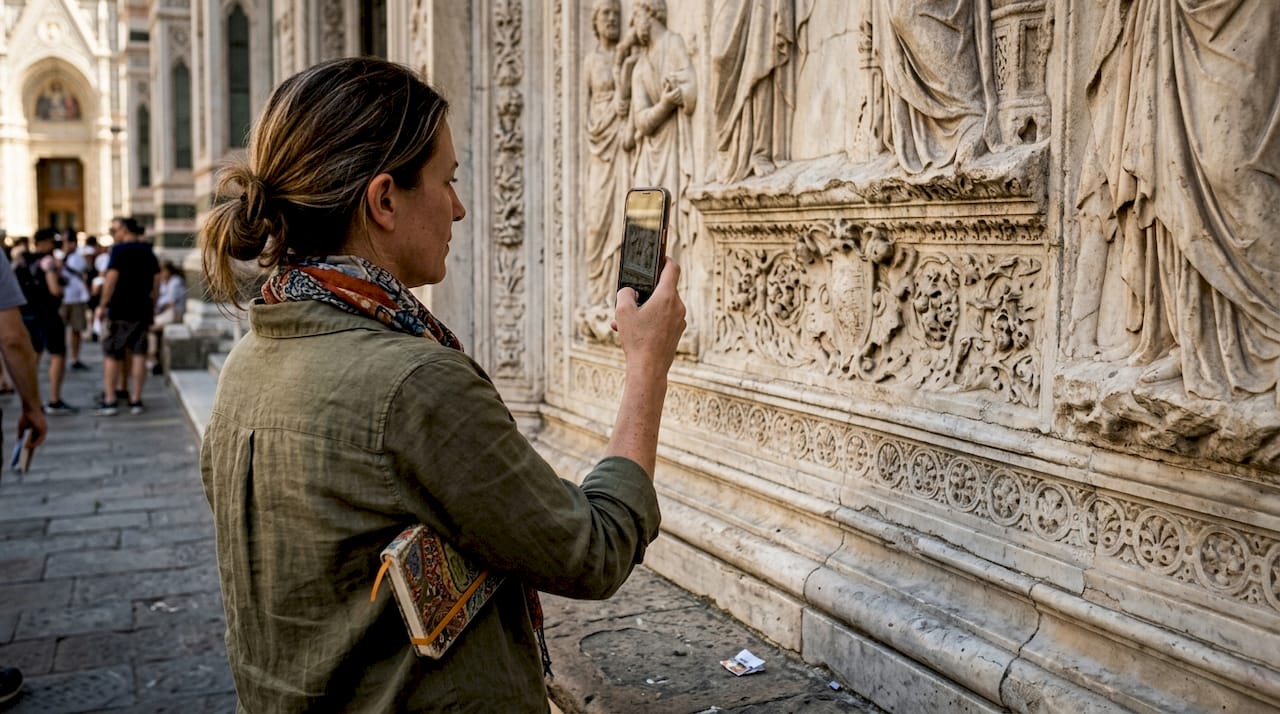
Workshops provide hands-on training in composition and timing at real sites, which accelerates growth far faster than solo practice. Learning artistic photography techniques in the field, with immediate feedback, builds confidence that stays with you long after the tour ends.
Here is a sequence that works reliably at any Italian historic site:
- Arrive before the light peaks and spend ten minutes simply observing the site without your camera.
- Identify three or four strong compositional anchors: a line, a frame, a texture, a human element.
- Shoot wide to establish context, then move closer for detail and atmosphere.
- Revisit your first compositions as the light shifts. The same scene can look entirely different within thirty minutes.
- Review your images on location and adjust your approach while the opportunity still exists.
Pro Tip: Smartphone cameras with portrait mode can render ancient stone textures with stunning depth. Never dismiss the tool in your pocket.
Telling a story: connecting culture, history, and artistry
Techniques unlock technical quality, but real impact comes from channeling history and local culture into your lens. A photograph of the Roman Forum is powerful. A photograph of a local schoolchild gazing up at the same ruins with wide-eyed wonder is unforgettable. The human element, rooted in cultural context, transforms a document into a story.
Researching a landmark before you visit is one of the most underrated practices in travel photography. Knowing that the Arch of Constantine was built to celebrate a military victory, or that Palermo’s Ballarò market has operated for over a thousand years, changes how you see and frame these places. That knowledge seeps into your images in ways that viewers sense even if they cannot name it.
| Landmark | Historical context | Storytelling angle |
|---|---|---|
| Pompeii | Preserved Roman daily life | Ordinary moments frozen in time |
| Venice’s Rialto Bridge | Center of trade for centuries | Commerce, movement, and light on water |
| Lecce’s baroque facades | 17th-century artistic flourishing | Ornament as cultural expression |
“Cultural understanding shapes images with authentic emotion, giving photographs a resonance that purely technical skill cannot manufacture.”
Incorporating local customs and everyday moments into your landmark photography is equally powerful. A vendor arranging fruit in the shadow of a Roman aqueduct, a nun crossing a sunlit cloister, an elderly couple sharing espresso beside a Renaissance fountain. These scenes connect the ancient to the living, and that connection is what moves viewers.
For deeper guidance on weaving narrative into your images, documentary travel photography offers a rich framework for approaching cultural sites with both curiosity and respect.
- Research the legend: Every major Italian landmark has myths and stories attached to it. Let them guide your framing.
- Observe before shooting: Spend time watching how locals interact with the space. The most authentic moments reveal themselves to patient eyes.
- Look for contrast: Ancient stone beside contemporary life creates natural visual tension that draws viewers in.
Workshops, tours, and continuous learning for amateurs
Bringing your skills to life is easier when you learn from others and practice hands-on, especially in Italy’s inspiring environments. Joining an expert-led photography tour does something that self-guided practice rarely achieves: it places you inside the scene with someone who already knows its rhythms, its best angles, and its hidden corners.
Peer learning is another undervalued dimension of group tours. Seeing how another photographer frames the same subject differently opens your mind to possibilities you would never have considered alone. Constructive feedback from both guides and fellow participants accelerates growth in ways that are genuinely difficult to replicate through solo exploration.
Workshops provide hands-on mechanics and guidance, making it easier for amateurs to excel without expensive gear. The emphasis shifts from equipment to observation, timing, and intention. That shift is liberating. Exploring Italy photography tours will show you the range of immersive experiences available across the country, from Venice’s labyrinthine calli to Tuscany’s rolling golden hills.
Pro Tip: After any workshop or guided tour, revisit the same site on your own within a day or two. You will see it with completely fresh eyes, and your images will reflect everything you absorbed.
Here is what structured learning in Italy consistently offers:
- Real-time feedback: Guides correct compositional habits gently and immediately, before they become ingrained.
- Curated timing: Expert-led tours are scheduled around the best light, removing guesswork from your day.
- Equipment perspective: Learning which Italy photography gear matters and which does not saves you from unnecessary investment.
- Community: Sharing the creative experience with like-minded photographers is motivating and sustaining.
- Confidence: Returning to a site with new techniques and seeing the difference in your images is one of the most rewarding feelings in creative practice.
A fresh perspective: why the heart of Italian photography isn’t in your camera
Let’s step back from gear and technique and look at the deeper reason why historic sites matter. After years of photographing Italy’s landmarks and guiding others through the same experience, one truth stands out above all others: the photographers who create the most resonant images are not the ones with the best equipment. They are the ones who arrive curious.
Curiosity about a site’s history, its light at different seasons, its human stories, its hidden corners. That curiosity drives you to linger longer, look closer, and return again. Italy is an endless classroom, and its landmarks are patient teachers. The essential Italy photo tips that truly matter are not about f-stops or focal lengths. They are about developing the habit of seeing deeply before you shoot.
Authenticity in photography comes from personal engagement. When you genuinely feel moved by a place, that emotion finds its way into the frame. Italy’s historic sites offer that emotional invitation at every turn. Accept it, and your images will carry a life that no amount of technical perfection can manufacture.
Ready to transform your Italian landmark photography?
Feeling inspired to turn these lessons into photographs of your own? Here’s how you can start. Italy Photo Tours connects passionate photographers with Italy’s most iconic and beautifully hidden locations, guided by professional photographer Mino Di Vita.

Discover what we do and how our curated experiences are designed to develop your eye, your technique, and your confidence in the field. Whether you are drawn to the grandeur of Rome or the quiet poetry of a Tuscan hillside, our photography tours Italy offer a structured, inspiring path from enthusiast to artist. Every tour is a conversation between you, the landscape, and the stories that Italy has been telling for millennia.
Frequently asked questions
What makes a historic landmark especially photogenic?
Historic landmarks offer narrative depth and visual context that ordinary locations cannot match. Unique architecture, aged textures, and rich cultural meaning give each site a distinct visual story that resonates with viewers on an emotional level.
Can amateurs get professional results without expensive camera gear?
Absolutely. Timing and planning matter far more than equipment at historic sites, and hands-on workshops help amateurs develop strong instincts that translate into compelling images regardless of what camera they carry.
How do I avoid crowds when photographing famous Italian sites?
Visiting early in the morning or traveling during the shoulder season, typically spring or autumn, gives you quieter, more atmospheric conditions. Many of Italy’s most famous landmarks are almost deserted in the hour after sunrise.
What techniques can make my landmark photos more impactful?
Focus on leading lines, natural frames, and storytelling details that connect visually with the site’s meaning. Alternating between wide establishing shots and intimate close-ups creates a more complete and emotionally engaging narrative.
Are there resources for learning landmark photography in Italy?
Workshops and guided tours provide structured, hands-on learning at Italy’s most photogenic sites, offering real-time feedback and curated access to the best light and locations.