

Most photographers return from Italy with hundreds of beautiful images and a nagging feeling that something is missing. The piazzas look perfect. The light was golden. But the photos feel empty. That gap exists because capturing authenticity, emotion, and narrative is what separates a memorable photograph from a pretty postcard. This guide walks you through the principles, techniques, and mindset that turn your Italy trip into a genuine documentary photography experience, one where the images tell real stories about real people and places.
Table of Contents
- What makes documentary travel photography unique?
- Key principles: Narratives, authenticity, and emotion
- Methods and mindset: Slow travel, connection, and preparation
- Essential techniques: Composition, light, and timing
- The documentary debate: Purity, expression, and ethical lines
- Documentary photography in Italy: Destinations and cultural context
- Level up with immersive Italy photo experiences
- Frequently asked questions
Key Takeaways
| Point | Details |
|---|---|
| Story over scenery | Meaningful documentary travel photos capture stories and genuine moments, not just beautiful locations. |
| Preparation matters | Slow travel, research, and connecting with locals set the stage for authentic images, especially in Italy. |
| Technical skills elevate | Mastering composition, light, and timing helps transform raw moments into lasting photographs. |
| Ethics define impact | Respecting subjects and local cultures ensures your photography is impactful and responsible. |
What makes documentary travel photography unique?
Standard travel photography chases the iconic shot: the gondola at sunset, the Colosseum at dawn, the perfectly plated pasta. Documentary travel photography asks a different question entirely. Instead of “what looks beautiful here?” you ask “what is actually happening here, and why does it matter?”
The essence of this genre lies in capturing authenticity, emotion, narrative, and real human experiences. That means a fisherman mending nets in Cinque Terre matters more than the cliffs behind him. The way a Florentine grandmother argues with a vendor at the market is more compelling than the market itself.
| Standard travel photography | Documentary travel photography |
|---|---|
| Focuses on landmarks and scenery | Focuses on people, culture, and moments |
| Planned, posed, or staged | Candid, observational, and real |
| Postcard aesthetic | Narrative and emotional depth |
| Location as the subject | Location as context for human story |
| Technically polished | Authentically imperfect |
“The best documentary travel images don’t just show you a place. They make you feel like you’ve lived there for a moment.”
This shift in intent changes everything about how you shoot. You start noticing cultural photo storytelling opportunities everywhere. You slow down. You watch before you raise your camera. And you begin using human storytelling techniques that give your images genuine weight.
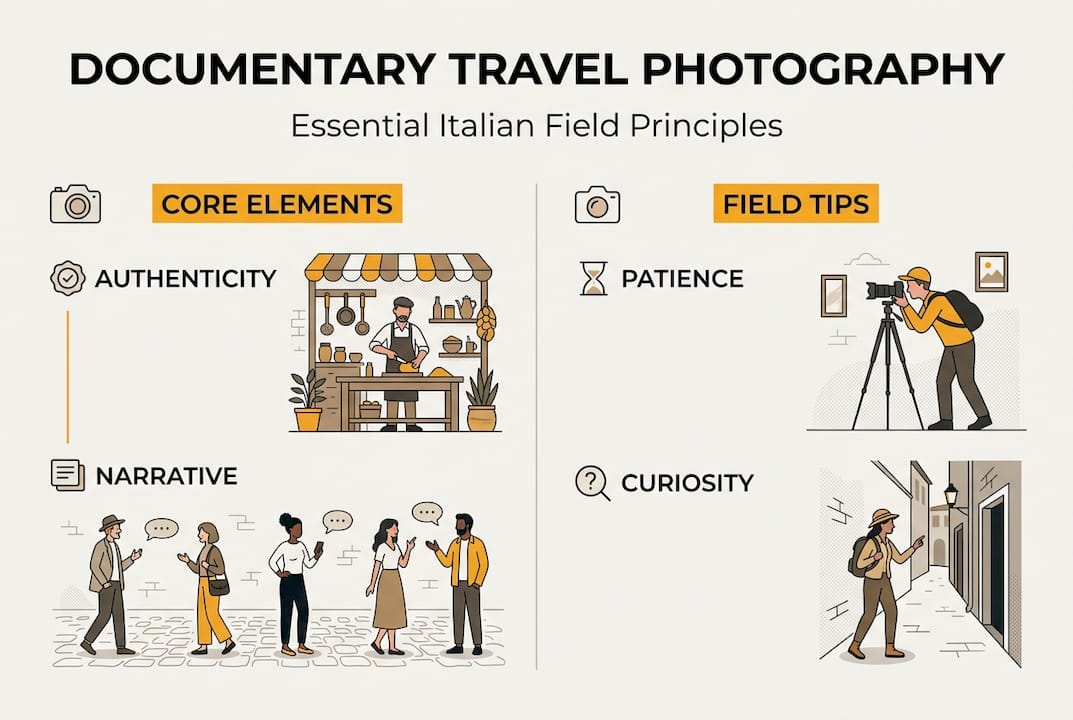
Key principles: Narratives, authenticity, and emotion
Great documentary travel photography in Italy rests on a few core principles. These aren’t rules to memorize. They’re habits of attention that you build over time.
Authenticity over aesthetics. The most powerful images capture something true, even if the light isn’t perfect or the frame is slightly off. A genuine laugh, a moment of grief, a quiet ritual observed from a respectful distance: these carry more weight than any technically flawless landscape.
Patience as a skill. Italy rewards photographers who wait. Sit in a piazza for an hour and watch what unfolds. The photo storytelling tips that matter most aren’t about camera settings. They’re about learning to be still long enough for real life to happen in front of you.
Here are the core principles to keep in mind on every shoot:
- Observe first, shoot second. Spend time in a location before raising your camera.
- Look for rituals and routines. Daily life in Italy, from espresso at the bar to the evening passeggiata, is rich with story.
- Prioritize emotion over composition. A technically imperfect image with real feeling beats a flawless but empty frame.
- Use context deliberately. What surrounds your subject tells as much of the story as the subject itself.
- Respect your subjects. Sensitivity builds trust, and trust opens doors to deeper images.
Mastering composition basics still matters, but it serves the story rather than replacing it. A strong documentary photo combines technical mechanics like lighting control and location scouting with a story-driven approach focused on people, culture, and everyday moments.
“Composition is the grammar of visual storytelling. You need it, but grammar alone doesn’t make a great novel.”
Methods and mindset: Slow travel, connection, and preparation
The biggest shift most photographers need to make isn’t technical. It’s behavioral. Rushing through Italy with a checklist of locations produces surface-level images. Slowing down produces stories.
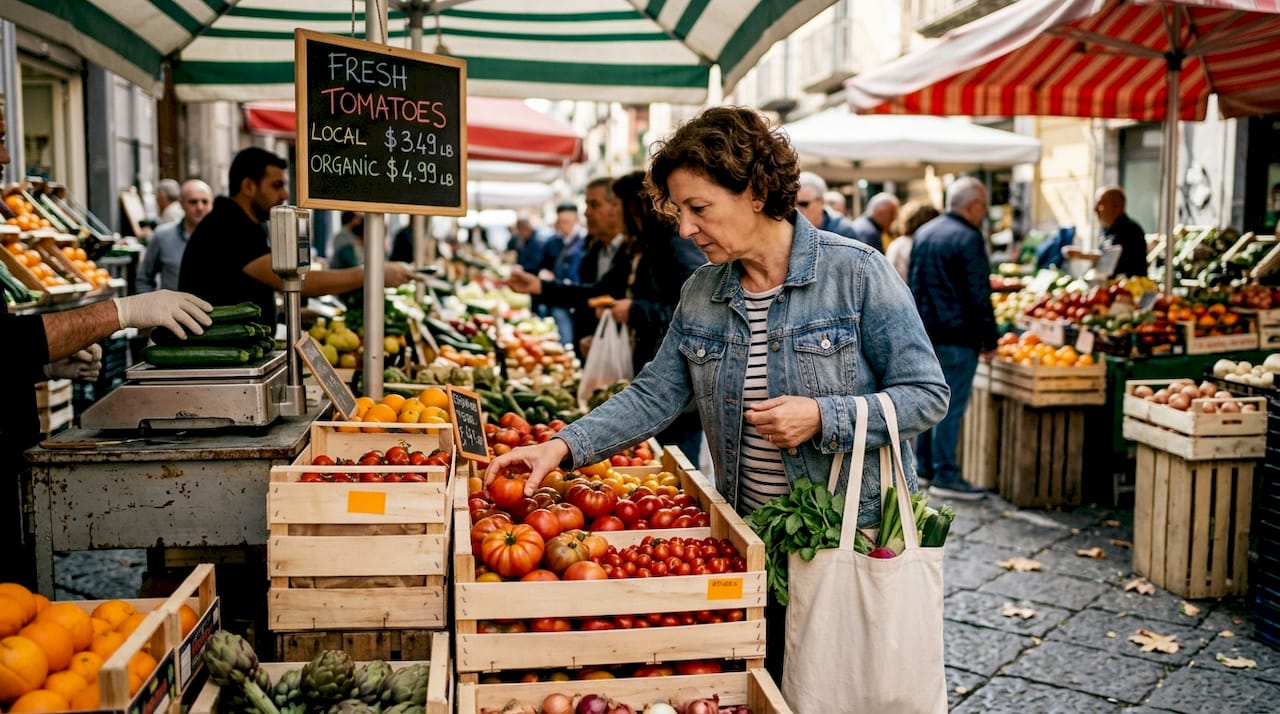
The slow travel method emphasizes depth over breadth: spending more time in fewer places, researching your subjects before arrival, building shot lists that reflect genuine curiosity, and developing patience for the right light and the right moment. When you spend three days in a single Tuscan village instead of racing through five, you start to see the rhythms of local life. That’s where the real images live.
Here’s a practical workflow for preparing your documentary shoot in Italy:
- Research your location deeply. Learn the history, the local traditions, and the daily rhythms of the place before you arrive.
- Build a shot list based on stories, not landmarks. What human stories do you want to tell? Start there.
- Scout locations on foot before shooting. Walk without your camera first. Notice the light, the people, the energy.
- Make connections respectfully. A few words of Italian, a genuine smile, and patience go a long way toward building trust with locals.
- Follow your travel photo workflow consistently. Review your images daily and adjust your approach based on what’s working.
Ethics matter here too. Italy’s most visited areas, Venice, Florence, Amalfi, can feel like open-air theaters where tourists photograph locals as if they were props. That’s the “human safari” trap. Essential shooting tips for Italy always include a reminder: your subjects are people, not scenery. Consent, sensitivity, and cultural awareness are non-negotiable.
Pro Tip: Amateurs who start with simple, local subjects and build their shot lists around genuine curiosity develop stronger documentary instincts faster than those who try to capture everything at once.
Essential techniques: Composition, light, and timing
Once your mindset is right, the technical tools become much easier to apply. You’re not learning rules for their own sake. You’re learning to express what you already see.
Composition tools that serve the story:
- Rule of thirds: Place your subject off-center to create visual tension and draw the eye naturally.
- Leading lines: Italy’s cobblestone streets, canal edges, and stairways naturally guide the viewer into the frame.
- Negative space: Empty space around a subject can amplify emotion and isolation.
- Layering: Foreground, midground, and background elements add depth and context to a scene.
Light is everything. Golden hour in Italy is genuinely magical, but don’t ignore the harsh midday light filtering through shuttered windows, or the blue-gray tones of an overcast morning in Venice. Each quality of light tells a different story.
| Time of day | Light quality | Best for |
|---|---|---|
| Golden hour (sunrise/sunset) | Warm, directional, soft | Landscapes, portraits, street scenes |
| Midday | Harsh, high contrast | Shadows, architecture, abstract details |
| Overcast | Soft, even, diffused | Portraits, markets, intimate moments |
| Blue hour | Cool, moody, atmospheric | Urban scenes, canals, cityscapes |
Mastering composition and urban scene tips work together when you’re shooting in places like Florence or Naples. For deeper work in Italy’s cities, understanding how to master cityscapes gives your documentary images a stronger visual foundation.
Timing is the hardest skill to teach. A story-driven approach requires waiting for the decisive moment: the instant when gesture, light, and composition align to reveal something true. You can’t rush it. You can only be ready.
Pro Tip: Set your camera to continuous shooting mode during active street scenes. You’ll capture the moment before and after the “perfect” shot, and often those frames tell a richer story.
The documentary debate: Purity, expression, and ethical lines
Here’s something most photography guides won’t tell you: pure documentary objectivity is a myth. Every photograph reflects a choice. Where you stand, what you include, when you press the shutter: all of it is expression. Acknowledging this makes you a more honest and more thoughtful photographer.
The debate between pure documentary authenticity and inherent photographer expression is one of the most interesting tensions in the genre. Some photographers insist on strict candid observation. Others take a collaborative or participatory approach, working with subjects to co-create images. Neither is wrong. Both have trade-offs.
Consider these contrasting positions:
- Candid/street approach: You observe without interfering. Images feel raw and unposed, but you risk missing context or misrepresenting your subject.
- Collaborative approach: You engage with subjects, explain your project, and sometimes direct. Images feel more intentional, but you risk losing spontaneity.
- Participatory approach: You involve your subjects in the storytelling process. This builds trust and depth but requires significant time and language skills.
“Every photograph is an act of selection. The question isn’t whether you’re expressing yourself. It’s whether you’re doing so honestly.”
In Italy’s tourist-heavy areas, the ethical stakes are real. Photographing locals as exotic curiosities, without context, consent, or genuine interest in their stories, reduces people to props. Authentic storytelling in Italy requires you to see your subjects as collaborators in the story, not just elements in your composition. That shift in perspective changes everything about how you approach a scene.
Documentary photography in Italy: Destinations and cultural context
Italy is an extraordinary laboratory for documentary travel photography. Every region offers a distinct visual language, and knowing where to focus helps you shoot with intention rather than overwhelm.
Italy’s best photography destinations for documentary work include Tuscany and Val d’Orcia for their timeless agricultural rhythms, Cinque Terre for fishing village life, Venice for the tension between tourism and local identity, Florence for artisan culture and street life, and the Dolomites for mountain communities and seasonal traditions.
Here’s how to approach each type of location:
- Rural Tuscany: Focus on agricultural cycles, local festivals, and the relationship between people and land. Early mornings before tourists arrive are essential.
- Venice: Look beyond the gondolas. The sestieri (neighborhoods) away from San Marco hold the real stories of Venetian daily life.
- Florence: The leather workshops, the Mercato Centrale, and the neighborhood bars are where authentic Florentine culture lives.
- Cinque Terre: The fishing communities and terraced vineyards offer rich documentary material, but ethical consent is especially important here where locals are accustomed to being photographed constantly.
- Sicily and the South: Less visited and more raw, these regions reward photographers willing to go slow and build genuine connections.
Finding hidden photo spots in Italy takes research and patience, but the images you find there are far more original than anything you’ll capture at a crowded overlook. Curated Italian tours designed for documentary photographers can open doors to locations and cultural moments that independent travelers rarely access.
Level up with immersive Italy photo experiences
Reading about documentary travel photography is a start. Practicing it in the field, with expert guidance and access to authentic locations, is where real growth happens.
At Italy Photo Tour, we design experiences specifically for photographers who want to go deeper than the tourist trail. Led by professional photographer Mino Di Vita, our guided tours give you access to off-the-beaten-path locations, local cultural moments, and real-time feedback on your storytelling approach. Whether you’re exploring what we do for the first time or ready to book one of our Italy photo tours, you’ll find experiences built around narrative, light, and genuine cultural immersion. We also explore the role of culture in photo tours as a foundation for artistic growth, not just a backdrop for pretty pictures.
Frequently asked questions
What gear is best for documentary travel photography in Italy?
A lightweight camera with one or two prime lenses keeps you agile and less conspicuous. Strip your gear down to one camera and a couple of lenses to develop a more focused and personal visual voice.
Do I need permission to photograph people in Italy?
It’s respectful and often legally important to seek consent, especially for close-up portraits. Ethical consent and cultural respect are especially critical in Italy’s tourist-heavy areas to avoid reducing people to photographic props.
How do I find authentic photo opportunities beyond tourist areas?
Slow travel, thorough research, and local connections are your best tools. Slow travel for depth combined with guided workshops helps you discover genuine stories that most visitors never see.
What is the biggest mistake amateurs make in documentary travel photography?
Focusing on aesthetics instead of stories, and rushing through locations without building real human connections. Starting with simple subjects and slowing down consistently produces stronger, more meaningful documentary work.