

TL;DR:
- Photojournalism combines photography with journalism to tell truthful, impactful stories driven by ethical standards. It emphasizes real-time, unmanipulated images that faithfully depict events, people, and cultural contexts, especially in Italy’s vibrant settings. Adhering to core principles like honesty, patience, and editorial responsibility transforms images into powerful reports that honor human and societal significance.
Photojournalism is one of the most misunderstood practices in visual storytelling. Many photographers assume it simply means shooting photos for a newspaper, but the definition of photojournalism reaches far deeper than that. It is a discipline governed by journalistic standards, ethical obligations, and the profound responsibility of truth. For photographers exploring Italy’s sun-drenched piazzas, weathered fishing villages, and ancient festival traditions, understanding what photojournalism truly means can transform how you see, frame, and share every image you take.
Table of Contents
- What is photojournalism? Understanding its core definition
- Journalistic ethics and standards in photojournalism
- How real-time visual storytelling sets photojournalism apart
- Applying photojournalism principles to Italy’s culture and landscapes
- Why many photographers miss the essence of true photojournalism
- Explore Italy with guided photojournalism tours
- Frequently asked questions
Key Takeaways
| Point | Details |
|---|---|
| Photojournalism defined | Photojournalism is journalism where photographs tell news stories with written text as a secondary element. |
| Ethical standards matter | Faithful, comprehensive, and unmanipulated visual depiction is essential to photojournalism’s credibility. |
| Real-time storytelling | Photojournalism uniquely captures events as they unfold, providing immediate, authentic visual reporting. |
| Context shapes meaning | Editorial decisions like image sequencing and captions are key to conveying accurate stories through photos. |
| Apply to Italy photography | Use photojournalism to tell true stories of Italy’s culture and landscapes by focusing on people, events, and significance. |
What is photojournalism? Understanding its core definition
The word itself already points toward its meaning: photojournalism is the marriage of photography and journalism. Merriam-Webster defines photojournalism as journalism where photographs are the dominant element rather than written copy. This is a crucial distinction. It is not about decorating a story with pretty images. The photograph is the story.
Oxford Learner’s Dictionaries describe photojournalism as giving news mainly through photographs, reinforcing the idea that the visual carries the primary communicative weight. The text, when present, serves the image rather than the other way around. Meanwhile, Cambridge Dictionary situates photojournalism firmly within news reporting and the press, drawing a clear boundary between it and commercial or fine art photography.
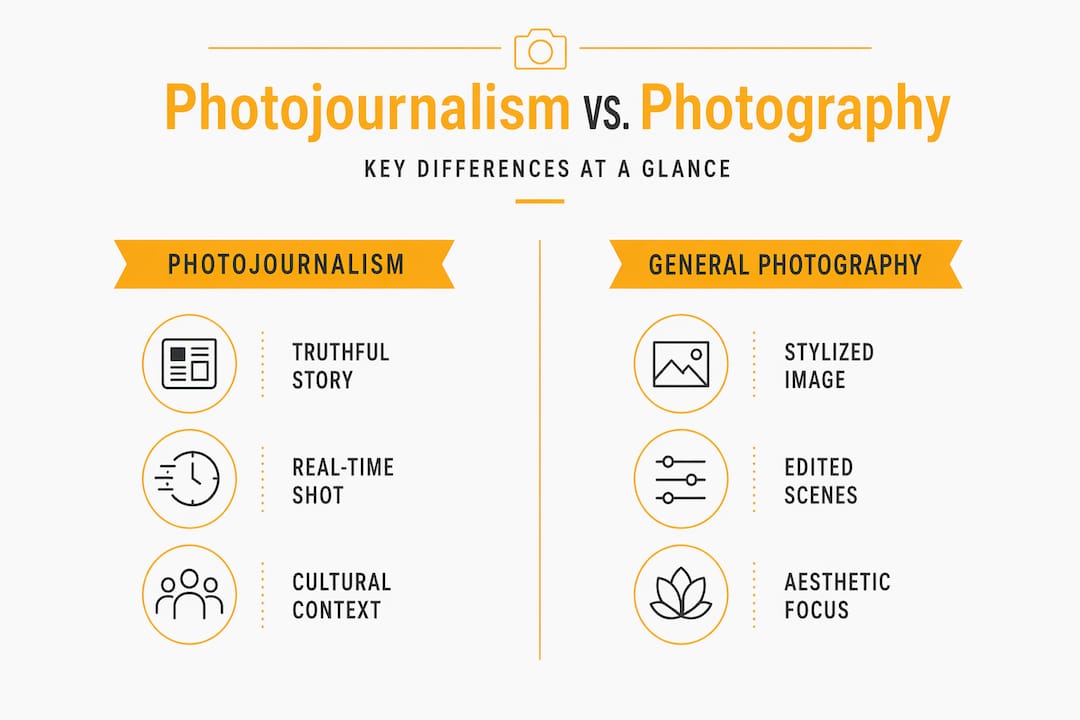
Understanding what is photojournalism means recognizing these three pillars that separate it from general photography:
- Journalistic intent: The goal is to inform, not to decorate or sell.
- Factual accuracy: Every visual element must reflect reality as it exists, not as you wish it appeared.
- Public significance: The subject matter carries meaning beyond personal expression, touching on events, people, or conditions that affect communities.
When you point your camera at a Venetian glassblower mid-motion or at an elderly Sicilian woman casting her fishing net at sunrise, the question photojournalism asks is not is this beautiful? It asks, is this true, and does it tell the world something worth knowing?
Journalistic ethics and standards in photojournalism
With the definition in place, the ethical layer becomes the beating heart of photojournalism explained. The National Press Photographers Association, one of the most respected bodies in visual journalism, makes this explicit. The NPPA’s Code of Ethics states that photojournalism’s primary role is the faithful, comprehensive depiction of news events and viewpoints. Not selective, not flattering. Faithful.
What does that mean in practice? Consider these core ethical principles that every photojournalist holds:
- No manipulation: Removing a distracting lamp post in post-processing, for example, alters the scene and misrepresents reality. The NPPA code explicitly prohibits manipulation that distorts the photographic moment.
- No staging: Asking subjects to re-enact an event, even for the sake of a stronger composition, crosses the line from journalism into theater.
- No deception: Captions, context, and sequencing must all reflect what genuinely occurred, not what the photographer wished had happened.
“Photojournalism’s role is to depict the scene faithfully and comprehensively, representing subjects and their environment as they are.” — NPPA Code of Ethics
These constraints can feel restrictive at first, but they are also liberating. When you know you cannot fabricate or manipulate, you must wait for reality to reveal itself. That patience is where the most extraordinary images are born. Learning to photograph local culture ethically deepens your respect for the people and places you capture.
Pro Tip: Before processing any image intended as photojournalism, ask yourself whether every edit you apply changes what was actually in the scene. Adjusting exposure and contrast is generally acceptable. Removing, adding, or repositioning any element is not.
How real-time visual storytelling sets photojournalism apart
Photojournalism’s great power, and its great challenge, lies in its relationship with time. It operates in real-time, inside unfolding events, without the luxury of set design, controlled lighting, or a cooperative subject. This is what makes photojournalism in media so distinctively urgent and visceral.

Zara Katz of NBC News offers a definition that captures this beautifully. She describes photojournalism as showing what is actually happening in real time, making the visual itself a form of reporting. Think about what that means for you as a photographer wandering through a crowded Florentine market or standing at the edge of a Cinque Terre festival. You are not composing a tableau. You are witnessing and recording, and your camera becomes a vehicle for truth.
The principles of real-time visual storytelling include:
- Presence over planning: You cannot predict the decisive moment, only be ready for it.
- Context over composition: A technically imperfect image that captures a genuine human moment often carries more journalistic weight than a perfectly lit, staged scene.
- Restraint over intervention: The photojournalist’s job is to witness, not to orchestrate.
“The visual is the reporting. You are not illustrating a story. You are telling it.” — Zara Katz, NBC News
This is why human storytelling in photojournalism is not simply a stylistic choice. It is the entire point. The faces, gestures, emotions, and interactions of real people caught in real moments carry the kind of truthful resonance that no staged photograph can replicate.
Applying photojournalism principles to Italy’s culture and landscapes
Now comes the most exciting part for photographers exploring this extraordinary country. Italy is an almost inexhaustible source of photojournalistic material. Its festivals, markets, religious processions, artisan workshops, and seasonal harvests are alive with human significance and cultural depth. Knowing the photojournalism characteristics that define the discipline helps you approach these scenes with intention.
Here is a practical approach to applying photojournalistic thinking on location in Italy:
- Identify a real event or human story. Rather than photographing the Palio di Siena as a picturesque spectacle, ask what story is unfolding within it. Whose victory matters, whose sacrifice is visible, whose emotions tell the larger narrative?
- Shoot sequences, not single frames. A single beautiful shot is a photograph. A sequence that shows a Venetian artisan beginning, shaping, and completing a glass figure is photojournalism. It educates.
- Write honest captions. Captions are not labels. They are the written element that gives factual grounding to your visual, stating who, what, when, and why.
- Use cropping deliberately. Cropping shapes what the viewer sees and what they do not. Crop to clarify truth, never to hide inconvenient context.
- Ask yourself the critical question. A self-check every photojournalist uses: do your images show what is actually happening and why it matters? If the answer is no, you may have a beautiful photograph, but not photojournalism.
The comparison below may help clarify the distinction between documentary and purely artistic approaches to the same Italian subject:
| Approach | Goal | Key technique | Outcome |
|---|---|---|---|
| Photojournalism | Inform and report truth | Real-time capture, honest captions | Images educate and document |
| Fine art photography | Express beauty or emotion | Staging, post-processing, abstraction | Images evoke feeling |
| Travel photography | Inspire and attract | Wide landscapes, golden-hour light | Images invite and enchant |
Learning to capture human stories in Italy with this framework in mind will elevate your work beyond beautiful snapshots into images that carry genuine weight. And if you want to go deeper still, mastering storytelling through images is a craft that rewards patience and practice in equal measure.
Pro Tip: In Italian cultural settings, the most powerful photojournalistic images often come from before the main event, when subjects are unguarded, nervous, or preparing. The anticipation before a festival procession reveals more humanity than the procession itself.
Why many photographers miss the essence of true photojournalism
Here is an observation that may feel uncomfortable but is worth sitting with. Most photographers who discover photojournalism get drawn to its aesthetic rather than its obligation. They love the gritty black-and-white frames, the raw emotion, the sense of urgency. And so they try to reproduce that look without internalizing what actually produces it: an unswerving commitment to truth above all other considerations.
The roles of a photojournalist are not glamorous. They include staying invisible when invisibility serves the story, abandoning technically perfect compositions because they misrepresent the moment, and resisting the temptation to help a scene along. This last point is where most photographers stumble. When light falls beautifully on a Tuscan olive farmer, the impulse to ask her to look toward the window is natural. Acted upon, it turns photojournalism into portraiture, and that is a choice worth making consciously.
Editorial choices are also far more powerful than most people realize. The NPPA emphasizes that meaning in a photojournalistic image depends heavily on how it is used: the sequencing, the cropping, the caption. Two photographers can take the same image of a Roman protest, and how each sequences and captions their work will produce two entirely different stories. That is not artistic license. That is editorial responsibility.
The photographers who truly internalize the importance of photojournalism are the ones who see their camera as a witness and themselves as accountable to the people they photograph. Italy gives you an abundance of authentic human life to witness. For photographers wanting to develop this documentary sensibility, exploring documentary travel photography in Italy is a worthy and enriching path.
Explore Italy with guided photojournalism tours
Italy is perhaps the most photogenically generous country on earth, and experiencing it through the lens of photojournalism principles transforms every cobblestone alley and twilight fishing harbor into a story waiting to be told. Knowing the definition of photojournalism is just the beginning. Putting it into practice on location, guided by a professional eye, is where real growth happens.

Italy Photo Tour, led by professional photographer Mino Di Vita, offers immersive photography tours across Italy that weave photojournalism techniques directly into the experience. Whether you are walking through the morning markets of Palermo or capturing the quiet rituals of a Venetian canal life, you will learn to photograph with both artistic instinct and journalistic intention. Discover the genuine value of guided photo tours and how they help you find authentic stories in every scene. Join a tour built to enhance your cultural photography skills and return home with images that genuinely say something.
Frequently asked questions
What distinguishes photojournalism from general photography?
Photojournalism focuses on truthful, real-time visual storytelling of news or significant events, whereas general photography may prioritize artistic or commercial goals. Oxford Learner’s Dictionaries define photojournalism as giving news mainly through photographs, underscoring its journalistic intent.
Why is ethical integrity important in photojournalism?
Ethical integrity ensures photos truthfully and comprehensively represent subjects without manipulation, maintaining public trust and credibility. The NPPA Code of Ethics places faithful depiction at the very center of what photojournalism demands of its practitioners.
Can photos of landscapes alone be considered photojournalism?
Landscape photos alone are generally not photojournalism unless they convey real events or significant cultural context that informs viewers. A self-check for photojournalism asks whether images show what is actually happening and why it matters to an audience.
How can I apply photojournalism techniques when photographing Italy?
Focus on capturing real people, events, and cultural contexts authentically, using sequencing and captions to tell true stories rather than staged or purely aesthetic images. The goal is always to show real events with their full human and cultural significance intact.
What role do captions and image sequencing play in photojournalism?
Captions and sequencing provide factual context that shapes the meaning and credibility of photojournalistic images. The NPPA highlights editorial choices like sequencing and captions as crucial tools for delivering truthful, accurate visual reporting.