

TL;DR:
- In 2026, photography trends balance AI-driven workflow efficiency with a strong preference for authentic, human-made imagery. These trends emphasize deliberate imperfection, storytelling, and technological advancements like neural ISP, which democratize high-quality image capture. Photographers who integrate AI tools while maintaining genuine authenticity and social responsibility will command higher market premiums.
Current photography trends in 2026 are defined by one central tension: the rise of AI-powered efficiency set against a surging cultural appetite for raw, human-made imagery. These two forces are not opposites. They are, for the photographers who understand them, a powerful combination. Computational photography, neural ISP technology, and AI editing tools are reshaping production workflows, while clients and brands simultaneously pay premiums for images that feel genuinely alive. Whether you shoot weddings in Tuscany, portraits in Milan, or street scenes in Venice, the 2026 photography styles that matter most reward those who can hold both truths at once.
What are the current photography trends in 2026?
AI integration is the single most disruptive force in photography workflows right now. Tools built into platforms like Adobe Photoshop now offer AI depth masking that separates subjects in three-dimensional space, replacing what once required painstaking layer stacking with a single, precise selection. This is not a marginal improvement. It changes how much time a photographer spends in post-production entirely.
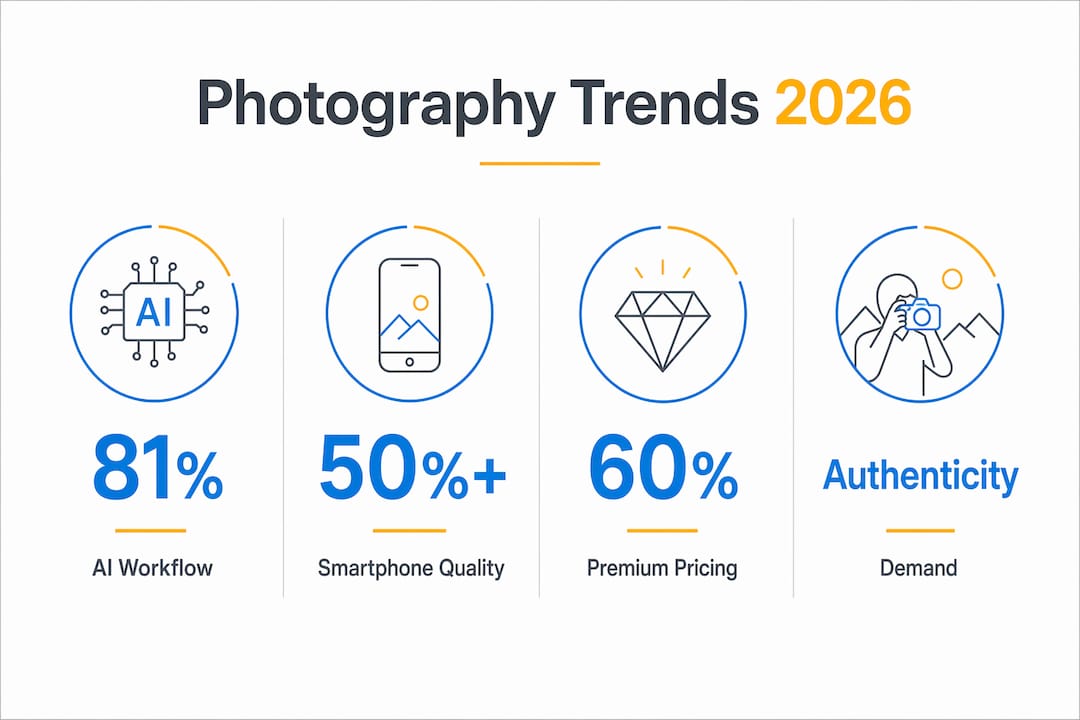
The market pressure behind AI adoption is real and measurable. 54% of clients now demand delivery within 14 days, and 13% expect results within 48 hours. That expectation would be impossible to meet at scale without automation. Photographers who have adopted AI culling and editing tools report meaningful relief: 81% say they experience better work-life balance through workflow automation. That statistic signals a profession reclaiming time, not surrendering creativity.
The risk, however, is real. The AI-driven headshot market grew 150% year-over-year through 2025, commoditizing basic portraits priced between $15 and $30. That compression forces every photographer to ask a hard question: where does your work sit on the spectrum between commodity and craft? The answer shapes every pricing and positioning decision you make this year.
- AI culling tools reduce selection time from hours to minutes on large shoots
- Adobe Photoshop’s depth-aware masking replaces complex manual exposure and color adjustments
- AI background replacement enables hybrid service offerings at premium price points
- Automated delivery pipelines free photographers to invest more time in client relationships
Pro Tip: Use AI for the mechanical work, culling, masking, and batch corrections, and protect your creative hours for shooting and client communication. That division of labor is where the real productivity gain lives.
Why imperfect, human-centric imagery dominates right now
The authenticity trend is not a stylistic preference. It is a market signal. Searches for “unfiltered” photographic content increased 100% in a single month, reflecting a decisive shift in buyer intent. Brands and consumers are actively seeking images that feel lived-in, spontaneous, and emotionally honest. Clinical perfection, once the gold standard, now reads as synthetic.
What does authentic imagery actually look like in practice? It is not accidental sloppiness. Deliberate imperfection means intentional motion blur that conveys energy, organic grain that adds warmth and texture, and off-center framing that suggests a moment caught rather than staged. These choices signal human presence. They tell the viewer that a person with a camera was genuinely there, responding to something real. That signal is now the most valuable commodity in a marketplace flooded with AI-generated perfection.
The commercial implications extend across genres. Wedding photographers who document rather than direct, portrait photographers who capture expression over pose, and stock photographers who shoot candid scenes over controlled setups all benefit from this shift. A 2026 Gartner survey found that 50% of U.S. consumers favor brands that avoid generative AI in consumer-facing content. That preference translates directly into client briefs and stock licensing decisions.
Here is how to build an authenticity-driven practice:
- Shoot in longer, uninterrupted sequences rather than directing individual poses
- Embrace available light with all its imperfections rather than correcting everything in post
- Include environmental context, the street, the kitchen, the crowd, rather than isolating subjects
- Introduce grain intentionally during editing rather than removing it reflexively
- Review your portfolio for images that feel genuinely surprising rather than merely polished
“The economic decoupling of aesthetic and value means imperfect, human-captured imagery commands higher premiums than flawless AI-generated work.” — Fstoppers
How are emerging technologies changing image quality in 2026?
Neural ISP technology represents the most significant hardware-level photography innovation of this decade. Glass Imaging’s Neural ISP corrects lens aberrations and recovers detail that traditional image signal processors discard during compression. In tests on the Honor 600’s 200MP sensor, Neural ISP improved resolution over 50% compared to conventional processing. That is not an incremental gain. It means smartphone cameras are now capable of delivering image quality that would have required dedicated mirrorless hardware just three years ago.
Computational photography extends this democratization further. Features like multi-frame noise reduction, AI-assisted focus stacking, and real-time HDR compositing are now standard on flagship Android and iOS devices. These tools give photographers, including those who travel light, creative control that was previously reserved for studio environments with controlled lighting and high-end glass.
| Technology | What it does | Creative benefit |
|---|---|---|
| Neural ISP (Glass Imaging) | Corrects lens aberrations at the processing level | Sharper detail from smaller sensors |
| AI depth masking (Photoshop) | Separates subjects in 3D space automatically | Faster, more precise portrait editing |
| Computational HDR | Composites multiple exposures in real time | Natural-looking high-contrast scenes |
| Multi-frame noise reduction | Stacks frames to reduce grain without softening | Clean low-light images without heavy NR |
Pro Tip: When shooting on a smartphone for serious work, shoot in RAW format where available. Neural ISP and computational processing apply to JPEGs, but RAW files preserve the full sensor data for additional control in Lightroom or Capture One.
The practical takeaway for travel and landscape photographers is significant. You can now carry a compact kit, a mirrorless body or even a high-end smartphone, and produce images that meet editorial and commercial standards. The barrier to entry for high-quality imaging has dropped, which means the differentiator is no longer gear. It is vision, timing, and the storytelling through images that only a skilled photographer can provide.
How sustainability and inclusion are reshaping photography standards
Inclusive portraiture and sustainable practice are no longer optional differentiators. They are baseline professional expectations in 2026. Clients reviewing portfolios now actively assess whether a photographer’s body of work reflects diverse representation across age, body type, ethnicity, and ability. A portfolio that only shows one demographic reads as a limitation, not a style choice.
Sustainable practice in photography covers both gear decisions and travel behavior. Photographers who extend the life of existing equipment, choose local subjects over long-haul travel shoots, and offset their carbon footprint are increasingly preferred by editorial clients with environmental commitments. This is especially relevant for travel photographers, where the carbon cost of a shoot is visible and quantifiable.
- Build portfolio diversity intentionally by seeking subjects outside your immediate community
- Use inclusive framing techniques that give subjects agency rather than positioning them as objects
- Document your sustainable practices for clients who ask about environmental impact
- Explore Italian photography styles that center local human stories rather than purely scenic compositions
- Invest in gear maintenance and repair rather than defaulting to replacement
The storytelling dimension of this trend is where the creative opportunity lives. Images that carry a human story, that show context, relationship, and meaning, outperform decorative photography in both editorial and commercial markets. Photographers who integrate human stories into their travel work produce images that clients return to, license repeatedly, and remember.
Practical strategies to adapt your photography practice in 2026
Adapting to 2026’s photography innovations does not mean abandoning what you already do well. It means layering new tools and sensibilities onto a practice that is already grounded in craft. The photographers gaining the most ground right now are those offering hybrid photography services that combine genuine image capture with AI-assisted editing, delivering both emotional authenticity and fast turnaround.
Here is a practical framework for positioning your work this year:
- Audit your current workflow and identify which tasks AI can handle without affecting creative quality
- Develop a clear client communication approach that explains your use of AI tools transparently
- Build a premium service tier that emphasizes your presence, your eye, and your editorial judgment
- Invest in one new technical skill, neural ISP optimization, advanced masking, or multiple exposure techniques, that AI cannot replicate
- Update your portfolio to lead with images that demonstrate emotional truth rather than technical perfection
Pricing strategy matters here. 60% of photographers are shifting toward premium positioning rather than competing on price as AI compresses the commodity market. That shift requires confidence in your own voice and a portfolio that justifies the investment. The wedding photography market is a clear example: couples paying for premium wedding coverage are not buying technically perfect images. They are buying the irreplaceable record of a day that will never happen again.
Pro Tip: Create a one-page client guide that explains your creative philosophy, your use of AI tools, and what makes your work distinct. Clients who understand your process are more likely to trust your judgment on the day and refer you to others.
Key takeaways
Photographers who balance AI-driven efficiency with authentic, human-centered image creation capture the highest market premiums in 2026.
| Point | Details |
|---|---|
| AI transforms workflows, not creativity | Use AI for culling, masking, and batch edits to reclaim time for shooting and client work. |
| Authenticity commands a price premium | Deliberate imperfection and candid imagery outperform polished, synthetic content in brand and editorial markets. |
| Neural ISP democratizes image quality | Glass Imaging’s technology delivers 50%+ resolution gains on smartphones, lowering the gear barrier for serious work. |
| Inclusion and sustainability are now baseline | Portfolio diversity and ethical practice directly influence client bookings and professional reputation. |
| Hybrid services lead the premium market | Combining real capture with AI editing lets photographers serve more clients without sacrificing quality or authenticity. |
Why I believe the camera in your hands still matters most
I have watched photography change more in the past three years than in the previous decade. AI tools that once felt like science fiction are now part of my weekly workflow, and I would not give them up. But here is what I have come to believe after years of shooting across Italy: the technology only matters if you are standing in the right place at the right moment, with the sensitivity to recognize what is worth capturing.
The photographers I see struggling in 2026 are not the ones who refuse AI. They are the ones who have lost confidence in their own eye. They chase technical perfection or trend-driven aesthetics without asking what they actually want to say. The authenticity trend is not a style you can apply in post-production. It grows from genuine curiosity about the world in front of your lens.
My honest prediction is that the gap between commodity and craft photography will widen further over the next two years. AI will continue to compress the bottom of the market, and that is not a threat to photographers who have invested in their own vision. It is a clarification. The Italy photography trends for 2026 I find most exciting are the ones that put photographers back in the field, responding to real light, real people, and real moments. That is where the work that lasts comes from.
— Mino
Explore photography in Italy with Italyphototour
The trends shaping photography in 2026, authenticity, storytelling, and the pursuit of genuine human moments, find their richest expression in the landscapes and streets of Italy. Italyphototour offers immersive, guided photography experiences across Milan, Tuscany, Venice, and Cinque Terre, designed to sharpen your eye and deepen your creative practice in some of the world’s most visually alive environments.

Led by professional photographer Mino Di Vita, each tour weaves together technical skill development, authentic storytelling, and the kind of sensory immersion that no online tutorial can replicate. Whether you are refining your approach to light and shadow or learning to capture the vivacity of Italian street life, these experiences are built for photographers who take their craft seriously. Discover what is possible when you bring your camera to Italy through photography tours in Italy with Italyphototour.
FAQ
What are the biggest photography trends in 2026?
The dominant trends are AI-assisted workflow automation and the authenticity movement, which prizes candid, imperfect, human-made imagery over synthetic perfection. Computational photography and neural ISP technology are also reshaping what is possible with compact and smartphone cameras.
How is AI changing photography workflows in 2026?
AI tools now handle culling, depth-aware masking, and batch color correction, with 81% of photographers using these tools reporting better work-life balance. The time saved is being reinvested into client relationships and premium creative work rather than repetitive editing tasks.
What does “authentic photography” mean in 2026?
Authentic photography refers to images that signal genuine human presence through deliberate choices like motion blur, organic grain, and candid framing. This aesthetic commands higher market premiums because it cannot be replicated by AI generation.
Is smartphone photography good enough for professional work in 2026?
Glass Imaging’s Neural ISP technology has improved smartphone resolution by over 50% compared to traditional processing, making flagship smartphones viable for editorial and commercial work. The differentiator is now the photographer’s vision, not the hardware.
How should photographers price their services in 2026?
60% of photographers are moving toward premium pricing rather than competing on cost, as AI compresses the commodity market. Photographers who clearly communicate their creative philosophy and offer hybrid services combining real capture with AI editing are best positioned to justify higher rates.