

TL;DR:
- Photographers often reach a point where technical skill surpasses visual storytelling, making images feel flat despite perfect exposure. Using targeted composition techniques based on emotional intent and visual problems like clutter or flatness enhances creativity and depth in photographs. Combining multiple techniques deliberately, breaking rules intentionally, and practicing with purpose accelerate mastery beyond mere rule-following.
Every photographer reaches a point where technical skill outpaces visual storytelling, and the image feels flat despite perfect exposure. A clear composition techniques list is the missing piece — not a rigid rulebook, but a living toolkit organized around the actual visual problems you face in the field. This article walks you through twelve essential compositional techniques, grouped by the specific challenge each one solves, so you can make deliberate, creative choices every time you raise your camera.
Table of Contents
- Key takeaways
- The composition techniques list: how to choose what works
- 1. Rule of thirds
- 2. Golden ratio and Fibonacci spiral
- 3. Central composition and symmetry
- 4. Fill the frame
- 5. Leading lines
- 6. Framing within a frame
- 7. Foreground interest
- 8. Negative space
- 9. Rule of odds
- 10. Diagonals and dynamic angles
- 11. Pattern and repetition
- 12. Simplicity and minimalism
- Comparing key techniques: a practical guide
- My perspective on mastering composition beyond the rules
- See your composition skills come alive in Italy
- FAQ
Key takeaways
| Point | Details |
|---|---|
| Match technique to intent | Choose composition methods based on the mood or story you want to convey, not habit. |
| Start with visual problems | Identify whether your challenge is centering, clutter, depth, or viewer direction before selecting a technique. |
| Combine techniques wisely | Two or three compatible methods work together beautifully; stacking too many creates visual chaos. |
| Practice intentional breaking of rules | Once you understand why a rule works, breaking it deliberately produces stronger, more personal images. |
| Foreground anchors everything | Adding strong foreground interest is the single fastest way to add depth and dimension to any landscape. |
The composition techniques list: how to choose what works
Before you can apply any list of composition methods effectively, you need a clear sense of what visual problem you are actually trying to solve. Composition should start with emotional or narrative intent, letting the mood drive the technique rather than the other way around.
Think of the four core compositional challenges most photographers face:
- Centering: Your subject sits dead center and the image feels static.
- Clutter: Competing background elements fight for attention with your subject.
- Lack of depth: The image reads as flat, with no layering or dimension.
- Directionless viewing: The viewer’s eye wanders without ever landing on a clear focal point.
Each technique in this article targets at least one of those four challenges. Symmetry, for example, conveys calmness and works beautifully on formal or still subjects. Diagonals and asymmetry, on the other hand, introduce tension and energy into the frame. When you understand the emotional grammar of each method, the choice becomes intuitive rather than mechanical.
Pro Tip: Before shooting, ask yourself one question: what do I want the viewer to feel? That single answer will point you toward the right technique faster than any formula.
1. Rule of thirds
The Rule of Thirds is the most widely taught entry point in any effective composition strategies guide, and with good reason. You divide the frame into a 3×3 grid and place your subject along the lines or at one of the four intersections. Those intersections are called power points because they naturally attract the viewer’s eye first.
What most beginners miss is the subtlety required. Small camera movements greatly shift where a subject lands on those power points. An inch to the left or right changes the entire balance of the frame. Think of a lone cypress tree in Tuscany: center it and it reads like a passport photo. Place it on the upper-right power point against an open sky and it breathes, tells a story, lives.
2. Golden ratio and Fibonacci spiral
The Golden Ratio feels more organic than the Rule of Thirds because it mirrors proportions found throughout the natural world. The Fibonacci spiral guides the viewer’s eye smoothly through the image, landing at the spiral’s focal point where your subject waits.
Where the Rule of Thirds gives you structure, the Golden Ratio gives you flow. It works especially well for scenes with natural curves: a winding road through Chianti, a river bending through a valley, or the arc of a staircase inside a Venetian palazzo. When you want subtlety over structure, reach for this technique instead.
3. Central composition and symmetry
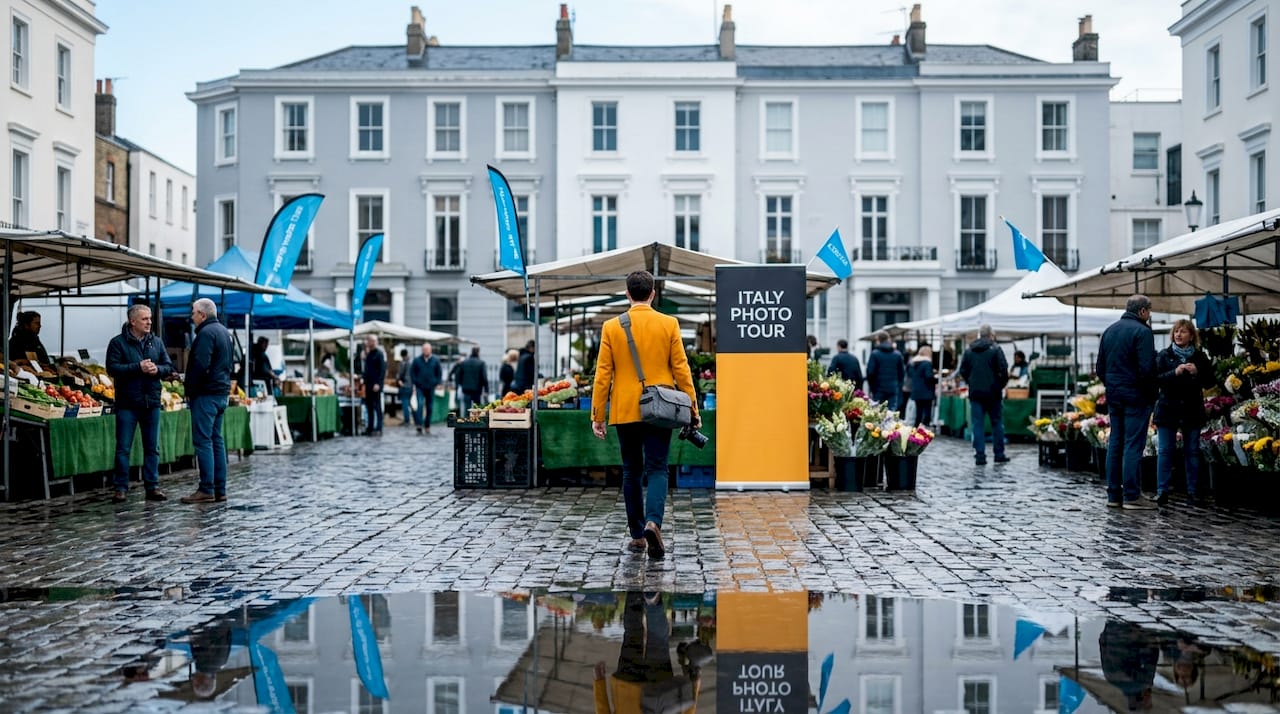
Centering is often treated as a beginner’s mistake, but used deliberately it is one of the most powerful creative compositional approaches available. Symmetry creates calm and order, making it ideal for reflections, doorways, archways, and formal architectural subjects.
The key word is deliberate. When you center a subject because it fills the frame with perfect symmetry, the choice radiates confidence. When you center it because you did not think about placement, it looks accidental. Consider the mirror-still surface of a Venetian canal at dawn: centering the reflection produces a haunting, meditative quality that no off-center placement could replicate.
4. Fill the frame
Filling the frame means letting your subject dominate the image completely, eliminating background distractions. This technique forces deep focus on the subject’s details: the weathered texture of an old door in Sicily, the vivid petals of a Florentine market flower, the creased and expressive face of a Venetian gondolier.
It solves the clutter problem instantly. No competing background, no visual noise, no ambiguity about where to look. For portraits, textures, and intimate close-ups, filling the frame creates an almost tactile connection between the viewer and the subject.
5. Leading lines
Leading lines are among the best composition techniques for guiding the viewer’s eye with purpose and intention. Cobblestone alleys, canal edges, rows of vineyard vines, and the converging rails of a Renaissance arcade all function as visual corridors pulling the eye through the frame.
The critical rule: leading lines must direct toward a meaningful subject. If a line trails off into an empty corner or a distracting background element, it actively weakens the image rather than strengthening it. Always evaluate the full trajectory of a line before committing to it. Start the line clearly in the foreground, and let it carry the viewer to exactly where you want them to look.
Pro Tip: Walk the entire length of a potential leading line with your eye before pressing the shutter. Where does it end? That endpoint becomes the star of your image.
6. Framing within a frame
This technique involves using elements in your scene to create a natural frame around your subject, building layers of foreground, midground, and background. An archway framing a distant cathedral, a window revealing a sunlit courtyard, branches overhead encircling a mountain peak — these layers create a 3D feeling in an inherently 2D medium.
The secret is depth separation. The essential factor is layering rather than simply the presence of a frame. There must be real physical distance between your framing element and your subject. A frame pressed too close to the subject looks like a border rather than a window into another world.
7. Foreground interest
For landscape photographers, this is the technique that separates good images from extraordinary ones. Foreground interest is the most impactful compositional element in landscape photography because it anchors the viewer’s eye while simultaneously adding layers that make the flat photograph read as three-dimensional.
Think of wild poppies leading toward the Tuscan hills, or weathered fishing nets in the foreground of a Cinque Terre harbor scene. The foreground object gives the viewer an entry point into the image, a place to begin their visual journey before moving through the frame toward the horizon. Italyphototour’s guides on landscape photography in Italy explore how to find and use these natural anchors across Italy’s most photogenic regions.
8. Negative space
Negative space is the intentional use of emptiness around your subject to amplify its presence. A single figure walking through a vast, pale Venetian fog. A lone boat on glassy water at dusk. These images hold tremendous emotional weight precisely because of what surrounds the subject rather than what fills the frame.
This technique is one of the most underused in the list of composition methods available to photographers. It requires resisting the urge to fill every corner of the frame and trusting that restraint creates power. The empty space breathes life and mood into the image, drawing attention to the subject through contrast rather than proximity.
9. Rule of odds
The Rule of Odds suggests that groups of odd numbers — three gondolas, five lanterns, seven wildflowers — feel more natural and visually satisfying than even-numbered groupings. Even numbers feel symmetrical and static. Odd numbers create a subtle dynamic tension, a natural imbalance that makes the eye move and explore.
This is one of those composition techniques for beginners that seems almost too simple to matter, until you see it at work. Photograph two people side by side and the image reads as a couple. Add a third and suddenly there is a story, a relationship, a moment unfolding.
10. Diagonals and dynamic angles
Where horizontal lines suggest calm and vertical lines convey strength, diagonal lines inject movement and energy into the frame. A staircase descending into shadow, a light beam cutting across a cathedral floor, a road receding into the distance at an angle — these compositions feel alive in a way that grids and horizontals simply cannot replicate.
This is one of the more advanced composition tips because it requires you to physically reposition yourself. Crouch low to exaggerate a diagonal. Tilt the camera slightly to transform a flat scene into one that hums with tension. Diagonals are one of the most effective creative compositional approaches for urban and street photography, where the geometry of buildings and shadows offers endless angles to explore.
11. Pattern and repetition
Patterns are everywhere in the built and natural world: the rhythm of terracotta roof tiles, the repeating arches of a Roman aqueduct, the symmetrical windows of a Baroque facade. Filling the frame with pure, uninterrupted pattern creates a hypnotic visual rhythm that holds the viewer’s gaze.
The more interesting creative move, however, is to find the moment when a pattern breaks. A single red door among a row of blue ones. A figure walking through a tiled courtyard. The interruption becomes the subject, and the pattern becomes the context that gives the interruption meaning. That contrast is where truly memorable images are born.
Pro Tip: When you find a strong pattern, photograph it twice: once as pure repetition, and once with a single breaking element. Compare them side by side. The second will almost always tell a richer story.
12. Simplicity and minimalism
Removing everything from the frame that does not serve the subject is one of the hardest skills to develop and one of the most rewarding. Avoiding cluttered backgrounds can mean physically moving to change your angle, using a shallow depth of field to blur competing elements, or cropping in post-processing.
Minimalism is not about empty images. It is about ruthless intention. Every element that remains in the frame should earn its place. A pale gray wall. A single window. One shaft of winter light. These images require confidence, but when they work, they work profoundly.
Comparing key techniques: a practical guide
This table summarizes the best composition techniques by purpose, emotional effect, and ideal context to help you make faster decisions in the field.
| Technique | Visual problem solved | Emotional effect | Best use case |
|---|---|---|---|
| Rule of Thirds | Static centering | Balanced, dynamic | Portraits, street, landscapes |
| Golden Ratio | Stiff framing | Organic, flowing | Natural scenes, winding compositions |
| Central symmetry | Directional ambiguity | Calm, formal | Architecture, reflections |
| Leading lines | Directionless viewing | Purposeful, immersive | Streets, paths, waterways |
| Negative space | Visual clutter | Atmospheric, poetic | Minimalist, mood-focused |
| Foreground interest | Flatness | Deep, layered | Landscapes, wide-angle shots |
| Diagonals | Static energy | Dynamic, tense | Urban, action, interiors |
| Fill the frame | Background distraction | Intimate, textural | Portraits, macro, details |
Combining techniques multiplies their effect. Leading lines paired with foreground interest, for example, creates both depth and direction simultaneously. A minimalist approach combined with the Rule of Thirds produces images with quiet, precise beauty. The goal is to improve your composition skills by developing a feel for which combinations reinforce each other and which ones compete.
My perspective on mastering composition beyond the rules
I have watched hundreds of photographers progress from nervous beginners to confident visual storytellers, and the most common turning point is not the moment they learn a new rule. It is the moment they feel permission to break one.
Rules in photography, including every technique on this list, are really just documented observations about what tends to work visually. They are starting points, not destinations. I have made images I am deeply proud of by centering subjects I was told to offset, by embracing flat scenes I was told needed foreground, by choosing chaos over order when chaos was the truth of the moment.
What I have found actually works is building the rules so deeply into your instinct that you stop thinking about them consciously. Then your creative decisions come from the scene in front of you, not from a mental checklist. Practice each technique with deliberate focus for a period of time, shoot the same subject using three different methods, and feel the difference. That physical, sensory comparison is how the techniques move from your head into your hands.
Composition is ultimately the grammar of visual storytelling. You can speak correctly and still say nothing remarkable. What transforms correct grammar into poetry is intention, emotion, and the willingness to trust your own eye.
— Mino
See your composition skills come alive in Italy
Learning composition from a list is one thing. Feeling it in your hands as golden light pours across a Venetian canal at dawn is something else entirely.

Italyphototour offers immersive, guided photography tours across Italy designed specifically to help photographers at every level apply and deepen their compositional skills in some of the world’s most visually rich environments. Led by professional photographer Mino Di Vita, each tour is built around the intersection of light, culture, and personal creative expression. From the misty vineyards of Tuscany to the chromatic streets of Cinque Terre, you will have expert guidance to make every frame count. Explore what we do at Italyphototour and take the next step in your photographic journey.
FAQ
What is the most important composition technique for beginners?
The Rule of Thirds is the most practical starting point because it immediately solves the most common beginner problem: static, centered framing. Placing subjects at the frame’s natural power points creates balance and energy with minimal effort.
Can you use more than one composition technique in a single photo?
Yes, and the most compelling images typically combine two or three techniques. Leading lines paired with foreground interest and the Rule of Thirds, for example, create layered depth, direction, and balance all at once.
How does negative space differ from an empty or poorly composed photo?
Negative space is intentional. The emptiness is chosen deliberately to amplify the subject’s presence and emotional weight. A poorly composed photo is empty by accident, with no clear focal point and no visual purpose to the surrounding space.
When should I use central composition instead of the Rule of Thirds?
Central composition works best when your subject is perfectly symmetrical or when you want to convey calm, formality, or stillness. Architectural reflections, doorways, and tunnels are ideal candidates for deliberate centered framing.
How do I improve my composition skills faster?
Shoot the same scene using three different techniques back to back, then compare the results immediately. That direct sensory comparison builds compositional instinct far faster than reading or watching tutorials alone.