

TL;DR:
- Arriving in Tuscany in October, you seek to capture its breathtaking autumn landscape with technical precision and artistic patience.
- Prepared with the right gear, timing, and location choices, you can transform Tuscan vistas into evocative images that move viewers deeply.
You arrive in Tuscany in October, camera in hand, heart full of expectation. The hills are draped in amber and gold, cypress trees cut sharp silhouettes against a pale sky, and the air smells of woodsmoke and damp earth. Yet when you review your shots that evening, something feels lost. The colors look flat, the light harsh, the magic somehow absent from the frame. This guide exists precisely for that moment of frustration. Whether you are shooting your first autumn landscape or refining a practiced eye, these actionable steps, expert techniques, and curated location recommendations will help you translate Tuscany’s breathtaking fall palette into images that genuinely move people.
Table of Contents
- Essential gear and preparation for autumn shoots
- Best locations in Tuscany for autumn colors
- Optimal timing and light for vibrant shots
- Composition and camera techniques for autumn landscapes
- Troubleshooting common autumn photo challenges
- What most guides miss about shooting autumn colors in Tuscany
- Take your Tuscany autumn photography further
- Frequently asked questions
Key Takeaways
| Point | Details |
|---|---|
| Choose inspiring locations | Val d’Orcia, Casentino, Chianti, and Mt. Amiata offer the richest autumn colors in Tuscany. |
| Time your shoots for magic | Sunrise and golden hour provide the best light, fewer crowds, and misty valley scenes. |
| Use the right techniques | Combine thoughtful composition, proper lens choice, and RAW post-processing for vibrant results. |
| Prepare and adapt | Pack key gear, dress for changing weather, and embrace Tuscany’s unpredictability for memorable shots. |
Essential gear and preparation for autumn shoots
Before you set out, being well-equipped is crucial for maximizing both creativity and technical success. Tuscany’s autumn mornings arrive with mist, dew, and rapidly shifting light, and the wrong gear choices can cost you irreplaceable moments.
Lens selection shapes everything. A wide-angle lens, typically 16 to 24mm, pulls in sweeping panoramas of rolling hills and vineyard rows stretching toward the horizon. A telephoto lens, 70 to 200mm or longer, compresses distant layers of color into lush, painterly compositions. As recommended for Tuscany shoots, carrying both a wide and a telephoto lens gives you the flexibility to respond to whatever the landscape offers. A sturdy tripod is equally non-negotiable. Fog, low golden-hour light, and long exposures all demand rock-solid stability, and a shaky tripod is the silent killer of otherwise perfect shots.
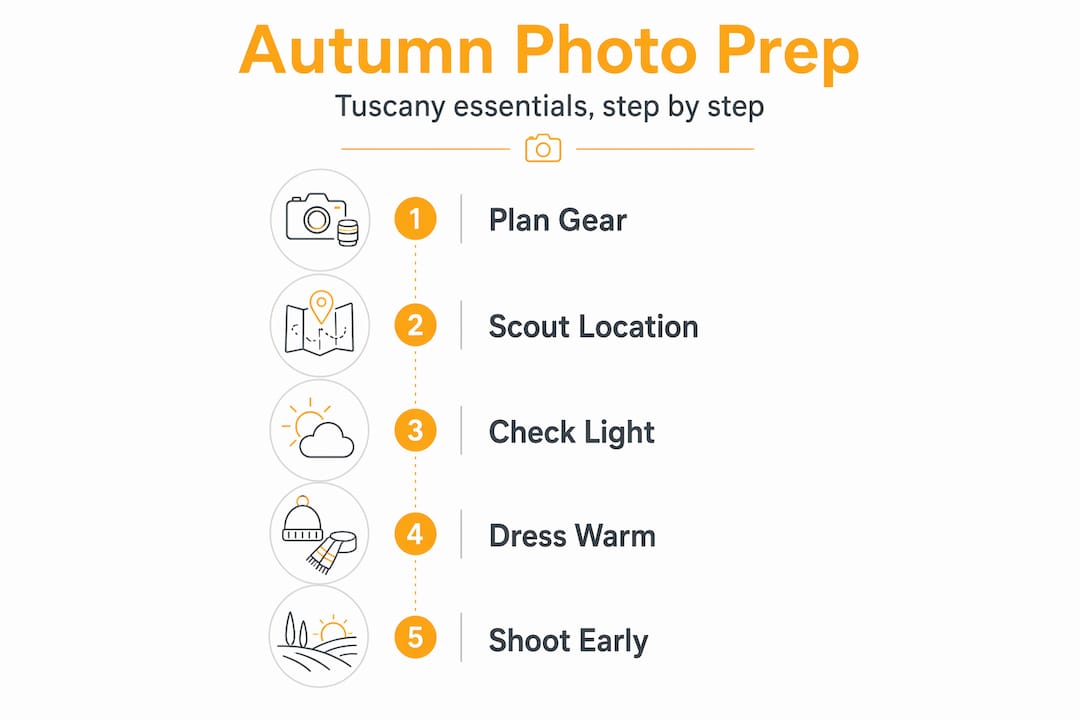
Prepare your best camera gear for Italy before departure by charging every battery and packing at least two spares. Cold mornings drain power faster than you expect. Bring lens wipes, a blower, and a microfiber cloth, because dew and dust are constant companions in the Tuscan countryside. A remote shutter release eliminates camera shake during long exposures, and a circular polarizing filter deepens the blue of autumn skies and reduces glare on wet leaves. Keep a complete Italy landscape photography checklist nearby to avoid leaving essentials behind.
| Gear item | Purpose | Priority |
|---|---|---|
| Wide-angle lens (16-24mm) | Grand panoramas, sweeping scenes | Essential |
| Telephoto lens (70-200mm) | Compression, detail, layering | Essential |
| Sturdy tripod | Stability in low light and mist | Essential |
| Remote shutter release | Eliminates camera shake | High |
| Circular polarizing filter | Richer skies, reduced glare | High |
| Extra batteries (x2) | Cold mornings drain power fast | Essential |
| Lens wipes and blower | Dew and dust management | High |
Dress in warm, waterproof layers for early starts. Temperatures in Tuscany can hover near freezing at dawn in late October, and you may be standing still for extended periods waiting for the perfect light.
Pro Tip: Pack your bag the night before and set your alarm for at least 90 minutes before sunrise. The walk to your chosen viewpoint, the setup, and the calm of waiting in darkness are all part of the creative ritual.
Best locations in Tuscany for autumn colors
With your gear ready, the next step is choosing locations that offer the richest colors and varied compositions. Tuscany rewards those who explore beyond the obvious, and each region has its own distinct autumnal character.
Val d’Orcia is the undisputed icon. Its undulating hills, isolated farmhouses, and perfectly placed cypress trees create compositions that feel almost too beautiful to be real. The soft morning light here wraps around every curve of the landscape like a warm glaze. Casentino National Park, tucked in the eastern Apennines, offers something entirely different: deep, cathedral-like forests of beech and chestnut that burn with color from mid-October onward. The Chianti SR222, sometimes called the Chiantigiana road, winds through vineyards heavy with the last harvest, their leaves turning crimson and gold against stone walls. Mt. Amiata, Tuscany’s ancient volcano, adds altitude and atmosphere, with forests swirling in mist and a quieter, more contemplative mood.
As autumn foliage guides confirm, Val d’Orcia, Casentino National Park, Chianti SR222, and Mt. Amiata are the prime autumn destinations in the region. For inspiring Italian landscapes beyond these well-known spots, ask locals about small roads between villages, where olive groves and private vineyards create intimate, crowd-free scenes.
| Location | Highlights | Accessibility | Unique feature |
|---|---|---|---|
| Val d’Orcia | Rolling hills, cypress rows | Easy by car | UNESCO World Heritage Site |
| Casentino National Park | Beech and chestnut forests | Moderate hiking | Deep, immersive forest color |
| Chianti SR222 | Vineyards, stone villages | Easy by car | Harvest season atmosphere |
| Mt. Amiata | Volcanic forests, mist | Moderate by car | High-altitude drama |
“The most memorable autumn frames in Tuscany often come not from the famous viewpoints, but from the quiet roads between them, where the light falls unexpectedly and the scene belongs entirely to you.”
Study autumn color inspiration from Italian photographers who know these roads intimately. Their work reveals angles and moments that no travel guide can fully map. Learning how to plan a Tuscany photo tour well in advance allows you to align your visit with peak color, local events, and ideal weather windows.
Optimal timing and light for vibrant shots
Great scenes are transformed by great light, so timing your shoots is as important as location. Tuscany’s autumn light has a particular tenderness to it, softer and warmer than summer, with longer golden hours and more dramatic contrasts between shadow and illuminated hillside.
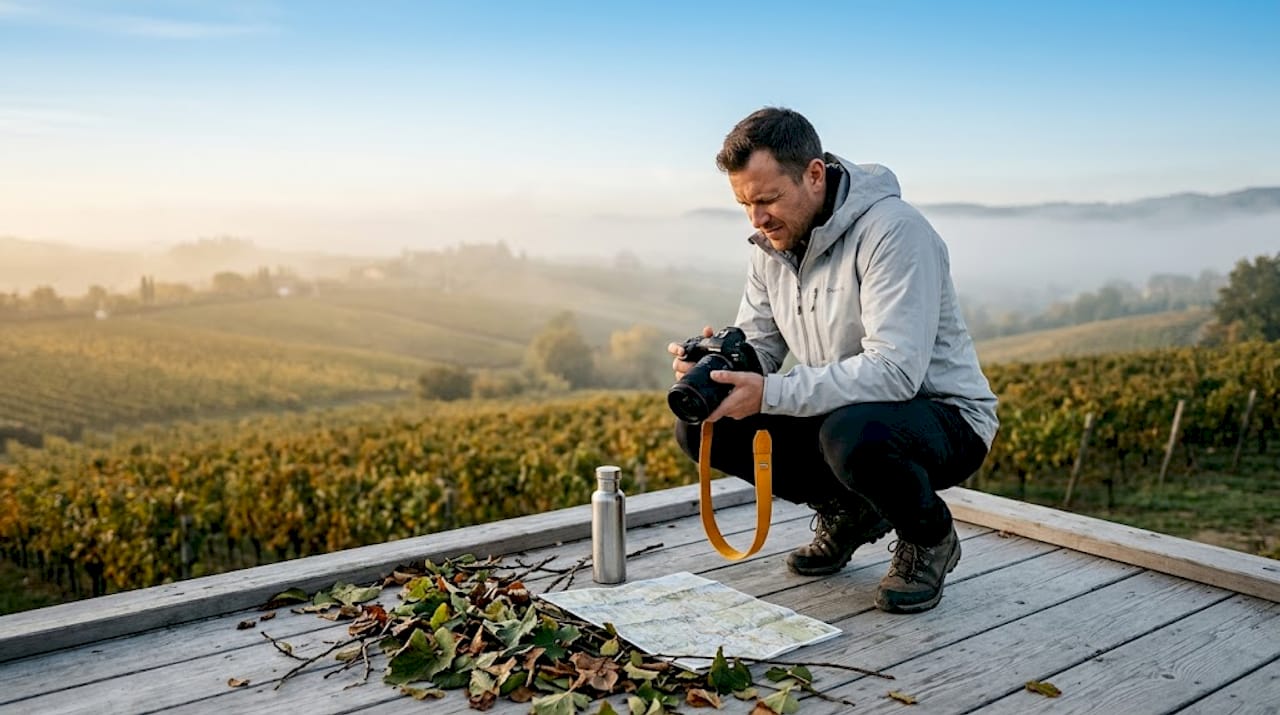
Golden hour, sunrise, and sunset are the three pillars of successful autumn photography here. Sunrise brings the most magical conditions: lingering fog settles in the valleys, backlight rims the cypress trees with gold, and the landscape is almost entirely yours. Sunset delivers saturated color across the hills, long shadows that sculpt the terrain, and silhouette opportunities against a burning sky. The hour just after rain is equally extraordinary, when the air clears and every color intensifies as if freshly painted.
Weather variability is not your enemy. Overcast skies produce beautifully diffused light, ideal for forest interiors and close-up foliage details where harsh shadows would be distracting. Study shooting autumn light techniques from experienced outdoor photographers to understand how to adapt your exposure and white balance as conditions shift.
- Check weather forecasts the night before and plan your primary and backup locations accordingly.
- Arrive at your viewpoint at least 30 minutes before sunrise to set up and compose before the light changes.
- Stay through the full golden hour rather than leaving after the first good shot.
- Return to the same spot at sunset to compare how the light transforms the identical scene.
- After rain, move quickly: the clarity and color intensity last only minutes before haze returns.
For deeper guidance on reading and mastering natural light in Italian landscapes, study how the angle of the sun interacts with terrain at different times of day. These essential landscape tips will sharpen your instincts for predicting when and where the light will be most rewarding.
Pro Tip: Use a sun-tracking app to know exactly where sunrise and sunset will fall relative to your chosen viewpoint. In Val d’Orcia, the famous Belvedere farmhouse catches the first light from the southeast in October, a detail that changes your entire positioning strategy.
Composition and camera techniques for autumn landscapes
Now that you have the right timing and place, mastering technical and artistic techniques is next. Tuscany’s geometry is extraordinarily photogenic, and learning to work with it rather than simply pointing your camera at it makes the difference between a snapshot and a story.
Wide-angle lenses capture grand landscapes while telephoto lenses compress distant hills into layered tapestries of color. Apply the rule of thirds by placing the horizon on the lower third when the sky is dramatic, or the upper third when the foreground is rich with texture. Leading lines are everywhere in Tuscany: cypress-lined roads draw the eye deep into the frame, vineyard rows create rhythmic diagonals, and stone walls guide attention toward a farmhouse or hilltop village.
RAW post-processing enhances color in ways that JPEG simply cannot match. Shooting RAW preserves the full tonal range of a scene, allowing you to recover highlights in bright skies and lift shadow detail in dark valleys during editing. Focus stacking, where you take multiple shots focused at different distances and blend them in post-processing, delivers edge-to-edge sharpness across a deep landscape. For a reliable outdoor photography workflow, set your aperture between f/8 and f/11 for maximum depth of field, keep ISO as low as conditions allow, and bracket your exposures in high-contrast scenes.
- Set up your tripod and compose before the light peaks so you are not rushing.
- Use the rule of thirds to place your main subject off-center.
- Identify one strong leading line and let it anchor the composition.
- Shoot three bracketed exposures for each key frame to protect against blown highlights.
- Review your histogram rather than the LCD screen to judge exposure accurately.
These Italy photography tips and the broader atmospheric beauty guide offer further depth on translating what you see emotionally into what the camera records technically. Studying spectacular Italian landscapes photographed by professionals also trains your eye to recognize the compositional choices that make an image sing.
Troubleshooting common autumn photo challenges
Even with great planning, Tuscany can throw you curveballs. Here is how to consistently get great results when conditions do not cooperate.
Flat, lifeless images often come from shooting in the middle of the day when the sun is high and the light is harsh. The fix is simple: wait. Shoot during the golden hours and let the warm, angled light do the heavy lifting. If your colors still look muted after editing, check your white balance. A slightly warmer white balance setting, around 5500 to 6500 Kelvin, brings out the amber and gold tones that define Tuscany in autumn.
Early mornings and weekdays are your best tools for avoiding crowds at famous viewpoints. Arriving before dawn means you often have the entire scene to yourself, and the quality of light at that hour is unmatched. When crowds do appear, use a longer focal length to isolate details and compress the scene, effectively cropping out distractions. Creative framing with foreground elements, a gnarled olive branch, a stone wall, a row of vines, can also redirect attention away from unwanted figures.
Mud and wet leaves are real hazards in the Tuscan countryside after rain. Protect your gear with a rain cover and keep a dry cloth in your jacket pocket. Clean your lens frequently, because a single water droplet can ruin an otherwise perfect frame. These landscape photo troubleshooting strategies, combined with practical vacation photo tips for field care, will keep your equipment performing at its best through unpredictable autumn weather.
“Every difficult morning in the field, the fog that arrives too late, the rain that comes too early, teaches you something that no tutorial ever could. Embrace the uncertainty. It is where the best photographs live.”
Pro Tip: If the fog you hoped for never materializes, shift your attention to close-up details: a single dew-covered leaf, a cluster of grapes left on the vine, the texture of ancient bark. These intimate frames often become the most cherished images of an entire trip.
What most guides miss about shooting autumn colors in Tuscany
Most photography guides focus heavily on technique, and technique matters enormously. But after years of leading shoots across Tuscany’s autumn landscape, the most striking observation is this: the photographers who return home with truly memorable images are rarely the most technically advanced. They are the most patient.
Patience in Tuscany means returning to the same viewpoint three mornings in a row until the mist finally settles exactly where you imagined it. It means lingering in a village long enough to notice that the market on Wednesday morning fills the piazza with color and life that no travel guide mentions. It means understanding that the post-harvest light in early November, when the vines are bare and the hills take on a more somber, melancholic beauty, tells a completely different and equally powerful story than the peak color of mid-October.
Unpredictable weather is not a problem to be solved. It is the raw material of extraordinary photography. A storm rolling across Val d’Orcia creates a drama that no amount of planning can manufacture. The Italy atmosphere insights that come from genuine immersion in local rhythms, the smell of the air before rain, the particular quality of light after a cold front passes, are what separate a technically correct image from one that makes a viewer feel something.
Post-processing is not cheating. It is the digital darkroom equivalent of what Ansel Adams did in his wet darkroom for decades. Tuscany’s autumn colors in RAW files are often richer and more nuanced than they appear on the camera screen, and careful editing honors that truth rather than inventing something false.
Take your Tuscany autumn photography further
If these pages have stirred something in you, consider what it would mean to experience all of this with an expert eye beside you, someone who knows exactly where the light falls at 7am on a November morning, and which quiet road offers a view that no travel magazine has yet discovered.

Italy Photo Tour offers immersive Italy photography tours led by professional photographer Mino Di Vita, timed specifically for Tuscany’s autumn peak. These experiences go far beyond sightseeing. You receive hands-on guidance, real-time feedback, and access to locations and moments that only deep local knowledge can unlock. Whether you are refining your technique or simply seeking inspiration in one of the world’s most beautiful landscapes, immersive Italy photo tours offer the kind of creative transformation that stays with you long after you return home.
Frequently asked questions
When is the best time to photograph autumn colors in Tuscany?
Mid-October to early November is ideal, with peak Val d’Orcia foliage and misty mornings that add atmosphere and depth to landscape compositions.
What camera settings work best for autumn landscapes in Tuscany?
Use low ISO, shoot in RAW, and set your aperture to f/8 to f/11 for depth of field. RAW post-processing is strongly recommended for the best color rendition and tonal range.
How can I avoid crowds at the best autumn photo spots?
Early mornings and weekdays consistently offer the quietest conditions and the most rewarding golden light at popular viewpoints like Belvedere in Val d’Orcia.
What if the weather is overcast during my autumn shoot?
Embrace diffused light for forest interiors and close-up foliage details, where even, shadow-free illumination reveals texture and color that direct sun would wash out. Fog and mist add atmospheric layers that can make an image unforgettable.
Which locations offer the most unique autumn colors beyond Val d’Orcia?
Casentino, Chianti SR222, and Mt. Amiata all offer gorgeous, less-crowded autumn scenes with distinct character, from deep forest canopies to volcanic highland mist.