

TL;DR:
- Photographing local life in Italy captures the country’s authentic character and preserves its traditions.
- Practicing patience, respect, and keen observation helps create heartfelt images that reveal cultural soul.
- Guided tours and ethical awareness ensure meaningful, responsible photography experiences in Italy’s vibrant streets.
Most photographers who visit Italy spend the bulk of their time chasing the same postcard angles. The Colosseum at dusk. The gondolas at Rialto. The leaning tower framed through outstretched hands. These images have their own undeniable beauty, but they rarely tell you anything new. The real Italy, the one that breathes and laughs and argues and lingers over espresso, unfolds in the spaces between the monuments. This guide is your invitation to step off the tourist path and learn how to photograph the living, breathing culture of Italy with skill, sensitivity, and genuine artistic purpose.
Table of Contents
- Why photographing local life matters
- Practical strategies for capturing Italian local life
- Navigating ethics and Italian cultural norms
- Applying your skills: from learning to shooting with confidence
- What most guides miss about capturing local life in Italy
- Experience authentic Italian life through a guided photo tour
- Frequently asked questions
Key Takeaways
| Point | Details |
|---|---|
| Authenticity over monuments | Capturing daily local life offers deeper stories and lasting images than typical tourist shots. |
| Techniques matter | Observation, anticipation, and focusing strategies like zone focusing help you catch genuine moments. |
| Ethics guide practice | Understanding Italian law, ethics, and cultural norms keeps your photography both powerful and respectful. |
| Preparation prevents problems | Planning, group etiquette, and awareness of privacy boundaries help avoid conflicts and missed shots. |
| Guided tours enhance learning | Joining a photo tour provides mentorship, off-the-beaten-path access, and crucial feedback. |
Why photographing local life matters
There is a particular kind of image that stops you mid-scroll, the one where a Sicilian fisherman mends his nets in golden morning light, or where a Milanese grandmother bargains at a fruit stand, her gestures fluent with decades of ritual. These photographs don’t just document a place; they reveal its soul. When you pursue photographing local culture, you move from being a tourist with a camera to becoming a genuine visual storyteller.
The difference between a monument “proof shot” and a daily life image is the difference between a receipt and a letter. One confirms you were there; the other shares what the place felt like. Research consistently shows that cultural tourism benefits extend far beyond the visitor, deepening local pride and sustaining traditions that might otherwise fade. When your lens turns toward everyday moments, you participate in that preservation rather than simply observing it.
“Street and documentary photography offer intimate access to humanity, but can also raise ethical concerns if privacy is compromised.” This tension, as noted in recent reflections on street photography, is precisely what keeps this style of image-making honest and alive.
There is also a powerful creative dividend at work here. Photographing local life pushes you to read light, gesture, and composition simultaneously, a kind of multi-sensory attention that sharpens every other aspect of your craft. You learn patience. You learn to see a scene before it happens. And you learn that the most authentic travel images are rarely staged; they are earned.
Being a respectful observer is, at its core, an ethical stance. It means understanding that the people sharing their daily routines with your lens did not necessarily audition for your photograph. Empathy is not just a moral virtue here; it is a technical tool. Photographers who approach scenes with warmth and genuine curiosity consistently capture images that feel alive, because the people in them have not retreated behind a self-conscious mask.
Practical strategies for capturing Italian local life
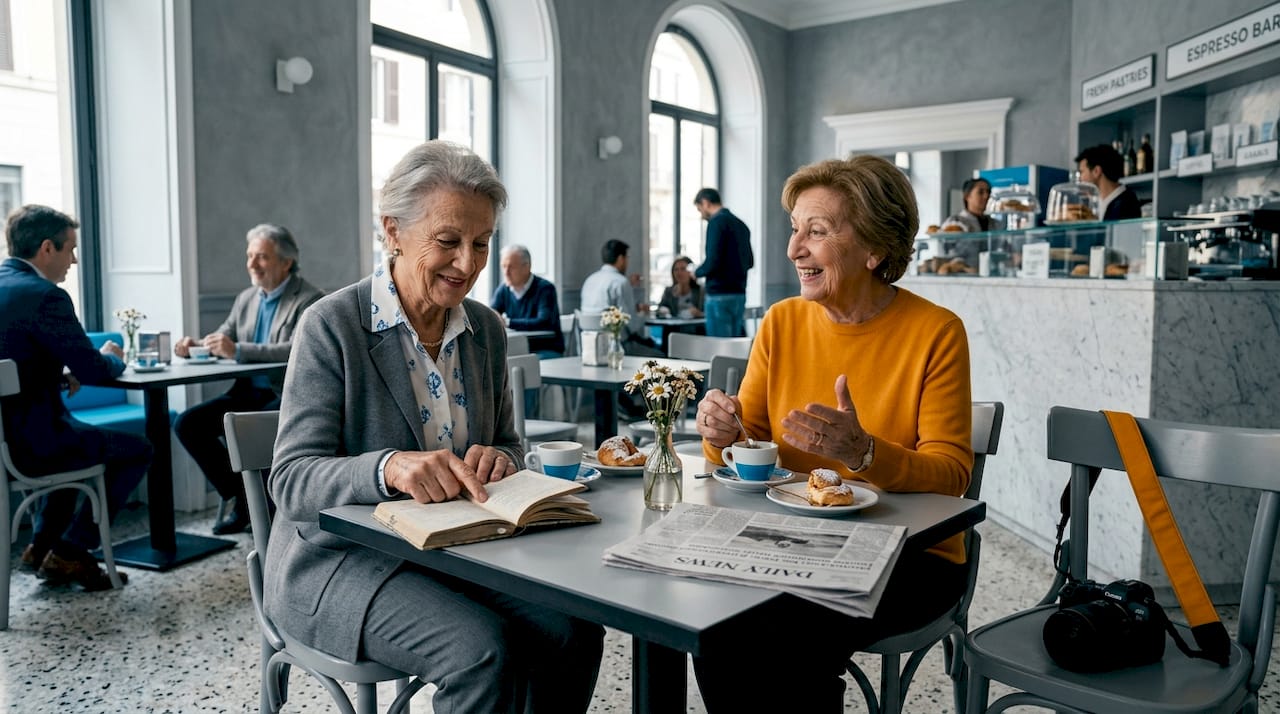
Slowing down is the single most counterintuitive yet transformative thing you can do with your camera in Italy. Most visitors move quickly, checking locations off a list. The photographer who lingers at a neighborhood bar, nursing a macchiato and simply watching the theater of morning unfold, is already ahead. Observation and anticipation are the twin engines of strong candid photography, and both require stillness before they require any camera setting.
Once you have found your position, consider the flow of daily activity rather than placing yourself outside it. Markets, church steps, narrow vicoli in Naples or Bologna, the edge of a village piazza where elders gather in the late afternoon. These are stages where human drama plays out on a gentle, repeating cycle. Position yourself so that the light falls naturally on faces, and let people move through your frame rather than rushing to follow them.
Here are four proven technical strategies for getting sharp, spontaneous shots in fast-moving scenes:
- Pre-focus on a spot. Choose a specific area of pavement, a doorway, a lamppost and set your focus there manually. When a compelling subject walks into that zone, your shot is already half-made.
- Use zone focusing. Stop your aperture down to f/8 or f/11 and set a focus distance of roughly two to four meters. This gives you a broad depth of field where almost everything in conversational range stays sharp.
- Raise your ISO confidently. In shaded alleys or interiors, don’t be afraid of ISO 800 or 1600. A grain-touched image with feeling beats a blurry, technically “clean” shot every time.
- Shoot in short bursts around peak gestures. A laugh, a handshake, a hand reaching for a melon at the market. Bursts of two or three frames around the anticipated peak moment increase your keeper rate dramatically.
Pro Tip: When you arrive at a new location, spend the first ten minutes without raising your camera at all. Simply watch the rhythm of the scene. Notice where the light lands, which corners attract activity, and what emotional beats repeat. This quiet observation will make every frame that follows more intentional and more powerful.
| Time of day | Best for | Light quality |
|---|---|---|
| Early morning (6:00–8:00 a.m.) | Markets, fishermen, cafe culture | Warm, directional, soft shadows |
| Late morning (9:00–11:00 a.m.) | Streets, artisan workshops | Bright, clean, good for interiors |
| Golden hour (5:00–7:00 p.m.) | Piazzas, neighborhood life, portraits | Golden, flattering, long shadows |
| Blue hour (just after sunset) | Cafes, trattorias, lit windows | Moody, cinematic, ambient warmth |
These are the same time windows that essential vacation photography guidance consistently highlights as most productive for candid, emotionally resonant results. For deeper exploration of these methods, the guide on documentary travel photography and practical urban photography tips both offer focused frameworks worth studying before your tour.
Anticipating interactions requires a different kind of intelligence. Watch for setup, the moment before the moment. A vendor arranging fruit is about to turn and call to a passing customer. Two elderly men sitting near each other are about to begin or resume a conversation. These micro-signals are readable once you train yourself to look for them. If capturing emotion in photos is your goal, the pre-moment is where the richest material often lives.
Navigating ethics and Italian cultural norms
Italy has a legal framework that generally permits photography in public spaces, but the letter of the law is only part of the story. Italian street photography laws allow candid work in public, yet dignity protections mean that certain uses of images, particularly those that embarrass or misrepresent a person, can cross legal lines. Understanding the legal and ethical landscape is not about memorizing statutes; it is about developing the sensitivity to recognize when a photograph serves your vision without diminishing someone else’s dignity.
Privacy signals come in many forms: a turned back, a raised hand, an averted gaze that lingers with discomfort rather than shyness. Reading these signals is a learnable skill, and acting on them gracefully is what separates the visual storyteller from the intrusive tourist. If someone indicates that they would rather not be photographed, stop immediately, nod acknowledgment, and move on without argument. This is not failure; it is respect. And it almost always leaves the door open for a genuine exchange that might yield a far richer image later.
| Approach | Legal standing | Ethical standing | Local reception |
|---|---|---|---|
| Open candid in piazza | Generally permitted | Strong, if respectful | Typically neutral to positive |
| Close-up without consent | Permitted but risky | Weak, potentially intrusive | Often uncomfortable |
| Photographing children | Strongly restricted | Requires parental awareness | Very sensitive, proceed carefully |
| Intimate religious moments | Gray area | Demands discretion | Potentially offensive if intrusive |
| Asking first, shooting after | Always safe | Excellent | Almost universally positive |
Pro Tip: If a police officer or local official questions your photography, remain calm, polite, and transparent. Show your images freely and explain your artistic intent simply. In almost every encounter, genuine respect and clear communication resolve the situation without conflict. The impact of photographers in tourism is generally recognized as positive, and local authorities often understand this.
Cultural sensitivity goes deeper than legal compliance. Italy is a country of deeply regional identity. What feels celebratory in Palermo may feel intrusive in a small Umbrian village. The pace of trust-building varies. In some communities, a photographer who visits the same piazza three mornings in a row becomes a familiar, welcome presence. In others, a single warm greeting and an honest explanation of your project will open doors that patient silence never would. For creative inspiration on how to approach these nuances, exploring cultural photography ideas can help you frame your intentions before you even pick up your camera.
Understanding what street photography in Italy genuinely requires is the foundation for making images that are both ethically sound and artistically powerful. The two goals are not in tension; they reinforce each other.
Applying your skills: from learning to shooting with confidence
Planning your local life photography sessions is as important as any technical preparation. The best times and places are rarely the most obvious ones. Early morning at a covered market in Florence, a weekday afternoon in a Venetian neighborhood far from San Marco, a Sunday passeggiata in a small Calabrian town. These are the stages where ordinary life becomes extraordinary imagery. If you are finding hidden photo spots before a guided tour, research local market days, seasonal festivals, and neighborhood rhythms specific to your destination.
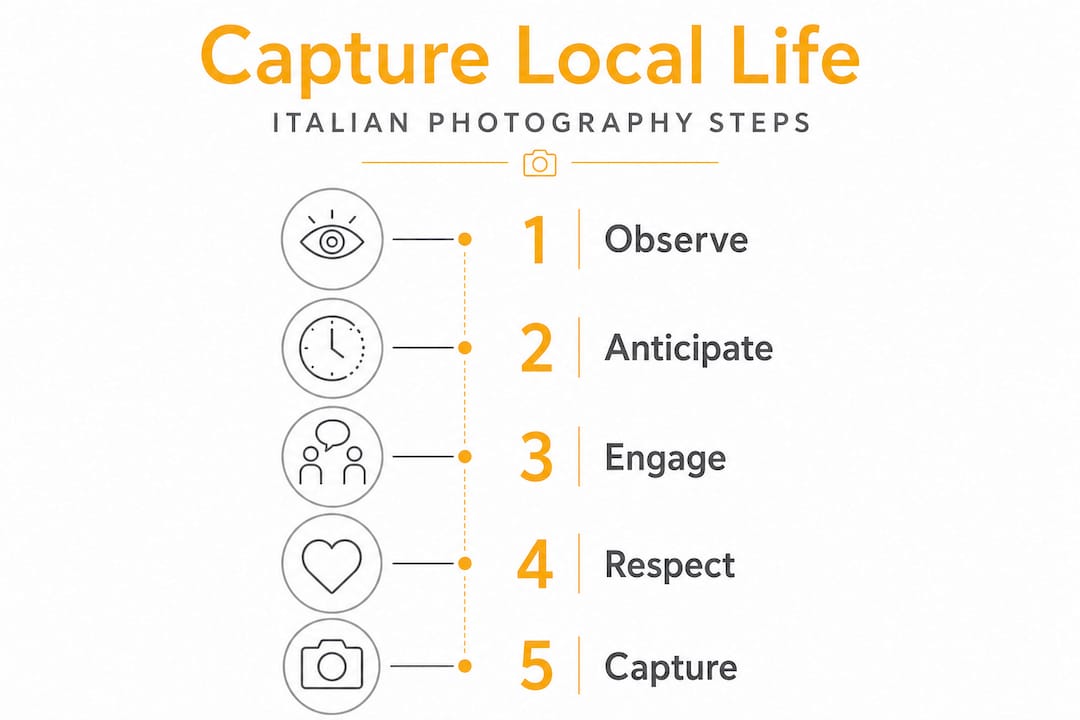
Here are five practical steps for structuring your local life shoot:
- Arrive early and stay late. The light and the life are most authentic at the edges of the day, before the tour groups arrive and after they leave.
- Walk before you shoot. A thirty minute reconnaissance walk without your camera bag signals openness and lets you spot the scenes worth returning to.
- Engage before you compose. A smile, a simple word of Italian, a genuine expression of interest in what someone is doing creates permission that no legal framework can fully replace.
- Edit with restraint. Over-processing candid images strips them of the texture and imperfection that make them feel real. Preserve the grain, the slight motion blur, the imperfect exposure that confirms the moment was spontaneous.
- Review images with your guide. In a group setting, a second perspective on what you captured and why it does or doesn’t work will accelerate your growth faster than any solo review.
A visitor-focused approach to cultural storytelling reminds us that the story is always bigger than a single frame. Think in sequences. Three images from the same morning at the same bar, the empty cups, the animated conversation, the quiet aftermath, tell a richer story together than any one of them would alone.
Improving candid work in Italy is, at its core, rooted in observation, anticipation, and sensitive interaction. These three qualities grow with practice, and they grow fastest when you are immersed in the environment, guided by someone who knows its rhythms and can point you toward the moments that matter.
What most guides miss about capturing local life in Italy
Most photography guides will tell you to slow down, get low, and use the golden hour. These are solid technical pieces of advice. But what they rarely address is the deeper emotional literacy that separates good local-life images from genuinely unforgettable ones. In our experience guiding photographers across Italy, the biggest obstacle is almost never technique. It is the photographer’s relationship with their own visibility.
Some photographers become invisible, shooting from distance, never making eye contact, treating the streets of Naples or Palermo like a wildlife documentary where the subjects must not notice the camera. The images that result are technically competent but emotionally cold. Other photographers go too far in the other direction, becoming a presence so assertive that the natural behavior they came to photograph simply evaporates. The magic, and this is the lesson we return to on every tour, lives at the intersection of skill, observation, and trust.
Italian locals respond with remarkable warmth to photographers who demonstrate genuine curiosity about their lives rather than a desire to extract an image and move on. We have watched the same fruit vendor wave off a dozen cameras only to pull a photographer aside and insist they photograph the back room where he stores family portraits. That invitation came because the photographer paused, asked about the produce, and listened. The camera was almost incidental.
Learning when not to shoot is as essential as knowing when to press the shutter. There are moments, a private grief, a family argument, a child’s vulnerability, where the photograph would be technically powerful and humanly wrong. The photographer who can recognize and honor that boundary will ultimately make more meaningful work, because their restraint builds the trust that opens other doors. The stories that transform travel photos are built on this kind of mutual respect. What every lasting image has in common is a sense of place, a clear story, and an unmistakable feeling that the photographer was a welcome presence in the frame.
Experience authentic Italian life through a guided photo tour
If these ideas have stirred something in you, the next step is to put them into practice somewhere that genuinely rewards this kind of attention. Italy, with its layered history, vivid light, and deeply theatrical culture, offers photographers an endlessly rich canvas.
Italy Photo Tour offers immersive experiences designed specifically for photographers who want to capture the living culture of Italy rather than its surface image. Led by professional photographer Mino Di Vita, our photography tours in Italy take you into neighborhoods, markets, and festivals that most visitors never find. In small groups, you receive personal feedback, technical guidance, and access to scenes that simply cannot be planned alone. Discover what we do and explore the full range of destinations we visit. The Italy you photograph on tour will be the Italy you remember forever.
Frequently asked questions
Is it legal to photograph people in public places in Italy?
Generally yes, candid photography is permitted in public spaces in Italy, but dignity laws and restrictions near sensitive locations such as courts or military sites apply and should be respected.
How do I avoid offending locals when photographing daily life?
Always read body language carefully, and if someone signals discomfort, stop immediately and acknowledge their wishes with a calm, respectful nod before moving on.
What camera settings work best for capturing spontaneous moments?
Zone focusing at f/8 to f/11 with a pre-set focus distance of two to four meters gives you a wide sharp zone and eliminates the delay of autofocus in fast-moving candid situations.
Why do images of local life feel more meaningful than photos of monuments?
Because daily life photography gives viewers access to human emotion, cultural context, and story in a way that architecture alone rarely can.
Can I share local life photos from Italy on social media?
Yes, but exercise careful judgment with intimate or identifying images. Consider softening faces or requesting permission when the photograph captures someone in a vulnerable or private moment, even if the location was technically public.