

TL;DR:
- Urban exploration photography captures decay and history in Italy’s abandoned and rarely accessed sites.
- Proper research, safety gear, and natural light techniques are essential for successful urbex projects.
- Guided tours and local knowledge help photographers find unique locations and improve their craft.
Urban exploration photography turns forgotten places into extraordinary visual stories. Most photographers think of Italy and picture sunlit piazzas, gondolas, or rolling Tuscan hills. But urbex photography documents abandoned or rarely accessed places, capturing decay, textures, history, and nature’s slow reclamation. Italy, with its layered centuries of civilization, holds an astonishing wealth of these forgotten spaces: ghost towns swallowed by forest, crumbling factory floors where light pours through shattered glass, and abandoned villas where frescoes still blush on peeling walls. This guide will show you what urbex truly is, where to find these haunting places in Italy, and how to photograph them with both craft and conscience.
Table of Contents
- What is urban exploration photography?
- How to find and access urban exploration photo spots in Italy
- Essential gear and safety tips for urban exploration
- Techniques and creative approaches for urban exploration photography
- What most urban explorers in Italy get wrong (and how to do it better)
- Take your urban photography in Italy to new heights
- Frequently asked questions
Key Takeaways
| Point | Details |
|---|---|
| Define urbex photography | Urban exploration photography reveals beauty and history in abandoned or off-limits Italian locations. |
| Scout legally and safely | Research, local tours, and safety gear are vital for exploring Italy’s urban ruins with confidence. |
| Use creative techniques | Natural light, color, and minimal editing help your photos tell powerful stories. |
| Start with accessible locations | Guided tours and public ruins offer rich scenes for amateurs without legal or safety risks. |
What is urban exploration photography?
To understand how you can become an urbex photographer, let’s clarify what sets this style apart from other urban genres. Urban photography is a broad and beautiful discipline, capturing the pulse of city life, street markets, architecture, and candid human moments. Urbex, however, steps away from that living, breathing world and into its silences.
Urbex photography is the art of documenting abandoned, derelict, or rarely accessed urban places such as old factories, hospitals, theaters, and homes, capturing decay, textures, history, and nature’s reclamation. The result is imagery that feels archaeological, as if you are holding a photograph of time itself paused mid-breath. A rusted operating table in a forgotten asylum, a ballroom floor carpeted in moss, or a rooftop overgrown with wildflowers: each image whispers of lives once lived there.
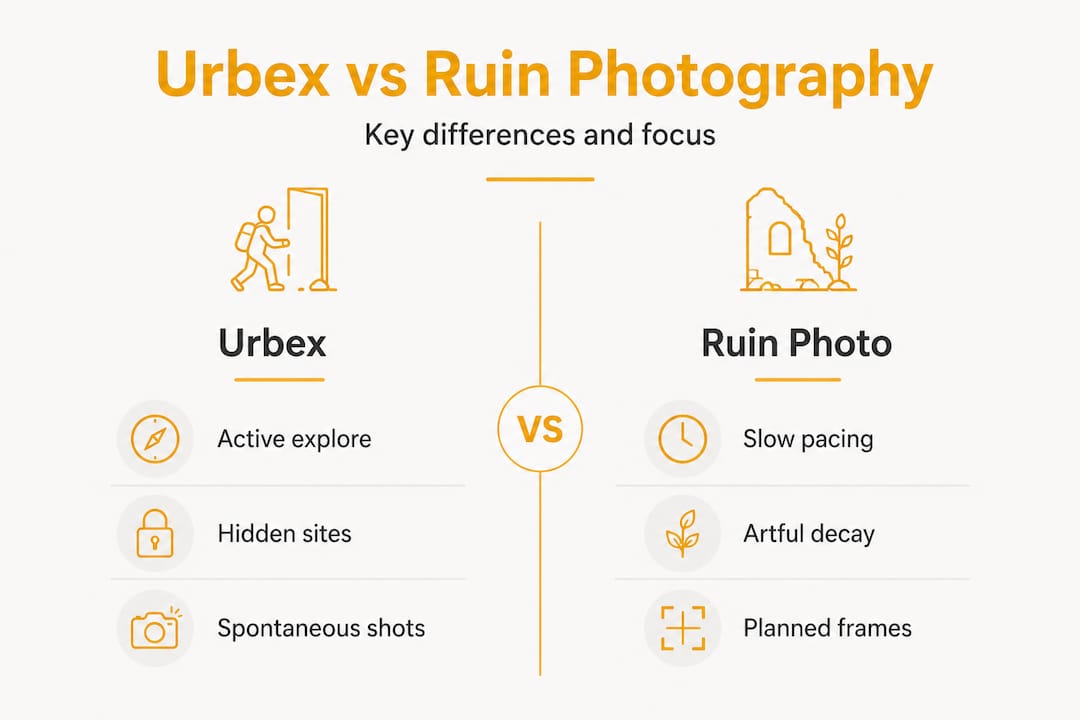
It’s worth knowing how urbex differs from closely related genres. Ruin photography tends to be slower and more contemplative, prioritizing the aesthetic beauty of decay over the act of accessing challenging spaces. Standard urban photography tips involve active city environments with living subjects. Urbex fuses the access challenge with documentary intent, and that combination is what makes it so richly compelling.
| Genre | Subject | Access level | Key focus |
|---|---|---|---|
| Urban photography | Active city scenes | Public, easy | People, architecture, life |
| Ruin photography | Decayed structures | Varies | Aesthetic of decay |
| Urbex photography | Abandoned or hidden sites | Often challenging | History, texture, reclamation |
Italy is uniquely suited for this kind of exploration. The country’s history spans millennia, and each era left its own architecture behind. You find Roman ruins alongside Baroque estates, industrial-era factories beside medieval hill towns that emptied in the twentieth century. The sheer architectural variety means every region holds a different visual character. If you want to find hidden photo spots in Italy, urbex offers one of the most rewarding and emotionally resonant paths to do so.
How to find and access urban exploration photo spots in Italy
With these definitions in mind, you’re ready to start searching for Italy’s most intriguing urban ruins. The good news is that Italy’s landscape is generous with its forgotten places. The challenge lies in finding them responsibly and accessing them safely.
Research is the indispensable first step. Satellite imagery through Google Maps reveals rooftops that don’t match their surroundings, overgrown courtyards, and structures that show no signs of recent activity. Italian local history forums, regional Facebook groups, and dedicated urbex websites offer leads that maps simply cannot. Many passionate Italian photographers document their explorations and share regional tips with the community. As research and guided urbex tours show, beginning with satellite imagery and local history before visiting any site is the safest and most productive approach.
Here is a practical sequence to locate and evaluate a site:
- Begin with a satellite overview of rural zones in Lombardy, Calabria, Basilicata, or Sicily where depopulation was common.
- Cross-reference with historical maps available through Italian regional archives online.
- Search Italian urbex communities for firsthand accounts and safety information.
- Identify whether the site is publicly visible or accessible, or whether permission is needed.
- Plan your visit during golden hour for the most painterly natural light.
- Visit with a companion, share your location, and carry a physical map of the area.
Some of Italy’s most accessible urbex destinations are genuinely spectacular. Consonno, a ghost town in Lombardy, was once a resort development that nature has steadily reclaimed. The abandoned towns of the Mezzogiorno in southern Italy, including Craco in Basilicata and Civita di Bagnoregio in Lazio (though the latter has become a tourist attraction), offer dramatic visual stories. Industrial northern sites around former textile and manufacturing hubs in the Po Valley provide a completely different mood, all iron and shadow.
| Region | Urbex character | Accessibility | Visual mood |
|---|---|---|---|
| Lombardy | Industrial ruins, ghost towns like Consonno | Moderate | Dark, brooding |
| Basilicata | Abandoned medieval villages | Moderate to high | Golden, melancholic |
| Sicily | Decaying noble estates and factories | Variable | Warm, theatrical |
| Veneto | Forgotten villas and farmhouses | Variable | Romantic, overgrown |
Pro Tip: Interiors lit by a single broken window or an open doorway produce some of the most dramatic contrasts in urbex photography. If you’re shooting under shifting light or in spaces where brightness varies wildly between shadow and open sky, HDR (high dynamic range) imaging, which captures multiple exposures and blends them, is your closest ally. Look for unique Italian photo spots where morning mist or late afternoon sun creates that otherworldly atmosphere only available for minutes at a time.
Understanding urban lighting in Italy across seasons will also help you plan visits strategically. Winter light casts long shadows that deepen texture. Summer haze softens color. Each season tells a different version of the same story.
Essential gear and safety tips for urban exploration
Once you’ve found your urban subject, preparation becomes critical, both for creating great images and for protecting yourself. Urbex is not inherently dangerous, but it does require thoughtful planning. The environments you’ll encounter are unpredictable in ways that city streets simply are not.
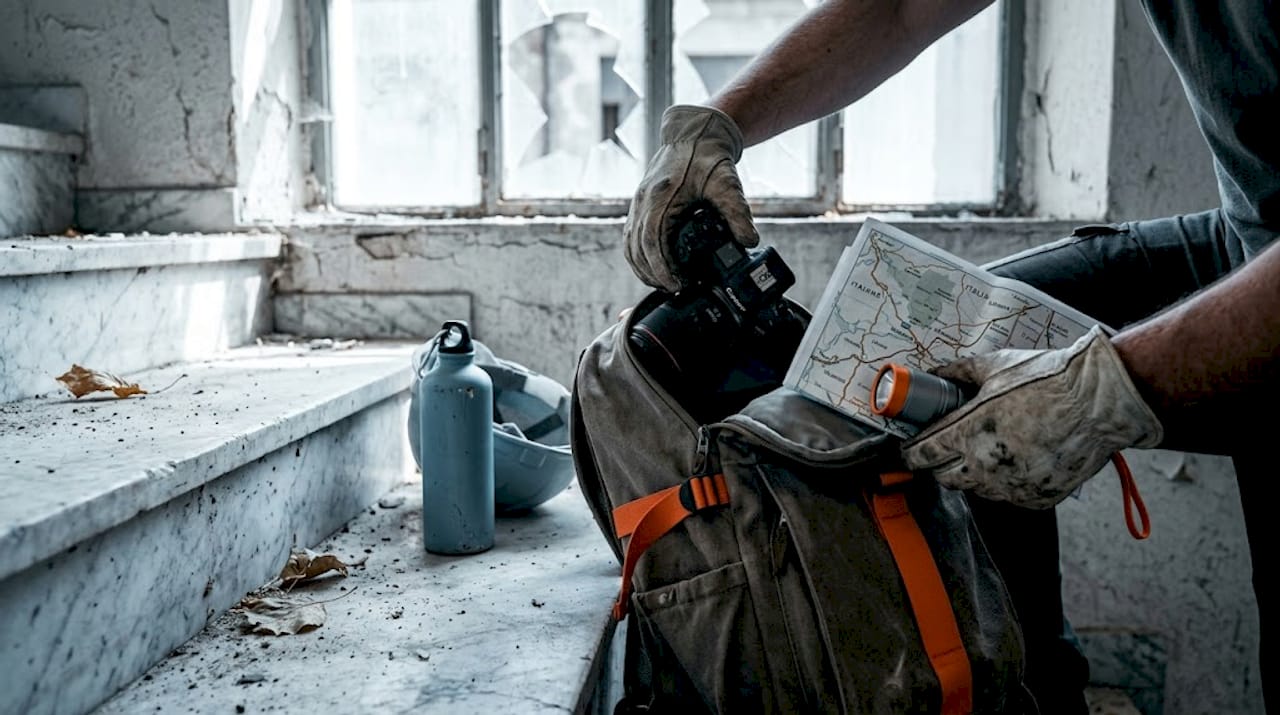
For gear, the philosophy is light and versatile. A mirrorless body with a weather-sealed build handles dust and humidity better than most entry-level DSLRs. Wide-angle lenses (between 16mm and 24mm) allow you to convey the scale of empty rooms and towering factory halls. A short telephoto, such as an 85mm, helps you isolate textures: peeling paint, cracked plaster, rusted metal seams. A compact, flexible tripod or gorilla-style clamp tripod is far more practical than a full-size tripod in tight or unstable spaces. Review the best camera gear for Italy before packing to ensure your kit is suited to these demanding environments.
Your personal safety checklist should include the following items:
- Sturdy ankle boots with puncture-resistant soles for broken glass and rubble
- Nitrile or leather gloves to protect against sharp metal and contaminated surfaces
- An FFP2 or N95 respirator mask, because abandoned buildings frequently harbor mold and, in older structures, asbestos particles
- A powerful flashlight with spare batteries for basement levels or windowless rooms
- Fully charged camera batteries and a portable power bank
- A basic first aid kit including antiseptic wipes and bandages
As urbex safety protocols make clear, you should never explore alone, always check for structural instability by looking up before stepping in, and always wear protective gear including boots, gloves, and masks. A buddy system is not optional: it is the most important single safety rule in urbex. If a floor gives way, a companion is the difference between a frightening story and a tragedy.
Check the weather before any visit. Rain softens ground beneath old foundations and makes surfaces slippery. High humidity levels raise air quality concerns inside enclosed spaces. After a wet period, mold spore counts inside ruins can be significantly elevated. Monitor Italian regional weather services the day before your visit and be prepared to postpone without hesitation.
Techniques and creative approaches for urban exploration photography
With safety and gear set, you can focus on the creative process to transform decayed structures into storytelling masterpieces. The most powerful urbex images are rarely the most technically complex. They are the most emotionally honest.
The first and most transformative technique is rejecting on-camera flash. Flash flattens texture and removes emotional depth from faded paints and rust, stripping the very qualities that make these spaces so arresting. Instead, work exclusively with natural light. Position yourself to use a window or broken wall as your key light source, allowing the shadow to build mood around your subject. Set a wide aperture and raise your ISO to a workable level, typically between 800 and 3200 depending on your sensor.
Here are creative compositional approaches that consistently yield memorable images in Italian urbex locations:
- Frame within a frame: Use doorways, arched windows, or collapsed walls to create natural frames around your primary subject, which adds layers of depth.
- Let nature intrude: Position plants, vines, or tree branches so they bisect the composition, representing the living world reclaiming the built one.
- Follow the light: Rather than planning shots in advance, walk through the space and observe where light pools and retreats across different hours.
- Emphasize scale: Include a human element, your companion or a carefully placed object, to communicate the true enormity of industrial or civic ruins.
- Seek color contrast: Faded painted walls in sienna and cobalt, set against iron-gray metal or pale limestone, create color contrasts that communicate decades of weathering.
“The most resonant urbex images are not about the rarity of access. They are about the depth of looking. A single peeling wall, observed long enough in the right light, holds more emotional weight than a dozen viral photographs of the same famous ruin.”
Italian locations offer particularly rich color palettes for this kind of work. Southern ruins often carry warm ochres and terra cottas baked by centuries of sun. Northern industrial sites lean toward cool silvers and rusted ambers. Baroque villas in Sicily show ghost-pale frescoes that read like watercolors in soft, diffused light. These color characteristics are not accidents of time. They are part of Italy’s visual identity, and exploring them through your lens is an act of cultural appreciation. An effective urbex workflow in Italy honors that visual heritage by resisting over-processing in post-production.
What most urban explorers in Italy get wrong (and how to do it better)
After you’ve learned the techniques, it’s easy to fall into common traps. Here’s how to stand out for the right reasons.
The most pervasive mistake among beginners is chasing the hyped location. The Italian urbex community celebrates a rotating cast of famous sites, and every year photographers make pilgrimages to the same ghost towns and abandoned villas, producing images that look remarkably similar. The obsession with rare access often overshadows the actual quality of the image. When everyone photographs the same collapsed chandelier in the same ballroom, the story of that space becomes diluted rather than enriched.
What yields truly powerful work is the willingness to slow down and observe. The small, locally specific urban ruin, a forgotten schoolhouse in a Calabrian village, a shuttered cinema on a Sicilian backstreet, a farmhouse at the edge of a Piedmontese vineyard, carries a narrative density that famous sites frequently lack. These places have not been photographed into clichés yet. They remain genuinely open to interpretation.
There is also a tendency among photographers new to urbex to reach for extreme editing. Heavy desaturation, aggressive grain overlays, and overworked HDR processing are understandable temptations: they create an instant mood. But they also impose the photographer’s emotion onto the image rather than allowing the place’s inherent atmosphere to communicate. The most enduring urbex photographs are those that feel like faithful witnesses, ones that allow the space to speak in its own voice.
Learning to see with this kind of restraint takes practice and mentorship. The artistic nuance in photography that separates memorable images from technically correct ones is often best developed through guided experience, shooting alongside a seasoned professional who can point to the quality of light in a doorway before you would have noticed it yourself. Italy, with its extraordinary visual culture, is perhaps the ideal country in which to learn that lesson.
Take your urban photography in Italy to new heights
Urban exploration photography offers an extraordinary window into Italy’s layered soul, but exploring it alone, without local knowledge or experienced guidance, can mean missing the finest locations, the subtlest light, and the richest stories.

Italy Photo Tour, led by professional photographer Mino Di Vita, offers immersive photography tours in Italy that bring you directly into Italy’s most evocative and photogenic urban spaces. Whether you’re drawn to the atmospheric streets of Milan, the timeworn rural south, or the extraordinary urban textures of Venice, each Italy Photo Tour experience is designed to develop your creative eye through hands-on shooting, expert guidance on light and composition, and intimate access to locations that take years to discover on your own. Let Mino guide you through the visual poetry that Italy’s hidden spaces hold, frame by luminous frame.
Frequently asked questions
Is urban exploration photography legal in Italy?
Urban exploration is legal when accessing public or openly abandoned sites, but entering private or sealed properties without permission is prohibited in Italy. For safe and legal options, guided urbex tours provide curated access to visible abandoned locations.
What are the biggest safety risks in urbex photography?
The greatest risks are unstable structures, hidden floor voids, mold, asbestos, and disorientation in unfamiliar spaces. Always follow core safety rules: never go alone, check for structural instability, and wear protective gear including boots, gloves, and a respirator mask.
How do I find the best urbex locations in Italy?
Research through satellite maps, local history forums, and regional urbex communities is the most reliable starting approach. Joining a guided photo tour is the fastest way to access safe and legally sound hidden locations with built-in expertise.
Should I use flash or HDR for urban exploration photography?
Avoid on-camera flash to preserve texture and emotional depth. HDR works exceptionally well for interiors with dramatic light contrasts, and HDR techniques excel particularly in the shifting, painterly light found inside Italian ruins.