

TL;DR:
- Italy’s golden hour varies greatly depending on geography, season, and terrain, requiring careful planning. It offers dramatic lighting that enhances Italy’s iconic scenes, but success depends as much on presence and improvisation as on technical precision. Using precise timing tools and engaging with local environments and people elevates your photography from good to extraordinary.
Few photography myths are as persistent as the idea that golden hour is simply a time on the clock. Set an alarm, show up, and the light will do the rest. But Italy has a way of dismantling that comfortable assumption the moment you arrive. The warm amber glow that bathes the Colosseum bears no resemblance to the fleeting shimmer that dances across Venice’s canals, and neither compares to the way light spills over Cinque Terre’s cliffside villages before the hillside shadow swallows it whole. Italy’s golden hour is a living, breathing phenomenon shaped by geography, season, and terrain. This guide gives you the knowledge, tools, and creative confidence to chase it with intention.
Table of Contents
- What is golden hour and why does it matter?
- When and where does golden hour happen in Italy?
- Essential camera settings for golden hour shots
- Italy’s unique golden hour scenes: From the coast to the cities
- Planning for golden hour success: Tools and expert workflow
- What most golden hour guides miss about Italy’s magic light
- Take your golden hour skills further with guided Italy photo experiences
- Frequently asked questions
Key Takeaways
| Point | Details |
|---|---|
| Golden hour is location-driven | Italian geography and terrain change golden hour timing and quality at each site. |
| Manual settings preserve warmth | Set your camera’s white balance and exposure manually to keep golden hour color. |
| Use planning tools | Apps and scouting are essential for timing your shot in Italy’s complex landscapes. |
| Unique scenes demand flexibility | Adapt your approach as light shifts across coastlines, cities, and hills for standout images. |
| Workflow matters | A repeatable, app-based workflow maximizes your golden hour photo success in Italy. |
What is golden hour and why does it matter?
Golden hour is not simply a poetic nickname. It describes a precise atmospheric event with dramatic visual consequences for every photographer who steps outside with a camera. As the sun approaches and lingers near the horizon, sunlight travels through a much thicker slice of Earth’s atmosphere. That journey filters out shorter blue wavelengths and allows longer red and orange wavelengths to dominate. The result, as any golden hour guide confirms, is warm, soft, directional light that arrives low across surfaces and sculpts everything it touches.
Technically, golden hour is the period shortly after sunrise and just before sunset when the sun is low on the horizon, producing warm, soft, directional light due to thicker atmospheric filtering of shorter wavelengths. In Italy, that physical reality becomes something profoundly artistic. The chiaroscuro effect on ancient stone, the amber spill across terracotta rooftops, and the long shadows that carve depth into narrow alleyways all become elements of a living composition waiting for you to frame it.
Understanding the practical differences between morning and evening golden hour matters deeply for planning. Morning light tends to arrive cleaner and cooler, with less atmospheric haze because the air has settled overnight. The colors skew toward soft peachy golds rather than the richer amber of evenings. Evening golden hour, by contrast, carries warmth accumulated over the day, and the light tends to deepen into copper and bronze as sunset approaches. Haze can soften the scene even further, lending a dreamlike quality that suits Venice’s canals or the rolling Tuscan hills beautifully. Reviewing a thorough Italy lighting guide can help you choose the right time of day for the mood you want to create.
The reasons this light elevates Italian scenes so dramatically are worth examining closely. Italy’s iconic elements, including sculpted marble, ancient brick, rippling water, and centuries-old stone piazzas, all respond to angled light in spectacular ways. Shadows lengthen, textures emerge, and colors that appear flat at midday seem to glow from within. Understanding natural light in Italy is the single most powerful upgrade any photographer can make before even thinking about camera settings.
When and where does golden hour happen in Italy?
Here is where Italy genuinely rewrites the rules. Golden hour timing is not fixed. It shifts based on latitude, local topography, season, and the specific orientation of the terrain around you. Northern Italian cities like Milan experience later sunsets in summer and dramatically shorter golden windows in winter. Southern destinations like Sicily enjoy extended twilight stretching well past what you might expect. Knowing your destination’s latitude and the season you are shooting changes everything about your plan.
Coastal and mountain environments add another layer of complexity. The Amalfi Coast lighting phenomenon, sometimes called the “false sunset,” is a compelling example. The dramatic cliffs and coastal orientation mean that sunlight disappears from many viewpoints well before the actual sunset over the water horizon. Photographers who arrive at what they believe is the correct time often find themselves standing in deep shadow while golden light still illuminates the distant sea. Planning around this kind of terrain shadow is the difference between a masterpiece and a missed opportunity.
Seasonally, Italy’s golden hour window varies considerably. In midsummer, golden hour can stretch luxuriously for 45 to 60 minutes, particularly in the far north. In December, the window may compress to 20 minutes or less, demanding faster decision-making and a more disciplined setup. The table below gives a useful seasonal overview for key Italian regions:
| Region | Winter golden hour window | Summer golden hour window | Notes |
|---|---|---|---|
| Milan | 20 to 25 minutes | 50 to 60 minutes | Fog can extend soft light in winter |
| Tuscany | 25 to 30 minutes | 45 to 55 minutes | Rolling hills soften shadow transitions |
| Amalfi Coast | 15 to 20 minutes | 40 to 50 minutes | False sunset common; scout early |
| Venice | 25 to 35 minutes | 50 to 60 minutes | Water reflections amplify golden tones |
| Sicily | 30 to 40 minutes | 55 to 65 minutes | Long evening light, warm color casts |
Shooters who thrive in Italy learn to calculate golden hour for exact dates and locations using dedicated apps. PhotoPills, The Photographer’s Ephemeris, and Golden Hour One all offer precise predictions that account for latitude and season. As experienced photographers recommend, timing differences tied to terrain mean that treating golden hour as a fixed clock window leads to disappointment. Arrive early, scout the terrain shadows, and observe how sunlight tracks across your chosen scene before committing to a single position.
Pro Tip: For urban Italian scenes, check urban golden hour tips to map the direction streets run relative to sunset. East-to-west street corridors in cities like Bologna or Florence become extraordinary golden tunnels of light for a few fleeting minutes. That knowledge is only useful if you are already positioned and ready.
For a broader sense of how these locations reward patient preparation, the atmospheric beauty travel guide for Italy offers evocative inspiration alongside practical positioning advice.
Essential camera settings for golden hour shots
Golden hour light changes faster than most beginners anticipate. What works at the beginning of the window will be wrong within fifteen minutes. The key is to build a flexible starting framework and adjust continuously as the light evolves.
Begin with ISO 100 to 200 when the sun is still above the horizon and light is abundant. As it sinks closer to the horizon, raise ISO incrementally rather than in large jumps. For portraits, open your aperture to around f/1.8 to f/2.8 to separate your subject from the background and allow the golden bokeh to bloom softly behind them. For landscapes, narrow your aperture to f/8 to f/11 to maintain sharpness across the scene. These starting settings by subject type give you a foundation to refine from rather than a prescription to follow rigidly.
Shooting in RAW format is non-negotiable for golden hour work in Italy. RAW files preserve the full range of color information captured by your sensor, giving you the latitude to recover shadows, protect highlights, and fine-tune the precise warmth of that golden cast in post-processing. A compressed JPEG will clip tonal information you cannot recover later.
White balance deserves special attention. Auto White Balance is designed to neutralize color casts, which means it actively works against you during golden hour by cooling down the very warmth that makes this light so enchanting. Instead, manage color temperature deliberately by setting white balance to Cloudy or Shade, or by dialing in a Kelvin value manually between 6,000 and 8,000K. This locks in the golden warmth rather than letting the camera wash it out.
Common missteps that flatten golden hour images include underexposing shadows in an attempt to protect highlights, which leaves foreground detail murky and lifeless. Relying on autofocus in rapidly dimming light leads to missed sharpness, so switch to manual focus or use focus peaking if your camera supports it. Forgetting to revisit white balance as the light shifts is another frequent error, as the color temperature changes noticeably every few minutes near sunset.
Pro Tip: Adjust your settings every five minutes as the sun approaches the horizon. Light intensity drops exponentially, not linearly. A setting that looks correct at 6:45 p.m. will underexpose dramatically by 7:05 p.m. Review your histogram with each adjustment and lean toward slight overexposure to preserve shadow detail in RAW files. Explore landscape photo tips and essential shoot tips for deeper coverage of field techniques across Italian environments.
Italy’s unique golden hour scenes: From the coast to the cities
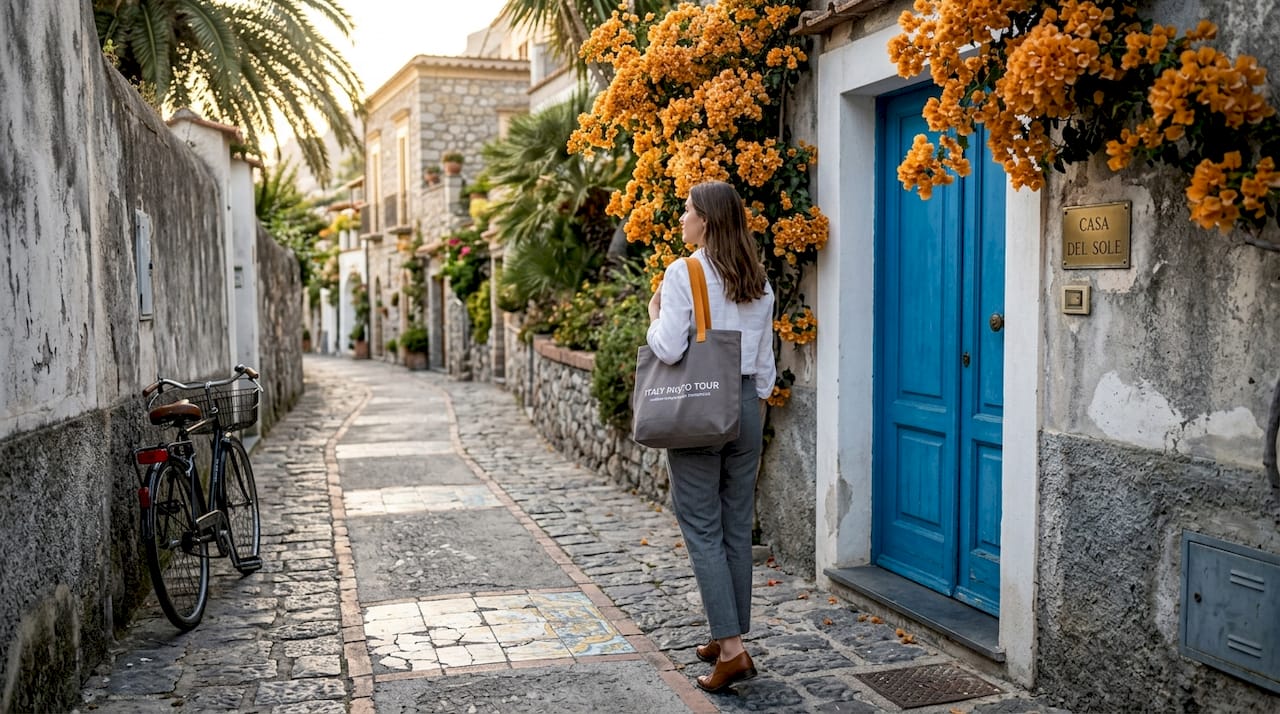
Italy is essentially a collection of radically different theatrical stages, and golden hour performs differently on each one. On the Amalfi Coast, the combination of steep cliffs, terraced villages, and the Mediterranean below creates layered lighting conditions that reward explorers who look beyond the most famous viewpoints. As terrain shadow and cliff orientation profoundly shape where the best light lands, scouting viewpoints that align with the actual direction of incoming light becomes as important as knowing the sunset time itself.
In Rome, the Forum and the Colosseum transform during golden hour into something almost sacred. Ancient stone absorbs the warm light and radiates it back in shades of amber and rust that no other time of day can replicate. The long shadows cast by columns and arches create natural leading lines that draw the eye deep into the frame. Venice, with its veins of shimmering water threading between Renaissance palazzi, becomes a mirror world during golden hour. Canals catch and multiply the light, and the reflections add a second layer of composition beneath every bridge and archway you photograph.
The Tuscan countryside presents a gentler kind of golden hour theater. Cypress-lined lanes, vineyard terraces, and hilltop villages like Montepulciano or Pienza become pure painterly compositions as the light rakes across the landscape. The challenge here is that wide-open terrain offers almost too many possibilities. Commit to a composition early, and let the shifting light do its work rather than constantly repositioning.
“Scouting viewpoints that match the direction of terrain shadow matters.” Knowing where the light will actually fall in terraced and coastal Italian towns requires on-the-ground observation, not just app data.
Common challenges across Italy’s diverse settings include early shadow arrival in terraced hill towns, glare bouncing off glass and polished stone in cities like Milan, and shifting tourist crowds that appear in your frame at precisely the wrong moment. Browse inspiring landscapes to study how experienced photographers have navigated these challenges, and examine composition tips for framing strategies that use the landscape’s natural geometry to your advantage.
Planning for golden hour success: Tools and expert workflow
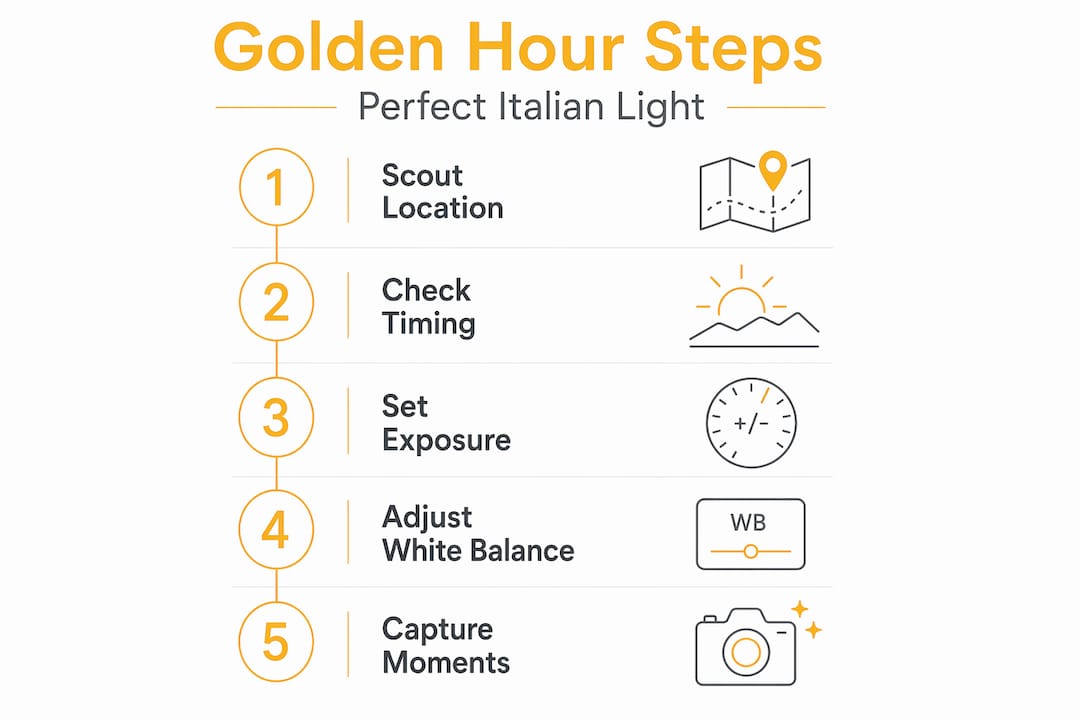
A repeatable workflow transforms golden hour from a stressful chase into a calm, creative session. The key steps follow a logical progression that starts well before you pick up your camera.
First, open your preferred planning app (PhotoPills is particularly powerful for its augmented reality sun tracking feature) and note the precise golden hour start and end times for your specific location and date. Note any terrain features that might cause the sun to disappear from your viewpoint earlier than expected. Second, visit your location at midday if possible. Observe where shadows fall, which surfaces catch direct light, and where the sun will be tracking during golden hour. Third, arrive at least 30 to 45 minutes before golden hour begins. Set up your composition, test your exposure, and make any necessary adjustments to your position while the light is still generous. Fourth, as keeping shooting into twilight suggests, treat golden hour as an approach window rather than a rigid start-stop event. Stay through the transition into blue hour.
Pro Tip: Do not pack up when the sun disappears. Blue hour, the 20 to 30 minutes of soft, cool twilight after sunset, produces some of the most iconic Italian images imaginable. Venice glows an impossible blue-silver, and Rome’s illuminated monuments stand out brilliantly against a deep cobalt sky. The expert natural light guide covers blue hour transitions in detail and is worth reviewing before any evening shoot. Use the timing workflow resources available to anchor your plan to real data rather than guesswork.
What most golden hour guides miss about Italy’s magic light
Here is an uncomfortable truth that years of photographing Italy have made clear: the photographers who consistently bring home extraordinary golden hour images are not the ones who executed the most precise technical plan. They are the ones who remained open to surprise.
Most guides focus heavily on apps, exposure values, and positioning strategies, as this one does, because those tools genuinely matter. But Italy rewards something that no app can provide. It rewards presence. The city of Italian landscapes and their artistic pull is ultimately about connection, not calculation. A local grandmother opening her shutters just as the light falls across the piazza below, a fisherman returning to the harbor as amber light streaks across the water, a tourist’s laughter echoing through a golden-lit archway. These are the moments that elevate a technically correct photograph into an image that tells a story.
Chasing perfection can make you rigid. You stake out your scouted position, guard it against other photographers, and miss the extraordinary shot forming thirty meters to your left because you were committed to your original frame. Italy’s cities and coastlines are alive with unpredictable human activity and shifting light that constantly offers alternative narratives. Shadows are not failures. Haze is not an obstacle. Imperfection, in the Italian context, is often the soul of the image.
Cultural engagement changes your photographs in ways that technical mastery cannot. When you linger in a piazza long enough to become a familiar presence, locals stop performing for the camera and simply live. That is when the most authentic golden hour portraits emerge, bathed in warm light that feels earned rather than captured.
Take your golden hour skills further with guided Italy photo experiences
Absorbing technique through reading is valuable, but there is no substitute for being in the field with someone who knows exactly where to stand, when to move, and how to read Italy’s ever-shifting light in real time.

Italy Photo Tour offers photography tours Italy designed specifically for photographers who want to experience golden hour in Italy’s most photogenic locations with expert guidance at their side. Led by professional photographer Mino Di Vita, each tour combines curated access to the best golden hour viewpoints with in-field mentorship that helps you adapt your technique to each unique scene. Discover what we do and explore how guided experiences transform not just your images, but your creative intuition. Let Italy’s landscape inspiration move you from observer to true visual storyteller.
Frequently asked questions
How can I calculate golden hour timing for a specific Italian location?
Use planning apps like PhotoPills or The Photographer’s Ephemeris to get accurate golden hour times based on your destination and date, since timing shifts by latitude, season, and local geography.
Does golden hour last longer at the beach or in the mountains in Italy?
Golden hour tends to feel shorter in the mountains due to early terrain shadows, while coastal areas offer a longer window, though location-specific timing differences tied to terrain still affect exact light conditions considerably.
What’s the best camera setting for golden hour portraits in Italy?
Start with aperture around f/1.8 to f/2.8, ISO 100 to 200, and set white balance to Cloudy or Shade; starting portrait settings differ from landscape settings precisely because subject separation and warmth preservation are the priorities.
Is morning or evening golden hour better for Italian landscapes?
Morning offers cleaner air and softer color tones while evening provides richer warmth; choose based on your desired mood, keeping in mind that morning vs evening differences are primarily atmospheric rather than technical.
Why do shadows fall so quickly in Italian hill towns during sunset?
Hills and steep terrain block the sun before it reaches the water horizon, meaning mountain shadows and cliffs cause an earlier end to golden hour than the nominal sunset time suggests.