

Most photographers who return from Italy with breathtaking, mood-soaked images will tell you they simply got lucky with the weather. The truth is far more intentional. Atmosphere in travel imagery is created through deliberate choices: light, weather conditions like fog and mist, layered composition, and post-processing that honors the mood you felt in the moment. This guide walks you through every element of that creative process, from reading the Italian golden hour to editing with a gentle hand. Whether you are wandering the cypress-lined roads of Tuscany or standing at the edge of a Venetian canal at dawn, these techniques will help you capture Italy’s soul, not just its surface.
Table of Contents
- Understanding atmosphere in travel imagery
- Lighting mastery: Harnessing the Italian golden hour
- Weather magic: Fog, mist, and mood in Italian landscapes
- Composition and gear: Tools for atmospheric impact
- Post-processing: Enhance mood while preserving authenticity
- Experience Italy’s atmosphere with a guided photo tour
- Frequently asked questions
Key Takeaways
| Point | Details |
|---|---|
| Atmosphere is intentional | Purposeful use of light, weather, and composition builds mood in Italian travel photos. |
| Italy’s unique light | Golden hour, misty mornings, and regional variations set Italian landscapes apart in travel imagery. |
| Gear and patience matter | Choosing the right lenses and waiting for changing conditions are key to capturing authentic atmosphere. |
| Subtle editing enhances mood | Post-processing should support the natural ambiance without making images look artificial. |
Understanding atmosphere in travel imagery
Atmosphere is the invisible thread that pulls a viewer into a photograph and makes them feel something. It is not about technical perfection. A slightly soft image bathed in warm amber light will always outperform a razor-sharp frame taken under a flat midday sky. For photographers exploring Italy, this distinction matters enormously.
So what actually builds atmosphere? Think of it as a layered recipe. The core ingredients are:
- Light quality and direction: Soft, angled light creates depth and warmth that flat light simply cannot replicate.
- Weather conditions: Fog, mist, overcast skies, and even rain add mystery and visual simplicity.
- Composition: Layers, foreground interest, and minimalism guide the eye and create a sense of space.
- Post-processing: Subtle editing that reinforces the mood captured in-camera rather than inventing one.
“Atmosphere in travel imagery is created primarily through light, weather conditions like fog and mist, composition emphasizing layers and minimalism, and post-processing that preserves mood.”
Italy is an extraordinary canvas for this kind of work. Its ancient architecture, rolling hills, shimmering waterways, and rich cultural textures offer endless opportunities for layered, emotionally resonant images. What most photographers miss, though, is that mood always outranks technical precision. A well-composed, atmospherically rich frame tells a story. A technically flawless but emotionally empty image does not. Explore this idea further in our artistic travel photography guide to see how storytelling shapes every great Italian photograph.
Lighting mastery: Harnessing the Italian golden hour
Once you understand what builds atmosphere, lighting becomes the foundation of everything. Italy’s light is unlike anywhere else in Europe, and learning to read it by region transforms your photography from competent to captivating.
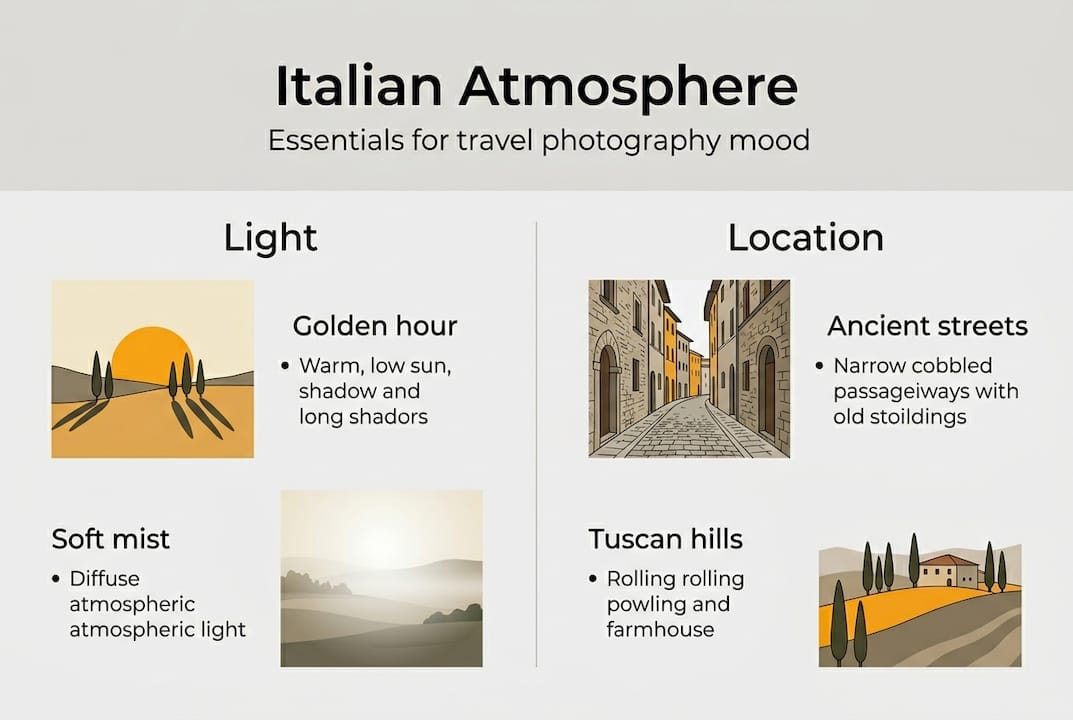
Golden hour, the 30 to 60 minutes after sunrise and before sunset, is when directional light rakes across surfaces, revealing texture, depth, and warmth. Shooting during golden hour enhances depth and texture in Italian landscapes in ways that midday light simply cannot. But Italy’s golden hour is not uniform across the country.
- The Dolomites (north): Cool, crisp light with blue undertones. Ideal for dramatic mountain silhouettes and sharp rock faces.
- Tuscany and Umbria (central): Warm, honeyed light that wraps around cypress trees and terracotta rooftops like a soft glaze.
- Sicily and the south: Saturated, intense light that makes colors pop and shadows deepen dramatically.
Italy’s regional light varies from cool north to warm central to saturated south, and adapting your technique to each region is what creates authentic mood rather than generic travel snapshots. Understanding this regional palette is central to our natural light workflow approach, and you can deepen that knowledge by studying light and shadow in travel photography as a creative discipline.
Pro Tip: Before any shoot, check the sunrise and sunset orientation for your specific location using a tool like PhotoPills. Position yourself so the light falls across your subject at an angle rather than directly behind you. This single habit will elevate your images immediately. For a deeper look at working with available light, our guide on capturing natural light offers practical, location-tested advice.
Weather magic: Fog, mist, and mood in Italian landscapes
Light sets the tone, but weather creates mystery. Fog and mist are among the most powerful atmospheric tools available to a travel photographer, and Italy offers them in abundance if you know where and when to look.
The key techniques for foggy conditions include:
- Embrace simplification: let the fog erase distracting backgrounds and isolate your subject.
- Keep the foreground sharp and dark against a softly fading background for visual depth.
- Apply +1 to +2 EV compensation to avoid underexposure, since fog reflects light and fools your meter.
- Use long exposures of 10 to 30 seconds to capture motion in mist and water.
- Set white balance between 4500 and 5500K to preserve the cool, moody quality of foggy light.
For location, few places rival Val d’Orcia. Val d’Orcia excels at sunrise due to its eastward-facing valleys and morning mist, which is most reliable from May through October. The Crete Senesi, just north of Val d’Orcia, offers a more minimalist landscape where rolling clay hills dissolve into fog with an almost painterly quality.
Here is a quick comparison of what foggy versus sunny conditions deliver atmospherically:
| Condition | Mood | Best for | Challenge |
|---|---|---|---|
| Foggy or misty | Mysterious, intimate, poetic | Minimalist landscapes, isolation | Metering, patience |
| Sunny golden hour | Warm, vibrant, textured | Architecture, portraits, color | Crowds, short window |
| Overcast | Soft, even, melancholic | Detail shots, forests, water | Flat light, low contrast |
| Rain or storm | Dramatic, raw, cinematic | Urban scenes, reflections | Gear protection |
Some photographers prefer foggy or overcast conditions over golden hour spectacle, finding that minimalist atmospheres outperform cluttered sunny scenes. This is a liberating insight: you do not need perfect weather. You need the right weather for the story you want to tell. Before heading out, review our photography checklist for Italy and make sure your best camera gear for Italy is ready for variable conditions.
Pro Tip: Arrive at your location at least 30 minutes before sunrise and simply wait. Fog shifts, lifts, and swirls in ways that create entirely different images within minutes of each other. Patience is not passive. It is the most active creative choice you can make.
Composition and gear: Tools for atmospheric impact
After mastering mood with light and weather, your composition and gear choices become the final layer of atmosphere-building. The way you frame a scene either deepens the feeling or dilutes it.
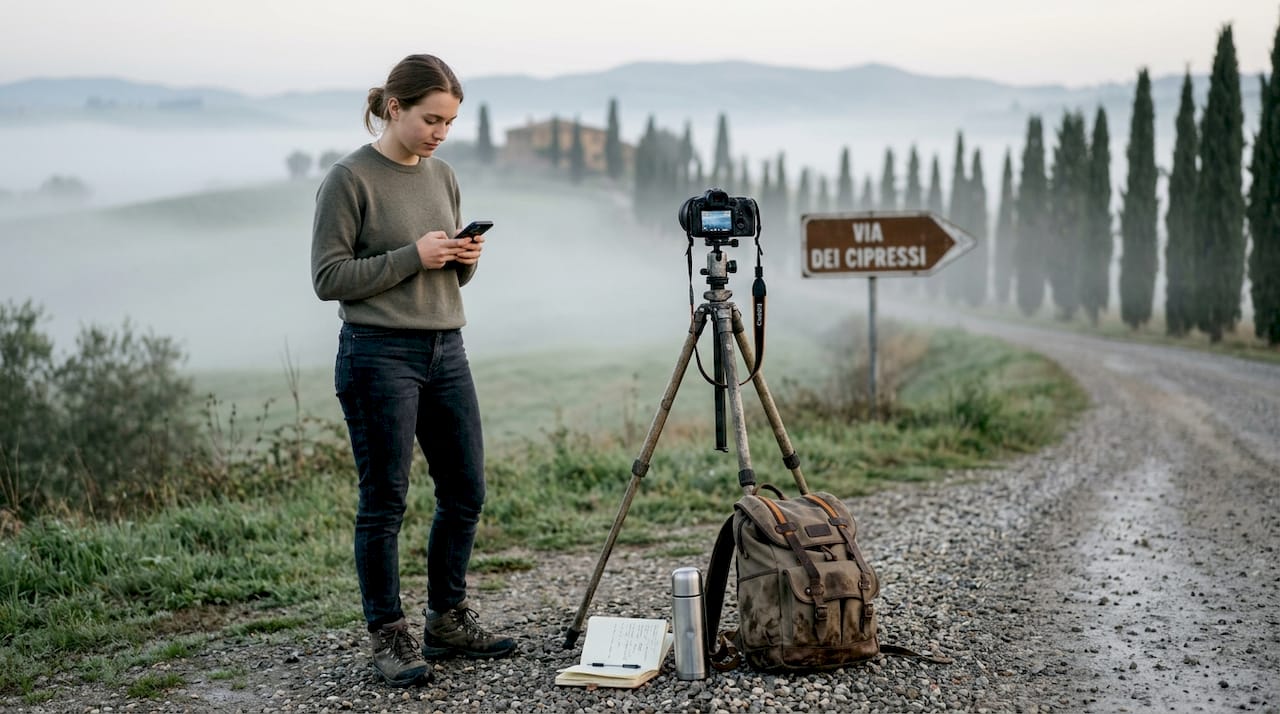
For composition, think in layers. A strong atmospheric image typically has a defined foreground element, a middle ground that carries the story, and a background that fades or softens into the mood. Minimalism is your ally here. Removing visual clutter forces the viewer’s eye toward what matters and lets the atmosphere breathe.
Telephoto lenses (70-200mm and beyond) are essential for compressing the rolling layers of Val d’Orcia and Tuscany’s hills, making distant cypress trees and farmhouses appear stacked and intimate. Polarizers reduce glare on water and deepen sky tones, while ND filters allow long exposures in bright conditions. Telephoto lenses outperform wide-angle for Italian hill regions, where compression creates the sense of a landscape folding in on itself.
| Region | Recommended lens | Key filter | Best time |
|---|---|---|---|
| Val d’Orcia | 70-200mm | Polarizer | Sunrise (May-Oct) |
| Dolomites | 24-70mm | ND filter | Golden hour, any season |
| Venice canals | 35-85mm | None or polarizer | Dawn, low tide |
| Cinque Terre | 24-70mm | Polarizer | Late afternoon |
| Sicily coast | 50-135mm | ND filter | Sunset |
For practical, location-tested advice, our guide on photographing Italy tips covers regional nuances in detail. You can also review our photo tour essentials for a gear-focused packing framework, and if urban scenes are your focus, the urban photography workflow offers a structured approach to Milan and Rome.
Post-processing: Enhance mood while preserving authenticity
Once you have created atmosphere in-camera, editing can subtly reinforce it. The key word is subtly. Italy’s landscapes and cultural scenes carry an inherent visual truth, and heavy-handed editing strips that away, leaving images that feel fabricated rather than felt.
A reliable sequence for mood-enhancing edits looks like this:
- Exposure and shadows: Lift shadows gently to reveal detail without destroying the sense of depth. Avoid crushing blacks in foggy scenes.
- White balance: Warm slightly for Tuscany and central Italy; keep cooler for the Dolomites and northern regions to honor the natural light character.
- Clarity and texture: Use sparingly. A small clarity boost on stone walls or tree bark adds tactile richness. Too much creates an artificial, over-sharpened look.
- Color grading: Subtle split toning, warm highlights and cool shadows, can reinforce the chiaroscuro quality that makes Italian light so distinctive.
- Vignetting: A gentle, natural vignette draws the eye inward and adds intimacy without announcing itself.
Post-processing that preserves mood is about reinforcing what was already there, not inventing something new. If you find yourself adding drama that was not present when you pressed the shutter, step back. The most enduring Italian travel images feel like memories, not manipulations. Our natural light workflow and authentic natural light guides offer editing frameworks that keep your images grounded in the real beauty of Italy.
Pro Tip: Edit on a calibrated monitor in a neutral-light environment. The warm glow of a desk lamp or a bright window will skew your color perception and lead to edits that look wrong on other screens.
Experience Italy’s atmosphere with a guided photo tour
Reading about atmosphere is one thing. Standing in the Val d’Orcia at dawn, watching mist curl through cypress-lined roads while the light turns gold, is something else entirely. That lived experience is where technique becomes instinct.

Our Italy photography tours are designed to place you in exactly those moments, guided by professional photographer Mino Di Vita, who knows Italy’s light, seasons, and hidden vantage points intimately. Each Italy Photo Tour is built around the principles explored in this guide: chasing the right light, reading the weather, composing with intention, and editing with restraint. Whether you are drawn to Tuscany’s rolling hills, Venice’s shimmering canals, or the dramatic coastline of Cinque Terre, our landscape photography tips and guided experiences will help you bring home images that truly breathe.
Frequently asked questions
What time of year is best for fog and atmospheric landscapes in Italy?
Val d’Orcia morning mist is most reliable from May through October, making those months ideal for atmospheric sunrise photography in Tuscany and the surrounding regions.
Which lenses work best for capturing Italy’s atmospheric landscapes?
Telephoto lenses (70-200mm+) are the preferred choice for compressing the layered hills of Tuscany and Val d’Orcia, creating that intimate, stacked quality that defines the region’s most iconic images.
How do you avoid over-editing while enhancing mood?
Apply subtle adjustments to exposure and color that reinforce the natural ambiance you captured in-camera, rather than adding drama that was not present in the original scene.
Is shooting in ‘bad’ weather worth it for travel photography?
Absolutely. Fog and overcast conditions often produce a more compelling, emotionally resonant mood than bright sunny scenes, particularly for minimalist landscape compositions where simplicity carries the story.