

TL;DR:
- Mastering natural light, especially golden and blue hour, transforms Italian landscape and city photography.
- Weather conditions and seasons greatly influence the mood and quality of images in Italy.
- Preparation, patience, and flexibility are essential for capturing Italy’s unpredictable and often stunning light.
Italy has a way of making every scene feel like a painting waiting to happen. Yet even the most breathtaking piazza or sun-drenched vineyard can fall flat in a photograph if the light is wrong. Mastering natural light is the single most transformative skill you can bring to your Italian photography journey. This guide walks you through every quality of light you will encounter across Italy’s diverse landscapes, from the golden warmth of Tuscany at dawn to the moody blue veil that settles over Venice after sunset, giving you the knowledge and confidence to turn every shot into something truly extraordinary.
Table of Contents
- Golden hour: Italy’s iconic lighting secret
- Blue hour and dynamic weather: Opportunities beyond the obvious
- Challenging light: Midday, summer, and harsh conditions
- Seasonal shifts: Light through Italy’s year
- Essential tools and expert tips for perfect light
- Why chasing Italy’s perfect light is about patience and practice
- Make the most of Italy’s light: guided photo adventures
- Frequently asked questions
Key Takeaways
| Point | Details |
|---|---|
| Golden hour is essential | Shooting in golden hour creates warm, rich, and flattering images of Italy’s landscapes, cities, and people. |
| Blue hour offers unique moods | Photographing during blue hour yields deep colors and beautiful cityscapes under balanced natural and artificial light. |
| Adapt to weather and season | Clouds, fog, seasons, and even mid-day harshness can shape creative and atmospheric Italian photos if you adjust your approach. |
| Essential tools matter | Tripods, filters, light apps, and RAW shooting make capturing Italy’s best light far more reliable and rewarding. |
Golden hour: Italy’s iconic lighting secret
There is a reason photographers set their alarms before sunrise when they are in Italy. Golden hour, that first hour after sunrise and last hour before sunset, delivers warm, soft, diffused light that wraps landscapes, architecture, and portraits in flattering tones while gently erasing harsh shadows. It is the hour when ancient stone churches seem to glow from within, when Tuscan cypress trees cast long, painterly shadows across terracotta earth, and when the surface of a lake becomes an artist’s palette of amber and rose.
Lake Como is a masterclass in why timing matters. Early morning at Lake Como rewards you with calm waters that mirror the soft light on the elegant villas along the shore, while the golden hour before sunset floods the scene with warm tones and shimmering reflections. The surrounding mountains, however, shorten the window of ideal light at certain spots, so knowing exactly where the sun will rise or set is essential. Midday glare bounces off the water and bleaches the color from your images entirely, making those early and late windows all the more precious.
Tuscany offers a different but equally enchanting experience. Rolling hills become rivers of gold during golden hour, and the ancient farmhouses scattered across the Val d’Orcia seem to breathe with a warmth that no studio light could ever replicate. Arriving at your chosen location at least an hour before the light peaks gives you time to scout, compose, and adapt as the scene transforms minute by minute.
Here are the key reasons golden hour is irreplaceable for Italy natural light tips:
- The low angle of the sun creates long, dramatic shadows that add depth and texture to landscapes.
- Warm color temperatures (around 2000K to 3500K) add richness without the need for heavy post-processing.
- Soft, diffused light reduces contrast, making it easier to expose both highlights and shadows correctly.
- Reflections on water, glass, and wet cobblestones become vivid and jewel-like.
- Portraits benefit from a natural, flattering warmth that no filter can fully imitate.
“Golden hour is not just a time of day. It is a state of light that Italy seems to have been built for, as if every ancient wall and rolling hill was designed to absorb and reflect that particular warmth.”
Pro Tip: Use a sun tracking app to identify the exact direction and elevation of the sun at your chosen location before you arrive. This allows you to pre-visualize your composition and choose the ideal vantage point rather than scrambling when the light peaks.
Blue hour and dynamic weather: Opportunities beyond the obvious
While golden hour often headlines every photography workshop, some of Italy’s most atmospheric and emotionally resonant shots emerge during the quieter, cooler blue hour and under dramatically shifting skies. Blue hour, that 20 to 30 minute window after sunset or before sunrise, bathes cityscapes in a deep, velvety blue that balances perfectly with the warm glow of streetlamps, café windows, and illuminated monuments. Florence’s Ponte Vecchio, Rome’s Colosseum, and the canals of Venice all take on an almost cinematic quality during this brief, magical interval.
The beauty of blue hour is its evenness. Unlike the dramatic contrasts of midday or even golden hour, blue hour wraps a scene in soft, consistent light that makes long exposures sing. Artificial lights become accents rather than distractions, and the color palette deepens into something rich and moody. For street photography and cultural scenes, this is the hour when light and shadow tips matter most, as every archway and cobblestone becomes a study in chiaroscuro.
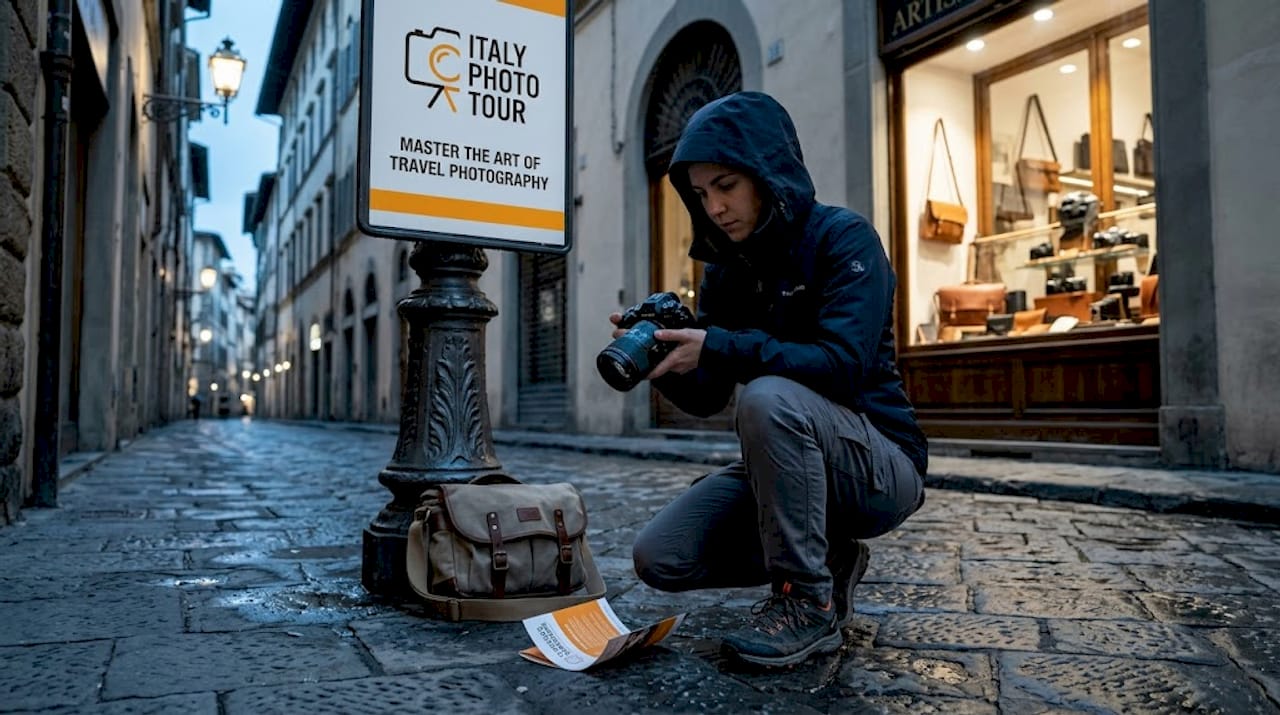
Dynamic weather opens another layer of creative possibility. Overcast and diffused light suits street and portrait photography beautifully, eliminating harsh shadows and creating even, flattering tones across faces and facades. A cloud cover of 30 to 70 percent can actually enhance golden hour colors, adding drama to the sky without blocking the warm light entirely. Fog rolling through the valleys of Umbria or Tuscany creates an ethereal, almost dreamlike quality that transforms a familiar landscape into something mysterious and new.
| Weather condition | Best photography use | Mood/effect |
|---|---|---|
| Clear sky, golden hour | Landscapes, architecture | Warm, vibrant, glowing |
| 30 to 70% cloud cover | Portraits, street scenes | Dramatic, rich, layered |
| Overcast | Street, portraits, markets | Soft, even, intimate |
| Morning fog or mist | Valleys, vineyards, hills | Ethereal, moody, painterly |
| Blue hour, clear sky | Cityscapes, long exposures | Deep blue, luminous, cinematic |
Pro Tip: When fog is forecast in Tuscany or Umbria, position yourself on a hilltop before dawn. As the mist fills the valleys below, you will capture a scene that feels like atmospheric photography in Italy at its most poetic, with church towers and cypress trees emerging from a sea of white.
Challenging light: Midday, summer, and harsh conditions
Not every moment in Italy provides ideal lighting, so understanding challenging conditions prepares you for any scenario. The Italian summer sun, particularly between 10 a.m. and 4 p.m., is one of the most demanding lighting environments a photographer can face. Midday light in summer is harsh, high in contrast, and carries real risks of overexposure, washed-out colors, and heat haze that blurs distant details into an indistinct shimmer. Shadows become short and unflattering, falling directly beneath subjects and creating dark, hollow shapes under eyes and architectural details.
That said, midday is not a lost cause if you approach it with intention. Here are practical strategies for combatting harsh light and still creating compelling images:
- Seek shade actively. Narrow medieval alleyways, covered loggias, and the shadows of tall buildings create natural diffusers that soften the light dramatically.
- Use a collapsible diffuser or reflector for portrait work, bouncing softer light back onto your subject’s face.
- Embrace high contrast intentionally. Strong top-down sun can create graphic, abstract compositions in urban environments, particularly with geometric architecture.
- Shoot backlit scenes. Placing your subject between you and the sun during midday can produce beautiful rim lighting and silhouettes.
- Revisit your location list. Use midday hours for scouting, resting, and planning your golden hour compositions rather than forcing shots in difficult light.
Pro Tip: Italy’s covered market halls, such as the Mercato Centrale in Florence or the Mercato di Porta Palazzo in Turin, are perfect midday photography destinations. The diffused light filtering through skylights and the vivid colors of produce and people create rich, evocative images even when the sun outside is at its most punishing.
A note on heat haze: At distances beyond 500 meters during summer afternoons, rising heat creates visible distortion that no amount of post-processing can fully correct. Plan your long-distance landscape shots for early morning or late evening to preserve sharpness and clarity.
Seasonal shifts: Light through Italy’s year
Beyond day-to-day changes, Italy’s seasons shape not only the landscape but the very quality of light you will encounter. Each season brings its own palette, its own mood, and its own set of creative opportunities that reward the photographer who plans thoughtfully.
Tuscany’s seasons illustrate this beautifully. Autumn is widely considered the finest season for photography in the region, offering golden harvest colors, morning fog that drapes the valleys in mystery, and a quality of light that feels warmer and more horizontal as the sun travels lower across the sky. Spring brings vivid green hills and the fleeting spectacle of poppies blooming across the fields, creating a lush, almost surreal landscape. Summer demands discipline, requiring early morning and late evening shoots to avoid the harsh midday glare, but rewards those who rise early with extraordinary clarity and warmth.
Here is how each season shapes your photographic opportunities across Italy:
- Spring (March to May): Fresh foliage and wildflowers create vibrant foregrounds. Golden hours are long and generous in northern regions. Light is crisp and clear, particularly in the Alps and Dolomites.
- Summer (June to August): Intense sunlight demands early starts and late finishes. Coastal locations like Cinque Terre and Amalfi glow magnificently at golden hour, but midday is best avoided for landscape work.
- Autumn (September to November): Perhaps the most photogenic season overall. Harvest colors in Tuscany and Umbria, morning mist in the valleys, and a softer, more golden quality of light that lingers longer into the morning.
- Winter (December to February): Snow in the Dolomites and the Alps creates dramatic, high-contrast landscapes. Venice in winter mist is hauntingly beautiful, and the low sun angle means golden hour light lasts for much of the morning.
For seasonal artistic photography, autumn and spring offer the most forgiving and rewarding conditions, while summer and winter reward the patient and the prepared.
Essential tools and expert tips for perfect light
Having mastered the types of light Italy offers, a few expert tools and practical habits push your results to the next level. The difference between a good shot and a great one often comes down to preparation and the right gear in your bag.
- Download PhotoPills or a similar app. PhotoPills gives you precise golden and blue hour timing, sun and moon position, and augmented reality tools that let you visualize exactly where the light will fall at any location and time. Arriving one hour early to scout compositions is always time well spent.
- Carry a sturdy tripod. Low light during blue hour and golden hour demands stability. Even the sharpest lens cannot compensate for camera shake during a one-second exposure.
- Use a polarizing filter. A circular polarizer cuts reflections on water and glass, deepens blue skies, and saturates colors in ways that post-processing simply cannot replicate.
- Add a graduated neutral density (GND) filter. When the sky is dramatically brighter than the foreground, a GND filter balances the exposure without sacrificing detail in either zone.
- Always shoot in RAW format. RAW files preserve the full dynamic range of your sensor, giving you the latitude to recover highlights and shadows in post-processing that JPEG files simply cannot offer.
Here are additional habits that consistently improve results in the field:
- Revisit the same location at different times of day to see how light transforms the scene.
- Keep a location notebook with notes on the direction of light, ideal seasons, and compositions to try.
- Study the work of painters who worked in Italy, such as Turner and Corot, to understand how masters read and interpreted Italian light.
Consult the Italy photography checklist and explore best camera gear Italy resources before your trip to ensure you are fully equipped for every lighting scenario.
Pro Tip: Bring a small LED panel light for tight interior shots in churches and historic buildings where flash is prohibited. A warm-toned panel at low power can fill shadows beautifully without disturbing the ambient atmosphere.
Why chasing Italy’s perfect light is about patience and practice
Here is something that took years of shooting across Italy to fully appreciate: the most memorable images rarely come from the perfectly planned golden hour shoot. They come from the morning the fog rolled in unexpectedly over the Arno, or the afternoon a summer storm turned the sky above the Dolomites into a churning canvas of violet and silver. Perfect conditions are a gift, but imperfect conditions are a teacher.
The photographers who consistently produce extraordinary work in Italy are not necessarily the ones with the best gear or the most precise planning apps. They are the ones who stay curious when the light does not cooperate, who adapt their composition when the clouds obscure the sun, and who find beauty in the gray, the flat, and the unexpected. Italy rewards return visits more than almost any other destination, because every season and every weather pattern reveals a completely different version of the same beloved place.
Treat each shoot as an experiment rather than a performance. If the golden hour is obscured by clouds, explore what those clouds do to the color of the light. If midday catches you in a piazza, look for the geometry of shadows on ancient stone. Planning Italian photo tours with flexibility built into the itinerary allows you to chase the light rather than fight the schedule. Patience and a willingness to return are, in the end, the most powerful tools in your kit.
Make the most of Italy’s light: guided photo adventures
Understanding light in theory is one thing. Standing in the Tuscan hills as the first golden rays break over the cypress trees, camera in hand, knowing exactly where to point it and why, is something else entirely. That lived, sensory knowledge is what our guided photo tours are designed to give you.

Italy Photo Tour, led by professional photographer Mino Di Vita, offers curated photography tours Italy across the country’s most photogenic regions, from the misty canals of Venice to the sun-drenched terraces of Cinque Terre. Each Italy photo tour is structured around the best light of the day and season, with expert guidance on composition, exposure, and the creative mindset that transforms good photographers into great ones. Whether you are just beginning your photographic journey or looking to deepen your craft, these immersive experiences connect you with Italy’s light in the most direct and inspiring way possible.
Frequently asked questions
What is the golden hour and why is it important for photos in Italy?
Golden hour is the first hour after sunrise and the last hour before sunset, producing warm, soft, diffused light that enhances landscapes, architecture, and portraits with flattering tones and reduced harsh shadows. In Italy, where ancient stone and rolling hills seem sculpted to absorb this light, it is the single most transformative time to shoot.
Is midday ever a good time for photography in Italy?
Midday light is generally harsh, with high contrast and overexposure risks, but shooting in shade, using diffusers, or embracing strong shadows for graphic urban compositions can yield striking results. It is also the ideal time to scout locations and plan your golden hour shots.
How can I plan ahead for the best lighting while traveling Italy?
Apps like PhotoPills give you precise golden and blue hour timing and sun position for any location in Italy, and arriving at least an hour early allows you to scout and adapt your composition before the light peaks.
What lighting is best for Italian cityscapes and street photography?
Blue hour, the 20 to 30 minutes after sunset or before sunrise, offers soft, deep blue light that balances perfectly with artificial illumination, making it ideal for cityscapes, long exposures, and cultural scenes where the interplay of natural twilight and warm lamp glow creates a cinematic atmosphere.