

TL;DR:
- Genuine human connection and emotion create the most powerful and authentic photographs.
- Observing, engaging, and capturing candid moments deepen storytelling in Italy’s rich settings.
- Patience, empathy, and trust are essential for revealing meaningful life stories through photography.
The most powerful photograph you will ever take probably will not come from owning a better lens. It will come from a moment of genuine human connection, a flicker of emotion caught in honest light, a story told not in words but in a glance, a weathered hand, or a shared laugh along a sunlit Italian piazza. Italy is a country that breathes storytelling. Its markets, monasteries, fishing villages, and ancient alleyways are alive with human moments worth preserving. This guide will walk you through the essence of human story photography, the mechanics of capturing it in Italy, real-world inspiration, and actionable techniques you can carry into the field.
Table of Contents
- What makes a human story in photography?
- Core mechanics: How to capture human stories in Italy
- Italian case study: Documenting real stories with Joe Pansa
- Techniques and tips for telling your own stories
- Why focusing on human stories changes your photography (and travels)
- Take your storytelling further with Italy Photo Tour
- Frequently asked questions
Key Takeaways
| Point | Details |
|---|---|
| Story over gear | Emotional connection and curiosity create memorable images—not camera specs. |
| Practical techniques | Blending human activity with Italian scenes adds depth, scale, and narrative power. |
| Patience pays off | Take the time to build trust and wait for authentic moments during your Italy travels. |
| Learn from real examples | Case studies like Joe Pansa show the value of immersive, empathetic photography. |
What makes a human story in photography?
With curiosity awakened, let’s clarify what a “human story” really means in a photo. At its simplest, a human story in photography is any image that reveals something true about a person’s inner world or lived experience. It is not a portrait posed in flattering light. It is something closer to a whisper, a gesture caught mid-thought, a face illuminated by the warmth of a bakery window, a fisherman mending his nets in the silver hour before dawn.
Understanding the visual storytelling basics of this craft starts with recognizing that emotion, context, and cultural depth are the real subjects of your frame. Light is a tool. Composition is a container. But the story is what makes someone stop scrolling and feel something.
Several elements work together to build that feeling:
- Emotion: A genuine expression, however subtle, anchors the viewer to a human truth.
- Context: The setting tells us where and how a person exists in the world.
- Gesture: The way hands move, shoulders slump, or eyes drift reveals what words never could.
- Light: Natural, ambient light wraps a scene in mood rather than spectacle.
- Candid timing: The most resonant moments arrive unannounced, through patience and presence.
“The best photographs listen before they look. They honor the subject’s story, not the photographer’s vision of it.”
The good news for amateur photographers is that none of this requires advanced technique. It requires trust, patience, and a willingness to be genuinely curious about the lives in front of your lens. You can transform travel photos entirely by shifting from observer to empathetic witness.
Pro Tip: Approach each scene as if you are listening to a person’s life, not just framing their face. When you slow down and truly observe, the decisive moment reveals itself naturally.
Core mechanics: How to capture human stories in Italy
Now that you know what to look for, here is how you can actually capture these stories in your photos. The process is less a rigid formula and more a rhythm you develop with practice, especially in Italy, where life spills so beautifully into the streets.
Think of these steps as your quiet guide through any scene:
- Engage your subject. Smile, make eye contact, exchange a few words in Italian if you can. Warmth dissolves walls.
- Observe before you shoot. Watch for recurring gestures, habitual movements, or small rituals that define a person’s daily life.
- Compose with Italian backdrops. A Venetian canal, a Tuscany doorway painted in terracotta, a Cinque Terre fishing boat all add narrative layers to your subject.
- Use natural light intentionally. The golden hour in Italy is extraordinary. Sideline flash entirely and let the warmth of ambient light do the emotional work.
- Capture candidly. Once trust is established, step back and let life continue. The candid moments that follow are where your real story lives.
- Edit for honesty. Resist heavy filters. Preserve skin tones, preserve shadows, preserve the imperfections that make a photo feel real.
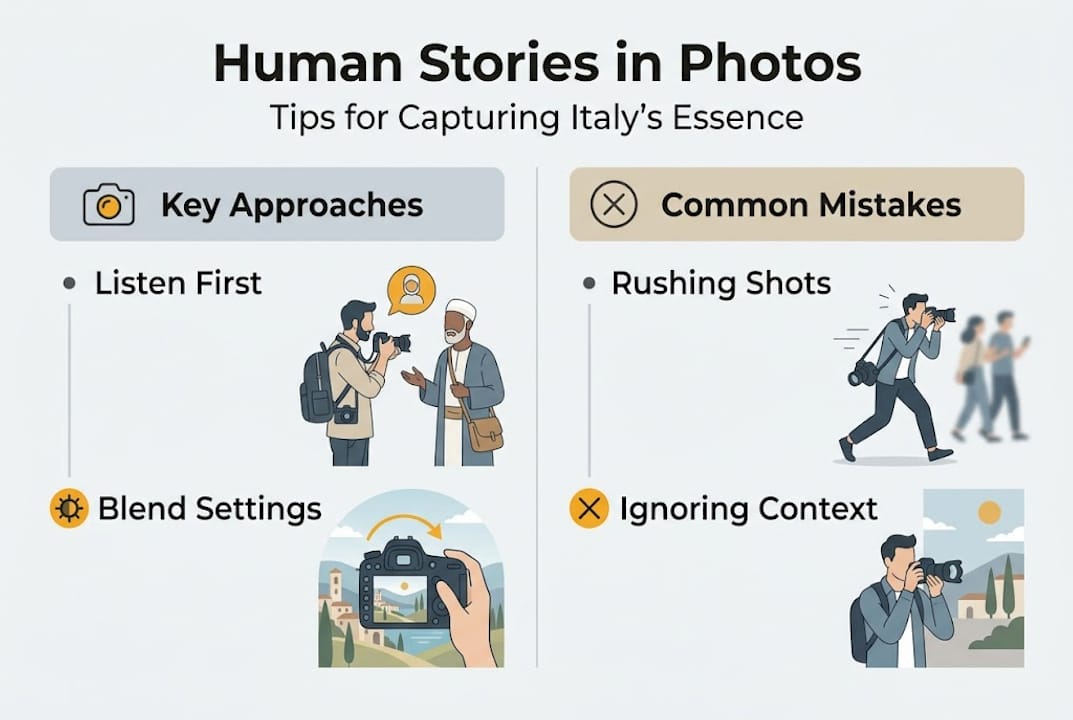
| Core mechanic | Common mistake |
|---|---|
| Listening and observing first | Shooting immediately without connecting |
| Using ambient, natural light | Relying on flash or harsh artificial light |
| Embracing candid moments | Staging every pose and expression |
| Editing to preserve emotion | Over-editing to create visual perfection |
| Building subject trust | Treating subjects as props in a landscape |
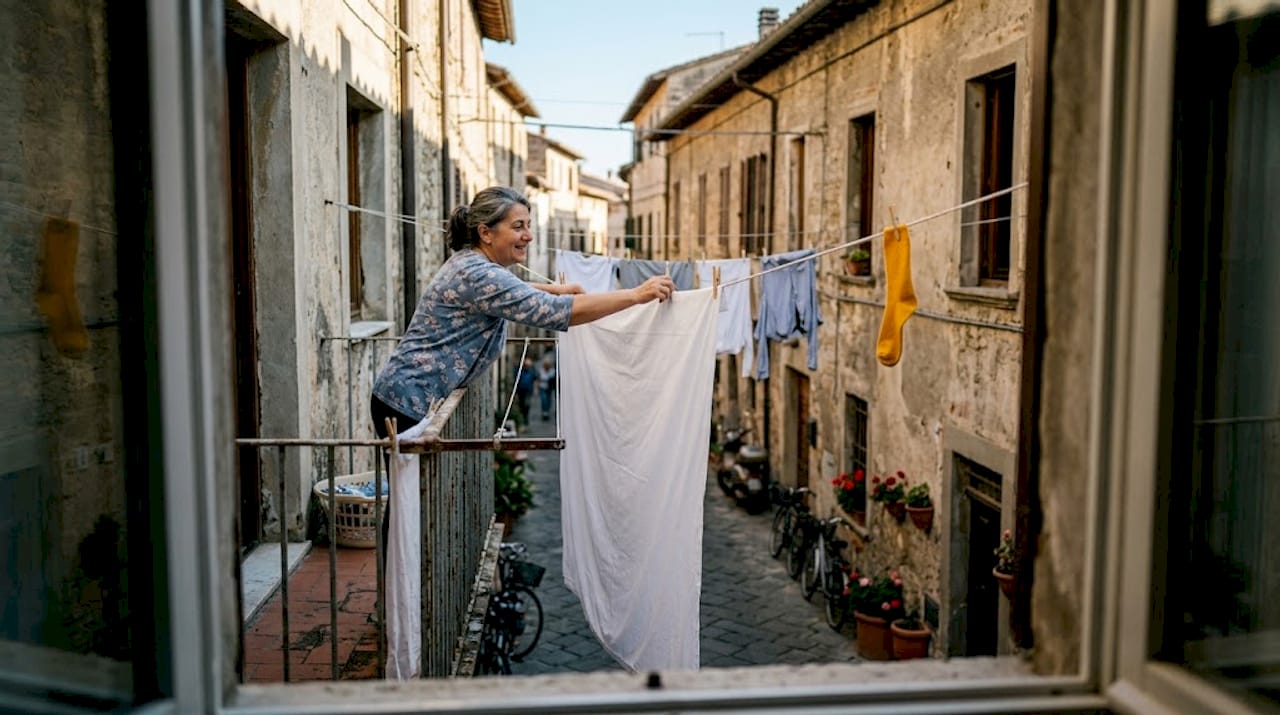
Pro Tip: In Italy, blend human activity with iconic backdrops for extra narrative depth. A woman hanging laundry across a Sicilian alley or a boy chasing pigeons in a Roman piazza tells a far richer story on your Italian journey than an empty landmark ever could.
Italian case study: Documenting real stories with Joe Pansa
Having a method is one thing, but seeing it in action can be transformative. Few stories illustrate the power of immersive documentary photography in Italy better than Joe Pansa’s celebrated series The Last Fishermen.
Pansa spent two years embedded with the fishermen of Mola di Bari, a small coastal town in Puglia, photographing their labor, their solitude, their quiet camaraderie, and their enduring relationship with a sea that has fed their families for generations. He did not arrive with a shot list. He arrived with patience, empathy, and a deep respect for the lives he was witnessing.
“These images are not just photographs. They are an act of preservation, a record of a way of life that may not survive another generation.”
The difference between what Pansa created and a tourist’s snapshot is both simple and profound:
| Tourist photograph | Immersive documentary series |
|---|---|
| Captured in minutes, from a distance | Built over months or years of relationship |
| Subject is unaware or performing | Subject forgets the camera exists |
| Records a place | Reveals a life |
| Single image with no sequence | Visual narrative with rhythm and arc |
Several lessons from Pansa’s work translate directly to your own documentary travel photography:
- Patience is your most powerful tool. Return to the same place, the same people, at different times of day and season.
- Empathy shapes your frame. When you genuinely care about your subject, the camera picks it up.
- Respect is non-negotiable. Never use someone’s vulnerability or hardship purely for aesthetic effect.
- Think in sequences. A single image is a sentence. A series is a story.
These Italian cultural photo ideas remind us that the richest photographic experiences come not from visiting a country, but from listening to it.
Techniques and tips for telling your own stories
Finally, let’s put these principles into your hands with ready-to-use tips and creative encouragement. Whether you are wandering Rome’s Trastevere quarter or watching fishermen sort their catch in a Sicilian harbor, these approaches will help you find and frame genuine human stories.
Building trust is your foundation. Introduce yourself. Show your previous photos on the camera screen. Laugh at yourself a little. People in Italy are warm and expressive by nature, and once they feel seen rather than photographed, they open up in ways that add remarkable impact to your images.
- Look for human scale. In vast landscapes like Val d’Orcia, a lone figure walking through golden wheat fields gives the scene emotional proportion and story.
- Blend the human and the natural. Prioritize curiosity and trust over chasing technical perfection. The most memorable images often feature a person that grounds an otherwise overwhelming landscape.
- Focus on moments, not poses. The best images arrive in the space between poses, the laugh after the photo, the glance toward the window.
- Ignore your gear anxiety. A smartphone can capture an honest story just as powerfully as a full-frame camera, provided the human connection is real.
- Tell visual sequences. Shoot wide for context, medium for relationship, tight for emotion. Three images together tell a story no single frame can.
You can enhance your photos with storytelling by simply deciding, before you raise the camera, what feeling you want someone to experience when they look at your image.
Pro Tip: In Venice or Rome’s crowded spaces, resist the temptation to photograph the obvious. Step into a quieter side street and look for introspective, solitary moments. A gondolier reading between fares or an elderly man feeding cats in a forgotten courtyard will outlast any image of a crowded bridge.
Why focusing on human stories changes your photography (and travels)
With a practical toolkit in hand, it is worth stepping back to consider why story-driven photography alters not just your images but your entire experience of being in a place. When you walk through a Florentine market with the intention of witnessing human stories rather than collecting scenic shots, something shifts. You slow down. You make eye contact. You notice things: a vendor’s pride as she arranges blood oranges, a child mimicking his grandfather’s posture, a nun laughing freely at something on her phone.
This approach transforms journeys through storytelling into something far more meaningful than sightseeing. The photos that result carry emotional weight because they came from genuine curiosity and empathy, not from a checklist of landmarks. They reflect not just what Italy looks like, but what it feels like to be inside it. And they do something remarkable for you personally: they change how you remember. The places you photograph with human intention stay with you in a completely different way, vivid, specific, alive. That is not something any camera setting can create.
Take your storytelling further with Italy Photo Tour
Ready to carry your camera and curiosity further? Here is how you can immerse yourself even deeper in Italy’s extraordinary human landscape.

At Italy Photo Tour, our guided photography experiences across Italy are designed precisely for photographers like you: curious, creative, and hungry for authentic connection. Led by professional photographer Mino Di Vita, each tour moves beyond postcard imagery to uncover the layered human stories that make Italy so endlessly enchanting. You will photograph in real communities, in extraordinary light, guided by someone who understands both the craft and the culture. Explore what we do and discover how our tours balance artistic mentorship with genuine Italian immersion. Whether you are drawn to Tuscany’s rolling hills or the vivid Italian landscapes waiting to be photographed, we will help you see and capture them with deeper intention.
Frequently asked questions
How do you approach people in Italy for candid photos?
Begin with warm, genuine interaction rather than immediately raising your camera. Listening and connecting first builds the natural trust that creates authentic, candid moments.
What if I only have basic camera gear?
Great storytelling depends on empathy, timing, and curiosity, not expensive equipment. Curiosity and trust will carry your images further than any camera upgrade ever will.
How can I blend landscapes and people in a single shot?
Position human figures within the scene to provide scale and emotional grounding. In places like Val d’Orcia fields, even a distant figure adds story depth that transforms a scenic image into something truly memorable.
What’s one common mistake in travel photography storytelling?
The most frequent error is prioritizing perfection over presence. Chasing candid moments and genuine emotions will always produce more powerful images than carefully staged compositions.