

There is a quiet tension every photographer feels when standing before the Trevi Fountain, camera raised, tourists swarming the frame. The instinct is to wait for the perfect, crowd-free shot. But what if the crowd itself is the story? Authentic travel images capture genuine cultural essence through candid moments, natural light, and immersion rather than staged perfection. Italy, with its kaleidoscope of light, color, and human vivacity, rewards those who set aside the pursuit of flawless compositions and instead open their eyes to what is real, raw, and resonant.
Table of Contents
- Understanding authenticity in travel photography
- Key mechanics: Light, timing, and immersion
- Practical methodologies: Capture candid travel moments in Italy
- Best times and places: Authentic Italian regions, off-peak strategies
- Ethics and presence: Photographing people and places with respect
- Candid, staged, and hybrid: Contrasting approaches to authentic images
- Next steps: How to refine your authentic travel imagery
- Immerse deeper: Join an authentic Italy photo tour
- Frequently asked questions
Key Takeaways
| Point | Details |
|---|---|
| Seek candid moments | Authentic images are about emotion and story, not perfect poses. |
| Leverage golden hour | Italy’s regional light is at its best just after sunrise or before sunset for genuine scenes. |
| Choose the right place and time | Hidden spots and off-peak hours allow more natural, local travel photos. |
| Prioritize ethics | Always gain permission for portraits and respect local culture in your photography. |
| Value intention over gear | Presence and connection with your subject matter far outweigh expensive equipment. |
Understanding authenticity in travel photography
Authenticity in photography is not simply the absence of a tripod or a posed smile. It is the presence of truth. The meaning of travel photography runs deeper than scenic backdrops; it lives in the wrinkled hands of a Sicilian fisherman mending nets, in the steam rising from a morning espresso on a Venetian calle, in the chiaroscuro of a Florentine alley at dusk. These are the images that linger.
“Success in travel photography is measured by personal connection and storytelling, not by viral metrics.” — National Geographic
The contrast between candid and staged imagery is worth examining honestly. Staged vs. real travel photography each carry their own merits, but the emotional weight of an unposed moment is difficult to replicate. Consider what separates the two:
- Candid images preserve spontaneity, cultural context, and emotional truth
- Staged images offer control, clarity, and compositional precision
- Hybrid approaches blend direction with natural behavior for a middle path
- Authentic documentary styles prioritize narrative over aesthetics
Neither approach is inherently superior. What matters is intention. When you photograph with empathy and curiosity, even a gently directed portrait can carry the weight of genuine human connection.
Key mechanics: Light, timing, and immersion
Italy is a country that performs differently depending on the hour. The light in Tuscany at golden hour is not the same as the silver mist that drapes Venice at dawn. Understanding these rhythms is one of the most powerful tools in your kit. Shoot during golden hour, the 30 to 60 minutes after sunrise or before sunset, to leverage soft, directional Mediterranean light and avoid the harsh midday shadows that flatten texture and mood.
| Region | Best light quality | Ideal time |
|---|---|---|
| Venice (north) | Soft silver, misty | Dawn, autumn mornings |
| Tuscany (center) | Warm amber, golden | Late afternoon, spring/fall |
| Sicily (south) | Intense, high contrast | Early morning, winter |
| Cinque Terre | Dramatic coastal glow | Sunset, shoulder season |
Immersion is the other half of the equation. Slow down. Sit at a café and watch the piazza breathe before you raise your camera. Observe the rhythm of local life, the way a shopkeeper arranges fruit, the angle of a child’s gaze. These observations become the foundation of images that feel lived-in rather than visited. For deeper guidance on working with available light, explore these natural light tips and an expert natural light approach tailored to Italian conditions.
Weather, too, is an ally rather than an obstacle. Rain-slicked cobblestones in Rome reflect lamplight in ways that dry stone never could. Fog rolling through the Tuscan hills at dawn transforms a familiar landscape into something mythic. The Venice light strategy embraced by seasoned photographers often involves arriving before the city wakes, when the canals are still and the light is pure.
Pro Tip: Set your alarm for 90 minutes before sunrise. The blue hour before golden light arrives offers a cool, ethereal quality that is almost impossible to replicate in post-processing.
Practical methodologies: Capture candid travel moments in Italy
Capturing candid moments is a craft that rewards preparation and patience in equal measure. Research local customs before you arrive, observe before you shoot, and build relationships respectfully. Here is a practical framework for the field:
- Research your location before arriving. Study the neighborhood’s rhythm, market days, festival schedules, and local gathering spots.
- Arrive early and stay late. The most authentic moments happen at the edges of the day, not during peak tourist hours.
- Get lost on purpose. Wander away from the main piazzas and follow narrow alleys, canal paths, and residential streets.
- Use a versatile lens. A 24-70mm range covers architecture, street scenes, and environmental portraits without drawing attention.
- Observe before shooting. Spend at least 10 minutes in a location simply watching before raising your camera.
- Engage with locals. A smile, a few words of Italian, and genuine curiosity open doors that a camera alone never will.
For urban shooting tips specific to Italian cities, and for cultural photography ideas that go beyond the postcard, these resources offer rich starting points. The National Geographic travel photo tips also reinforce that presence and intention consistently outperform technical perfection.
Pro Tip: A small mirrorless camera or a compact prime lens is far less intimidating to strangers than a large DSLR with a telephoto zoom. Less gear often means more access.
Best times and places: Authentic Italian regions, off-peak strategies
Knowing where and when to shoot is as important as knowing how. Shoulder seasons and early mornings in regions like Cannaregio in Venice or the Tuscan hills in autumn fog offer the kind of crowd-free, light-rich conditions that make authentic images possible. Arriving at the Rialto Bridge before 7 AM, for instance, transforms one of the world’s most photographed spots into something intimate and personal.
| Location | Best season | Authentic shot scenario |
|---|---|---|
| Cannaregio, Venice | Autumn/winter | Misty canal at dawn, lone gondolier |
| Val d’Orcia, Tuscany | Spring/autumn | Rolling fog over cypress-lined roads |
| Palermo markets, Sicily | Winter/spring | Vendors arranging colorful produce |
| Matera, Basilicata | Autumn | Golden light on ancient sassi caves |
| Cinque Terre villages | Early spring | Fishermen on quiet harbor at sunrise |
For finding hidden photo spots across Italy, and for discovering unique Italian locations beyond the well-worn tourist trail, these guides offer curated starting points. The Florence photographer tips from seasoned local photographers are especially useful for navigating that city’s complex light and crowds.
A few quick strategies for beating the crowds:
- Visit iconic sites on weekday mornings rather than weekends
- Explore neighborhoods adjacent to famous landmarks, where local life continues undisturbed
- Travel in November, February, or early March for dramatically reduced visitor numbers
Ethics and presence: Photographing people and places with respect
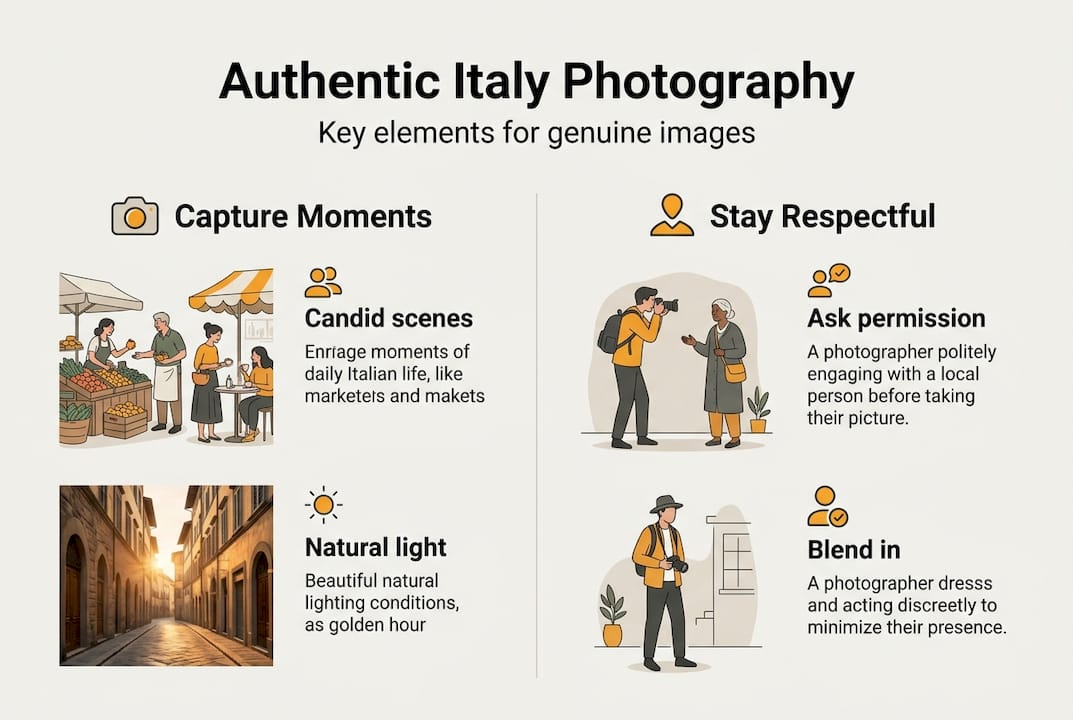
Every portrait is a relationship. Before you press the shutter on a stranger’s face, consider what you are asking of them and what you are offering in return. Ethical portraiture requires permission and connection; blending into the environment for candid street shots is equally important for honest imagery.
“The most powerful images are made when the photographer is present, not just physically, but emotionally and ethically.”
Here is a simple ethical framework for photographing people in Italy:
- Ask permission for close portraits, especially of elderly subjects or children. A gesture and a smile often communicate more than words.
- Offer to share the image. Showing someone their portrait on your screen creates a moment of genuine connection.
- Respect a refusal. A declined request is not a failure; it is a boundary worth honoring.
- Blend in. Dress modestly, move slowly, and avoid drawing attention to your equipment in sensitive or sacred spaces.
For deeper guidance on ethical travel imagery and documentary approaches, this resource explores the intersection of respect, presence, and visual storytelling in Italian contexts. Remember that imperfection, a slight blur, a rain-streaked lens, a subject caught mid-laugh, often adds more authenticity than a technically flawless frame.
Candid, staged, and hybrid: Contrasting approaches to authentic images
Authenticity is not the exclusive property of candid photography. Staged environmental portraits can be deeply authentic when approached with respect and clear intent. Purists favor the unposed moment, but many skilled photographers find genuine value in directed storytelling. The key is knowing which approach serves your narrative.
| Approach | Strengths | Limitations | Best for |
|---|---|---|---|
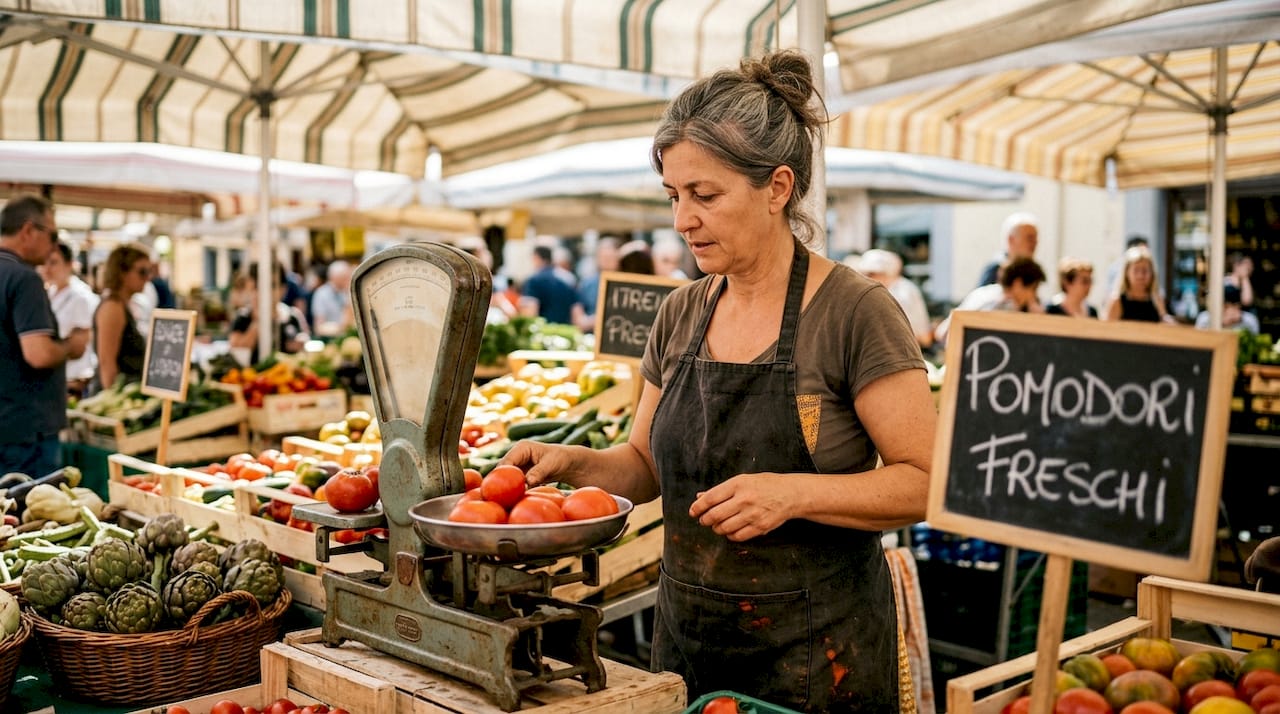
| Candid | Spontaneous, emotionally raw | Unpredictable, requires patience | Street scenes, markets, festivals |
| Staged | Controlled, compositionally precise | Can feel artificial | Environmental portraits, architecture |
| Hybrid | Balances direction with naturalness | Requires trust and rapport | Cultural stories, local artisans |
A few guiding principles for choosing your approach:
- Let the story dictate the method, not the other way around
- If a scene feels forced, step back and observe longer before intervening
- The Italy Photo Tour blog offers real-world examples of all three approaches across Italian regions
For a sharp eye on spotting staged photos and understanding what separates genuine imagery from fabrication, this resource sharpens your critical instincts as both a creator and a viewer.
Next steps: How to refine your authentic travel imagery
Capturing the image is only the beginning. What you do afterward shapes how your story lands. Prioritize presence and intention over gear; storytelling over technical perfection. Here is how to carry that philosophy into your editing and sharing practice:
- Review with story in mind. When culling images, ask which frames carry emotional weight, not just which are sharpest.
- Edit with restraint. Subtle adjustments to exposure, contrast, and warmth preserve the mood of a scene. Heavy filters and oversaturated edits betray the authenticity you worked to capture.
- Sequence your images. A series of related frames tells a richer story than a single standout shot.
- Keep learning. Workshops, guided tours, and photography books by documentary masters all accelerate growth in ways that solo practice cannot.
For advanced Italy photography tips that bridge technical skill with artistic vision, this guide offers a strong next step for photographers ready to move beyond the basics.
Immerse deeper: Join an authentic Italy photo tour
Reading about authentic photography is one thing. Standing in the blue-hour light of a Venetian calle, camera in hand, guided by someone who knows exactly where the light will fall and when the fishermen will arrive, is something else entirely. Italy Photo Tour offers curated Italy photography tours led by professional photographer Mino Di Vita, designed to place you inside the moments that matter most.

Whether you are drawn to the fog-draped hills of Tuscany, the chromatic vivacity of Burano, or the ancient textures of Matera, each Italy Photo Tour experience is built around authentic immersion, genuine light, and the kind of unhurried presence that transforms a good photograph into a lasting story. These tours are not about ticking off landmarks. They are about learning to see Italy the way it truly is.
Frequently asked questions
What defines an authentic travel image in Italy?
An authentic travel image captures real, candid moments that reflect Italy’s cultural and scenic character without excessive staging or editing. The emotional truth of the scene matters more than technical perfection.
How can beginners find less crowded spots for original travel photos in Italy?
Begin by researching off-peak regions and shoulder season locations like Cannaregio at dawn or the Tuscan hills in autumn fog. Planning early morning shoots consistently yields crowd-free, light-rich conditions.
Is it okay to direct or stage images and still be ‘authentic’?
Yes, if your approach is respectful and intentional. Staged environmental portraits can tell authentic stories as long as the subject is comfortable and the intent is honest.
What gear is essential for capturing Italy’s authentic images?
A wide lens in the 24-70mm range, a light camera body, and basic weather protection are ideal. As National Geographic emphasizes, presence and observation matter far more than equipment.
How do you handle photographing people respectfully in Italy?
Always ask permission, connect authentically, and respect personal boundaries for ethical portraits. A genuine smile and a few words of Italian go a long way toward building trust.