

TL;DR:
- Cultural immersion transforms travelers by fostering empathy, language fluency, and deep community bonds. Engaging authentically with local customs awakens creativity, broadens worldviews, and reduces feelings of isolation. Even short, participation-based trips can generate profound personal growth beyond traditional sightseeing.
There is a profound difference between passing through a place and truly inhabiting it, even briefly. The advantages of cultural immersion go far beyond collecting passport stamps or photographing famous landmarks. When you step into the daily rhythm of a community, share meals with locals, and allow a new language to reshape how you think, something in you shifts permanently. This article explores ten distinct ways that deep cultural engagement transforms travelers, from the sparks of creative inspiration it ignites to the lasting human bonds it forges.
Table of Contents
- Key takeaways
- 1. The core advantages of cultural immersion, defined
- 2. Deepened self-awareness and personal growth
- 3. A profound boost to creativity and artistic inspiration
- 4. Language acquisition that actually works
- 5. Building genuine connections with local communities
- 6. Creativity amplified through visual and sensory richness
- 7. Reduced isolation and a stronger sense of belonging
- 8. Psychological and social benefits at a glance
- 9. A broader worldview and global citizenship
- 10. The cumulative effect: a life genuinely enlarged
- My honest perspective on what immersion actually demands
- Experience Italy’s culture through the lens of Italyphototour
- FAQ
Key takeaways
| Point | Details |
|---|---|
| Immersion accelerates personal growth | Daily exposure to unfamiliar customs builds adaptability, empathy, and emotional intelligence faster than standard travel. |
| Language learning is uniquely effective | Active use of a local language in real contexts produces fluency and cognitive gains that classroom study rarely matches. |
| Creativity receives a genuine spark | Engaging with local art, music, and craft traditions unlocks fresh perspectives and imaginative approaches. |
| Community bonds run deep | Living alongside locals, rather than observing them, creates reciprocal relationships that enrich both visitor and host. |
| Psychological well-being improves | Immersion reduces feelings of isolation and builds a broader, more inclusive sense of belonging in the world. |
1. The core advantages of cultural immersion, defined
Most travelers experience a culture the way you experience a painting behind glass: you can admire the colors and composition, but you never feel the texture of the brushstrokes. Cultural immersion removes that glass entirely. Rather than moving between curated attractions, authentic immersion involves participating in mundane local activities, from morning market routines to neighborhood festivals, which accelerate genuine cultural adaptation.
This distinction matters enormously. The traveler who spends three days in Venice eating at tourist restaurants absorbs very little of Venetian life. The traveler who cooks with a local family, attends a neighborhood church feast, and navigates the vaporetto like a commuter begins to understand how Venice actually breathes. That understanding is where the real transformation begins.
2. Deepened self-awareness and personal growth
Cultural immersion works like a mirror that shows you angles of yourself you had never noticed. When the social codes you have relied on your whole life suddenly do not apply, you discover which of your assumptions were genuine values and which were simply habits inherited from your surroundings.
The growth that emerges from this disorientation is real and measurable. Consider what immersion systematically delivers:
- Increased adaptability: Navigating unfamiliar systems builds a tolerance for ambiguity that carries into every area of life.
- Stronger empathy: Daily interactions with people whose worldview differs from yours make abstract cultural sensitivity into something lived and felt.
- Greater self-reliance: Solving small problems without the comfort of familiar language or social structures quietly expands your confidence.
Research confirms that immersion builds empathy and cultural sensitivity in ways that standard tourism simply cannot replicate. The discomfort is not the obstacle. It is the mechanism.
Pro Tip: When you feel most disoriented during an immersive experience, resist the urge to retreat to familiar comforts. That friction is precisely where the growth is happening. Lean into it.
3. A profound boost to creativity and artistic inspiration
Artists across centuries have understood something that science is only recently confirming: exposure to radically different visual languages, musical traditions, and craft techniques rewires how the creative mind works. Cultural immersion experiences place you inside that rewiring process.
When you spend a morning in a Florentine workshop watching a goldsmith use techniques unchanged since the Renaissance, or when you sit with Sicilian fishermen as the golden hour dissolves into the Tyrrhenian Sea, you are absorbing a visual and emotional vocabulary that no amount of studying photographs can provide.
“The deepest growth from immersion comes from unstructured interactions like shared meals or community events more than scheduled tours or landmarks.” (Women Travel Abroad)
This is the painter’s truth and the photographer’s truth in equal measure. When you engage with local culture through its textures, sounds, and light rather than through a filtered highlight reel, the creative breakthroughs feel less like inspiration and more like inevitability. The kaleidoscope of new impressions simply demands expression.
4. Language acquisition that actually works
There is a reason that language schools advertise immersion programs so aggressively. The classroom teaches grammar; immersion teaches you to think in a language. That is a fundamentally different process, and the distinction explains why immersion produces fluency by associating vocabulary with real emotions and experiences rather than with translation equivalents.
The cognitive gains extend well beyond the language itself. Navigating communication under real pressure sharpens several skills at once:
- Problem-solving speed: When you cannot rely on your native tongue, your brain finds creative workarounds faster.
- Active listening: Every conversation demands full attention and careful reading of tone, gesture, and context.
- Communicative confidence: Successfully ordering a meal or negotiating a price in Italian, however imperfectly, builds a communicative fearlessness that follows you home.
Notably, 90% of immersion participants achieve meaningful language fluency when compared with those who study in traditional settings. That statistic alone speaks to the singular power of learning through cultural immersion.
Pro Tip: Before your immersive trip, learn just enough of the local language to attempt simple conversations. Locals everywhere respond warmly to the effort, and that warmth opens doors that a translation app never will.
5. Building genuine connections with local communities
Surface-level tourism keeps you at a comfortable distance from the people who actually inhabit a place. Immersion collapses that distance. When benefits of cultural exchange are described as reciprocal, the research is pointing to something travelers often overlook: you are not just receiving hospitality. You are offering a mirror to your hosts as well.
Living with a host family in rural Tuscany or joining a local photography collective in Naples generates a very different kind of relationship than booking a day tour. These bonds tend to endure because they are built on shared experience rather than transaction. The advantages that flow from these connections include:
- Expanded social networks that reach across continents and provide perspective on your own culture long after you return home.
- Access to authentic spaces that organized tourism never reaches, from private family dinners to neighborhood artisan studios.
- A living understanding of how local people navigate joy, difficulty, and everyday beauty in their particular corner of the world.
The cultural awareness impact of these relationships shapes how you see every subsequent encounter with difference, whether on future travels or in your own community.
6. Creativity amplified through visual and sensory richness
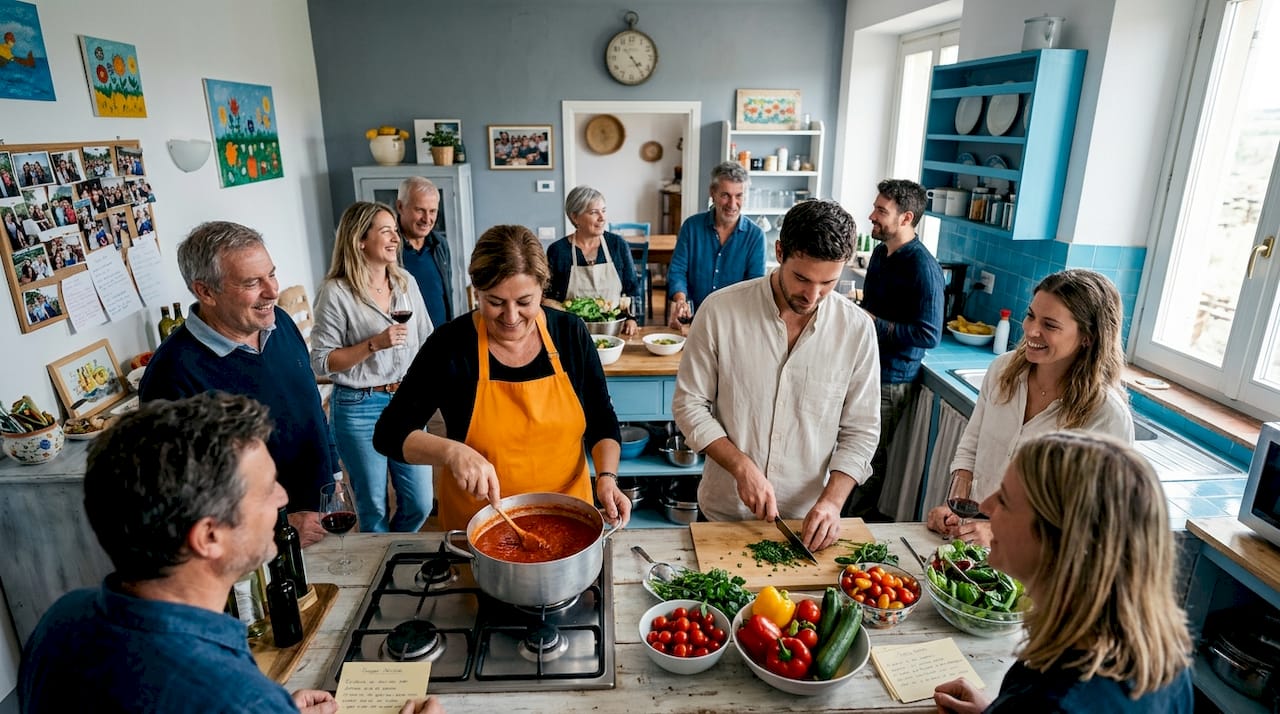
Italy offers a particularly vivid illustration of how the sensory density of a place can saturate a creative person’s imagination. The quality of afternoon light falling across the ochre walls of Siena, the sound of a dialect spoken in a covered market, the weight of handmade linen between your fingers: these are not decorative details. They are the raw material of art.
Travelers who pursue cultural immersion in photography often describe a moment when the camera stops feeling like a barrier between themselves and a scene and begins to feel like an extension of genuine engagement. That shift happens when you stop being a visitor documenting something and become a participant bearing witness.
The importance of cultural immersion for creative practitioners lies precisely here. You cannot manufacture that quality of attention. You have to earn it by spending time, showing curiosity, and allowing a place to reveal itself at its own pace.
7. Reduced isolation and a stronger sense of belonging
One of the quieter and more underreported advantages of cultural immersion is its effect on loneliness. Traveling fast and light across multiple destinations can, paradoxically, feel deeply isolating. There is always another city, another monument, another restaurant. But there is rarely anyone who knows your name.
Immersion reverses this. Research shows that 60% of immersion travelers report overcoming feelings of loneliness compared to typical travel, a finding that points toward something most travel writing ignores entirely. Connection is not just a pleasant side effect. It is one of the core psychological benefits of choosing depth over breadth.
The sense of belonging that emerges from being genuinely welcomed into a community, even temporarily, carries a warmth that no amount of sightseeing can replicate.
8. Psychological and social benefits at a glance
The measurable outcomes of immersion are worth examining side by side. The following table illustrates how cultural immersion experiences compare to conventional tourism across key dimensions of well-being and development.
| Dimension | Conventional tourism | Cultural immersion |
|---|---|---|
| Language skills | Minimal exposure | Active fluency development |
| Empathy and cultural sensitivity | Surface awareness | Deep, lived understanding |
| Social connection | Transactional encounters | Reciprocal, lasting relationships |
| Creative inspiration | Visual stimulation | Sensory and emotional integration |
| Psychological well-being | Temporary escape | Reduced isolation, increased belonging |
Immersion reduces mental distance between people from different cultures, and that reduction has consequences that ripple outward. It shapes how you collaborate professionally, how you parent, how you vote, and how you extend trust to strangers who are different from you.
9. A broader worldview and global citizenship
The word “global citizen” gets used so frequently that it has lost much of its weight. But cultural immersion is one of the few experiences that actually earns that description. When you have lived local rhythms through cooking classes, community activities, and unhurried daily life rather than sprint-touring a city in 48 hours, your understanding of human commonality becomes specific rather than abstract.
You stop thinking of other cultures as exotic backdrops and start recognizing them as fully realized worlds with their own textures of joy and difficulty. That recognition is not just philosophically admirable. It makes you more effective, more creative, and more compassionate in every context you inhabit.
10. The cumulative effect: a life genuinely enlarged
Each of the advantages described above compounds the others. Language confidence opens social doors. Social connection deepens creative inspiration. Creative inspiration sharpens observation. Sharper observation builds empathy. Empathy reduces isolation. And reduced isolation makes you more open to the next immersive experience, completing a cycle of growth that has no natural ceiling.
The importance of cultural immersion is not that it makes travel more memorable, though it certainly does that. It is that it makes you more capable: more resilient, more curious, more connected to the vast and gorgeous variety of human experience.
My honest perspective on what immersion actually demands
I have led photography tours through Italy for years, and the transformation I witness in travelers who genuinely engage with local culture never stops surprising me. But I want to be honest about something most articles on this subject gloss over.
Immersion is not always comfortable. There are afternoons when the language barrier feels less like a creative challenge and more like a wall. There are moments when local customs seem opaque or even unwelcoming. The temptation to retreat to the familiar is real. What I have found, though, is that those are precisely the moments worth enduring. The richest photographs I have ever taken, and the deepest conversations I have ever had with the Italians who invite us into their communities, have come from staying present through that discomfort rather than retreating from it.
The misconception I encounter most often is that immersion requires a long commitment, months of living abroad, full linguistic fluency before you arrive. In my experience, a single well-designed week of genuine local engagement, built around participation rather than observation, can shift your creative perspective more profoundly than a month of conventional sightseeing. The ingredients are humility, curiosity, and a willingness to be a beginner. The rest follows.
— Mino
Experience Italy’s culture through the lens of Italyphototour

The cultural immersion advantages described in this article are not theoretical at Italyphototour. They are built into every tour that Mino Di Vita leads through Italy’s most luminous corners. Whether you are photographing the shimmering canals of Venice at dawn or spending a golden afternoon with artisans in Tuscany, each experience is designed to place you inside the culture rather than in front of it. These are not sightseeing itineraries with cameras attached. They are genuine encounters with Italian light, life, and community, shaped by years of local relationships and artistic vision. Explore the full range of photography tours in Italy and discover what immersion truly feels like when creativity and culture move together.
FAQ
What are the main advantages of cultural immersion?
Cultural immersion builds empathy, accelerates language acquisition, sparks creativity, and forges lasting community bonds. Research shows it also significantly reduces feelings of isolation compared to conventional travel.
How does cultural immersion help with language learning?
Immersion places you in real contexts where you must use the local language to navigate daily life, which trains the brain to associate vocabulary with lived experience rather than translation. Studies show 90% of participants achieve meaningful fluency through immersion.
Can a short trip deliver genuine cultural immersion?
Yes. Even a focused week built around local participation, cooking, community events, and unstructured social time, rather than landmark-hopping, delivers authentic insight and measurable personal growth.
How does immersion benefit local communities?
Cultural exchange is reciprocal. Locals gain fresh perspectives on their own culture through meaningful interaction with visitors, deepening community pride and intercultural understanding on both sides.
Why is cultural immersion valuable for photographers?
Immersion shifts photographers from documenting a scene to genuinely participating in it, producing images that carry emotional authenticity. The cultural awareness impact on photographic storytelling is profound and lasting.