

TL;DR:
- Human elements provide scale, cultural context, and emotional storytelling in Italian travel photography.
- Effective inclusion relies on observing natural light, respectful rapport, and natural gestures rather than staging.
- Knowing when to exclude people enhances themes of serenity, timelessness, and landscape purity.
There is a quiet misconception that follows many photographers to Italy: that the most powerful images are the ones without a single soul in frame. Empty piazzas, deserted bridges, fog-draped hills with no human trace. Yet some of the most emotionally resonant travel photographs ever taken place a solitary figure at the center of an ancient scene, and everything changes. Human elements add scale, context, and storytelling to travel landscape photos, transforming static scenes into relatable narratives. This article explores why the human element is so essential to Italian travel photography, how to use it with skill and sensitivity, and when to step back and let the landscape breathe on its own.
Table of Contents
- Why the human element matters in travel photography
- Techniques: Making people enhance, not distract, from your shots
- Iconic Italian backdrops: Specific practices for adding people
- Balancing the human element: When less is more
- A new look at the human element: Our lessons from Italian travels
- Level up your Italy travel photography experience
- Frequently asked questions
Key Takeaways
| Point | Details |
|---|---|
| People create impact | Adding human figures brings scale, emotion, and stories to your Italian travel photos. |
| Use thoughtful techniques | Golden hour, candid moments, and composition rules help people enhance—never clutter—your shots. |
| Adapt to each location | Apply specific strategies for Italian cities, bridges, and landscapes to capture culture naturally. |
| Balance authenticity and privacy | Respect local etiquette, use silhouettes when needed, and avoid paying for posed shots. |
Why the human element matters in travel photography
Italy is a country that wears its history openly. Every cobblestone, every crumbling facade, every canal shimmering in afternoon gold carries centuries of human story. When you place a person within that frame, something almost magical happens: the viewer is no longer just observing a place. They are feeling it.
One of the most immediate gifts a human figure offers is scale. A lone fisherman on the edge of a Venetian fondamenta suddenly reveals just how vast the lagoon stretches behind him. Without that figure, the scene is beautiful but abstract. With it, the viewer’s eye finds a reference point, and the landscape becomes scale in photography made visceral and immediate.
Beyond scale, people bring cultural context. A woman hanging laundry between the ochre walls of a Trastevere alley is not just a compositional element. She is a living thread connecting the viewer to centuries of Roman daily life. That kind of contextual depth is nearly impossible to manufacture in post-processing. It either exists in the moment you press the shutter, or it does not.
There is also the undeniable power of emotion and narrative. A gesture, a glance, a pair of hands wrapped around a morning espresso: these small human details ignite stories in the viewer’s imagination. As human stories transform travel photos in ways that pure landscape shots rarely achieve, the emotional connection becomes the photograph’s true subject.
The numbers support this instinct. Research shows that human presence enhances engagement with travel images by 40 percent. That is a remarkable figure, and it reflects something deeply human: we look for ourselves in the world around us.
“A photograph without a human soul is a postcard. A photograph with one is a memory.”
That said, not every human presence needs to be identifiable. Silhouettes, blurred figures in motion, and anonymous passers-by can carry enormous emotional weight while preserving a sense of universality. They invite the viewer to project themselves into the scene, which is often the most powerful invitation a photograph can extend.
Key reasons to include the human element in Italian travel photography:
- People provide instant, intuitive scale against grand Italian architecture
- Figures add cultural authenticity that no filter can replicate
- Faces and gestures create emotional resonance and narrative depth
- Anonymous figures offer universal appeal and protect subject privacy
- Human presence statistically increases viewer engagement and sharing
Techniques: Making people enhance, not distract, from your shots
Knowing why to include people is only half the journey. The real craft lies in knowing how to do it so the result feels genuine rather than forced.
Light is your first and most powerful ally. Golden hour, that warm window of soft radiance just after sunrise and before sunset, flatters skin tones in ways that midday sun simply cannot. In Italy, this light takes on an almost amber quality, especially in Tuscany and along the Ligurian coast. Shooting during these hours means your subjects glow rather than squint, and the entire scene feels bathed in something close to poetry. Pair this with natural light in Italy and you begin to understand why so many iconic Italian photographs feel like paintings.
Composition is equally important. The rule of thirds for human placement is a foundational principle: position your subject along one of the vertical thirds of the frame, and let the landscape fill the remaining space. This creates visual balance without making the person feel like an afterthought.
Here is a practical sequence for incorporating people into your Italian shots:
- Arrive early and observe. Spend at least 20 to 30 minutes watching how people move through the space before lifting your camera.
- Identify your background first. Lock in your composition, then wait for the right human element to walk into it.
- Adjust your aperture. For environmental portraits, f/5.6 to f/8 keeps both subject and background in pleasing focus. For tighter faces against a blurred backdrop, open to f/2.8 or wider.
- Use a moderate shutter speed. Around 1/250s freezes most pedestrian movement without losing the sense of life in the scene.
- Build brief rapport. A smile, a nod, a few words in Italian: even a simple “posso fare una foto?” (may I take a photo?) can transform a guarded expression into an open, authentic one.
- Embrace movement. A figure mid-stride, a hand reaching for a door, a child running: motion creates dynamism that static poses rarely achieve.
Pro Tip: Before photographing locals in markets or narrow streets, spend a few minutes simply being present. Buy something small, share a greeting, let them see you as a person rather than a tourist with a lens. The photographs that follow will carry a warmth that no technical setting can produce.
For deeper inspiration on visual storytelling with people, the difference between a technically correct image and a truly moving one often comes down to the quality of connection you establish before you ever press the shutter. You can also capture stunning travel photos by studying how light and human placement interact in real locations.
Iconic Italian backdrops: Specific practices for adding people
Italy offers an extraordinary range of settings, each with its own rhythm and visual language. Knowing how to work with people in these specific environments will transform your portfolio.
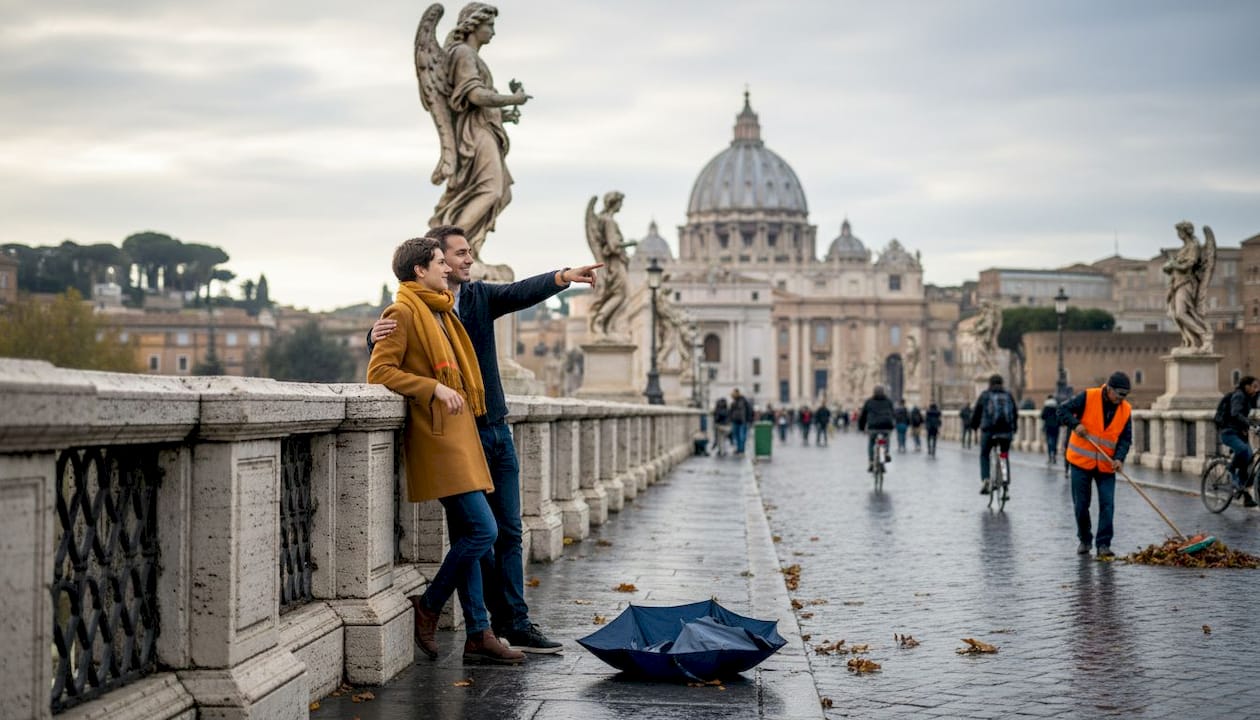
Bridges are among the most rewarding locations. The Ponte Sant’Angelo in Rome, lined with Bernini’s angels, becomes something otherworldly when a solitary figure crosses at dawn. Position yourself low on the embankment, use a wide angle, and let the bridge’s curve lead the eye toward your subject. The human figure here provides both scale and a sense of pilgrimage.
Street scenes in Florence and Trastevere reward patience above all else. Dawn is your best friend: the light is soft, the streets are quiet, and the few people you do encounter are locals going about genuine routines rather than tourists performing for cameras. The Florence photo guide highlights the Oltrarno neighborhood as particularly rich for this kind of intimate street photography.
The Arno at early morning offers rowers, runners, and the occasional solitary photographer leaning against the parapet. These figures, reflected in the still water, create a kind of visual poetry that speaks to both the timelessness of the city and the quiet rhythms of daily life. Reflections are especially powerful here: they allow you to include human presence without visual clutter, doubling the scene’s emotional depth.
For managing crowds at popular sites, silhouettes are a practical and artistic solution. Shoot into the light, expose for the sky, and let your subjects become dark, graceful shapes against a luminous backdrop. This technique works beautifully at the urban Italian photo tips level, turning tourist-heavy scenes into something mysterious and timeless.
| Location | Best time | Recommended aperture | Human element to seek |
|---|---|---|---|
| Ponte Sant’Angelo, Rome | Dawn | f/8 | Solitary walker or cyclist |
| Arno riverbank, Florence | Early morning | f/5.6 | Rower or runner reflected in water |
| Trastevere alleys | Dusk | f/4 | Local resident, daily routine |
| Cinque Terre terraces | Golden hour | f/6.3 | Farmer or fisherman at work |
| Venice fondamenta | Overcast midday | f/7.1 | Gondolier or market vendor |
Pro Tip: Use capture authentic Italian travel images as a reference when scouting locations. Reflections in canal water or wet cobblestones allow you to include human figures in the lower half of the frame while keeping the architecture dominant above, a balance that feels both artistic and natural. Explore cultural photography ideas Italy for location-specific inspiration.
Balancing the human element: When less is more
For all the power that people bring to a photograph, there are moments when the wisest choice is to step back and let the landscape speak alone. Knowing when to make that choice is what separates a thoughtful photographer from one who simply follows rules.
Consider the difference between these two approaches:
| Approach | Best for | Emotional effect | Risk |
|---|---|---|---|
| Human-included shot | Cultural storytelling, scale, engagement | Warm, relatable, narrative | Distraction, staged feeling |
| Pure landscape | Timelessness, serenity, environmental scale | Vast, meditative, abstract | Emotional distance |
As anonymous silhouettes can provide universal appeal and protect privacy, they offer a middle path: the presence of humanity without the weight of identity. A shadow stretching across ancient stone, a blurred figure passing through a beam of light: these elements suggest human life without demanding the viewer’s full attention.
Ethics matter deeply in this practice. When photographing identifiable individuals, especially in intimate or vulnerable moments, always seek permission. This is not only a legal consideration in Italy but a moral one. The best candid portraits are taken with a kind of invisible consent, a mutual understanding built through presence and respect rather than stealth.
“The most powerful photographs are taken with permission of the soul, not just the subject.”
Avoiding paid poses is equally important. When someone performs for your camera in exchange for money, the authenticity that makes a photograph sing evaporates. What remains is a transaction, and transactions rarely move people. Instead, enhance Italy photos with people by cultivating genuine moments through patience and presence.
For technical balance, consider using focus stacking when both a close human figure and a distant landscape need to be sharp. This technique, which blends multiple exposures at different focus distances, allows you to add scale with people without sacrificing background clarity.
A new look at the human element: Our lessons from Italian travels
After years of guiding photographers through Italy’s streets, hillsides, and waterways, we have noticed something that no technique guide fully captures: the photographers who return home with the most powerful images are not always the ones who included the most people. They are the ones who understood why they were including them.
American photographers, in particular, sometimes approach the human element as a compositional checkbox rather than a cultural conversation. They add a figure for scale and move on. But the photographs that truly resonate are born from genuine curiosity about the person in frame, their story, their morning, their world.
Sometimes, the most powerful story is told by the absence of people: a single chair outside a shuttered trattoria, a pair of weathered boots by a farmhouse door. These details whisper of human life without showing it directly. Find hidden photo spots in Italy and you will discover that the country’s most intimate stories are often told in the spaces between people, not in the people themselves.
Our contrarian advice: seek out the less recognizable local figures rather than the obvious tourist moments. The elderly man feeding pigeons in a forgotten piazza, the baker dusting flour from his apron at 6am: these are the images that age beautifully and carry Italy’s true soul.
Level up your Italy travel photography experience
The principles in this article come alive most fully when you are standing in the actual light of an Italian morning, camera in hand, watching a city wake up around you. Reading about golden hour and the rule of thirds is a beginning. Living it, with expert guidance beside you, is where real growth happens.

At Italy Photo Tour, our Italian photography tours are designed precisely for photographers like you: curious, passionate, and ready to move beyond postcard images into something genuinely moving. Led by professional photographer Mino Di Vita, each tour offers curated access to locations, light, and local culture that most visitors never encounter. For Italy photography inspiration and a closer look at what awaits, explore our full Italy photo tour details and take the next step toward images you will cherish for a lifetime.
Frequently asked questions
How do human subjects enhance travel photos of Italian landscapes?
People add scale, context, and storytelling to travel landscape photos, transforming static scenes into emotionally relatable and memorable images that connect viewers to the place and its culture.
What is the best way to include people in travel photos without making them look staged?
Observe the scene for at least 20 to 30 minutes before shooting, capture candid moments and build rapport with locals, and wait for natural gestures rather than directing poses.
Are there ethical guidelines for photographing people in Italy?
Always ask permission for identifiable portraits, avoid paid poses that strip away authenticity, and use silhouettes or anonymous figures when ethical permission is not possible or practical.
When should you leave people out of your travel photos?
Empty landscapes emphasize serenity and scale, and excluding humans works best when you want to evoke timelessness, vast natural environments, or a meditative mood free from narrative distraction.